#Behavioral Finance
113 articles on Behavioral Finance — behavioral finance and market psychology from IM7 Intelligence.
Library TopicConfirmation Bias →
Bitcoin Got Macro Relief. Why Didn't Buyers Take Control?
Bitcoin rebounded from the $81K area but stalled near $84K despite easing macro pressure. IM7 Intelligence explores the Relief–Proof Inversion: why reduced selling pressure doesn't automatically create sustained buying demand.

Bitcoin Traders Hit the Gas and Bought Crash Insurance
Bitcoin rejected $84K, dropped toward $82.3K, and bounced back near $83K. Meanwhile, a derivatives snapshot showed traders adding leveraged exposure as demand for downside protection increased. IM7 Intelligence examines the Conviction–Insurance Split—and why bullish positioning doesn't necessarily mean confidence without fear.
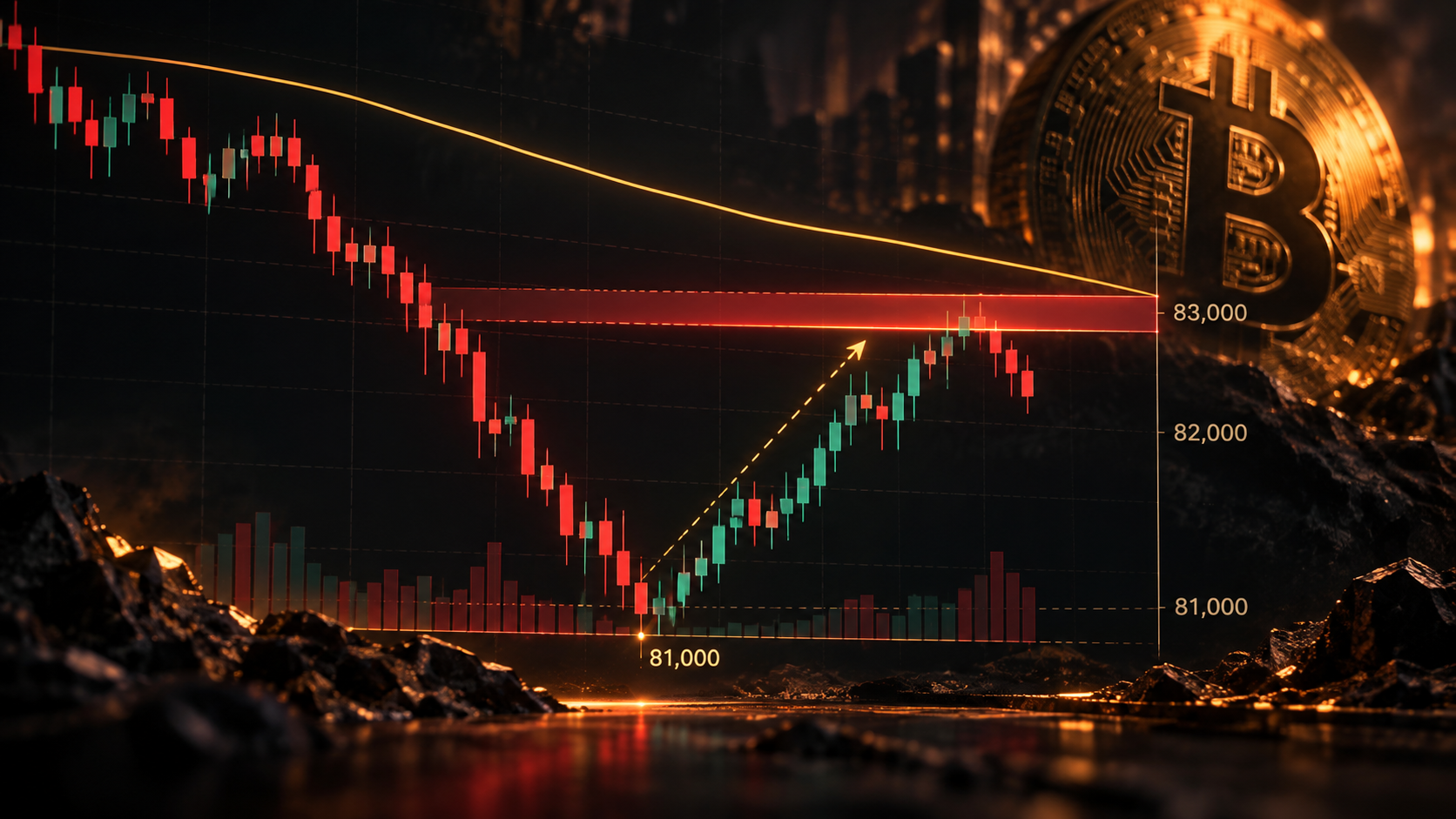
Bitcoin Bounced Again — Traders Called It Recovery
Bitcoin bounced from roughly $81.4K toward $83.2K, but the move stalled back near $82.5K before reclaiming the levels lost earlier in the week. The behavioral mistake is treating relief from selling as proof that buyers have regained control. Relief describes what stopped happening; recovery requires evidence of what buyers can actually accomplish.
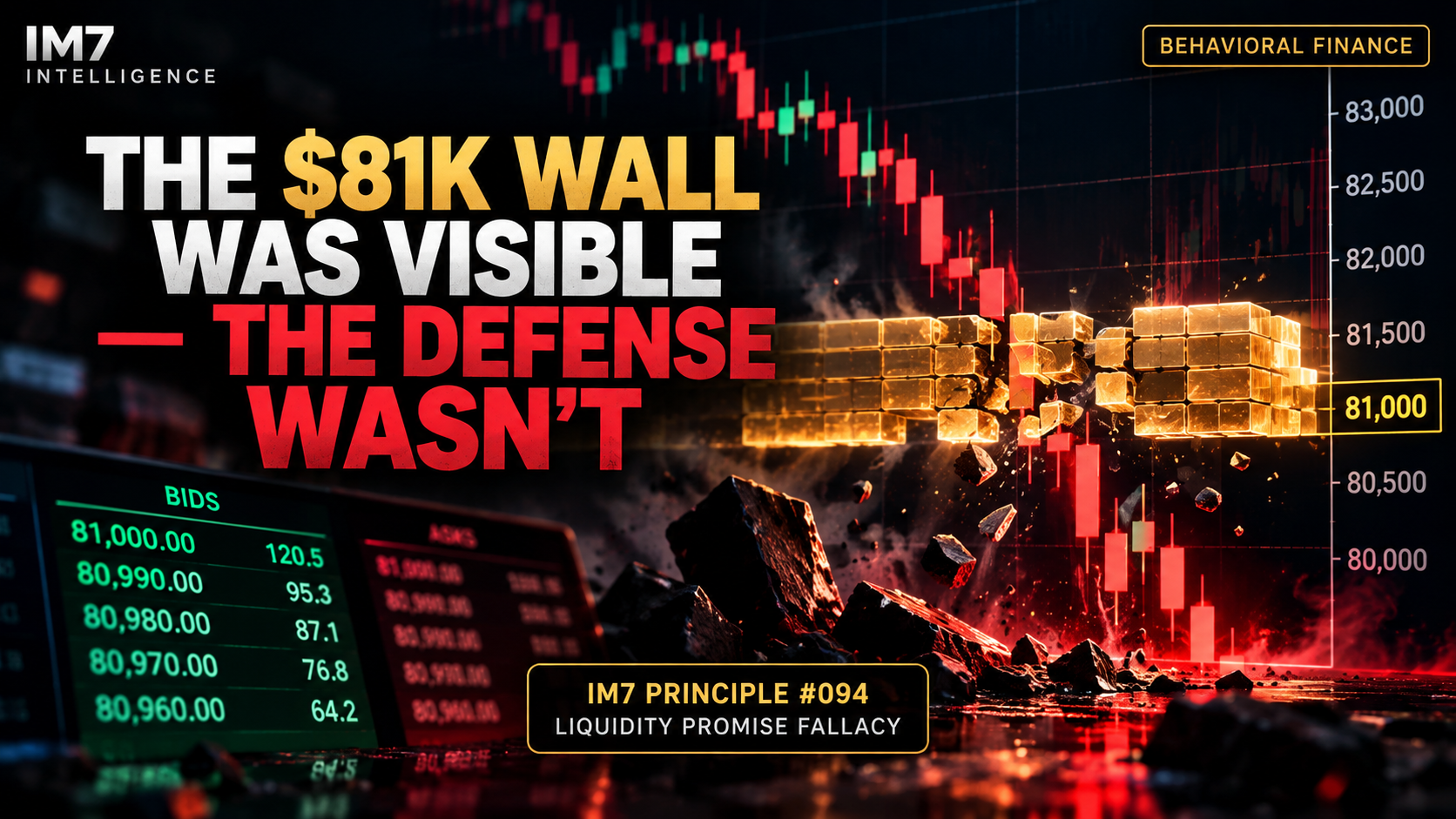
Bitcoin's $81K Buy Wall Looked Safe — Until Price Reached It
Bitcoin traded through the highly visible $81K bid wall, exposing a common behavioral error: traders treated resting liquidity as a guaranteed defense. A visible bid can show where buyers might act, but only execution, absorption, and a sustained response reveal whether they actually took control.

Bitcoin Liquidated $550M in Longs — The Bottom Was Assumed
Bitcoin wiped out roughly $550M in long positions, yet the rebound failed to hold $84K. The liquidation removed forced sellers — but traders treated their disappearance as proof that durable buyers had arrived.
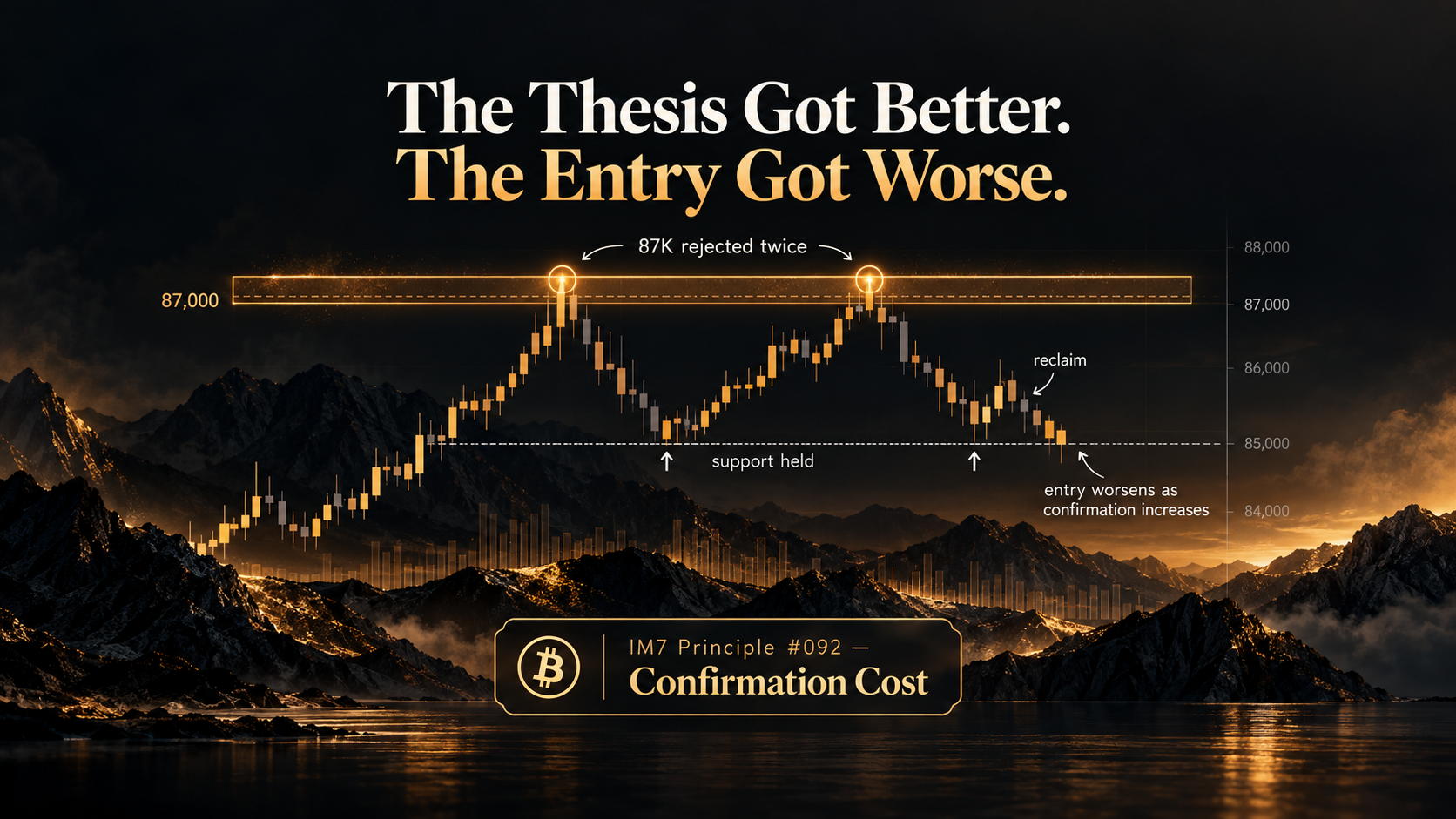
Bitcoin Got More Proof — And a Worse Entry
Bitcoin’s evidence improved as price climbed back toward the $87K area, but the trade location deteriorated at the same time. The behavioral trap is Confirmation Cost: waiting for more certainty can improve conviction while shrinking the margin for error. Better evidence does not automatically mean a better entry.
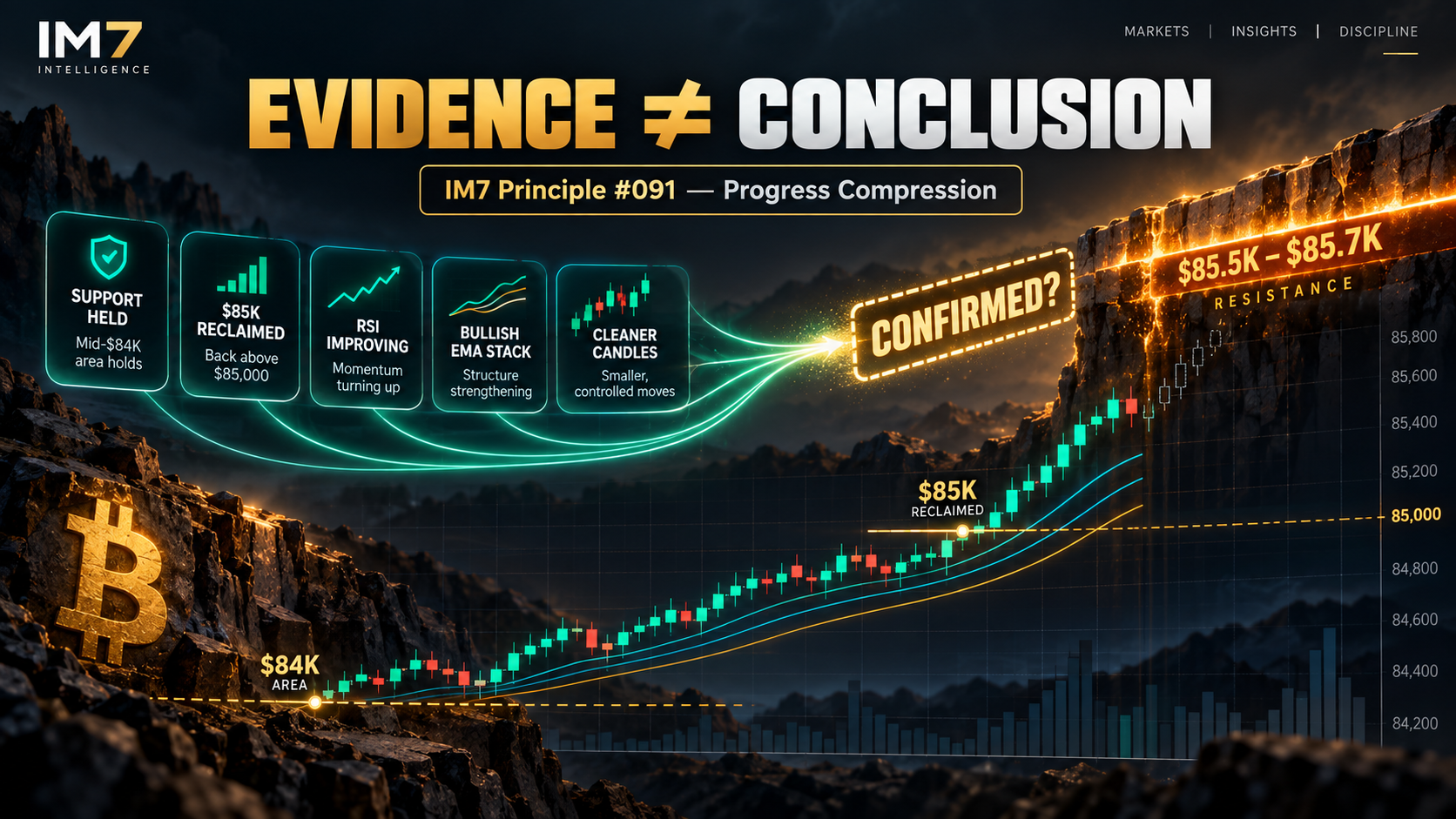
Bitcoin Improved Everywhere — Except Where It Mattered
Bitcoin reclaimed $85K and continued a controlled recovery, but the prior $85.5K–$85.7K rejection zone remained unresolved. The behavioral trap is Progress Compression: combining several legitimate improvements into one conclusion that the market has not actually earned. Progress can accumulate without confirmation.
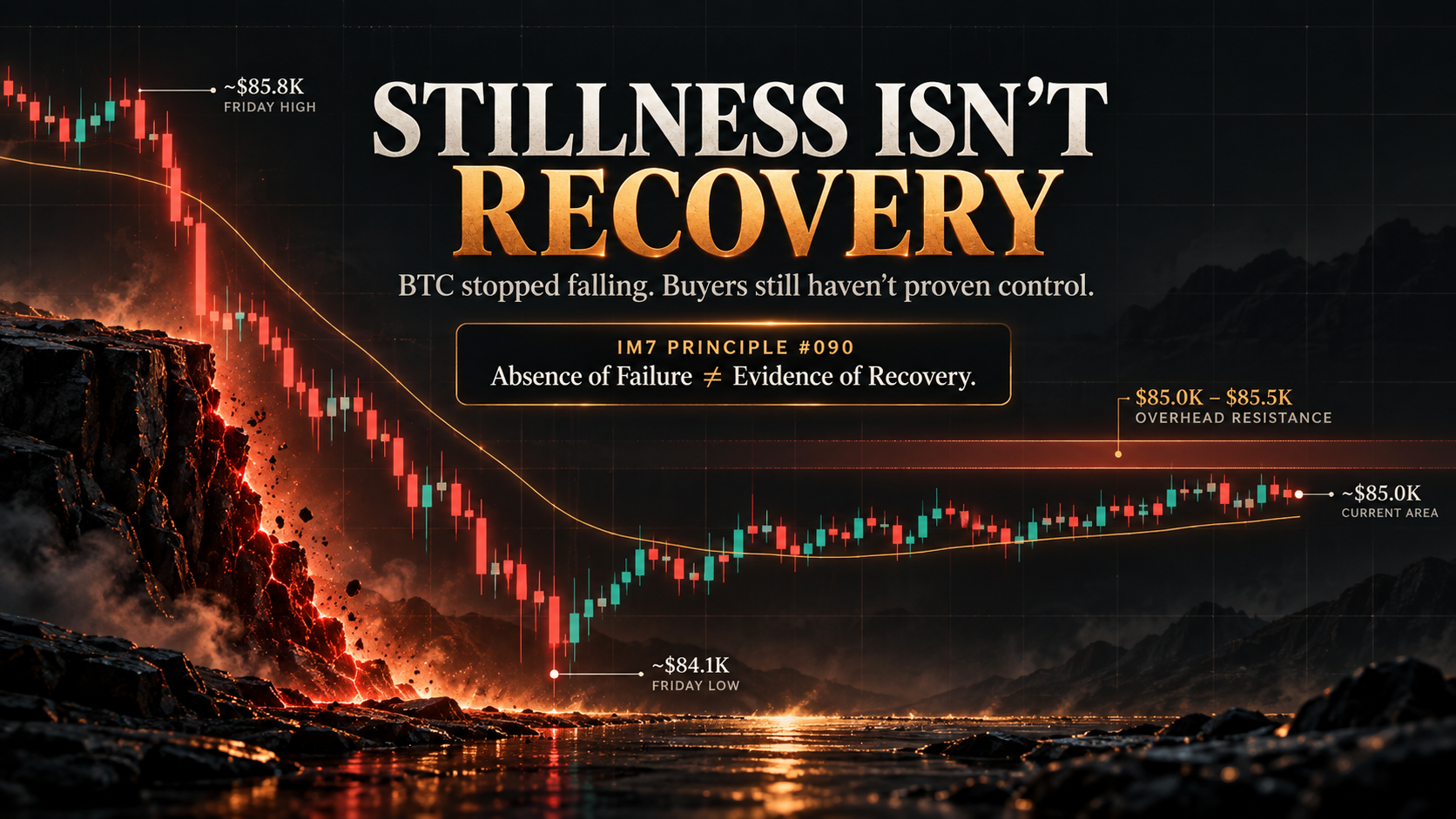
Bitcoin Stopped Falling — Traders Called It Bullish
Bitcoin stopped falling after Friday’s sharp flush and spent hours stabilizing around the mid-$84K area. The behavioral trap is treating the absence of further downside as proof that buyers have regained control. Calm can reduce uncertainty without confirming recovery.
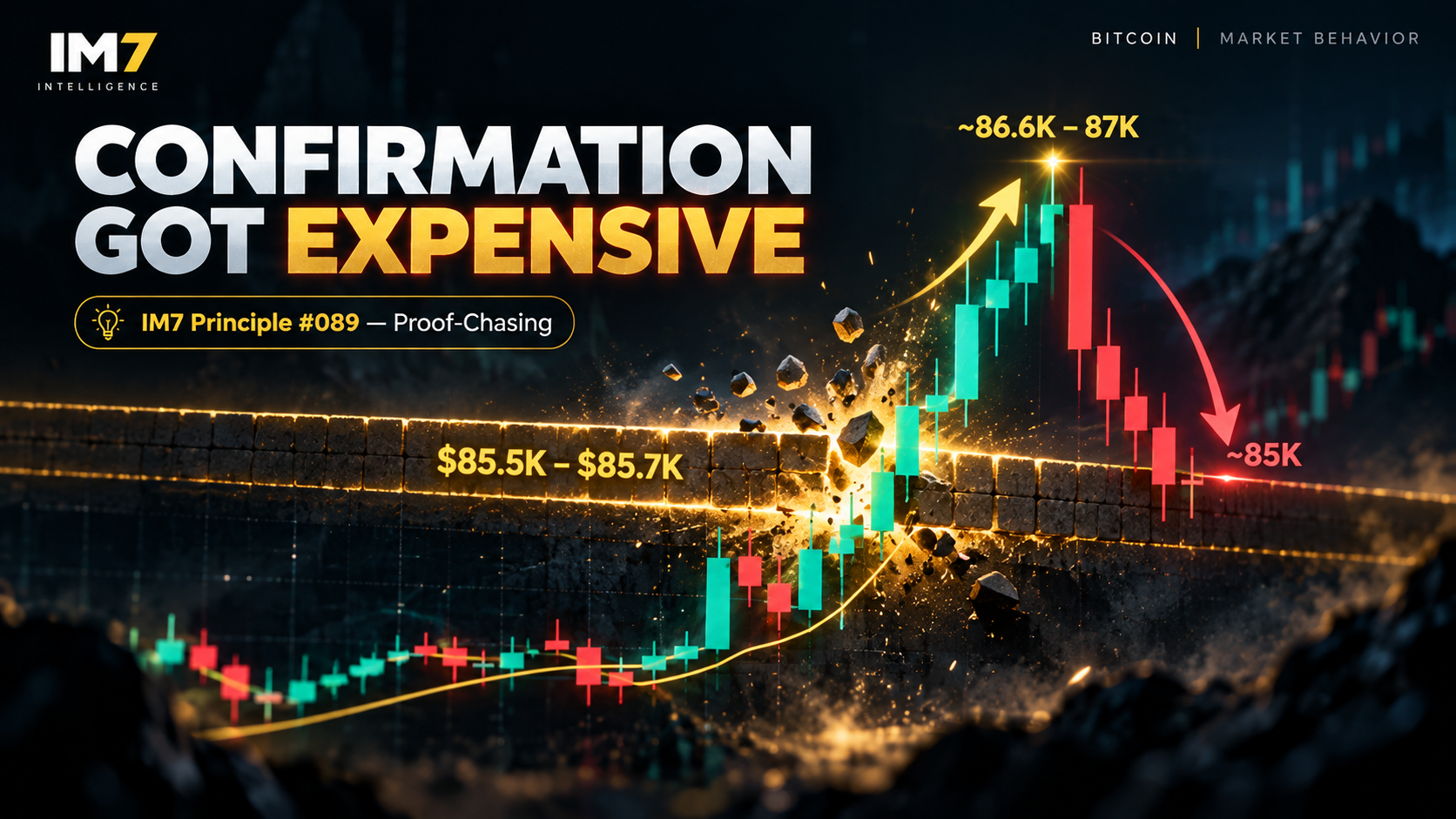
Bitcoin Finally Gave Traders Proof — Then Made Them Pay for It
Bitcoin broke through the level traders had been watching and pushed toward $87K, only to pull back sharply afterward. The behavioral trap is Proof-Chasing: traders often wait for the market to look obvious before acting, then confuse confirmation with urgency. Proof should improve confidence — not make the decision more expensive.
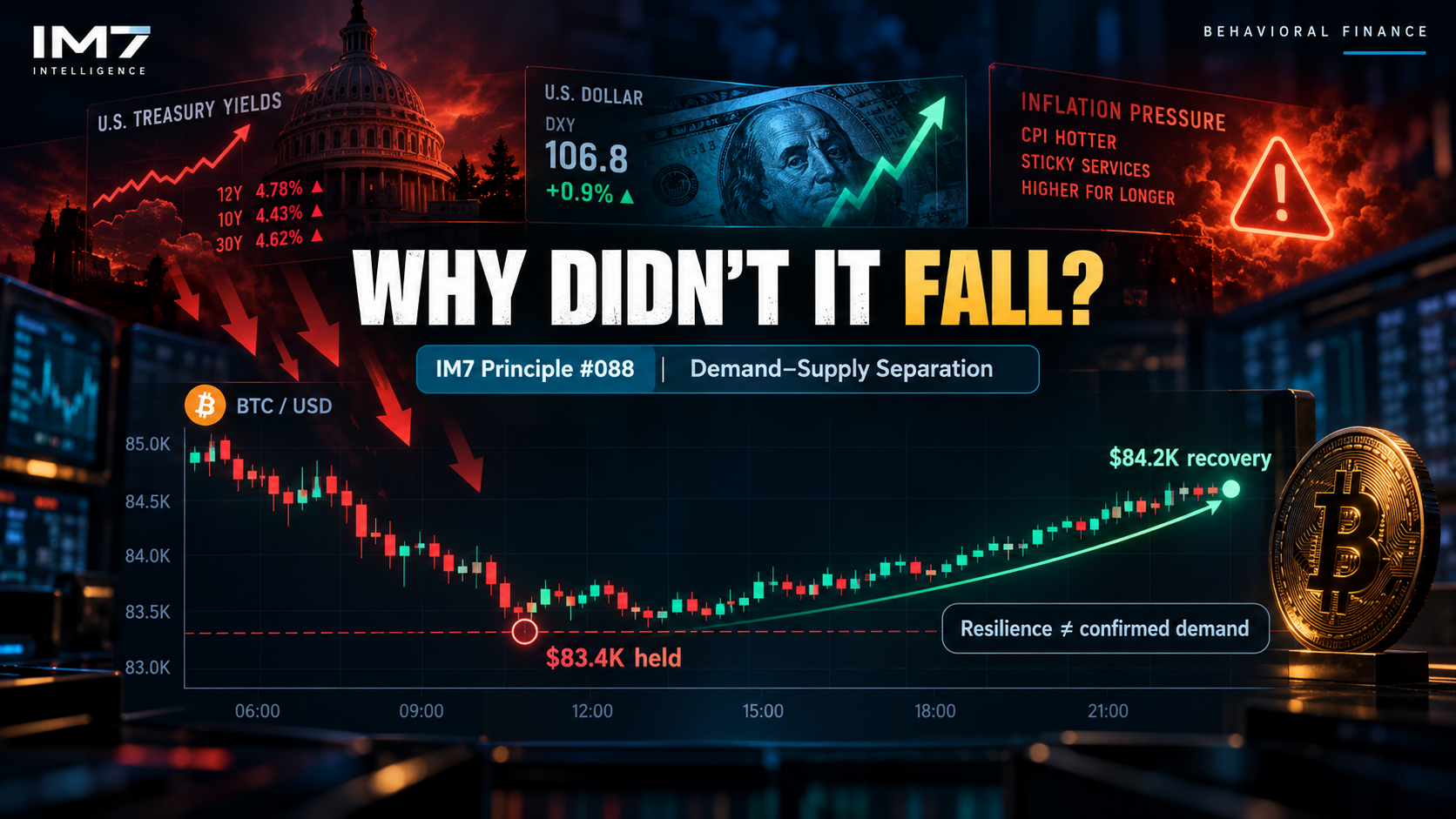
Bitcoin Had Every Reason to Fall — So Why Didn’t It?
Bitcoin faced a hostile macro backdrop — higher Treasury yields, stronger economic data, and a firmer dollar — yet price refused to break lower. The behavioral trap is assuming that “not falling” automatically means buyers are in control. Sometimes resilience reflects real demand; other times it simply means sellers are absent.

Bitcoin Got Good News — Then Gave Half the Move Back
Bitcoin broke higher after cooler PCE data, then quickly gave back a large part of the move. The behavioral mistake was treating one resolved uncertainty as full confirmation. Good news can justify a breakout without proving the market will accept higher prices.
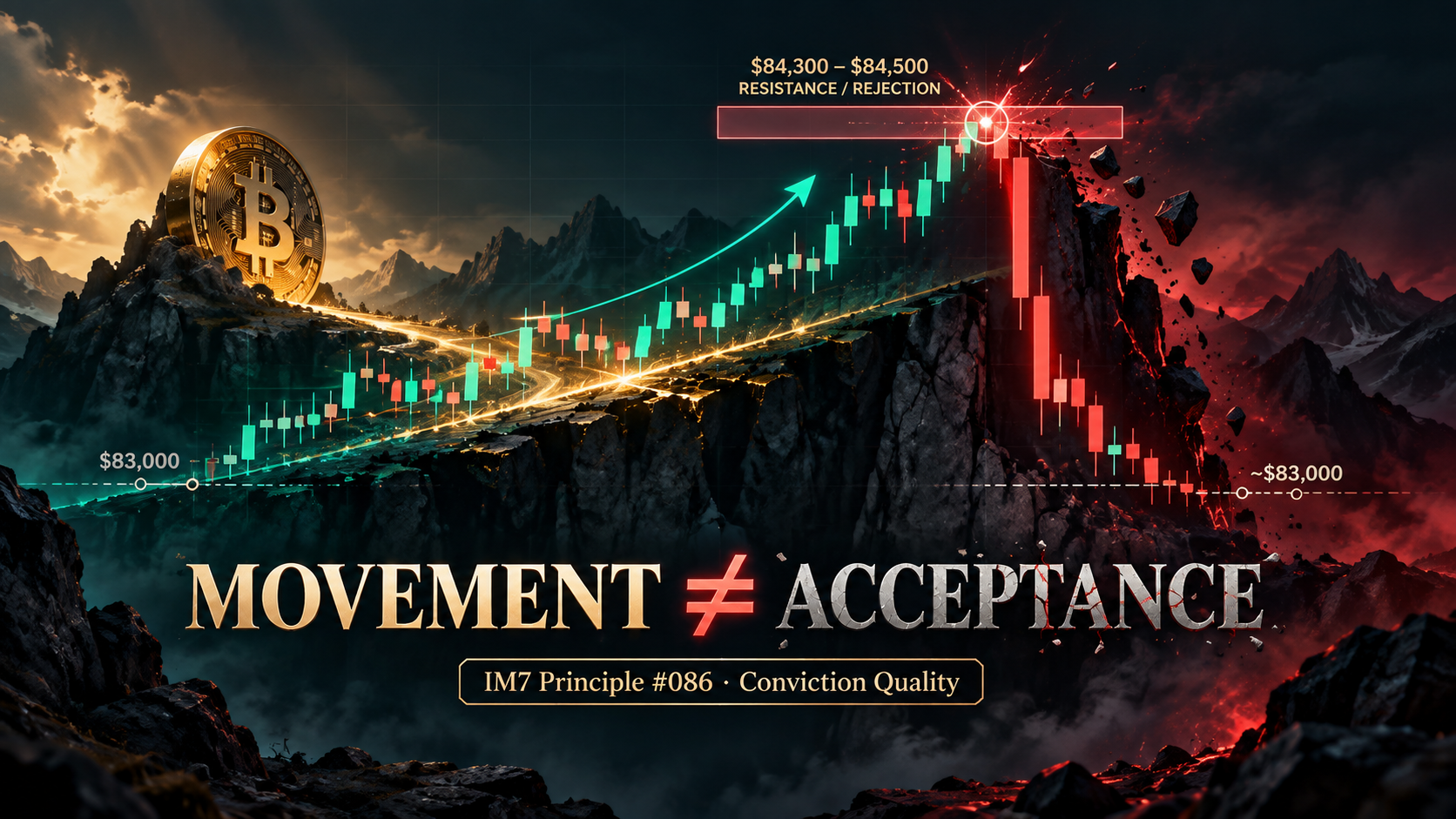
Bitcoin Spent Hours Rallying — One Candle Erased Almost All of It
Bitcoin rallied above $84K, then gave back nearly the entire move in one 2-hour candle. The lesson wasn’t about direction — it was about conviction quality. Traders often let fast price movement strengthen their confidence before the evidence actually improves.

Bitcoin Bounced From $82.6K—But a Correct Thesis Still Became a Bad Trade
Bitcoin’s bounce from $82.6K exposed a distinction traders often learn too late: a correct market thesis cannot rescue poor entry, excessive leverage, or weak position sizing. The first bounce showed relief. The retest will reveal whether buyers actually returned.
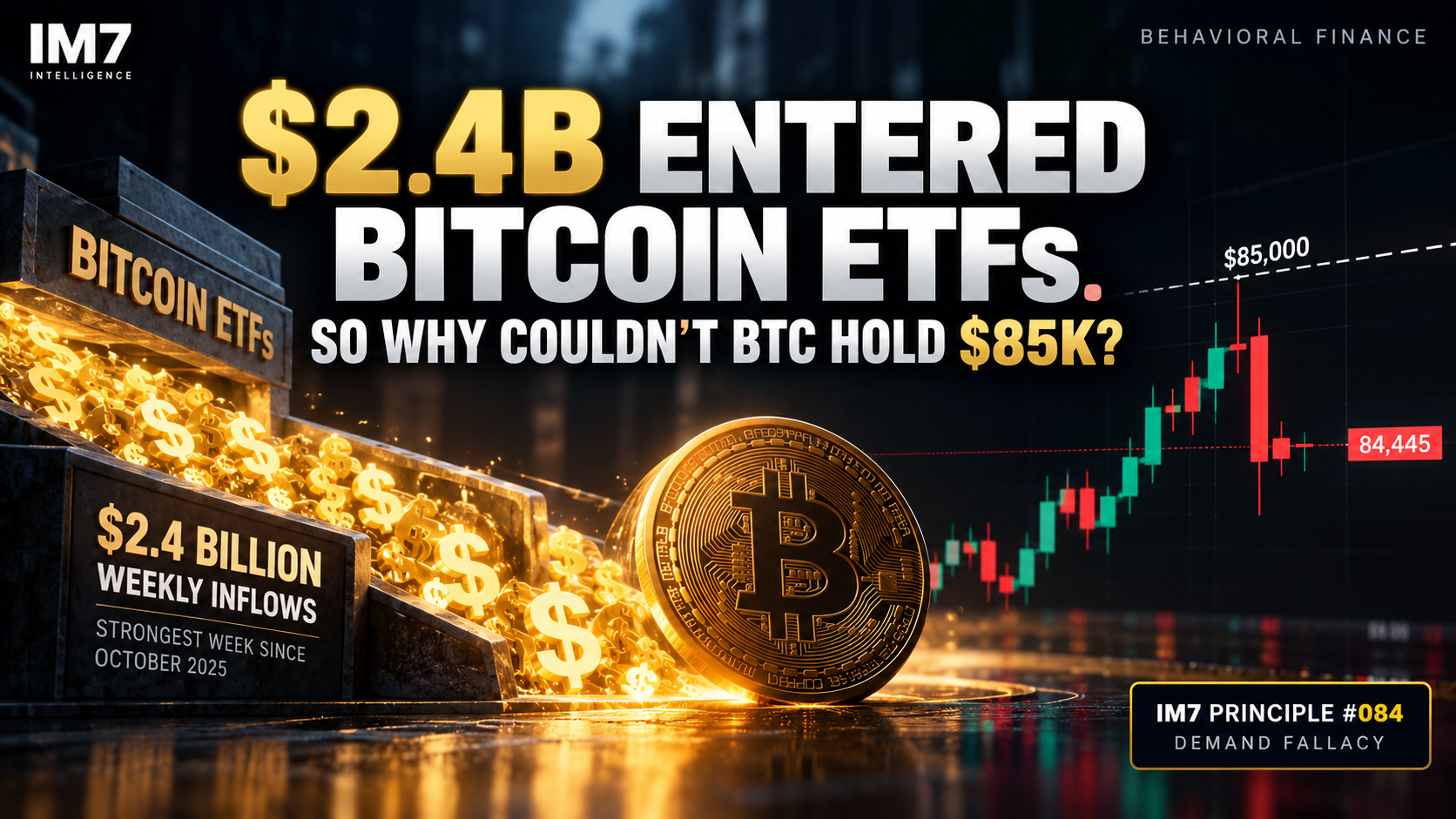
$2.4B Flowed Into Bitcoin ETFs. So Why Couldn't Bitcoin Hold $85K?
U.S. spot Bitcoin ETFs attracted roughly $2.4 billion in net inflows during the week, yet Bitcoin failed to sustain its move through $85K. Demand Fallacy explains why traders can mistake the size of buying pressure for proof of the market outcome instead of asking whether that demand actually changed price behavior.

You’re Still Trading Monday’s Evidence. It’s Saturday.
Bitcoin gave traders powerful evidence earlier this week. But markets keep producing new information after a thesis is formed. Evidence Has a Half-Life explains what happens when traders keep giving old evidence the same weight while newer evidence is telling them to update.
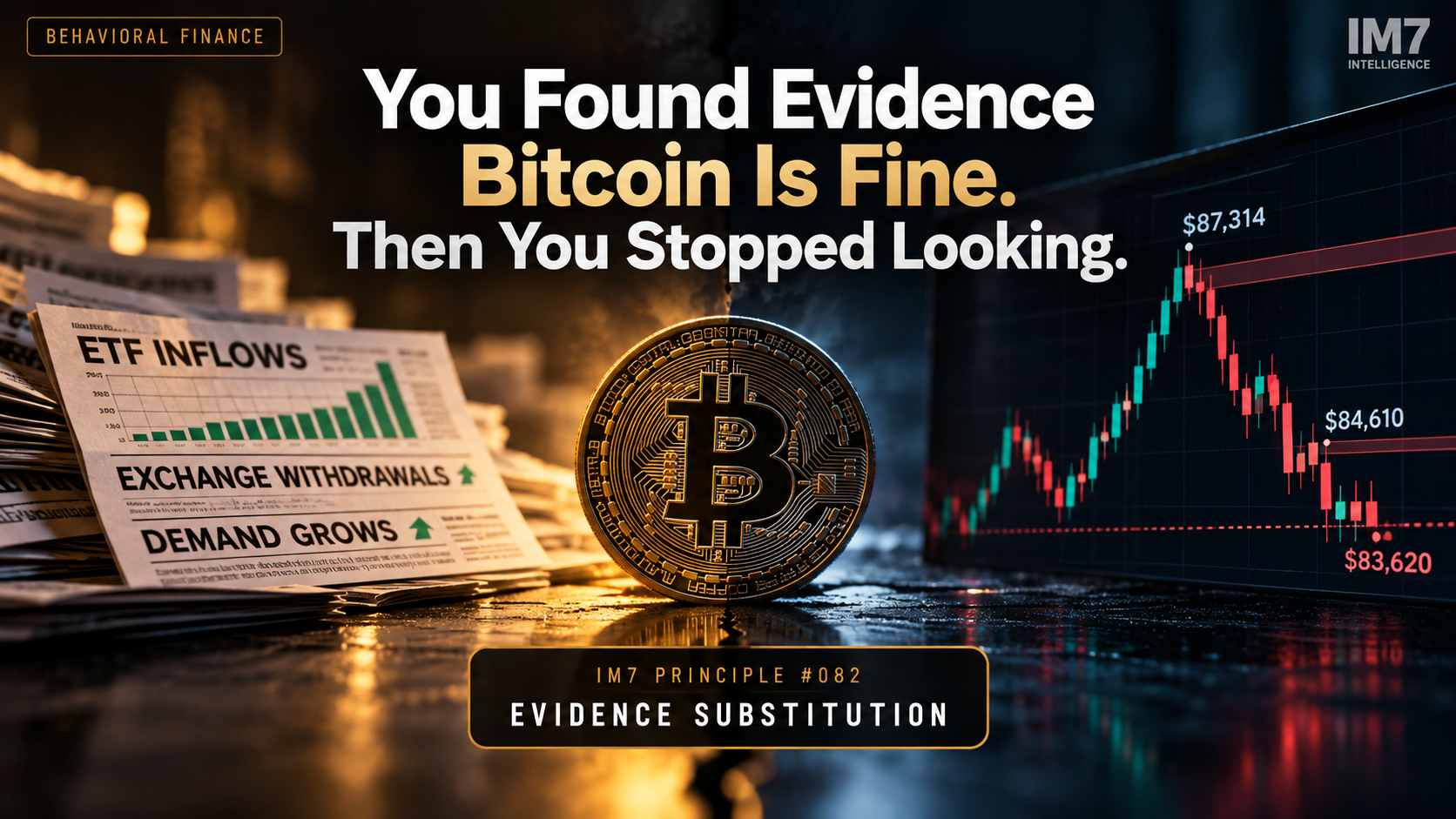
You Found Evidence Bitcoin Is Fine. Then You Stopped Looking.
Bitcoin traders have real evidence supporting both sides of the current debate. The behavioral mistake begins when supporting evidence becomes a reason to stop looking. Evidence Substitution explains why evidence that agrees with your position is not the same as evidence that the market has confirmed it.

Bitcoin Stopped Falling. You Called It a Recovery.
IM7 Principle #081 — Relief Is Not Recovery

You Got the Confirmation. Then One Pullback Made You Doubt It.
Bitcoin delivered the confirmation traders demanded, but the first uncomfortable pullback quickly changed how that evidence felt. Confirmation Fragility explains why traders often trust evidence only while price continues rewarding them—and mistake discomfort for invalidation.
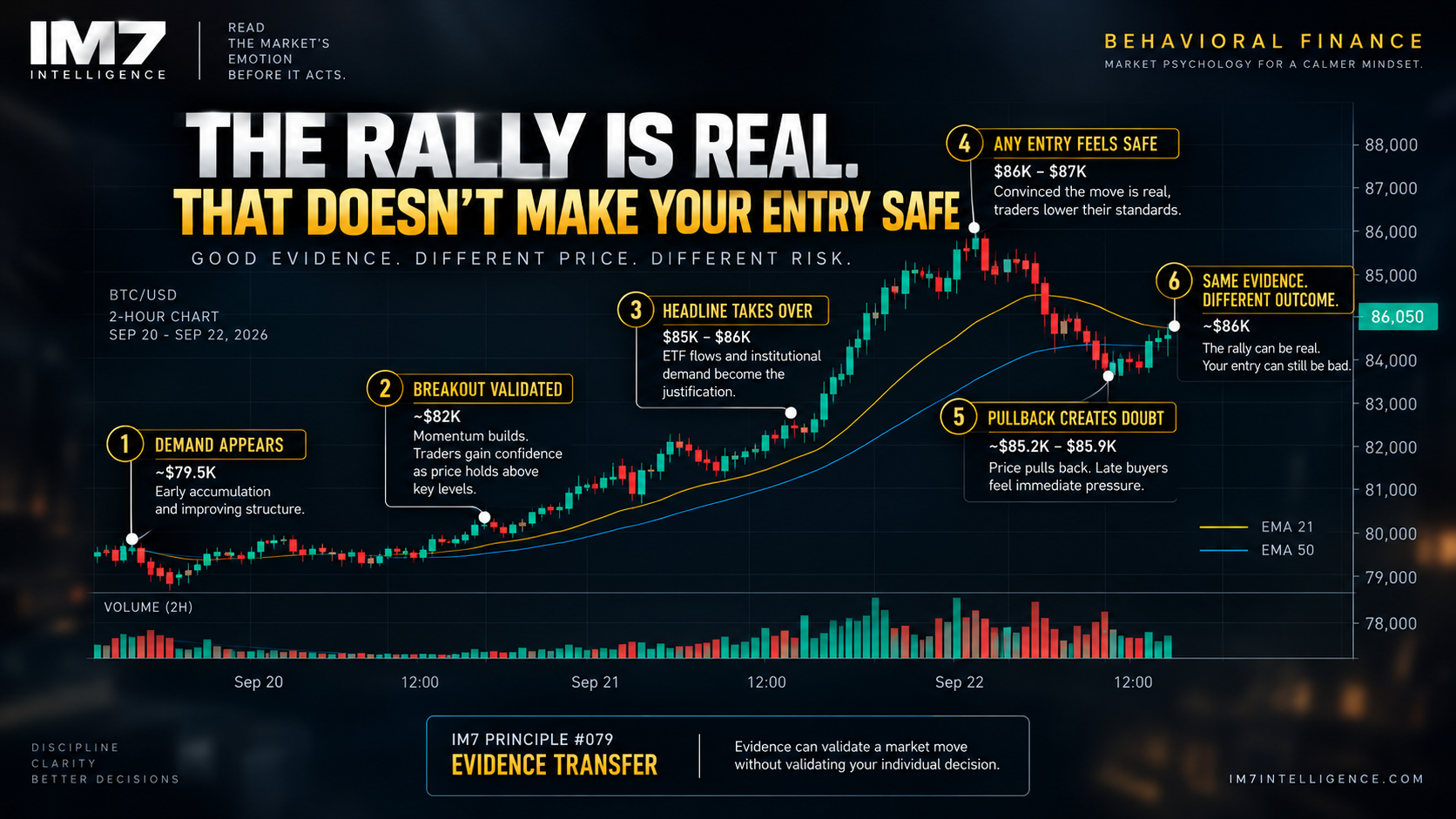
The Rally Is Real. That Doesn’t Make Your $86K Entry Safe.
Bitcoin’s rally has real evidence behind it, including strong ETF demand. But evidence that validates the move does not automatically validate a late entry. Traders get into trouble when they transfer confidence in the market to confidence in the price they are paying.
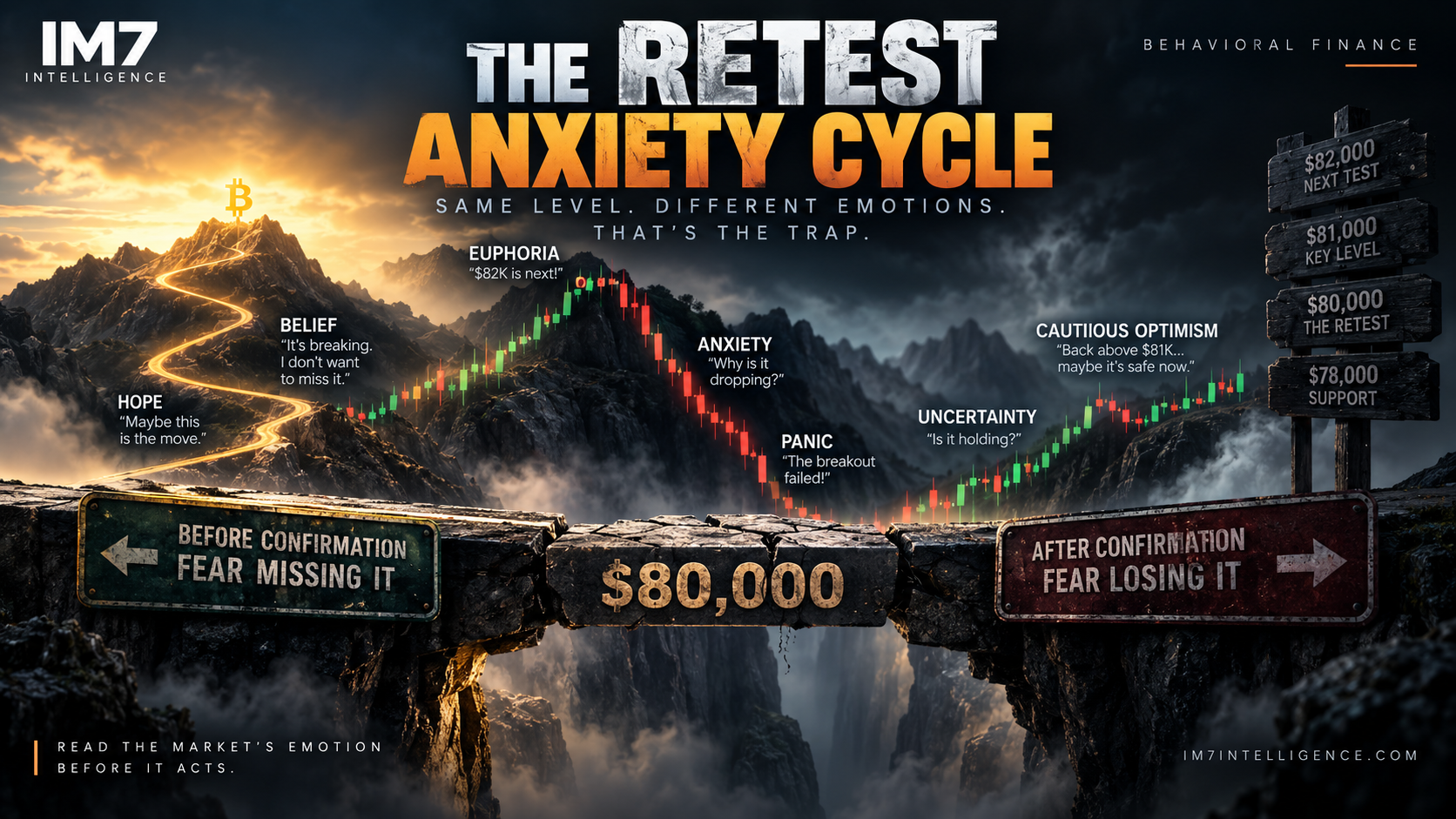
Bitcoin Retests $80K: When Discomfort Feels Like Invalidation
Bitcoin pulled back toward $80K after advancing toward $82K, then recovered above $81K. The Retest Anxiety Trap begins when traders mistake the discomfort of renewed uncertainty for evidence that the breakout has failed.
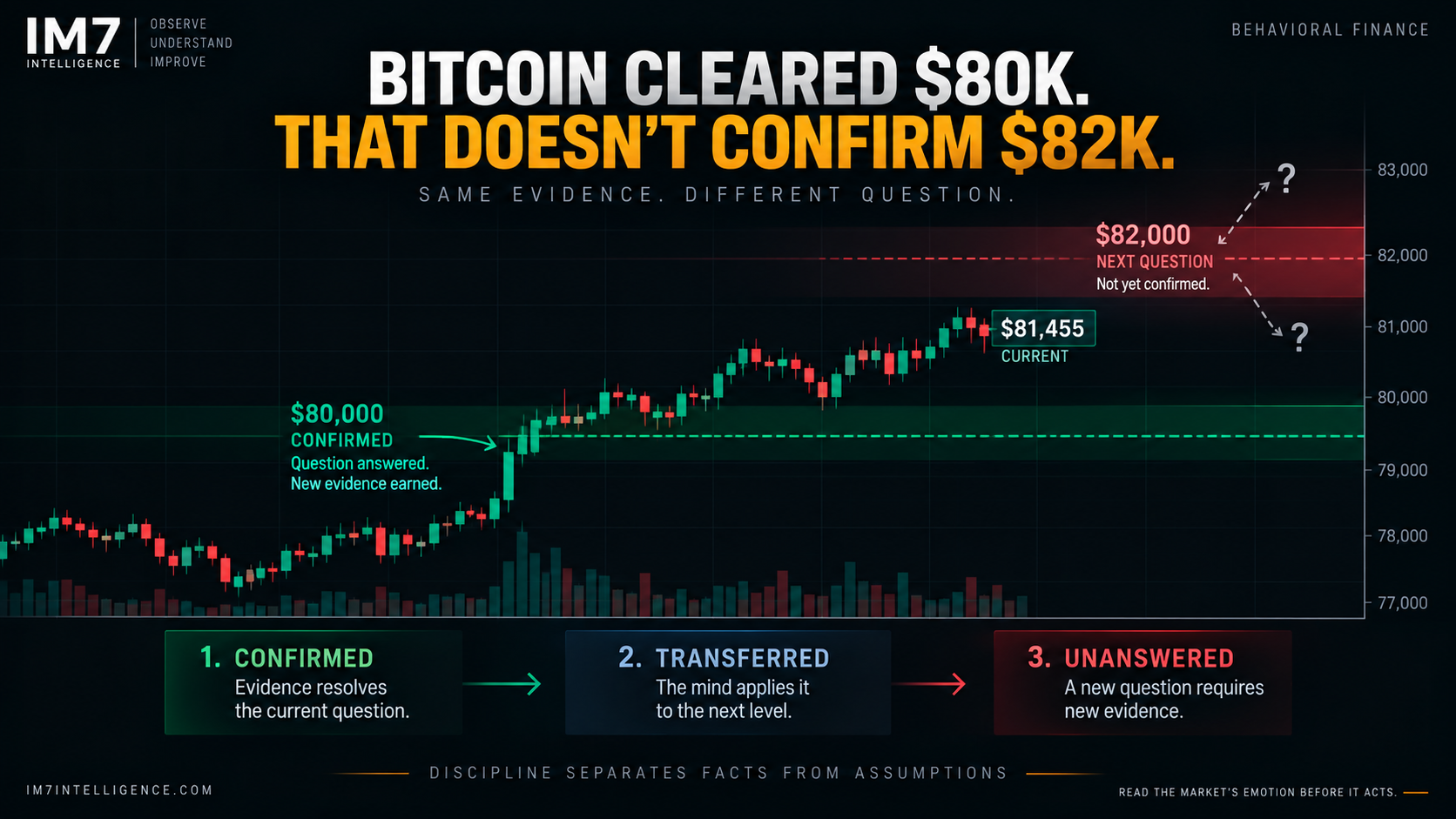
Bitcoin Cleared $80K. That Doesn't Confirm $82K.
Bitcoin cleared $80K and continued toward $81.5K, giving traders meaningful new evidence. But confirmation at one level does not automatically confirm the next. Confirmation Transfer occurs when traders take evidence that resolved yesterday’s uncertainty and mistakenly apply it to tomorrow’s unanswered question.

Bitcoin Breaks $80K as ETF Flows Flip Positive
Bitcoin surged through $80K as U.S. spot Bitcoin ETF flows flipped from $295.9 million of net outflows to $159.5 million of net inflows. The move matters because the evidence around price changed too: institutional demand improved while Bitcoin pushed into a new short-term range. The behavioral lesson is simple — when the evidence changes, the market story should be allowed to change with it.
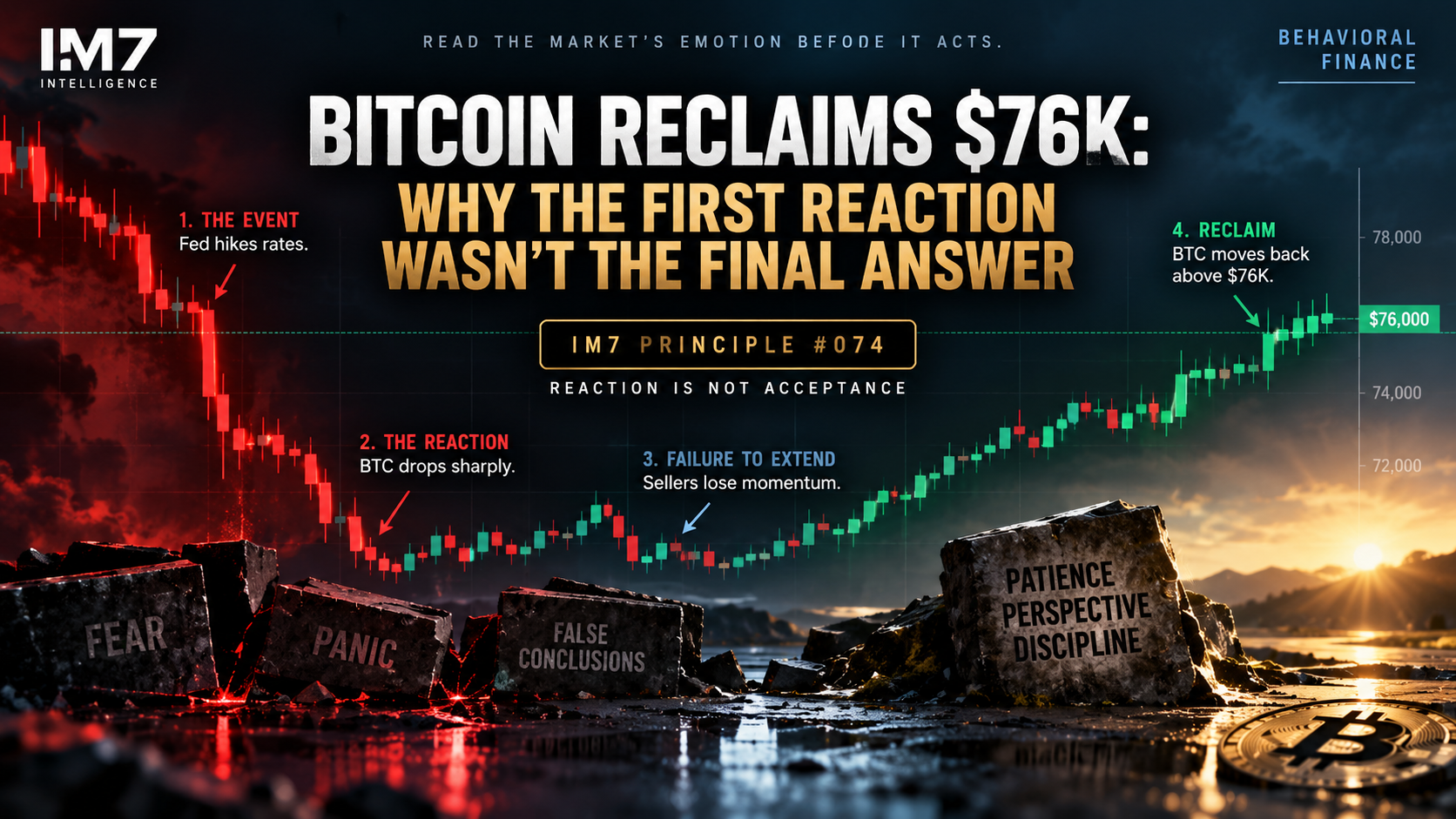
Bitcoin Reclaims $76K: Why the First Reaction Wasn't the Final Answer
Bitcoin dropped after the Fed decision, giving traders an immediate bearish story to believe. But price later reclaimed the $76K area. The behavioral mistake isn't reacting to new information — it's treating the first reaction as the market's final conclusion. This is why reaction should never be confused with acceptance.
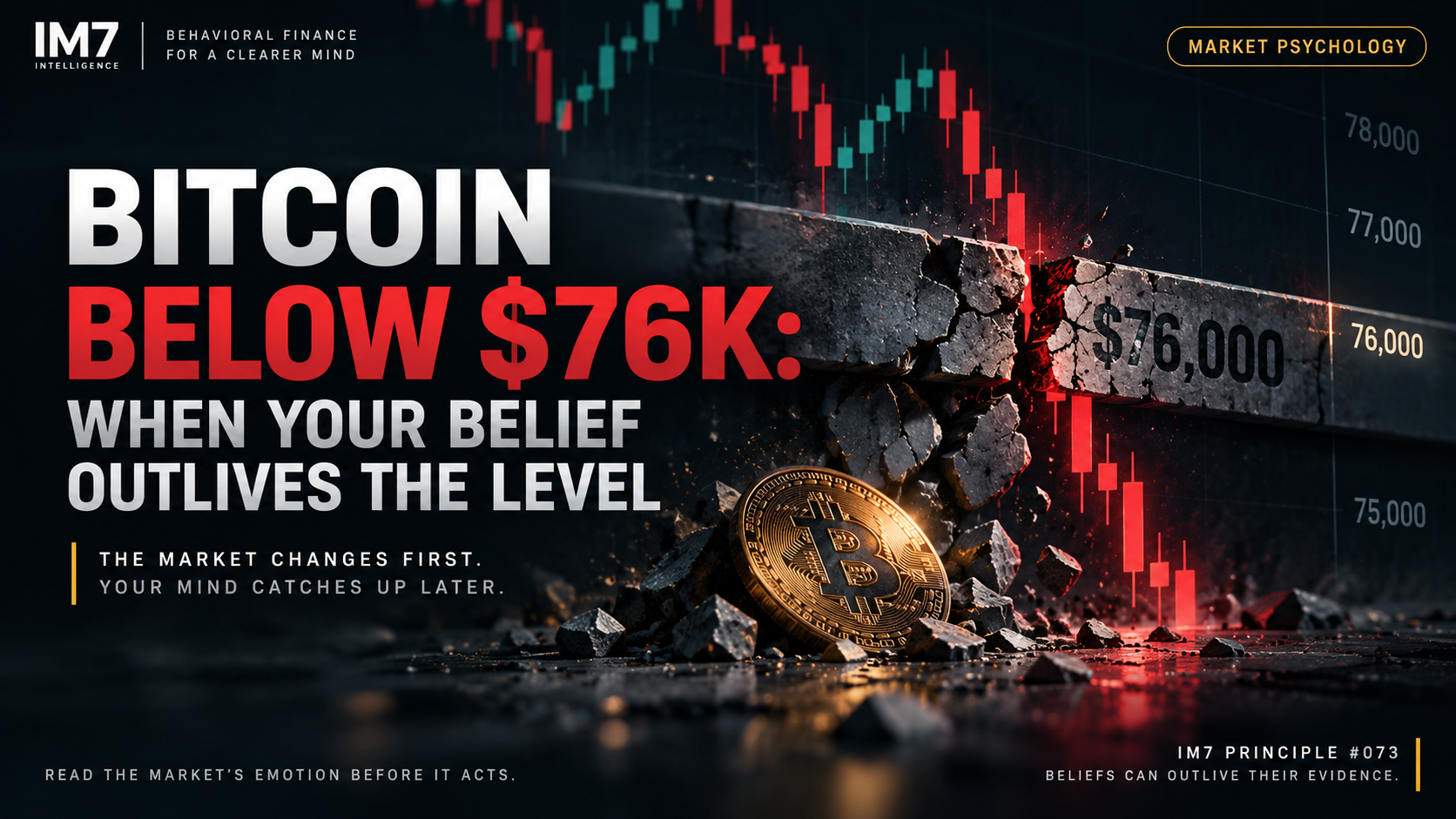
Bitcoin Below $76K: When Your Belief Outlives the Level
Bitcoin broke below the $76K area after repeated defenses had trained traders to trust the level. Now the behavioral risk changes: instead of questioning the old belief, traders may interpret every bounce as evidence that the familiar floor is returning. This is how a market thesis can survive after the evidence that created it has changed.
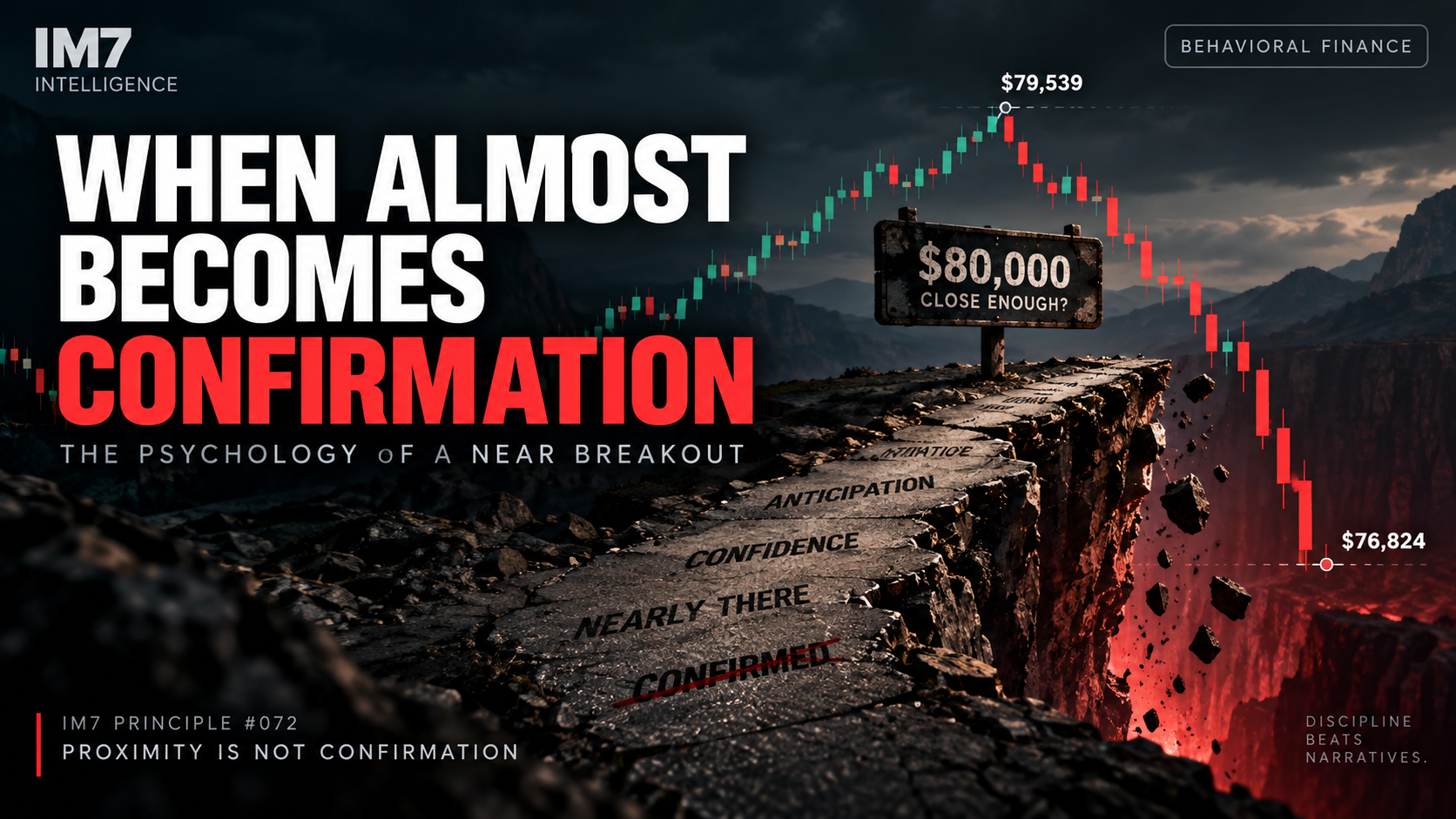
Bitcoin Near $80K: When Almost Becomes Confirmation
Bitcoin pushed toward $80K before reversing back below $77K. The behavioral mistake happened before the decline: traders began treating proximity as confirmation. When “almost there” becomes “good enough” in the mind, anticipation quietly replaces evidence.
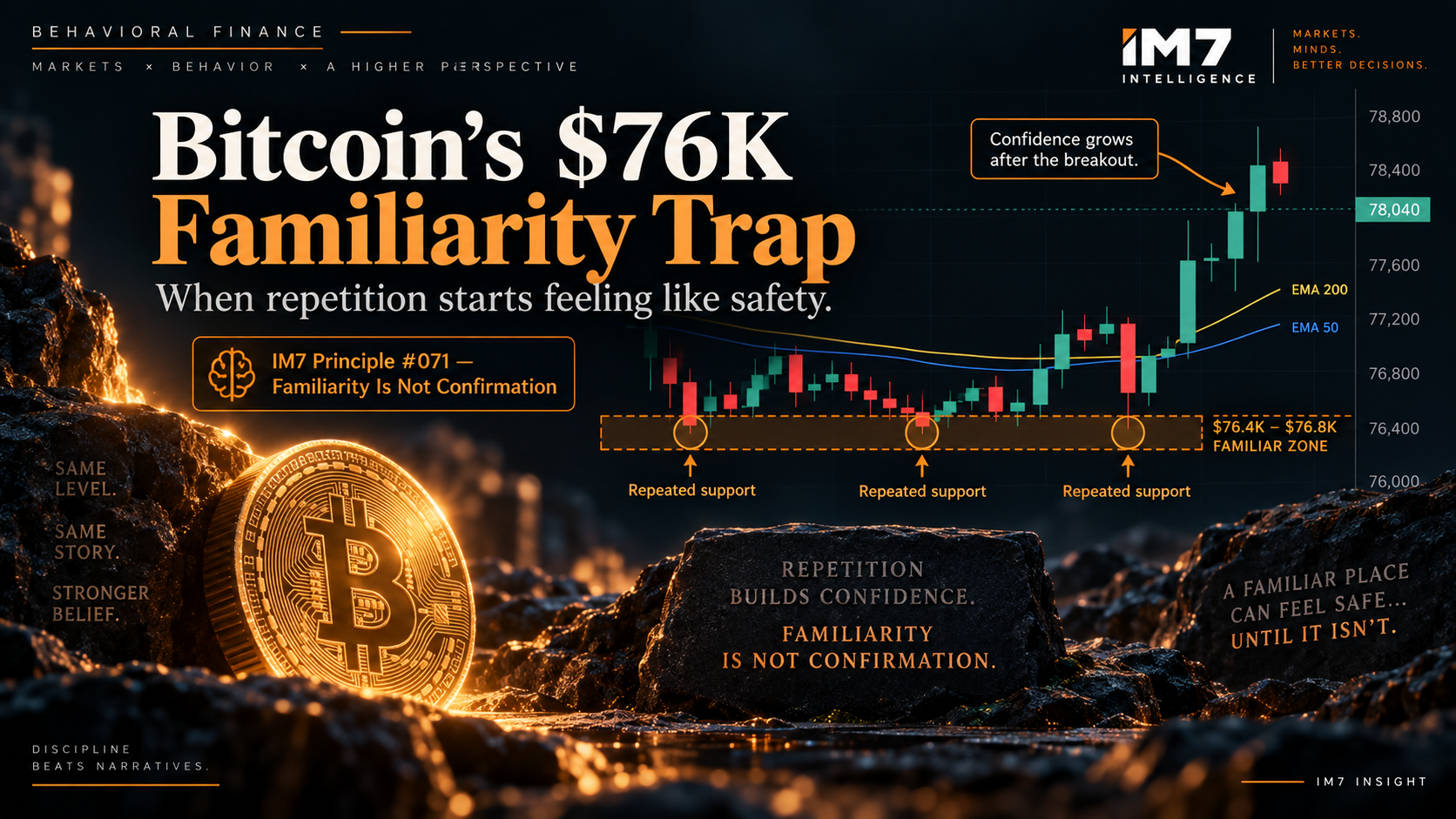
Bitcoin’s $76K Familiarity Trap: When Repetition Starts Feeling Like Safety
Bitcoin has defended the $76K area repeatedly, and each successful bounce makes traders more confident that the level is “safe.” But repetition can create false certainty. This article breaks down the familiarity trap behind repeated support tests and why a streak should never be mistaken for a rule.
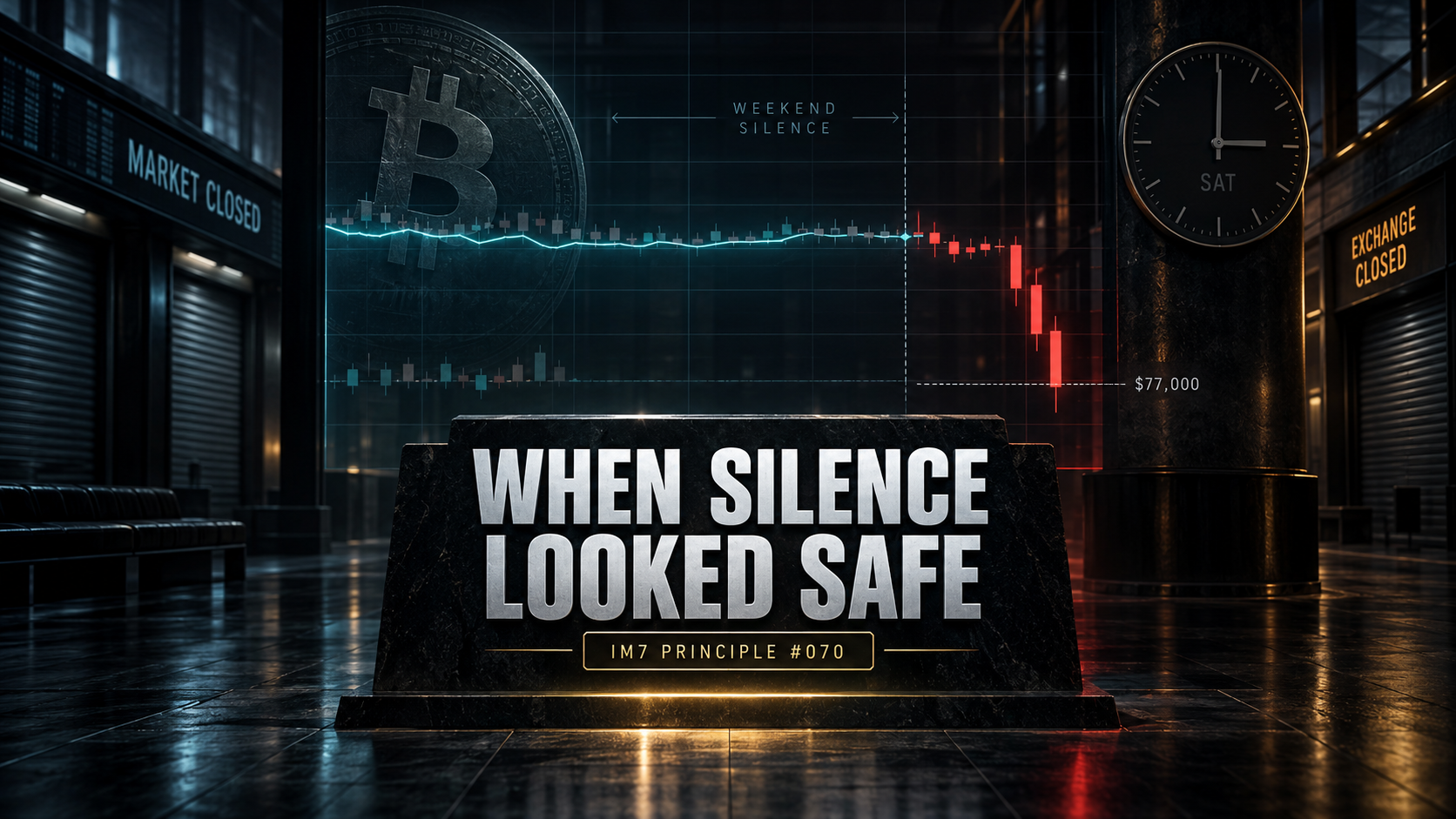
Bitcoin Below $77K: When Weekend Silence Looked Like Safety
Bitcoin’s quiet weekend encouraged traders to believe the escalating oil and shipping risks had already been absorbed. But with major traditional markets closed, the silence reflected incomplete participation—not confirmed resilience.
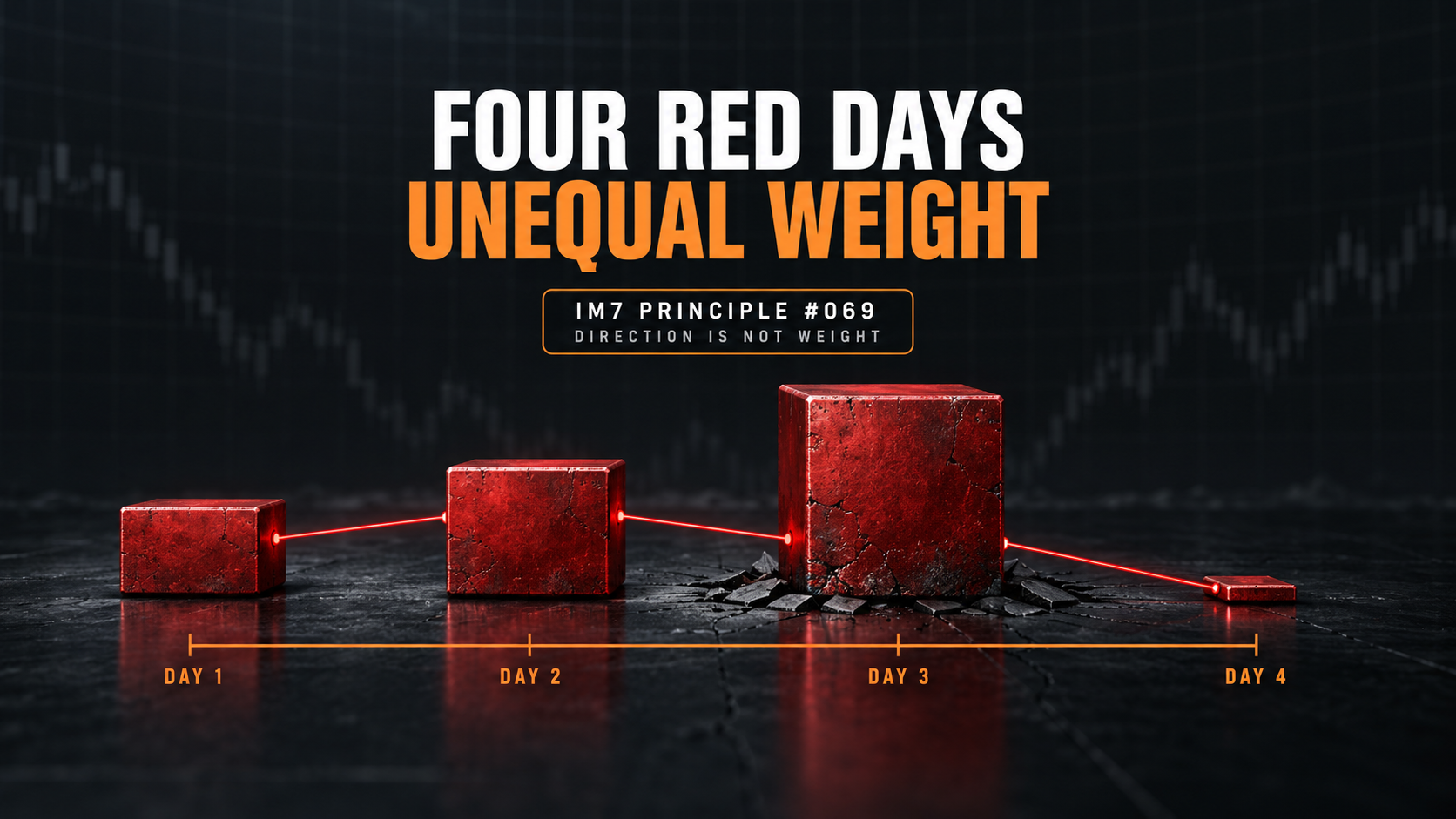
Bitcoin ETF Outflows: Four Red Days Didn’t Carry Equal Weight
Bitcoin ETFs recorded four consecutive outflow days, but the final outflow collapsed to just $13.2 million after a $282.7 million withdrawal. The streak looked increasingly bearish while the force behind it was sharply fading—revealing why direction without magnitude can mislead traders.

Bitcoin Rallied After Hot CPI: When Bad News Stops Working
Hot CPI, rising yields, and higher rate-hike odds appeared bearish for Bitcoin—yet BTC reversed its initial flush and reclaimed $79K. The reaction exposed the danger of trading a headline without watching whether price continues to obey it.
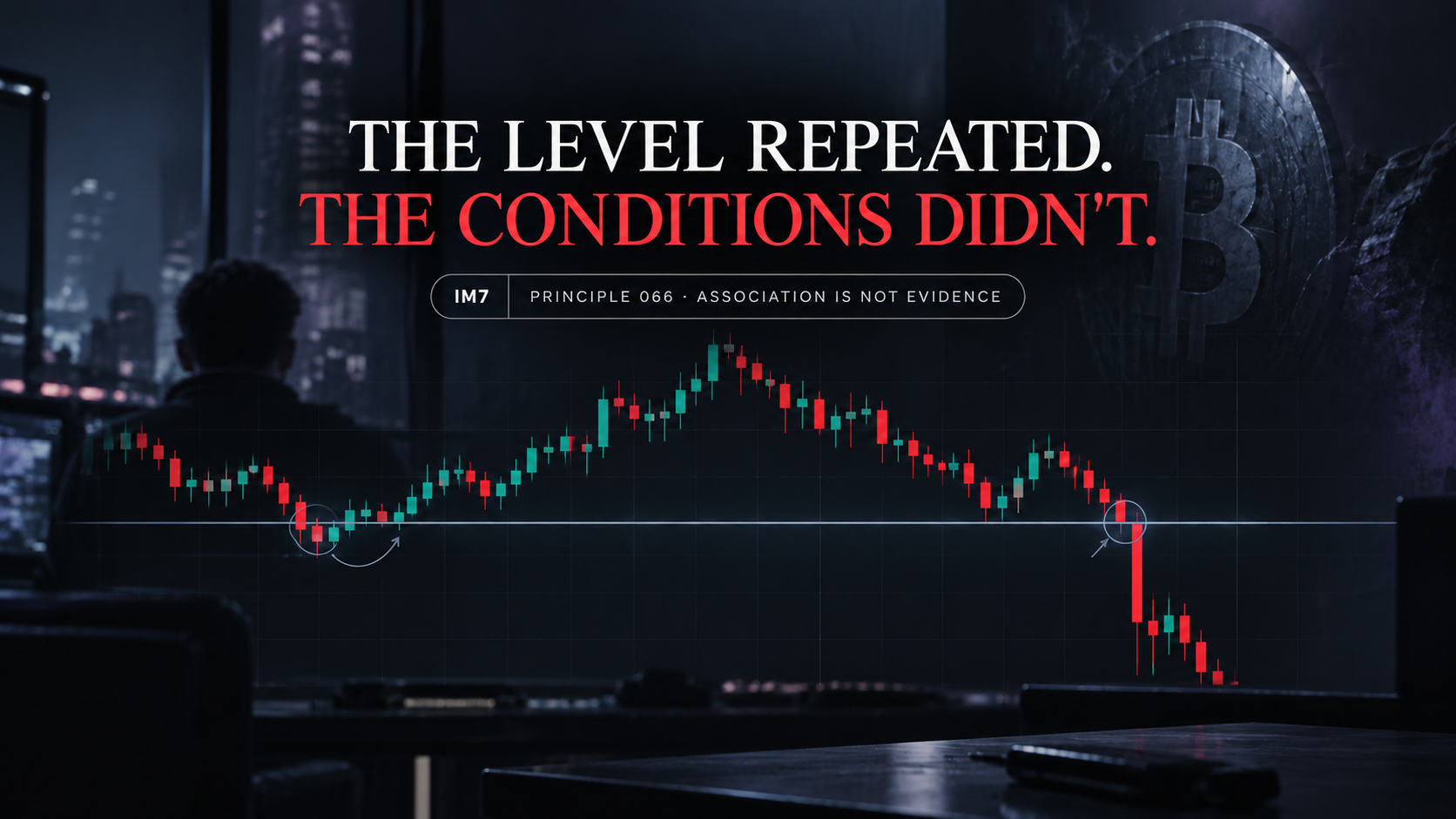
Bitcoin’s $77.3K Breakdown: The Level Repeated, the Conditions Didn’t
Bitcoin broke $77.3K after holding the same zone the day before, exposing the danger of trusting a level without checking what changed underneath it.

Broken Isn’t Accepted: How Bitcoin Trapped Breakdown Traders
Bitcoin swept below support near $77.56K, prompting traders to call for a deeper breakdown. When price reclaimed $79K, the move revealed a critical distinction: a level can be broken without being accepted. This is how certainty traps traders on both sides of a failed breakdown.

Support Felt Certain: How Repeated Tests Trapped Bitcoin Bulls
Bitcoin repeatedly defended $78K until traders began treating support as inevitable. When oil approached $100 and macro pressure intensified, that confidence became vulnerable—revealing how repetition creates false certainty before structure actually confirms it.

Bitcoin Wasn’t Hacked: How the $320M Liquid Incident Triggered Category Contagion
A $320 million security incident involving Liquid Network sparked misleading “Bitcoin hack” reactions. The event reveals how category contagion causes traders to transfer fear from adjacent infrastructure to Bitcoin itself.

$1B Came In. Bitcoin Still Dropped $2K.
Nearly $1 billion in recent Bitcoin ETF inflows did not prevent a sharp $2,000 decline. The behavioral trap is the Institutional Safety Illusion: visible institutional demand can make downside feel more protected than the evidence justifies.
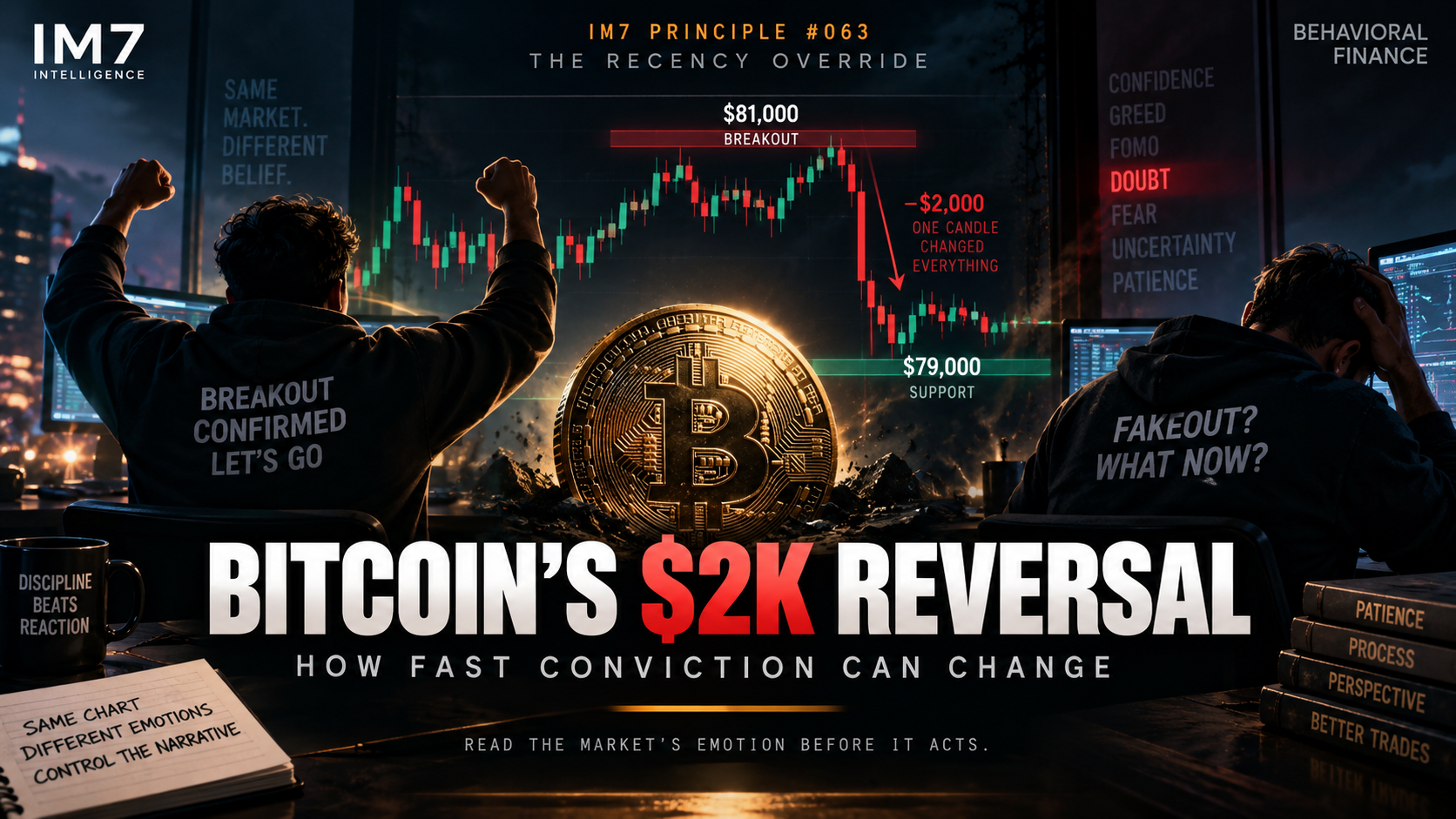
Bitcoin Changed $2,000. Trader Certainty Changed Everything.
Bitcoin went from “breakout confirmed” above $81K to “breakout failed” near $79K in less than a day. The deeper behavioral signal is how quickly one jobs report and one large red candle overrode the market thesis traders had just formed.

Why Bitcoin Feels Safer at $81K Than It Did at $76K
Bitcoin surged from the upper-$79K area toward $81.9K, and traders who felt uneasy near $76K now feel increasingly comfortable buying higher. The behavioral trap is Price-Induced Safety: rising price can reduce perceived risk even when actual market risk has not fallen.
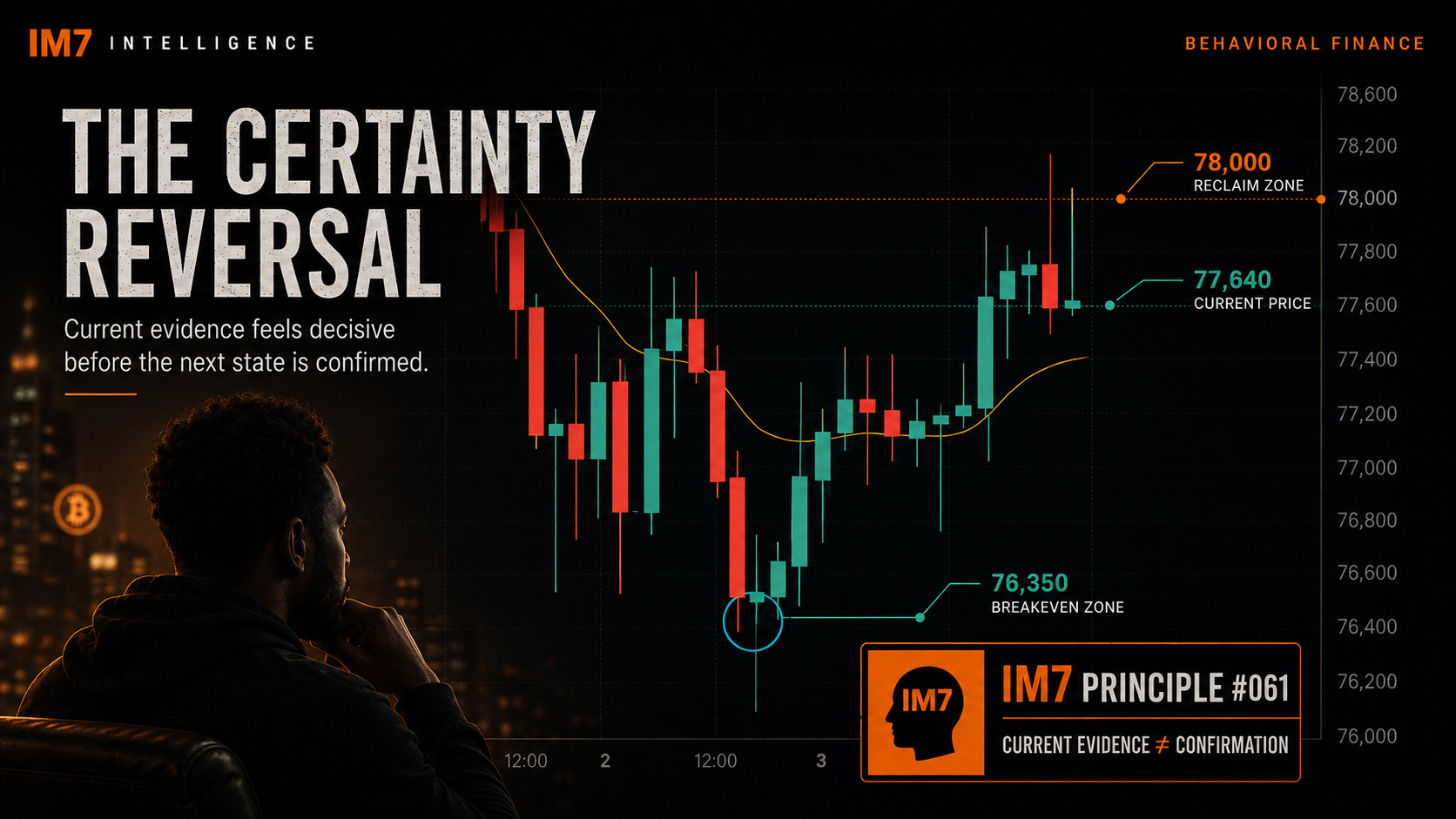
Yesterday Bears Were Certain. Today Bulls Are.
Bitcoin bounced from roughly $76.35K toward $77.64K after yesterday’s breakdown. The bigger behavioral risk is how quickly traders convert each new move into certainty about what comes next.
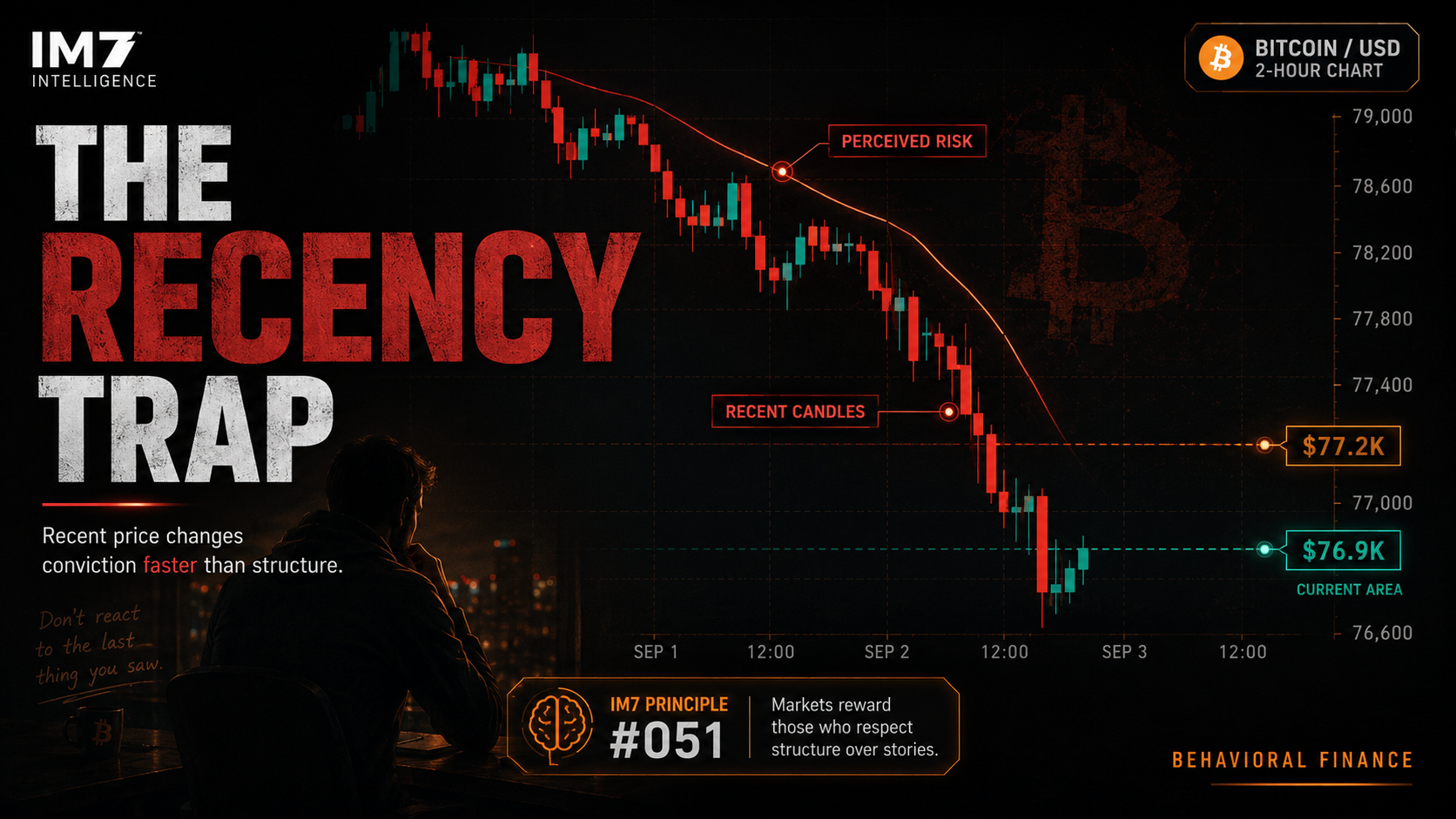
Why Bitcoin Felt Safe at $80K and Dangerous at $76K
Bitcoin fell from the upper-$78K range toward $76.9K, and trader perception shifted with it. IM7 examines the Bitcoin Recency Loop: how recent candles change perceived risk faster than market structure actually changes.
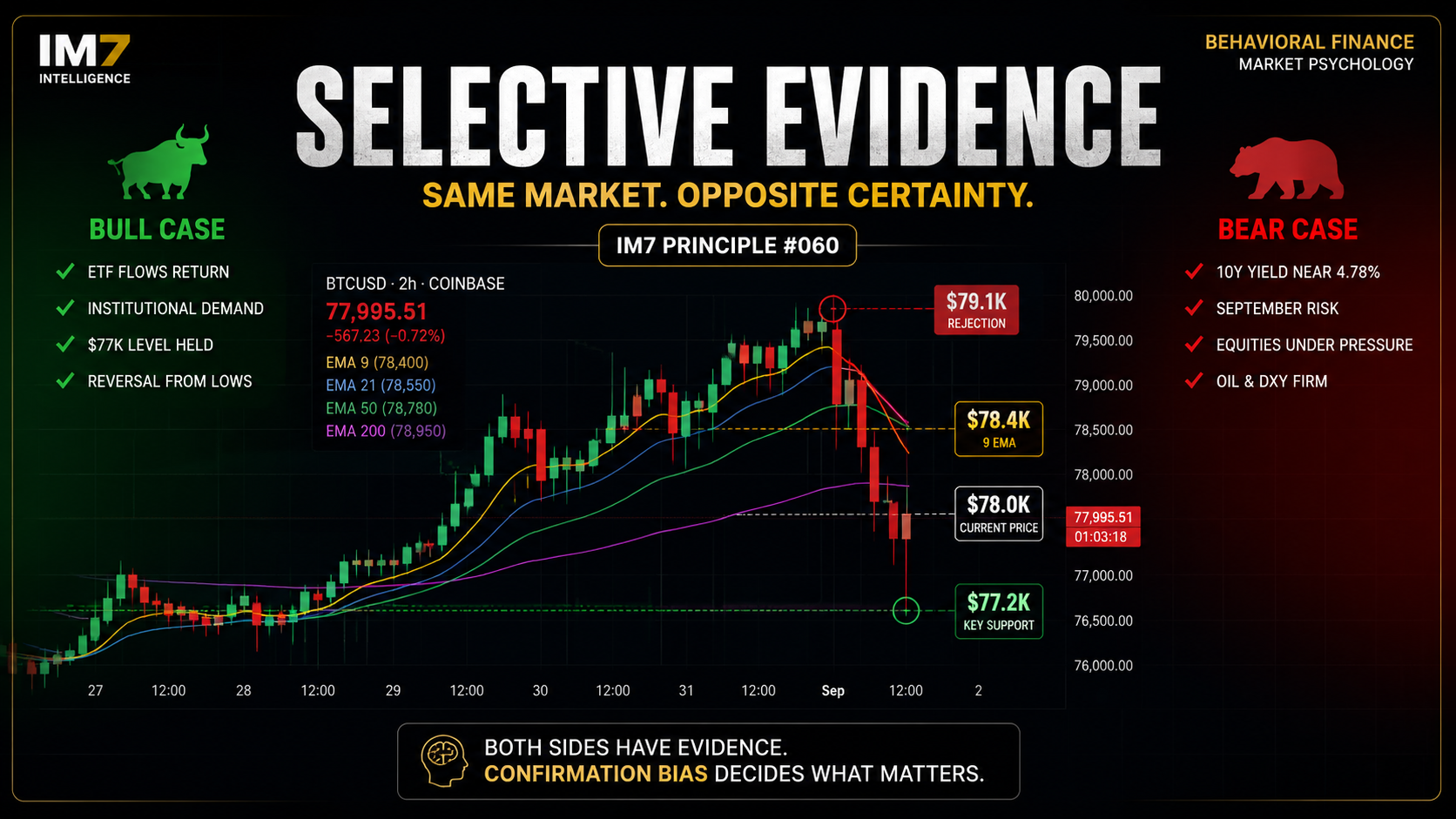
Bitcoin Gave Bulls and Bears Evidence. Both Used It Wrong.
Bitcoin is caught between bullish ETF demand and a worsening macro backdrop. The bigger behavioral risk is not choosing the wrong side — it is selectively using evidence to defend the side you already believe.
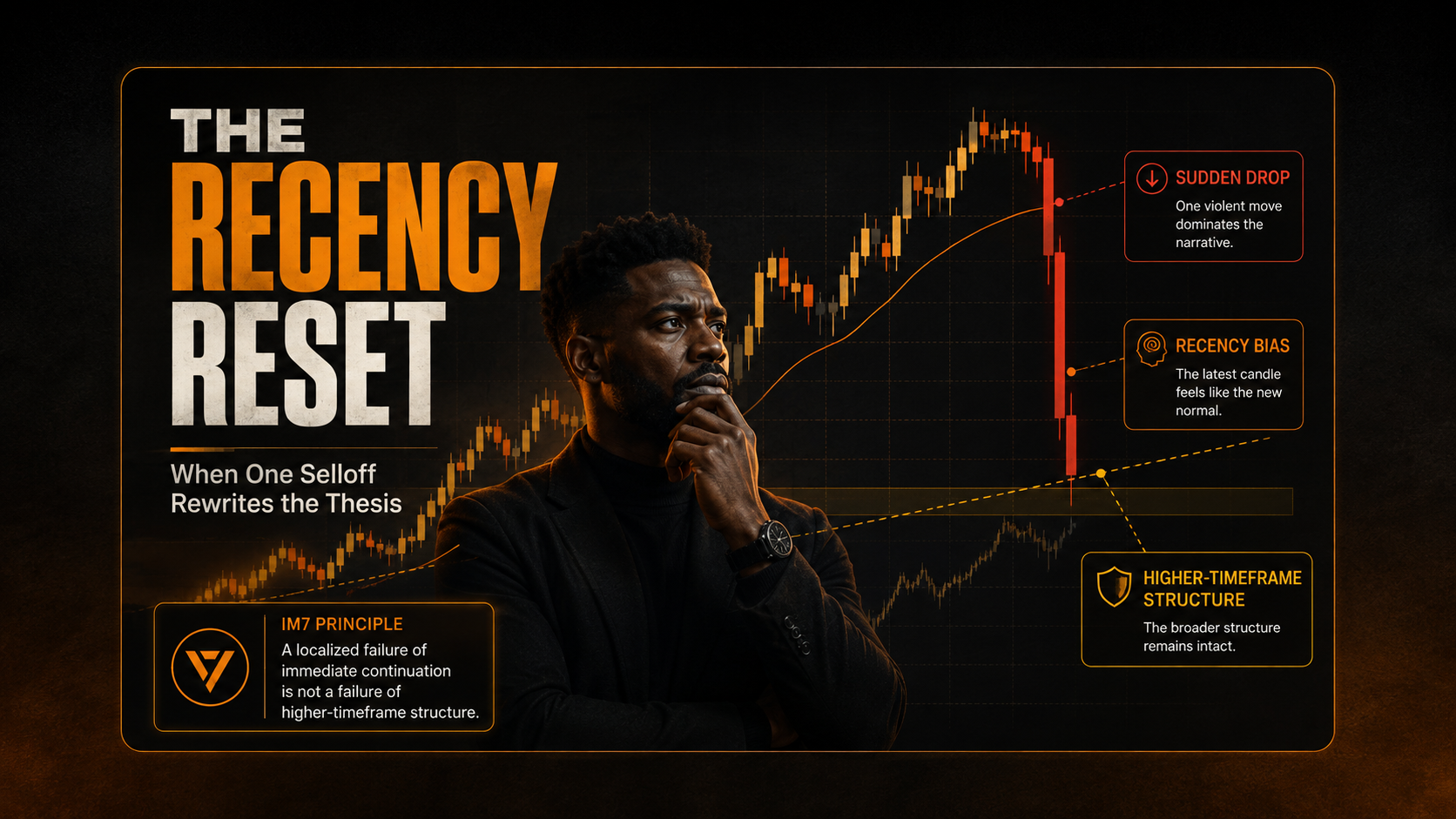
The Recency Reset: Why Bitcoin Traders Flip Their Entire Thesis After One Selloff
A single sharp adverse move can trigger a psychological shock that causes traders to abandon a higher-timeframe thesis too quickly. IM7 examines how recency bias turns one Bitcoin selloff into a complete rewrite of market conviction.
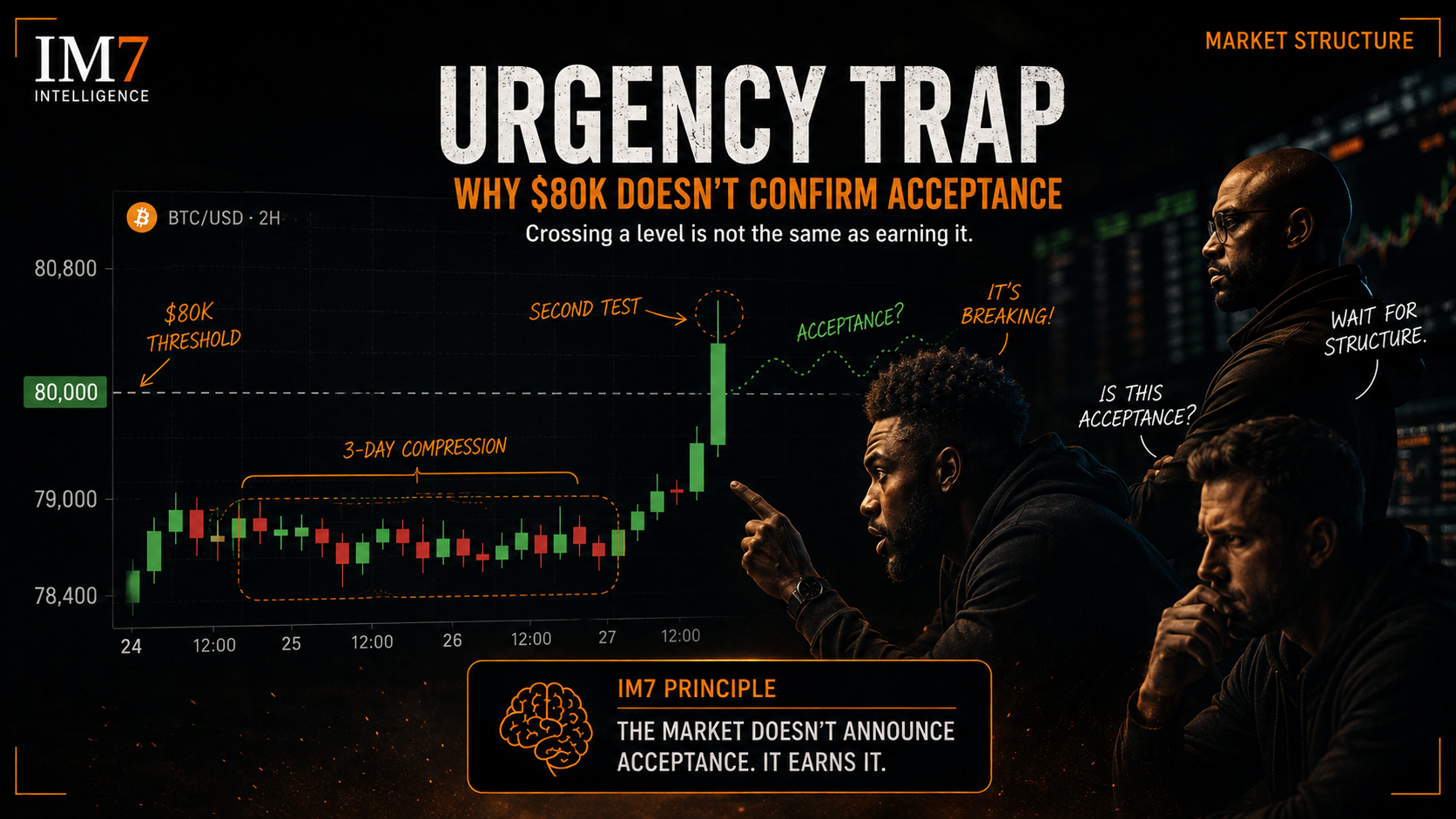
The Urgency Trap: Why Bitcoin Crossing $80K Does Not Confirm Acceptance
Bitcoin pushed back through $80,000 after days of compression, but the behavioral risk is shifting from impatience to urgency. IM7 examines why crossing a level is not the same as establishing acceptance above it.
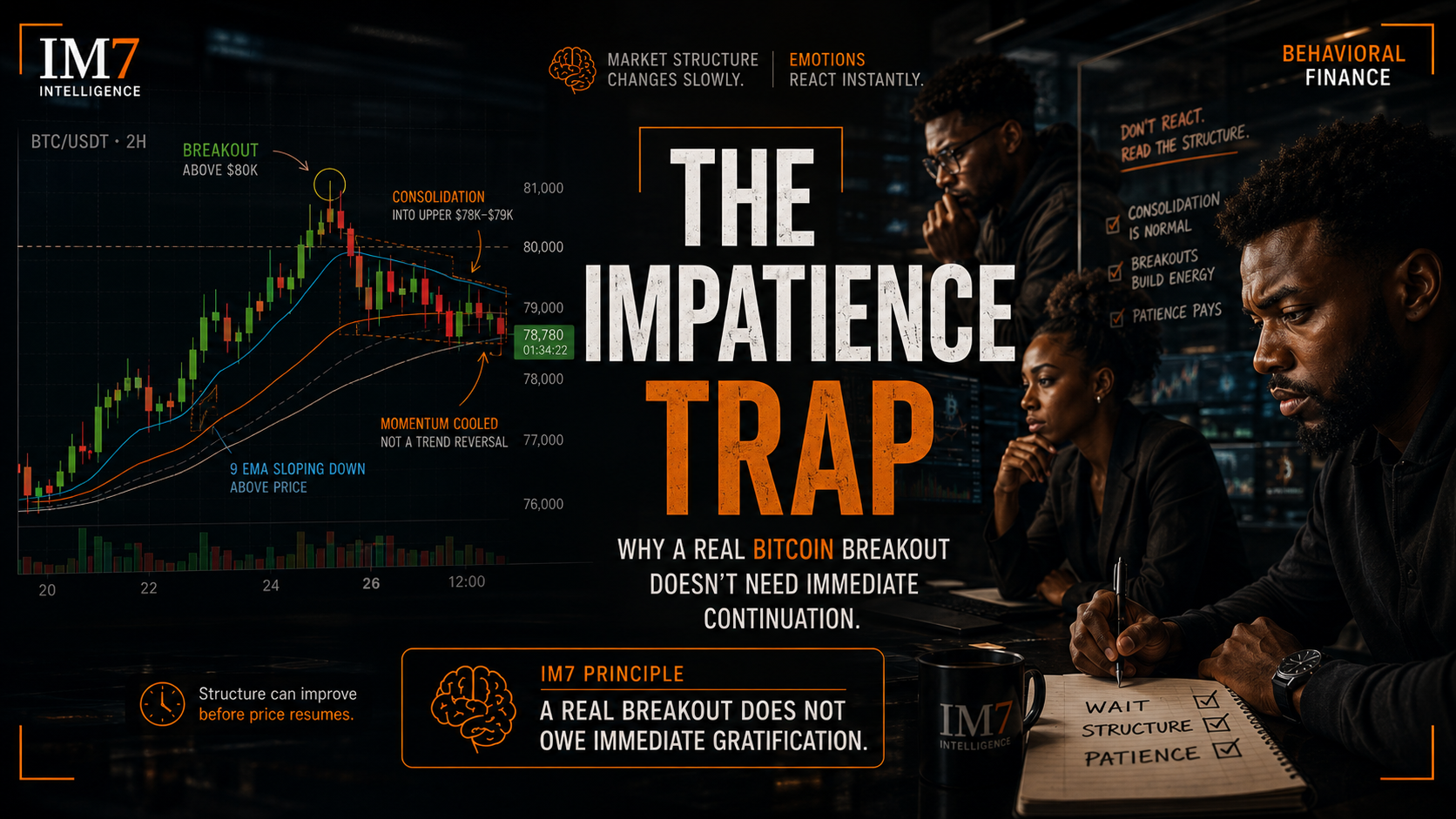
The Impatience Trap: Why a Real Bitcoin Breakout Doesn't Need Immediate Continuation
Bitcoin broke above major structure and briefly cleared $80K, but the pause that followed exposed a new behavioral trap: traders often mistake the absence of immediate continuation for evidence that the breakout failed.
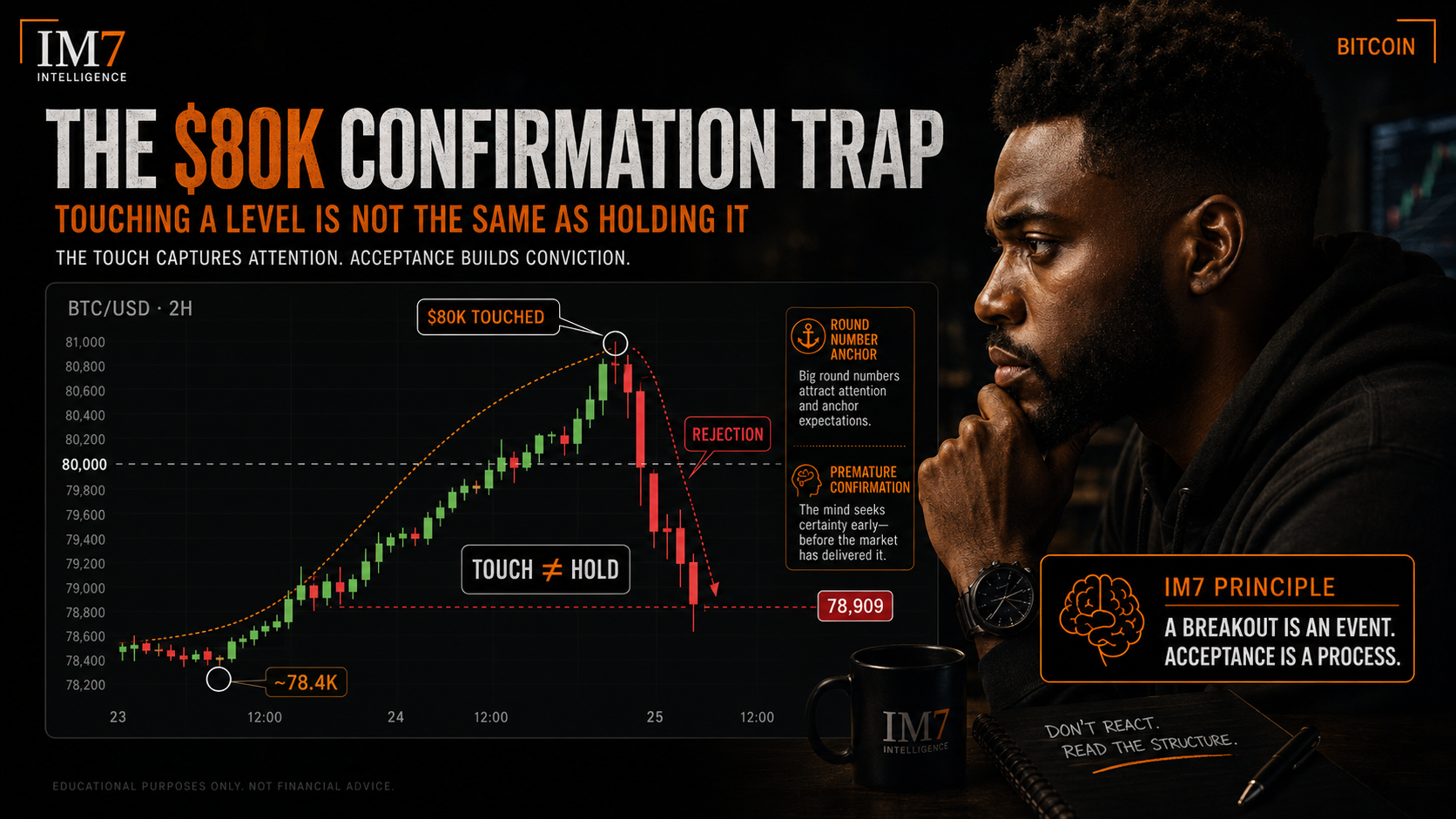
The $80K Confirmation Trap: Why Touching a Level Is Not the Same as Holding It
Bitcoin touched the $80K milestone, but the sharp rejection that followed exposed a behavioral trap: traders often confuse reaching a level with proving acceptance above it. A breakout is an event. Acceptance is a process.
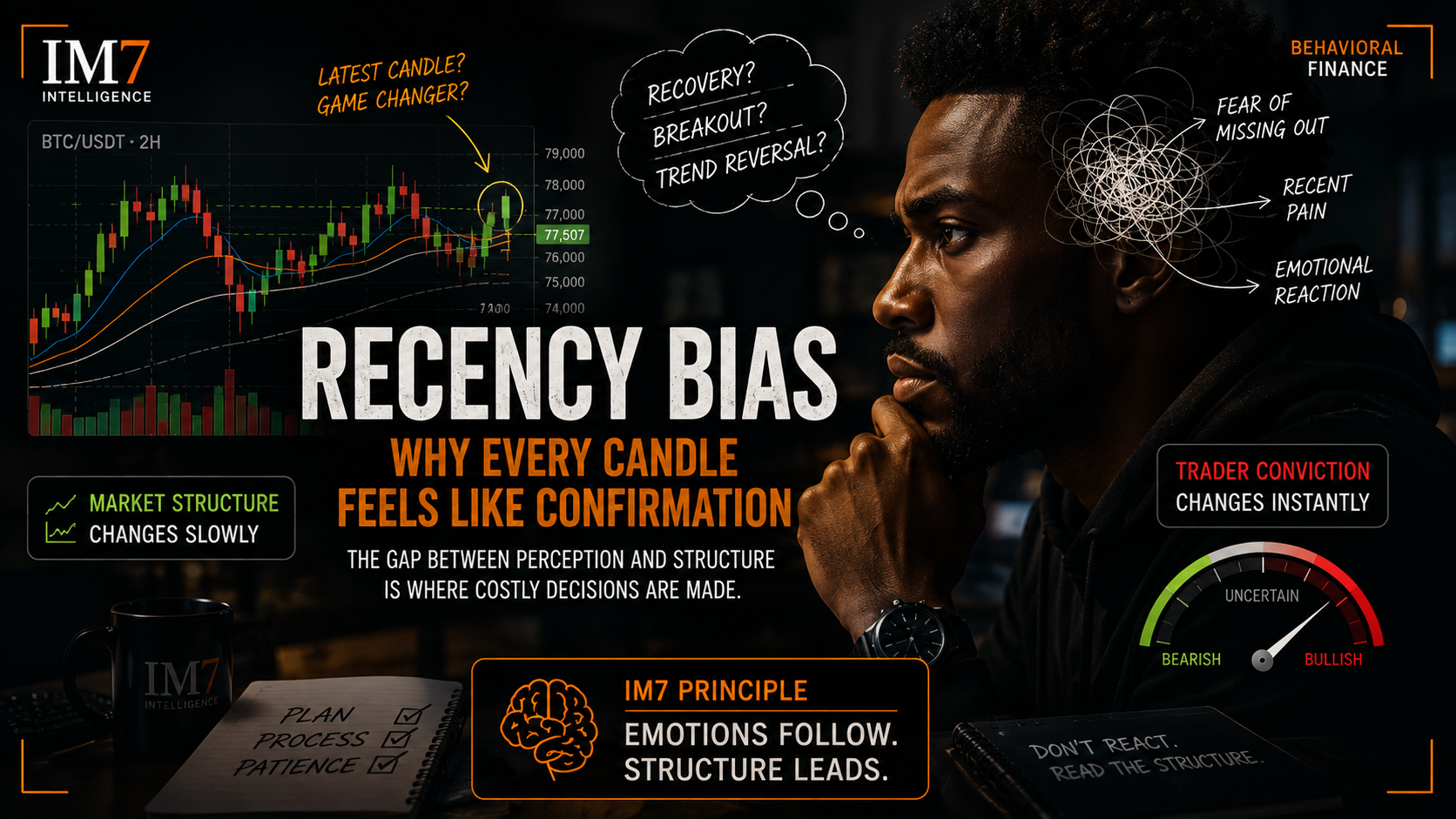
The Recency Trap: When Every Bitcoin Candle Feels Like Confirmation
Bitcoin’s volatile swings are making every new candle feel like confirmation. But when a trader’s conviction changes faster than the market structure, recency bias may be driving the interpretation.
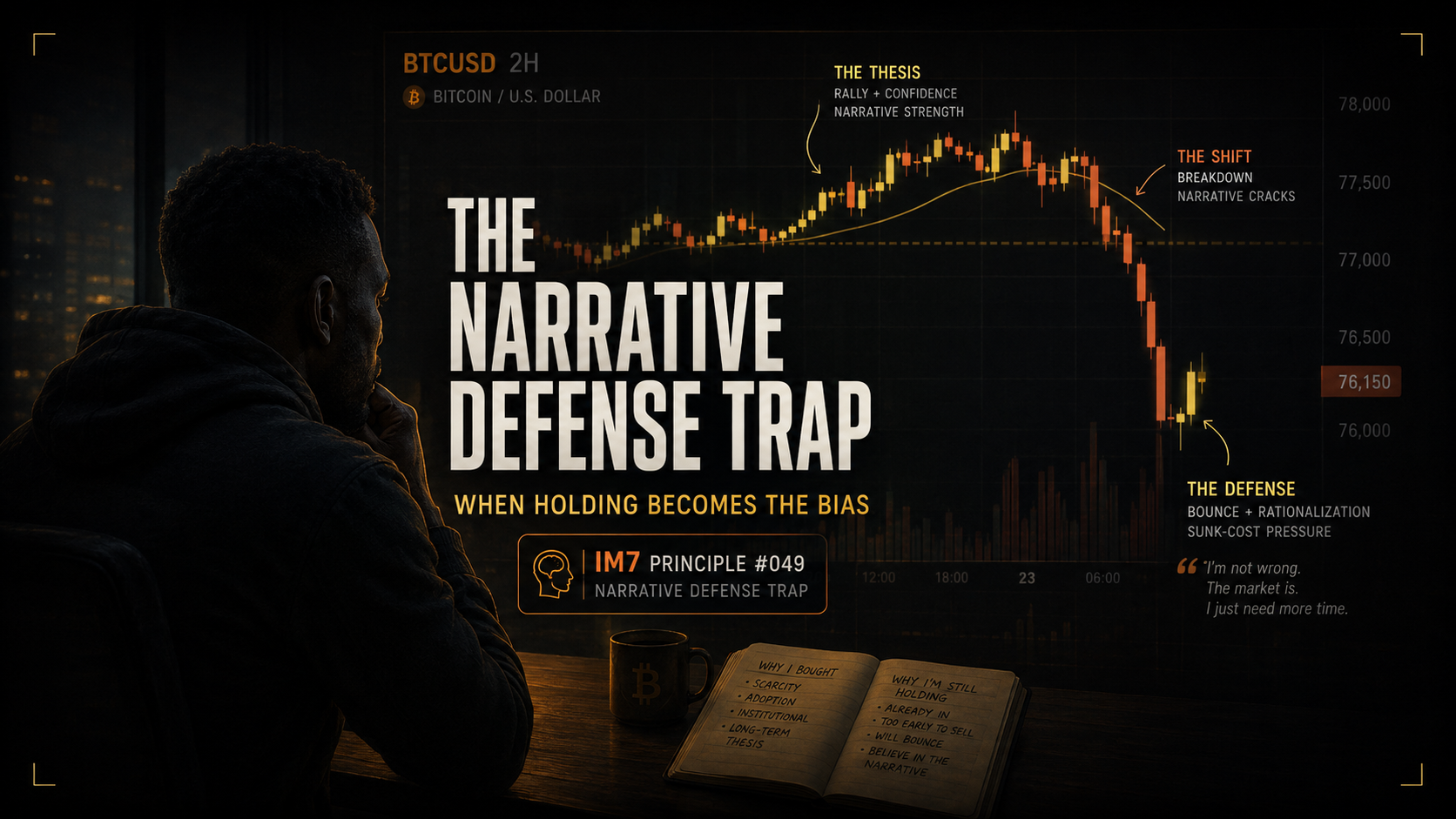
The Cost of Narrative Defense: When Holding Becomes the Bias
Bitcoin’s sharp pullback has turned yesterday’s narrative defense into a more expensive behavioral problem. When traders hold because exiting would make the loss feel real, sunk cost can replace objective reassessment.
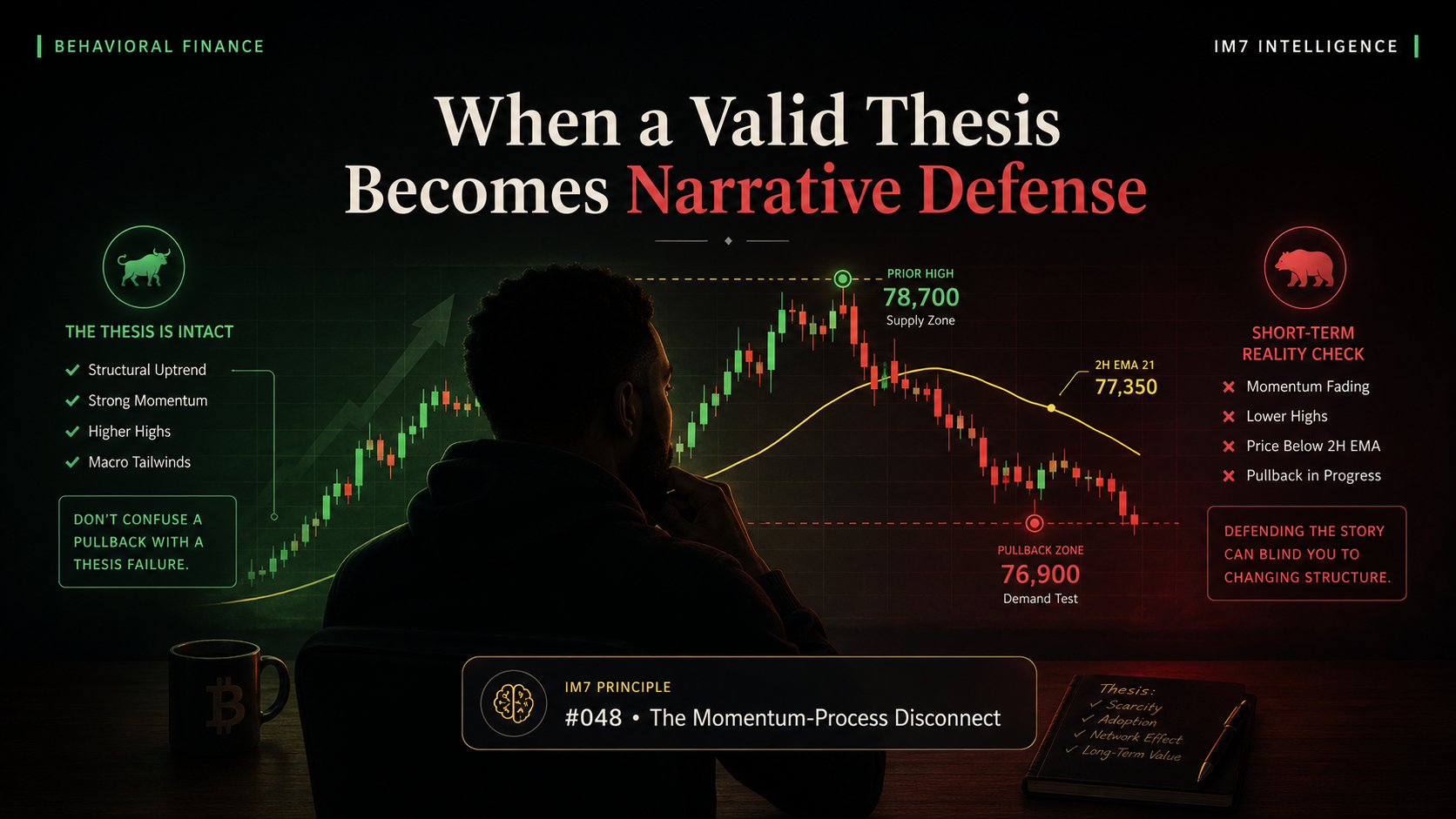
Yesterday’s Rally Was Real — Today’s Evidence Is Different
Bitcoin’s rally had real catalysts and genuine upside strength. But as price pulls back from recent highs, traders face a different behavioral test: whether they can update a previously rewarded thesis when new evidence begins to conflict with it.

Bitcoin's Strength: When Momentum Tests Process Discipline
Bitcoin is exhibiting considerable upside strength. That observable momentum can create psychological pressure for traders, especially when a strong move begins to feel like permission to loosen entry standards. The critical distinction is between acknowledging market strength and allowing that strength to dictate execution quality.
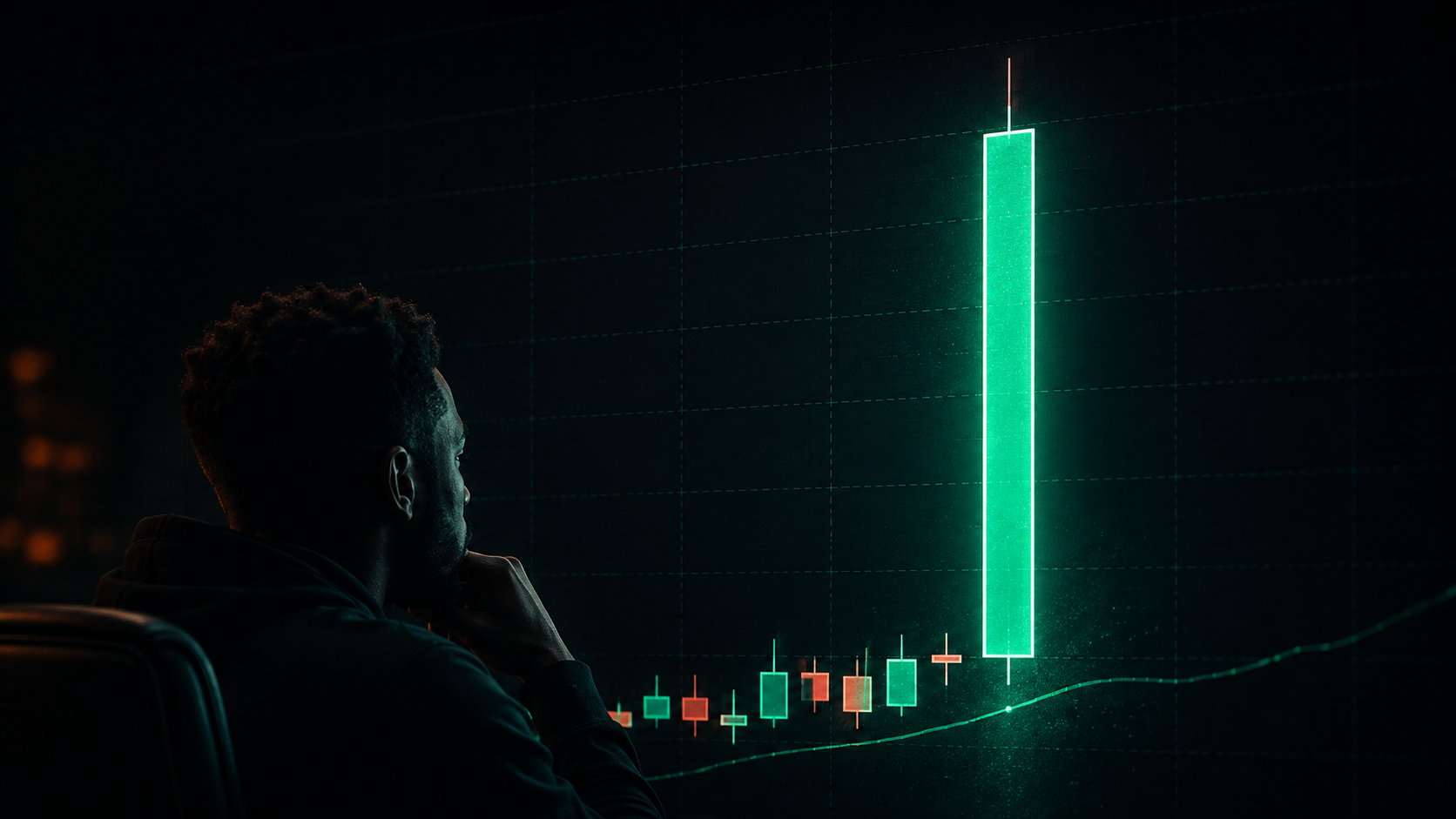
The Salience Trap: Why One Giant Bitcoin Candle Feels Like Certainty
A recent Bitcoin candle surged from below $70,000 to above $71,000 and visually dominated the surrounding chart. Large moves like this can become psychologically dominant, increasing salience, urgency, and the temptation to mistake visual magnitude for confirmation.
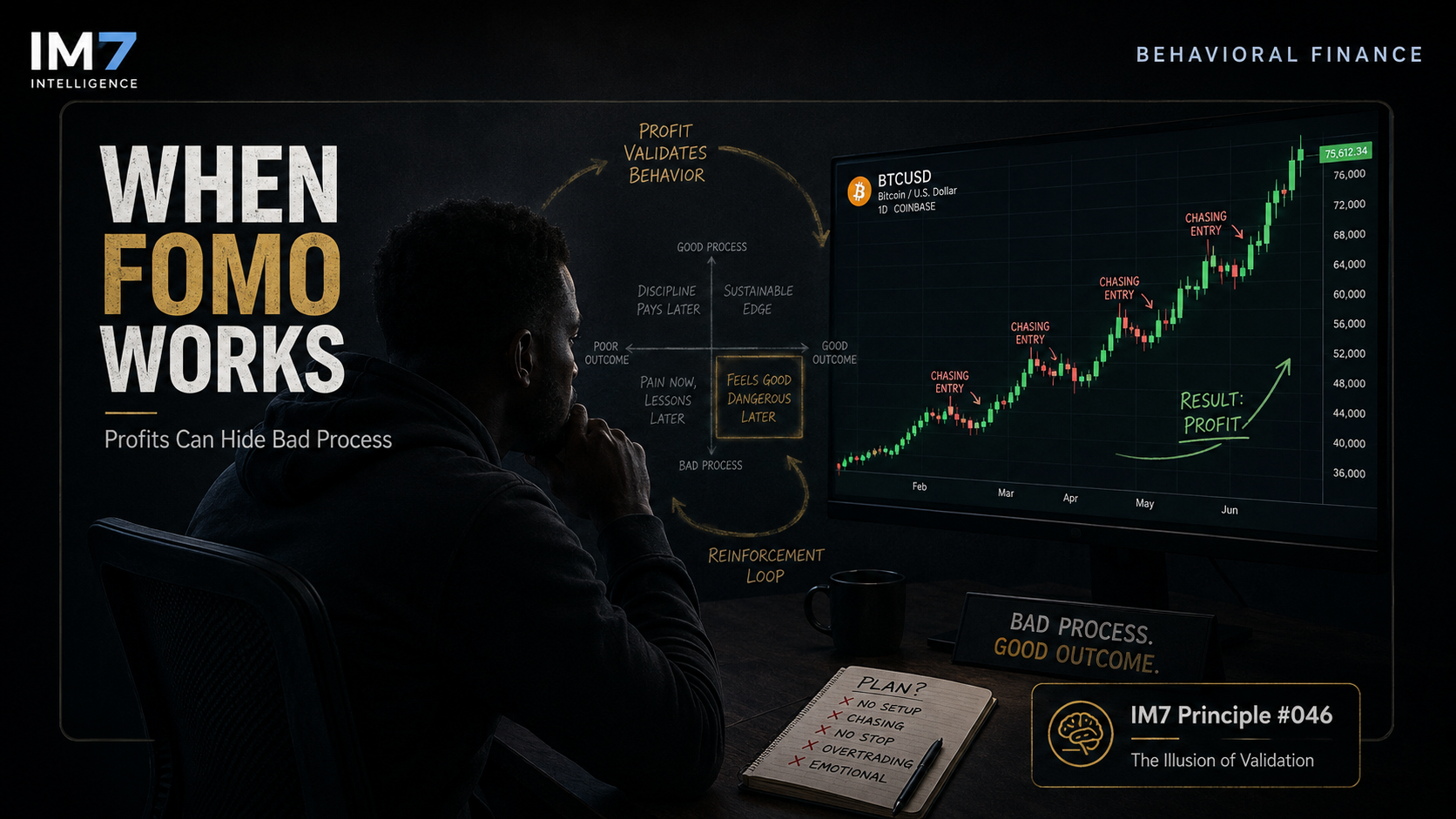
When FOMO Works: How Profitable Trades Reinforce Bad Process
When a rushed Bitcoin entry makes money, the profitable outcome can reinforce the wrong lesson. Outcome bias can turn an impulsive decision into a behavior the trader becomes more willing to repeat—even when the original process was weak.
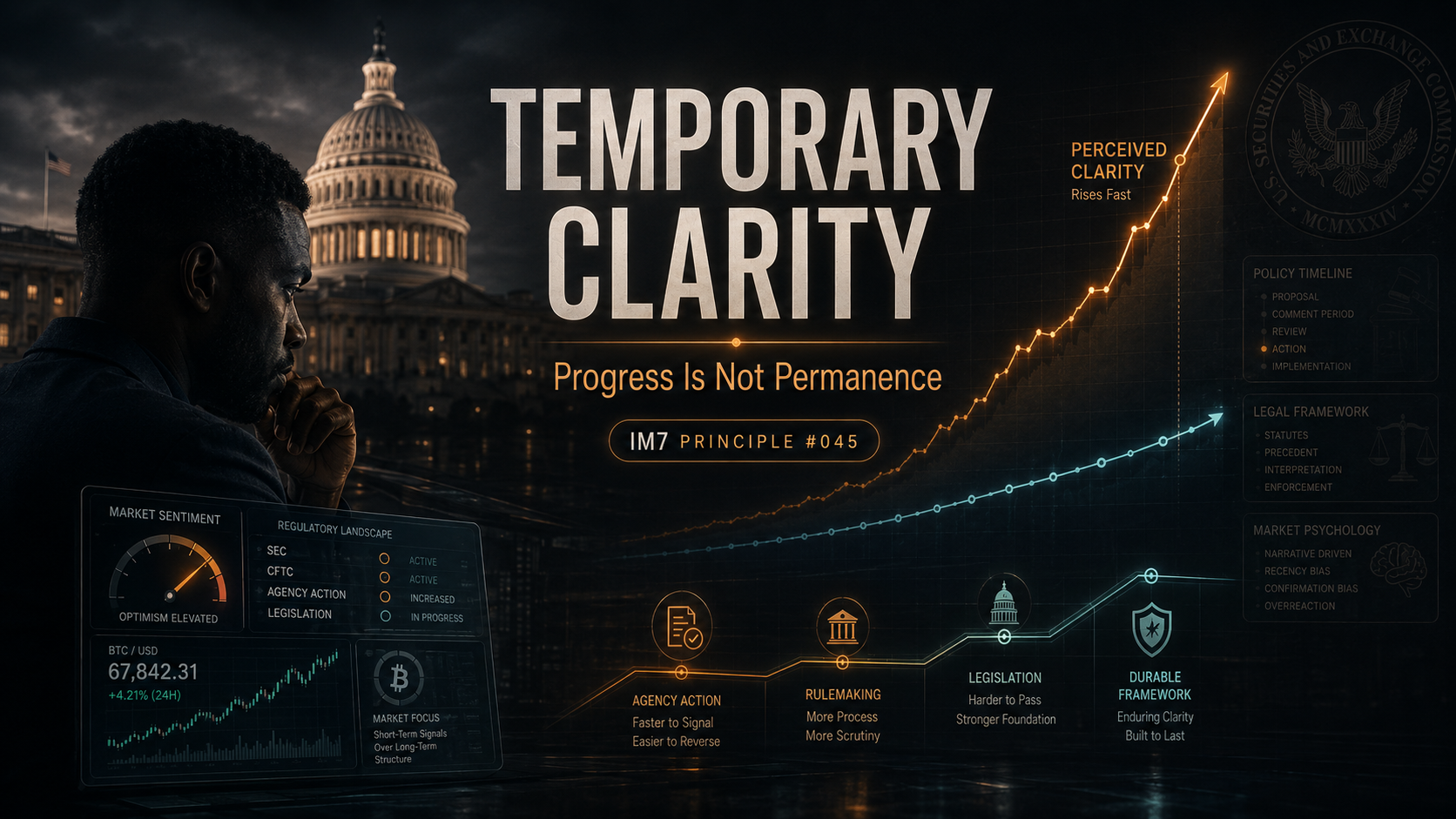
Temporary Clarity: Why Market Optimism Precedes Regulatory Certainty
Regulatory progress for digital assets is visible through agency actions. Yet, market participants often conflate this progress with an enduring resolution. This behavioral dynamic creates a perception of settled clarity, even as foundational legal and political challenges persist. Understanding this distinction is crucial for navigating evolving market structures.
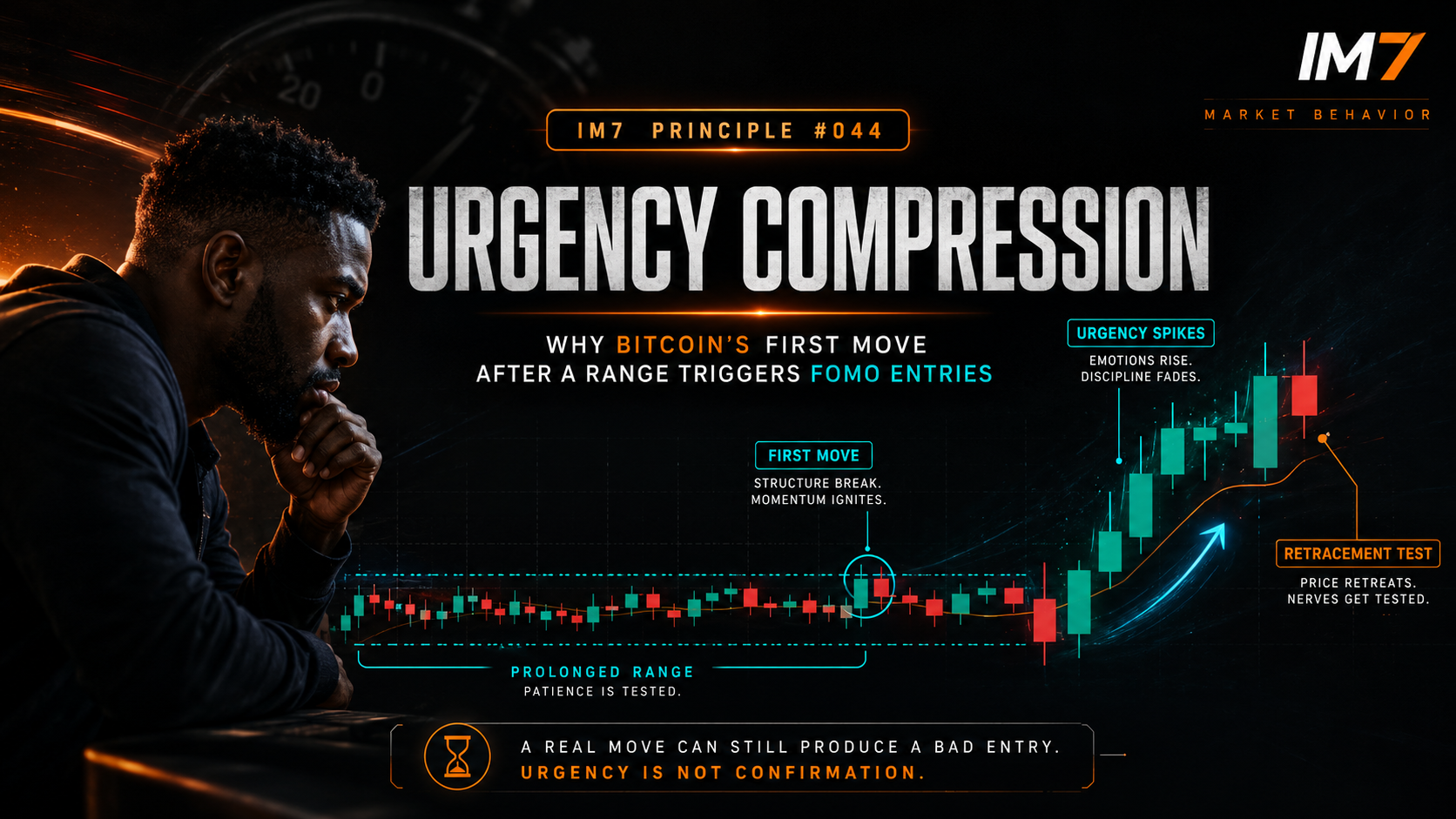
Urgency Compression: Why Bitcoin’s First Move After a Range Triggers FOMO Entries
After weeks of consolidation, a few green Bitcoin candles can make waiting feel unbearable. The move may be real, but urgency can still turn the first available entry into a poor one. A real move does not automatically make the first entry a good entry.
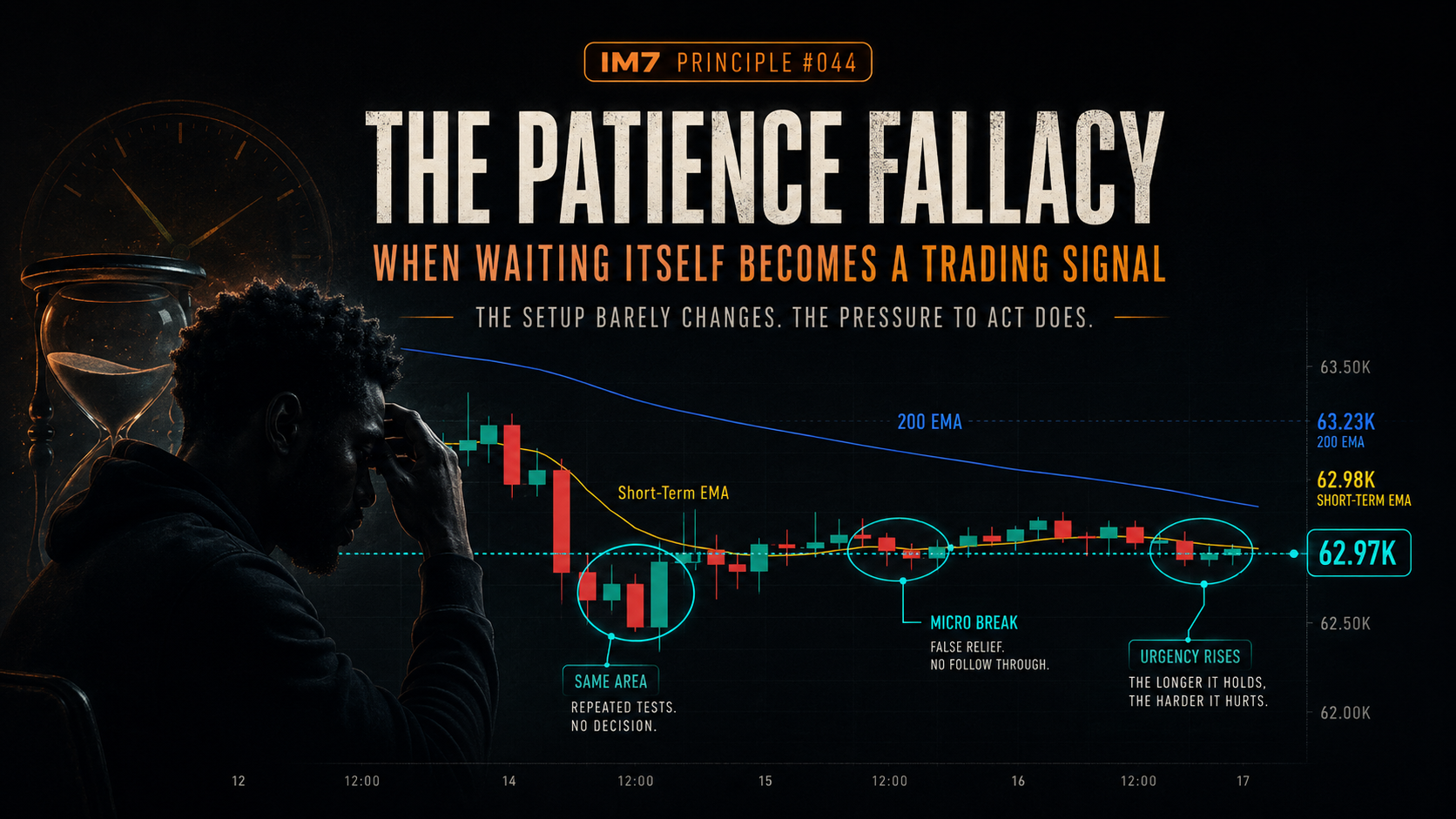
The Patience Fallacy: When Waiting Itself Becomes a Trading Signal
Week one: I’ll wait for confirmation. Week two: It has to move soon. Week three: That candle looks like a signal. The chart barely changed, but the urgency did. Prolonged Bitcoin consolidation can make waiting feel like evidence—and boredom feel like a trading signal.
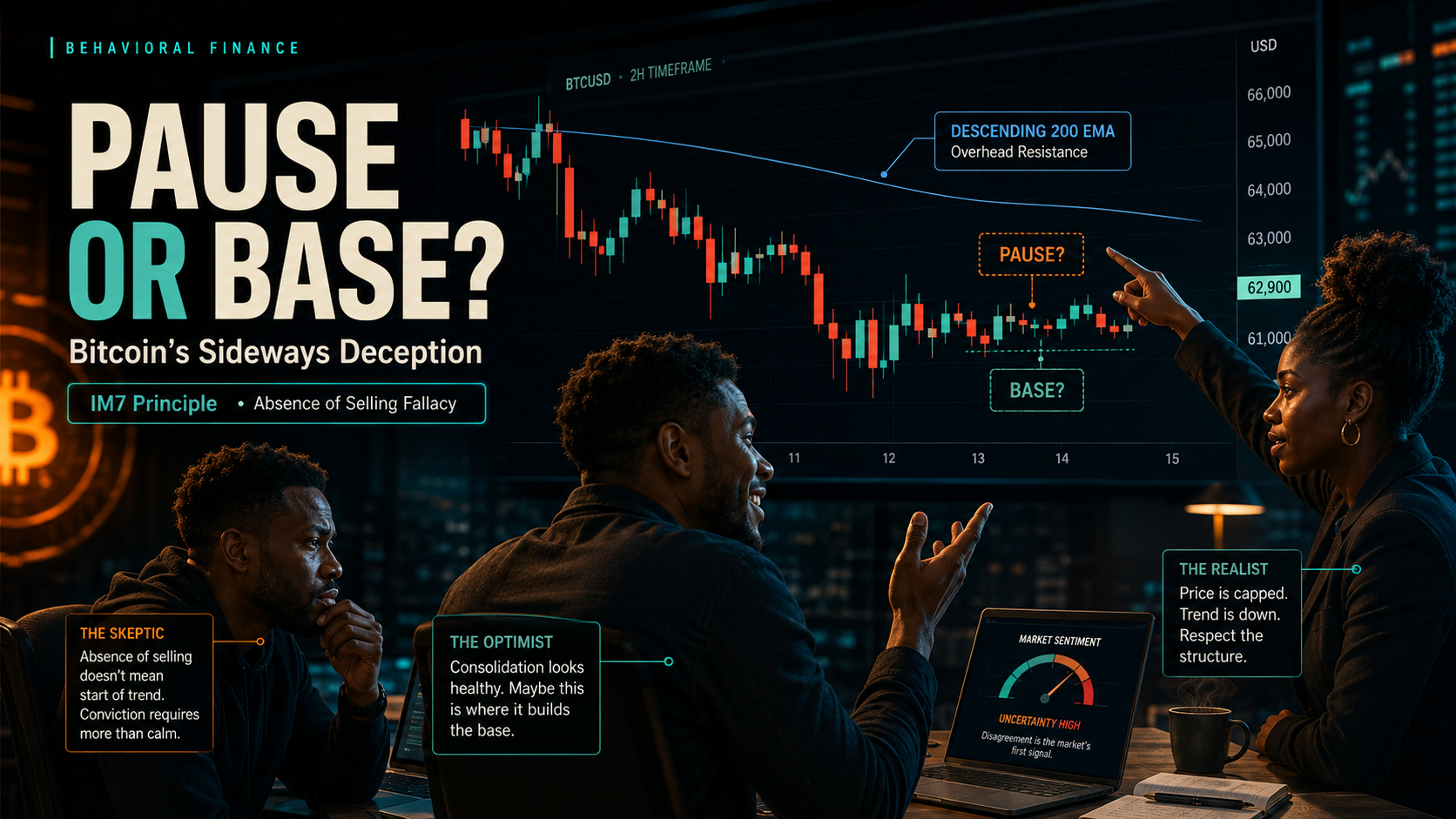
Bitcoin's Sideways Deception: Why a Pause Feels Like a Base
After a recent decline, Bitcoin stabilized near $62.9K, creating the appearance of a developing base. But the absence of aggressive selling is not the same as evidence that buyers have taken control. Sideways price action can create premature confidence before the market has actually confirmed direction.
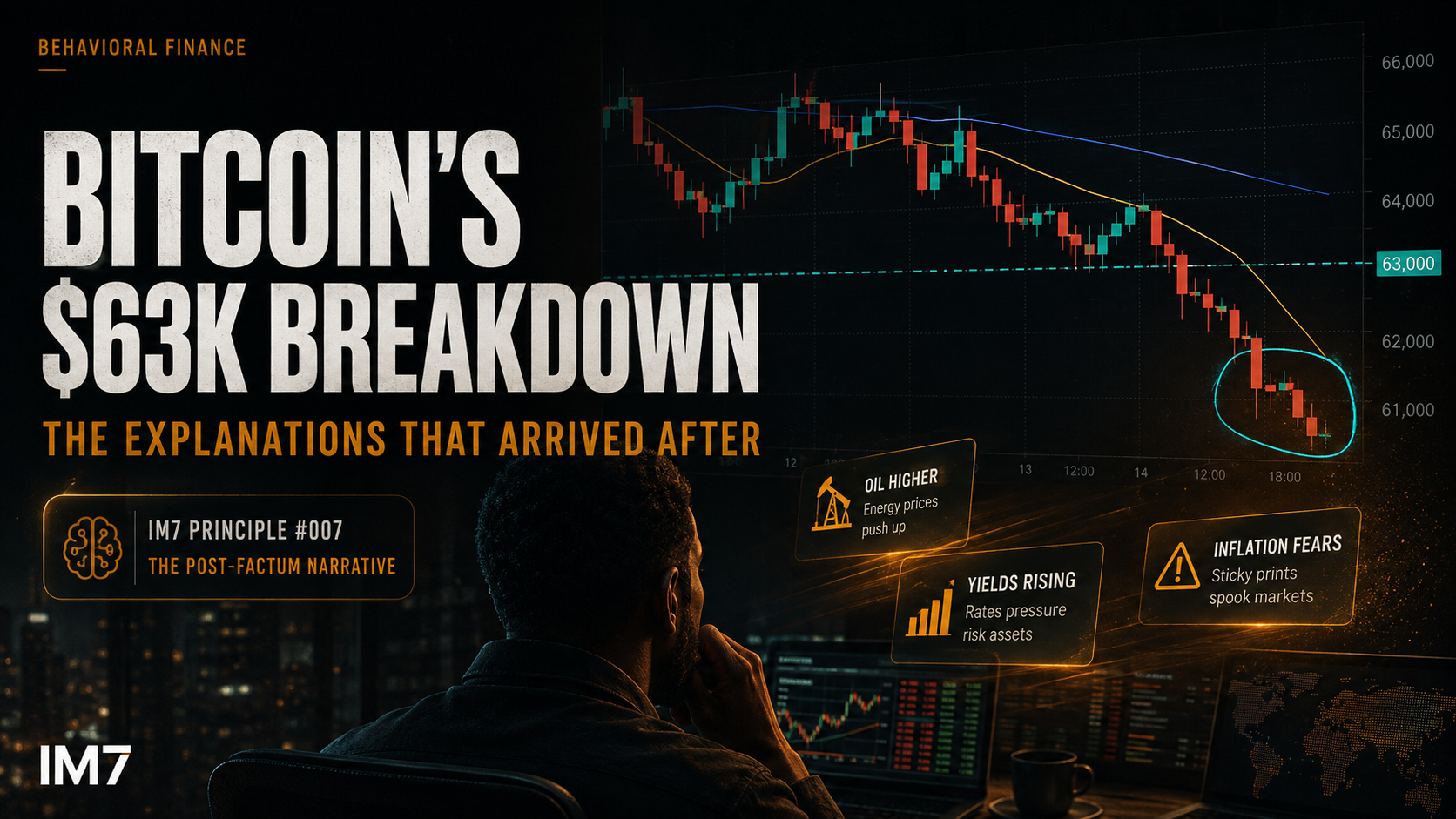
Bitcoin’s $63K Breakdown: Why the Explanations Came After
Bitcoin’s move below $63,000 triggered an immediate wave of explanations — macro pressure, yields, oil, market structure. The behavioral risk is that once the outcome is known, those explanations can feel more obvious and predictive than they actually were beforehand. The real test is separating post-move understanding from genuine pre-move edge.
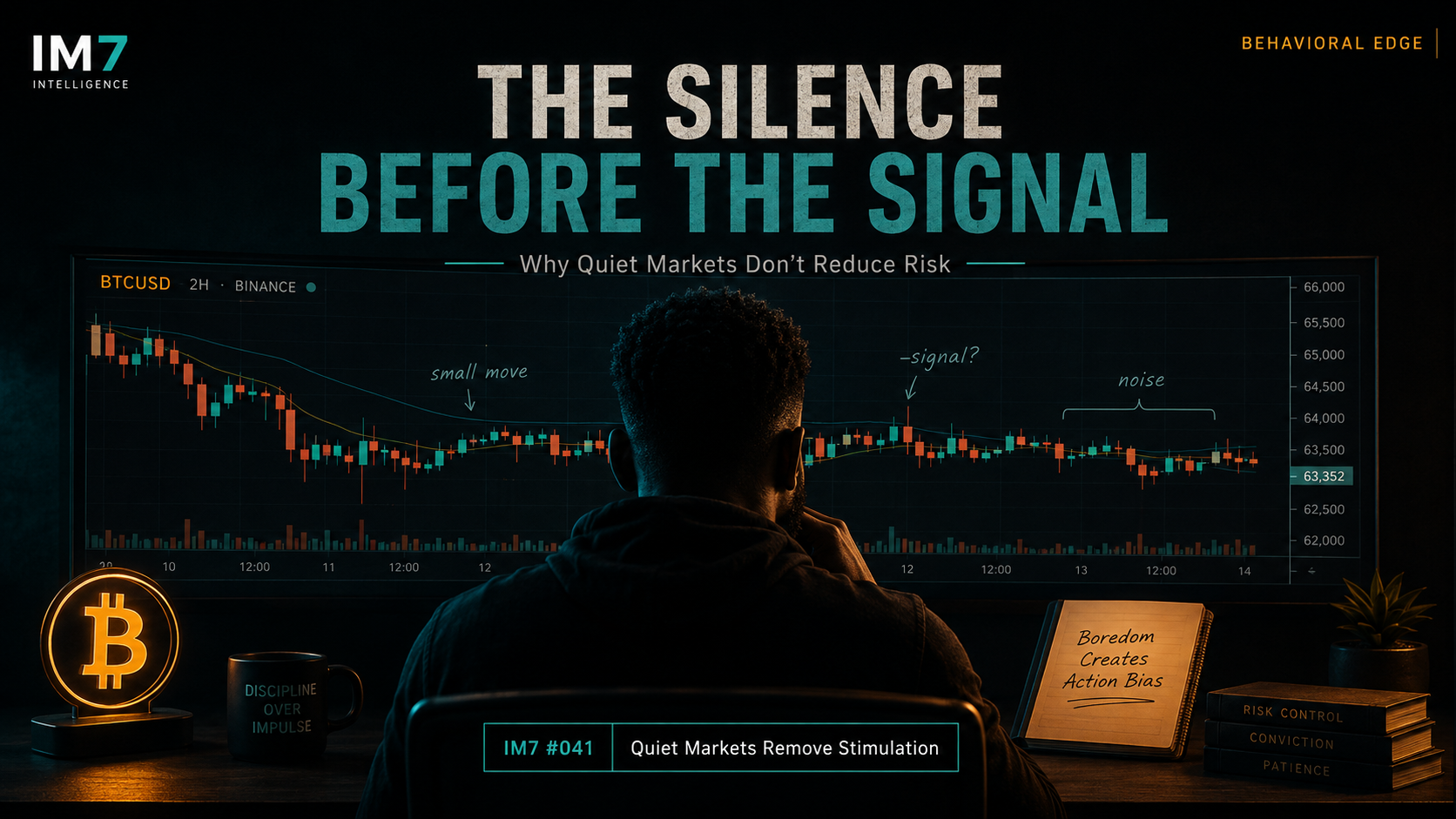
The Silence Before the Signal: Why Quiet Markets Don't Reduce Risk
Bitcoin perpetual trading activity recently fell to multi-year lows, creating an environment that can feel deceptively safe. But low stimulation changes trader behavior. Boredom, impatience, and action bias can lower setup standards and turn ordinary market noise into perceived opportunity. The professional challenge is not predicting what happens next, but recognizing when the urge to act is stronger than the evidence.
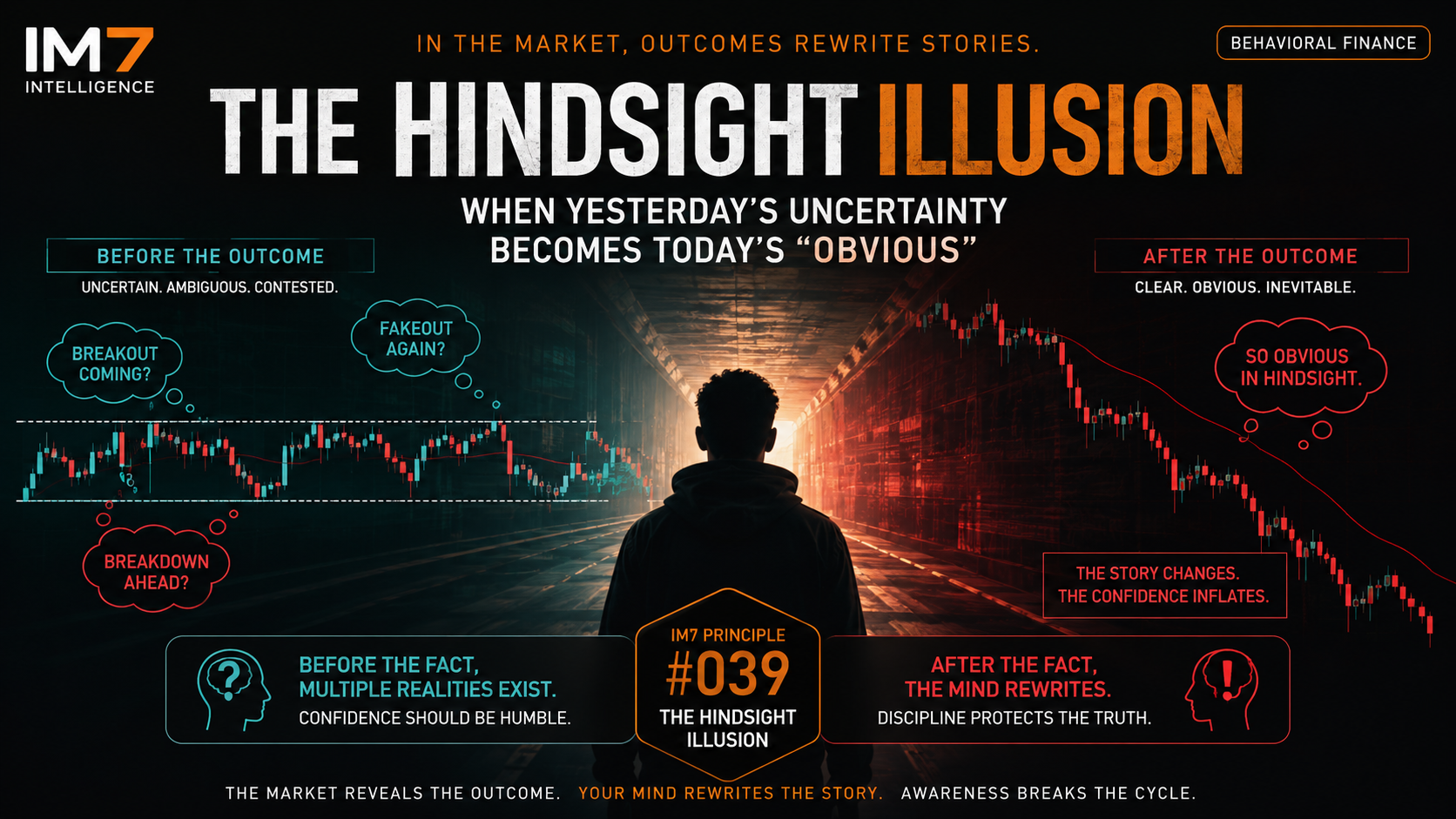
When the Range Breaks: Why Bitcoin Suddenly Looks Obvious
Bitcoin’s range looked ambiguous—until it broke. Then the warning signs suddenly seemed obvious. That shift is hindsight bias: once the outcome is known, traders rewrite uncertainty as predictability and mistake being right about the result for having had better evidence.
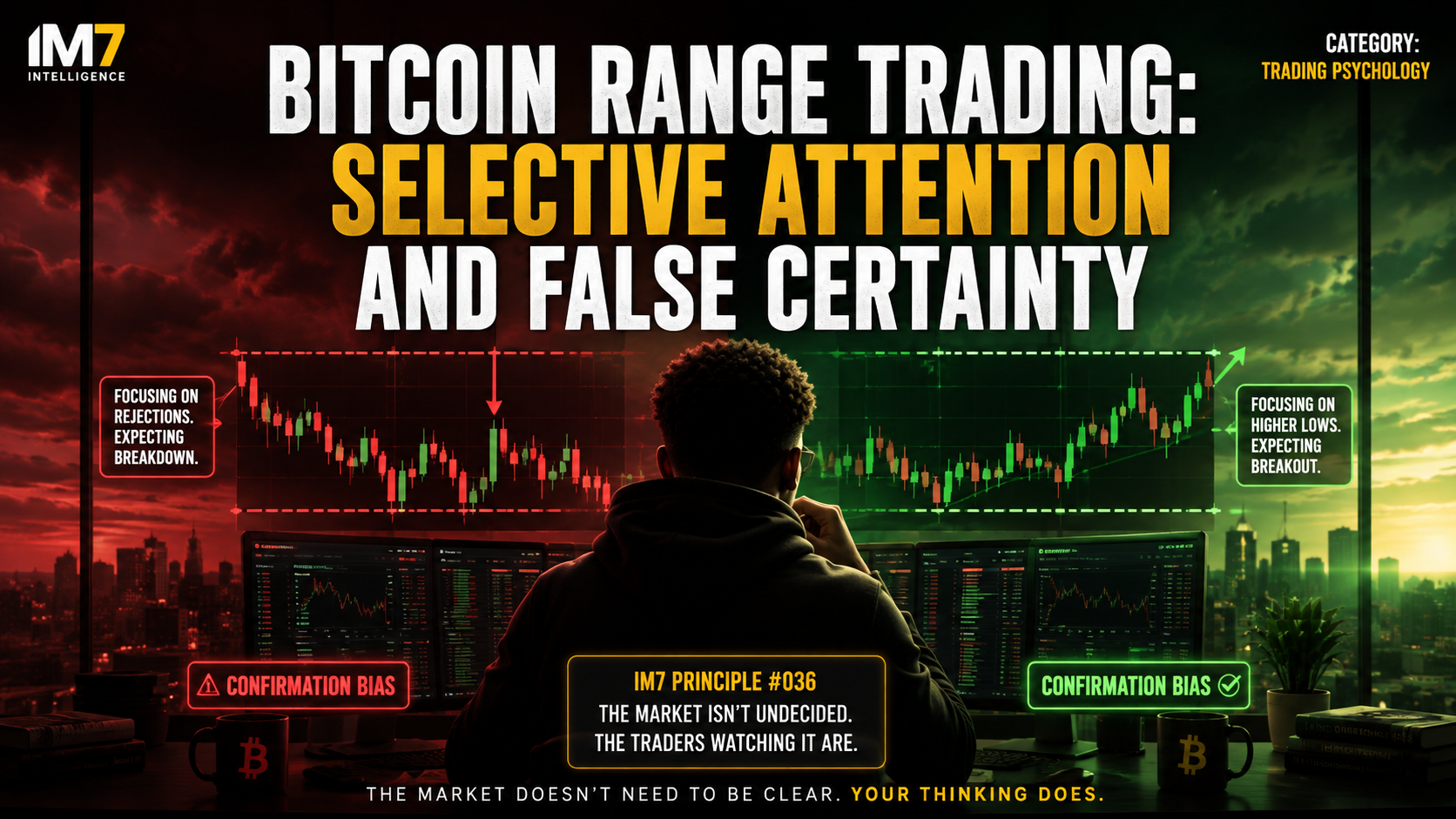
Selective Attention: How Bitcoin Traders Find False Certainty in Ranges
A narrow Bitcoin range around $65,000 gave bulls and bears enough evidence to support opposite conclusions. Bulls focused on rising lows, bears on rejected highs. The chart stayed the same; selective attention changed what each trader believed it was saying.
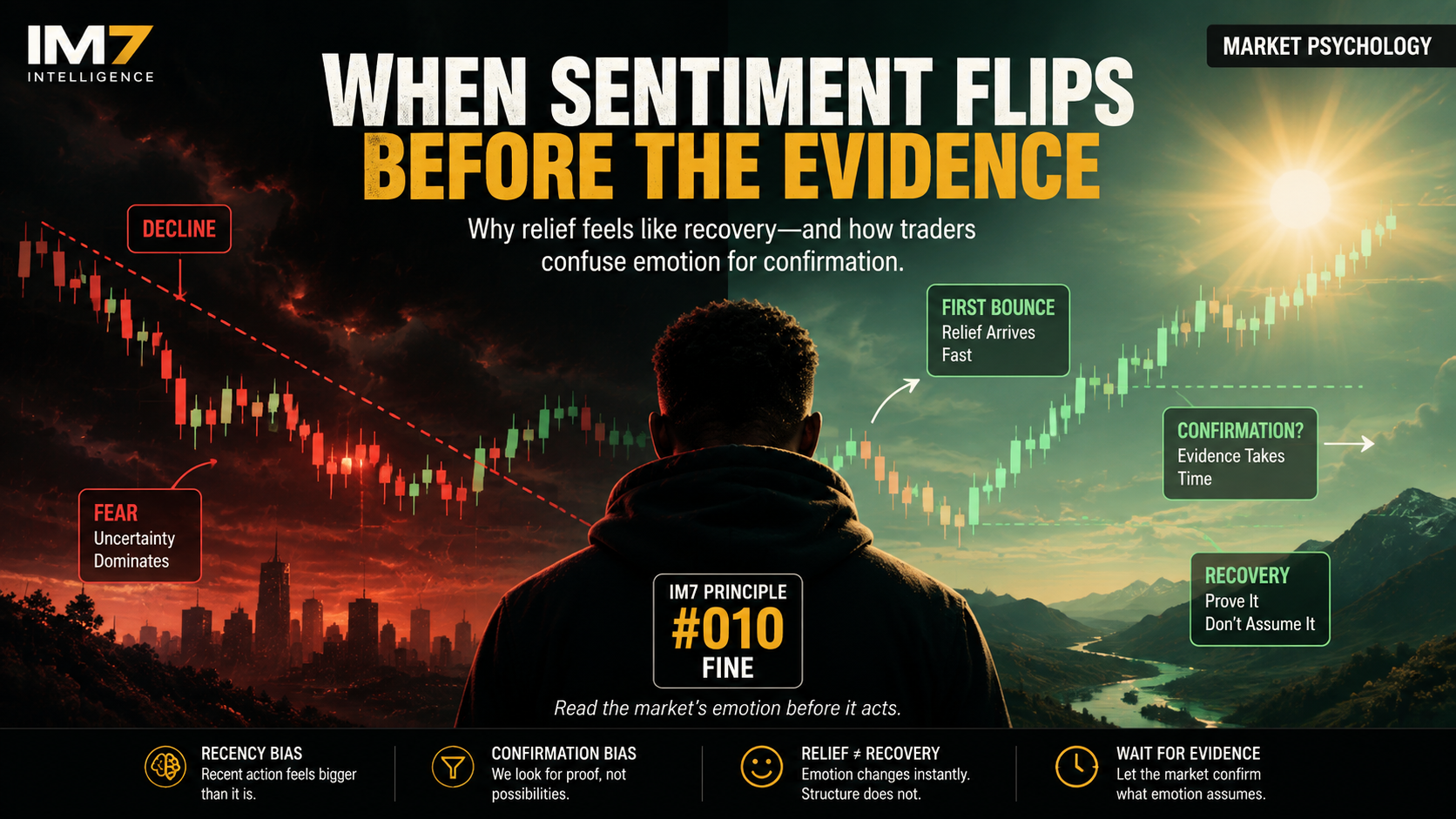
The First Bounce Fallacy: Why Bitcoin Traders Confuse Relief with Recovery
Bitcoin’s first bounce can feel like confirmation before the market has confirmed anything. Relief becomes conviction, and a temporary rebound becomes a recovery narrative. The danger isn’t the bounce—it’s how quickly traders decide what it means.
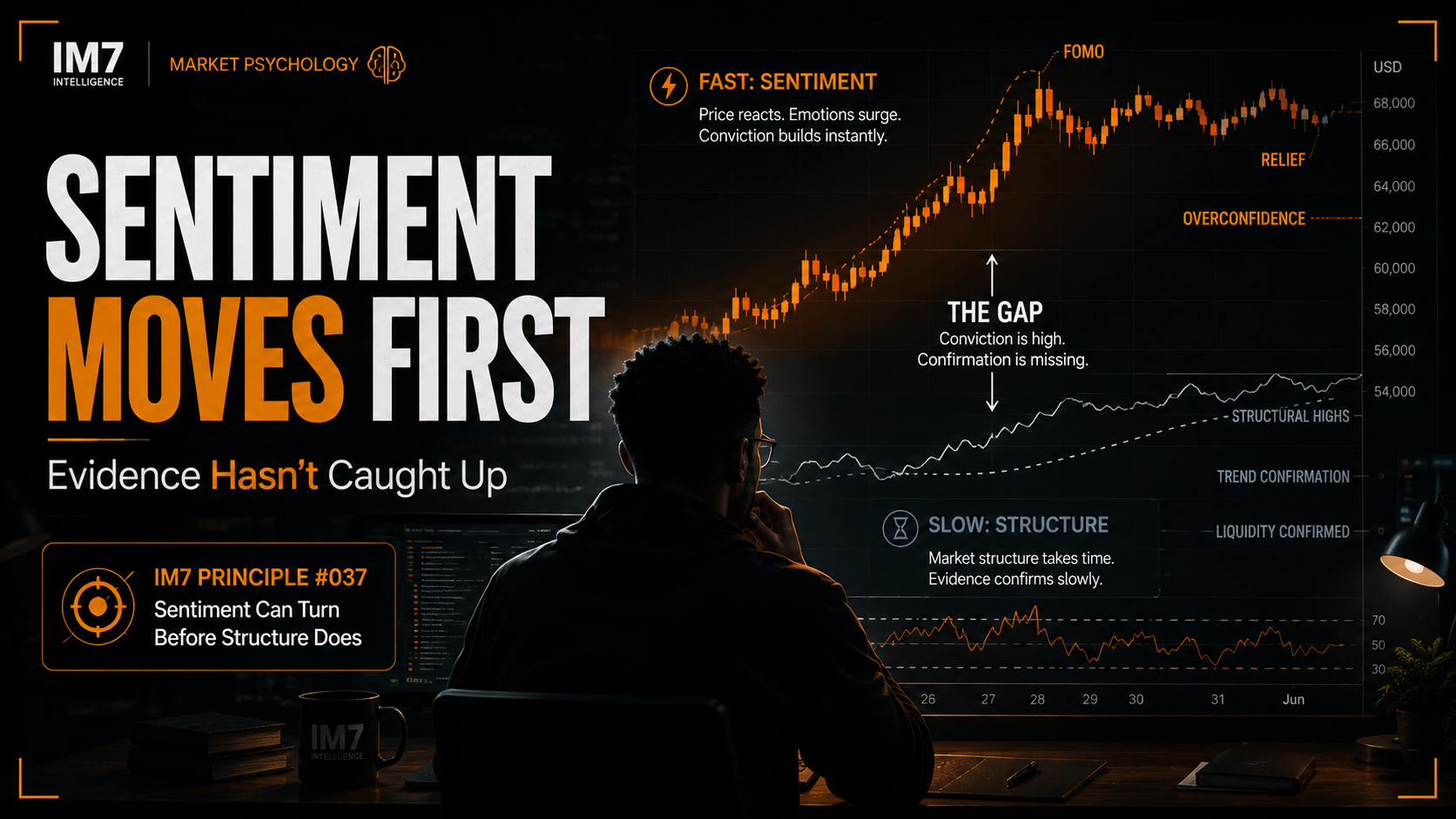
When Sentiment Flips Before Evidence: The Gap Between Feeling and Fact
A sharp market rally can flip sentiment faster than the underlying evidence changes. Traders may begin positioning for continuation while broader structural confirmation remains incomplete. That gap between feeling and fact reveals a core behavioral risk: sentiment can turn long before the evidence justifies conviction.

Emotional Certainty vs. Evidence: Why Traders Read the Same Bitcoin Chart Differently
Bitcoin is consolidating below resistance with mixed evidence, yet many traders have already committed to bullish or bearish conclusions. The disagreement does not come from different charts. It comes from confirmation bias, emotional certainty, and the tendency to interpret uncertain information through beliefs formed before the market has confirmed either outcome.

Why Traders Notice Opportunity Too Late
Markets often consolidate quietly for hours—or even days—while evidence steadily accumulates beneath the surface. Yet most traders remain disengaged until a single dramatic green candle captures their attention. This isn't a market phenomenon; it's a behavioral one. The first green candle rarely creates the opportunity—it simply makes it impossible for the crowd to ignore.

One Green Candle Doesn't Confirm a Recovery
One powerful green candle can change how traders feel long before it changes the market itself. Relief often arrives before confirmation, causing investors to mistake a temporary rebound for the beginning of a new trend. This article explores why our brains trust dramatic price moves more than the quieter evidence that follows.

When Selling Doesn't Mean Losing Confidence
Markets reward interpretation, but investors often mistake transactions for conviction. A company selling Bitcoin doesn't automatically signal fear, just as buying doesn't always signal confidence. Understanding the difference separates disciplined analysis from emotional assumptions.

Outcome Bias: Why Good Outcomes Can Reward Bad Decisions
A profitable trade does not always reflect a sound decision. Outcome Bias causes traders to judge the quality of their process by the result instead of the evidence that supported it. When fortunate outcomes reinforce flawed decision-making, the next mistake often becomes larger, more confident, and more expensive.

When Conviction Stops Curiosity: Belief Perseverance in Trading
A conviction, once formed, often feels like certainty. Traders stop gathering new evidence because the market appears to validate their original thesis. The real danger isn't developing conviction—it's allowing conviction to replace objective inquiry when conditions begin to change.

When Relief Becomes Expensive: Why One Candle Isn't Confirmation
A singular, strong market movement frequently evokes immediate emotional relief, often preceding any genuine structural confirmation. Traders commonly conflate this feeling of being correct with objective evidence of a sustained trend. ThiOne strong market move can make traders feel right long before the market confirms they are. Relief arrives instantly. Confirmation takes time. This article explores why confusing those two emotions often leads to expensive trading decisions.s critical distinction between instantaneous relief and time-dependent confirmation holds profound implications for decision-making.

The Recovery Reached Resistance: Confidence Before Confirmation
Three green candles after a sharp decline can create a powerful sense of relief, but relief is not confirmation. Traders often mistake arriving at resistance for breaking through it, allowing emotions to outrun market structure. The recovery may feel convincing, yet the real test often begins where confidence returns.

ETF Flows: Conviction, Not Price, Moves Markets
Most traders watch price. Professional capital leaves clues through ETF flows. While headlines explain yesterday's move, persistent inflows and outflows often reveal changing conviction before market psychology fully shifts. Learning to read capital—not just candles—helps traders understand the behavior driving market structure.

When Liquidity Disappears: Why Markets Move Faster Than Emotions
Markets don't move because emotions suddenly change. More often, emotions change because liquidity disappears first. When buyers and sellers step away, even small orders can trigger outsized price movements, creating the fear, urgency, and volatility most traders mistakenly believe caused the move.

When Waiting Becomes the Decision
Most losses don't begin with panic—they begin with waiting. This article explores why uncertainty paralysis keeps traders frozen while markets quietly evolve, and how delaying decisions often becomes a decision itself.

When Lower Highs Whisper: The Anchoring Bias Traders Miss.
Markets often reveal a change in character through small structural shifts long before a reversal becomes obvious. Traders miss those signals when they judge each candle separately, anchor to the previous high, and fail to recognize the sequence forming in front of them.

When Recovery Becomes the Risk: Why Relief Can Lead to Overconfidence
A sharp recovery often changes market psychology faster than market structure. Relief becomes confidence, confidence becomes certainty, and traders begin taking larger risks before objective confirmation arrives. The recovery doesn't erase the risk—it simply makes it harder to see.

Patience or Paralysis? When Waiting Helps—and When It Costs You
Patience is one of the most celebrated virtues in trading—but not every delay is discipline. Learn how to distinguish evidence-based patience from fear-driven hesitation before missed opportunities become expensive lessons.

Disposition Effect: Why Investors Sell Winners Too Soon and Hold Losers Too Long
Most investors do the opposite of what long-term success requires. They sell winning investments too early, hold losing positions too long, and mistake emotional relief for disciplined investing. Learn how the Disposition Effect influences decision-making—and how to overcome it.

Commitment Bias: When Holding On Becomes More Expensive Than Letting Go
Commitment Bias causes traders to defend yesterday's decisions with today's evidence. Learn why investors hold losing positions, ignore changing market conditions, and how disciplined decision frameworks help protect capital.

Stabilization Bias: Why Sideways Markets Feel Safer Than They Are
After a sharp decline, markets often move sideways before making their next major decision. Traders mistake the absence of selling for the presence of buying, creating a dangerous sense of stability. Stabilization Bias explains why quiet markets frequently produce the most expensive decisions—not because the trend has changed, but because confidence has.

The Overconfidence Delusion: Why Intelligence Doesn't Protect You from Bad Decisions
Intelligence doesn't eliminate cognitive bias—it often disguises it. Overconfidence can lead even experienced investors, entrepreneurs, and professionals to underestimate risk, overestimate their knowledge, and mistake confidence for competence. Understanding this psychological trap is essential for better decisions in markets and beyond.

The Allure of the Oracle: Why We Over-rely on Technical Indicators
Despite frequent evidence of their fallibility, market participants often exhibit profound trust in technical indicators. This persistent belief in predictive patterns, even when statistically tenuous, reveals deep-seated cognitive biases. Understanding the subconscious mechanisms driving this over-reliance is crucial for disciplined decision-making.

The Behavioral Misconception: Why Relief Rallies Aren't Structural Recovery
A bounce can restore confidence long before it restores market structure. After Bitcoin defended the $62,000 support level, many traders interpreted relief as recovery. This research examines why temporary rebounds often create false optimism, how cognitive biases distort decision-making during relief rallies, and why rebuilding structure requires far more evidence than surviving a single level.

The Safest-Looking Chart Is Sometimes the Most Dangerous
Three indicators agreed. The structure looked healthy. Confidence returned. Then one candle erased everything traders thought they knew. False certainty doesn't happen because indicators fail. It happens because traders stop questioning them.

When "Fine" Becomes Expensive: How Status Quo Bias Traps Bitcoin Traders After Support Breaks
This article explores how status quo bias and other cognitive pitfalls can lead Bitcoin traders to cling to outdated theses, even after critical technical support breaks. We examine the psychological journey from comfort to re-evaluation, using a recent Bitcoin price action as a case study. Understanding these biases is crucial for effective risk management and adaptive decision-making in volatile markets.

The Silent Erosion: How Sideways Bitcoin Markets Quietly Destroy Trader Confidence
After a strong breakout, traders often expect momentum to continue. But when Bitcoin begins moving sideways, confidence slowly gives way to doubt. This behavioral analysis explores how quiet consolidation erodes conviction, why traders mistake inactivity for safety, and how psychological biases—not price alone—shape decision-making during periods of uncertainty.

Why Clean Trends Create Dangerous Confidence: The Psychology Behind Chasing Bitcoin Breakouts
When Bitcoin exhibits a 'clean' trend, breaking out from a period of moving average compression, it often triggers a powerful, yet potentially dangerous, psychological shift in traders. This article explores how such clear price action can lead to overconfidence, fueled by FOMO, recency bias, and confirmation bias, diverting focus from disciplined entry strategies to emotional decision-making.

Why EMA Compression Creates Maximum Uncertainty: The Behavioral Psychology Behind Bitcoin's Decision Points
While technical indicators like Exponential Moving Averages (EMAs) are often used to identify trends, their compression can indicate something far more profound: concentrated market uncertainty. This article explores the psychological underpinnings of why traders often misinterpret EMA compression as a signal for impending price movement, rather than a reflection of deep indecision.

Why Relief Bounces Fail: What Bitcoin's $62,000 Breakdown Is Really Telling Traders
Often, what looks like a potential market reversal is merely a temporary reprieve – a "relief bounce" that ultimately fizzles out. This article delves into the psychological traps that lead traders to misinterpret these bounces, using a recent Bitcoin price action example to illustrate core behavioral finance principles. We'll explore how anchoring, confirmation bias, and other cognitive biases cloud judgment, turning fleeting optimism into financial frustration.

Why the Biggest Candle Isn't the Most Important: Relief vs. Confirmation in Trading
One explosive candle can change how traders feel without changing the market itself. Learn why relief is often mistaken for confirmation, how outcome bias shapes trading decisions, and why real conviction is measured by follow-through—not one impressive move.

The Same Price Level, Different Story: Why Recency Bias Skews Trading Decisions
Traders often anchor their decisions to past price movements, mistaking familiar patterns for reliable indicators. This tendency, influenced by recency bias, can lead to costly misinterpretations of market dynamics. We explore how psychological factors can lead traders to misinterpret 'support' levels, focusing on the behavioral traps of memory-based trading versus observation-based analysis.

The Price is Right... or is it? The Psychological Pull of a Single Number in Trading
Traders often find themselves fixated on a single price point, overlooking broader market dynamics. This phenomenon, known as mental anchoring, offers a false sense of clarity in volatile markets. We delve into how psychological biases contribute to this obsession and how to overcome it.

Why Sideways Markets Feel Harder Than Crashes: The Psychology of Waiting and Expectation Bias
Sideways markets can often feel more emotionally taxing than sharp crashes, despite the absence of dramatic losses. This article explores the psychological underpinnings of why periods of consolidation, exemplified by Bitcoin's recent price action, challenge traders' emotional resilience more than volatile downturns. We delve into expectation bias, impatience, and the urge to overtrade when the market goes quiet.

Why Traders Freeze After a Rally: The Psychology of Anchoring and Decision Paralysis
After a rally, most traders think the hard part is over. It isn't. The real trap begins when price stops moving, traders anchor to the recent high, and hesitation disguises itself as patience.

Why Traders Hate Boring Markets
Boring markets feel useless because they don’t give traders dopamine. But the quietest candles are often where patience gets rewarded and overtrading gets punished.

The Price of Waiting for Certainty: Why the Market Charges You for Confirmation
We all crave certainty, especially when money is involved. But in the fast-paced world of markets, waiting for that 'sure thing' often comes at a steep price. This article explores how our natural desire for confirmation can lead to costly delays, using a Bitcoin chart as a vivid example.

One Winning Trade Can Teach You the Wrong Lesson: The Perils of Overgeneralization in Markets
A single successful trade often feels like a revelation, teaching us a powerful lesson about market behavior. But what if that 'lesson' is actually a trap, leading to overconfidence and rigid strategies that eventually backfire? This article explores how our minds overgeneralize from limited data, using a dramatic Bitcoin chart example to illustrate how one profitable decision can implant a false conviction in trading.

The Most Dangerous Candle Is the One That Feels Safe: Why Calm Markets Can Be Deceptive
In the world of finance, danger rarely announces itself with a trumpet blast. Instead, major shifts often begin with quiet, unassuming moments, making them particularly difficult for investors to recognize. This article explores why seemingly safe periods can be the riskiest, examining the psychological biases that lull us into a false sense of security.

Panic Wicks: Why Short-Lived Crashes Lead to Long-Lasting Regret in Trading
Temporary price volatility, often seen as 'panic wicks' on charts, can trigger a flood of emotional decisions leading to significant losses. This article explores the psychological mechanisms behind these reactions, using a recent Bitcoin price movement as a case study. Understanding these behaviors is crucial for making more rational trading choices.

The First Red Candle: Why We Often Miss the Turn
It's a familiar scenario: a market that has been rallying suddenly prints a small red candle after an extended climb. In hindsight, this candle often marks the beginning of a significant pullback. But in real-time, why do traders so frequently dismiss these early warning signs? This article explores the behavioral biases that prevent us from recognizing a market turn as it unfolds, using a recent Bitcoin example to illustrate these psychological traps.

The Unassuming Peak: Why the Most Dangerous Candle Never Looks Dangerous
In the volatile world of finance, market tops often manifest not with dramatic crashes, but with small, ordinary-looking candles on a chart. This article explores the psychological reasons why these subtle signals are consistently missed by even experienced investors and traders. We delve into hindsight bias, confirmation bias, and the emotional biases that cloud our judgment at critical junctures.

The Premium for Certainty: Why Waiting for Confirmation Costs Investors Dearly
In the volatile world of markets, from Bitcoin to established equities, a common behavioral trap ensnares countless participants: the quest for certainty. Many believe that by waiting for confirmation, they are reducing risk, when in fact, they are often paying a steep premium for reassurance. This psychological dynamic, rooted in our innate aversion to uncertainty, reveals a fundamental truth about human decision-making and market behavior.

The Quiet Zone: Why Boredom Is More Dangerous Than Volatility
Many traders fear market volatility, but often the greatest danger lies in the quiet, seemingly uneventful periods. These 'quiet zones' can lead to decreased attention, causing traders to miss crucial market turns and opportunities. It's a behavioral trap where boredom, not panic, becomes the ultimate undoing.

Flat Markets: Why Sideways Action Leads to Costly Trading Mistakes – A Behavioral Finance Perspective
During periods of low volatility and sideways price action, even experienced traders can fall prey to behavioral biases. Boredom, impatience, and the craving for certainty can lead to forced trades, unnecessary risks, and significant losses. This article explores the psychological traps of flat markets and offers strategies to navigate them effectively, particularly using Bitcoin as a prime example.

Why Most Traders Miss The Bottom: A Behavioral Finance Perspective on Market Reversals
Market bottoms are often clear in hindsight, but in real-time, they are shrouded in fear, uncertainty, and capitulation. This article explores the behavioral biases that prevent most traders from recognizing and capitalizing on these pivotal moments, using Bitcoin as a prime example. We delve into how emotional extremes create opportunities and why waiting for confirmation can lead to missing the biggest moves.

The Silent Trap: Why Traders Lose the Most Money in Boring Markets
Sideways markets, often perceived as safe, can be fertile ground for significant trading errors. This article unpacks the psychological traps of boredom and impatience that lead traders to overtrade and abandon positions right before major market moves.

Why the Biggest Bitcoin Moves Often Begin During Boring Markets: A Behavioral Finance Perspective
Investors often anticipate major market shifts to be heralded by dramatic price action. However, a deeper look into market psychology reveals that some of the most significant moves in assets like Bitcoin frequently germinate during periods of apparent calm and widespread disengagement. This phenomenon stems from a confluence of behavioral biases and subtle shifts in market dynamics.

THE BREAKDOWN WAS THE TRAP.
A superficial market breakdown can often give way to a deeper psychological trap, where reinforced confidence, rather than the initial dip, becomes the true pitfall for traders. This phenomenon, particularly evident in volatile markets like Bitcoin, highlights crucial behavioral finance principles. Understanding the distinction between observation and reaction is key to navigating such complex emotional landscapes in trading.

Why Bitcoin's Biggest Rallies Create The Most Uncertainty
It's a common misconception that market clarity follows a significant price move. In reality, a strong rally, such as those often seen in Bitcoin, can paradoxically ignite greater uncertainty among traders. This article delves into the psychological underpinnings of why opportunity, once visible, frequently becomes a source of anxiety rather than assurance.

The Illusion of Certainty: Why Traders Feel Smart Again Before the Market Decides
A modest market rebound often triggers a disproportionate surge in trader confidence, a phenomenon we recently observed with Bitcoin. This article explores the psychological underpinnings of this 'false certainty' and how it can lead to vulnerability, especially after a rally, rather than during a downturn. We delve into confirmation bias and emotional decision-making, highlighting how a small price movement can be misinterpreted as definitive proof of one's foresight.

The Peril of Confirmation Bias: Why Traders Mistake Validation for Opportunity
Many traders, driven by a natural human need for certainty, wait for definitive 'confirmation' before entering a trade. This psychological safeguard, however, often leads them to miss the most lucrative risk-reward setups. This article explores the behavioral underpinnings of this phenomenon, particularly in volatile markets like Bitcoin.

The Market Has Amnesia. So Do You.
Bitcoin bounced from 60k to 62.5k and sentiment changed almost instantly. The bigger story isn't the price move—it's how quickly investors forgot the fear that came before it.

Crowd Conviction and the Four Market Regimes
Markets do not have prices. They have regimes. A simple four-regime framework based on crowd conviction can clarify almost any chart.

The Paradox of Prudence: Why Retail Traders Wait for Confirmation and Often Miss the Big Moves
Retail traders often wait for confirmation before entering a position, believing certainty reduces risk. In reality, markets often charge a premium for certainty, turning caution into missed opportunity. This article explores how confirmation bias, loss aversion, and herd behavior can cause investors to arrive late to the very moves they hoped to capture.

Why Fear Creates Better Opportunities Than Euphoria in Bitcoin: A Behavioral Finance Perspective
In the volatile world of Bitcoin, emotions often drive market movements. This article deconstructs how fear, rather than euphoria, can present more compelling opportunities for savvy investors, drawing insights from behavioral finance and crowd psychology.

Why Retail Buys Tops and Sells Bottoms
The crowd is not stupid. It is structurally late. We map the behavioral pipeline that makes retail buy euphoria and sell despair — and how to step outside it.

The Psychology of Panic Selling in Crypto Markets
Panic selling is not a price event — it is a collapse in conviction. We break down the behavioral structure that turns drawdowns into capitulation.