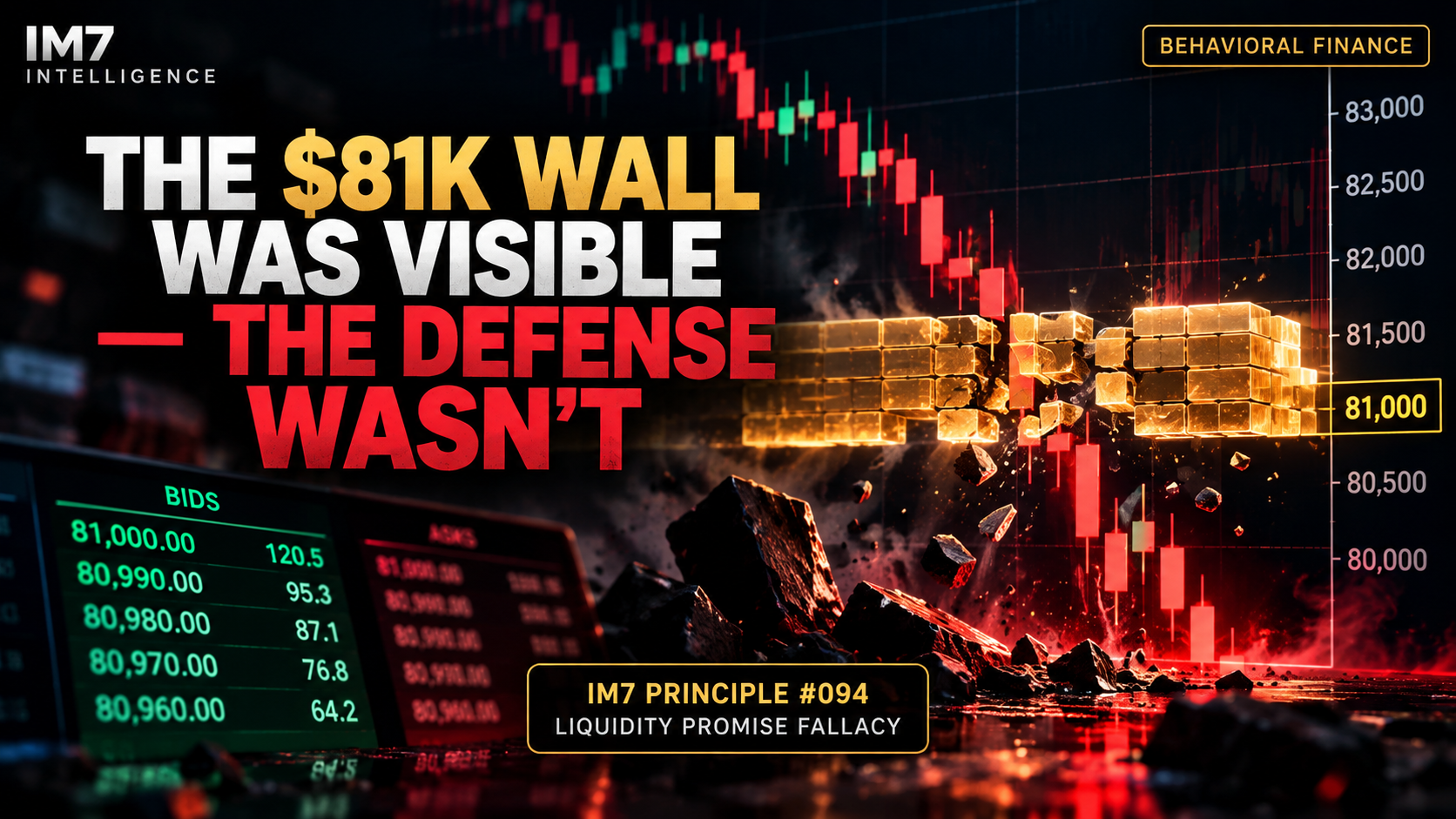
Bitcoin's $81K Buy Wall Looked Safe — Until Price Reached It
AI Generated • IM7 Intelligence
- Reading time
- 4 min read
- Word count
- 904 words
- Published
Bitcoin traded through the highly visible $81K bid wall, exposing a common behavioral error: traders treated resting liquidity as a guaranteed defense. A visible bid can show where buyers might act, but only execution, absorption, and a sustained response reveal whether they actually took control.
Executive Summary
Bitcoin traded through the highly visible $81K bid wall after already losing several levels traders had treated as obvious support. The mistake was not seeing the liquidity — it was converting visible orders into certainty that buyers would defend the level. Resting bids show potential demand, but only execution, absorption, and the market's response reveal whether that demand is strong enough to matter. The next decision should therefore depend on what buyers actually accomplish after contact, not what the order book appeared to promise beforehand.
IM7 Principle
IM7 Principle #094 — Liquidity Promise Fallacy
Visible liquidity shows where orders are currently resting, not where traders are committed to defend price. An order becomes meaningful evidence only when it survives contact, executes, absorbs supply, and produces a measurable market response.
Market Context
Bitcoin entered the session under sustained pressure after losing multiple levels that had previously attracted attention.
$85K failed.
The $82K area failed.
Then attention shifted toward $81K, where visible buy liquidity created a new psychological anchor.
But price continued lower, trading through $81K toward roughly $80.7K.
The important information was not simply that bids existed.
It was what happened when price reached them.
What The Market Wanted You To Believe
"$81K has a huge bid wall. Buyers will defend it."
Visible liquidity feels concrete.
Traders can see the orders.
They can point to the size.
They can compare the wall to surrounding levels.
That visibility creates psychological comfort because uncertainty appears to have been replaced by something measurable.
But a resting order is conditional.
It can execute.
It can move.
It can be reduced.
It can disappear.
And even if every order remains and fills, those buyers can still fail to absorb enough supply to change the market's behavior.
The wall was visible.
Its effectiveness was not.
Behavioral Observation
Watch what happens when traders discover a large, obvious liquidity cluster below price.
The language often changes immediately.
Instead of saying:
"There appear to be buyers around $81K."
The crowd begins saying:
"$81K is the floor."
That is the behavioral shift.
Possibility becomes expectation.
Expectation becomes certainty.
On the chart, Bitcoin moved from around $83K through a sequence of lower candles, lost the $82K region, pushed through $81K, and continued toward approximately $80.7K.
The presence of bids did not independently stop the decline.
The test of the level revealed more than the visibility of the level ever could.
Cognitive Bias Breakdown
This is a form of attribute substitution: replacing a difficult question with an easier one. Kahneman & Frederick, 2002
The difficult question is:
Will buyers absorb enough supply to gain control when price reaches this level?
The easier question is:
Can I see a large amount of buy liquidity sitting there?
Because the second question is observable, traders can unconsciously treat it as an answer to the first.
But visible liquidity, executed liquidity, and market control are three different stages.
A bid wall can exist without being filled.
It can be filled without stopping the decline.
And it can absorb selling temporarily without producing a sustained reclaim.
Seeing the order tells you where interest may exist.
The reaction tells you whether that interest mattered.
The Professional Read
A disciplined operator does not ignore visible liquidity.
They classify it correctly.
A professional may view a large bid cluster as useful information, but not as confirmation.
The sequence matters:
Visible bid: potential liquidity.
Filled bid: execution.
Absorption: buyers successfully taking supply.
Sustained reclaim: evidence that buyers may be gaining control.
Each stage provides stronger information than the one before it.
The mistake is skipping directly from the first stage to the last.
The professional waits for the market to show what those orders actually accomplish.
Decision Framework
When a large bid wall or liquidity cluster becomes visible:
- Identify the liquidity. Know where the orders are resting.
- Do not convert visibility into certainty. The wall is conditional.
- Watch contact. Does the liquidity remain when price reaches it?
- Watch execution. Are the orders actually filled?
- Watch absorption. Does selling slow or continue through the level?
- Watch the response. Can price reclaim and maintain lost territory?
- Judge control last. A visible wall is not the same as buyers controlling the market.
Risk Management Lesson
Visible liquidity can make risk feel smaller before the market has actually reduced it.
That creates a dangerous asymmetry.
The trader becomes more confident because the order book appears to show protection, while the underlying uncertainty remains unresolved.
Position sizing should reflect what buyers have proven — not what traders hope a visible wall will accomplish.
A level can look obvious and still fail.
A wall can look large and still be insufficient.
And a trader can be correct about where buyers are waiting while being wrong about whether those buyers can change the outcome.
IM7 Quote
"The order can be visible before the commitment is real."
IM7 Observation
The $81K wall mattered.
But not because it guaranteed support.
It mattered because it gave the market something observable to test.
Bitcoin traded into that liquidity and continued through the level.
That response provided information the original order book could not.
The buyers were visible.
Their control was not.
IM7 Decision Rule
Treat resting liquidity as conditional until execution and market response prove otherwise.
A visible bid tells you where buyers may act; what happens after contact tells you whether they actually mattered.
How did this land?
What emotion or bias did this article help you recognize?
References
- [1]Kahneman, D. & Frederick, S. (2002). Representativeness Revisited: Attribute Substitution in Intuitive Judgment. Heuristics and Biases: The Psychology of Intuitive Judgment. Cambridge University Press. DOI: 10.1017/CBO9780511808098.004. https://www.cambridge.org/core/books/abs/heuristics-and-biases/representativeness-revisited-attribute-substitution-in-intuitive-judgment/AAB5D933A3F944CFB5CB02265D376C8F
Pass the signal forward.
IM7 Intelligence studies financial markets through the lens of psychology rather than prediction. Our research focuses on behavioral finance, crowd psychology, sentiment, and decision-making to help readers understand why markets move—not just where they move.
IM7 Intelligence publishes educational research on market psychology, behavioral finance, and investor behavior. Nothing published by IM7 Intelligence constitutes financial, investment, tax, or legal advice. Always conduct your own research before making financial decisions.
Read the market's emotion before it acts.
Where this article sits in the map.
- Confirmation BiasYou are here
- Behavioral Finance
- Risk Management
- Fear
Curated paths, not random articles.
Behavior read in real time.

Ismael Mercius
Ismael Mercius is the founder of IM7 Intelligence, where he writes about crypto market psychology, behavioral finance, and the sentiment cycles that drive digital asset prices. His work focuses on how traders actually make decisions — and the recurring errors that show up in their P&L.
- Crypto market psychology
- Behavioral finance
- Market sentiment analysis
- Trader behavior & decision-making