Market Psychology
How emotion, narrative, and crowd behavior move price — before fundamentals catch up.
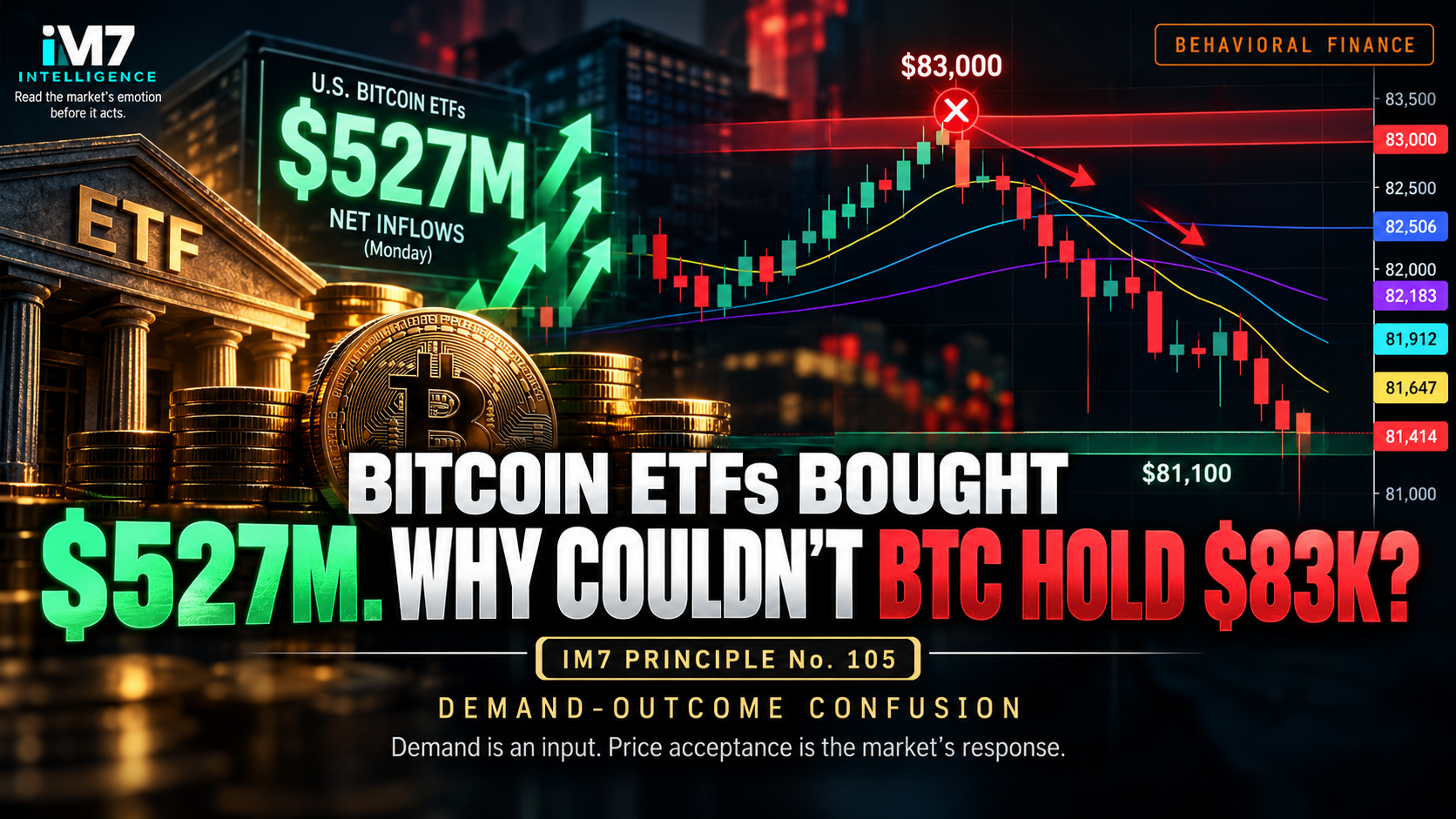
Bitcoin ETFs Bought $527M. Why Couldn't BTC Hold $83K?
Bitcoin ETFs recorded $527 million in net inflows, yet BTC failed to hold $83K. Discover why institutional demand doesn't guarantee price acceptance—and how traders confuse buying pressure with confirmation.
 Market Psychology
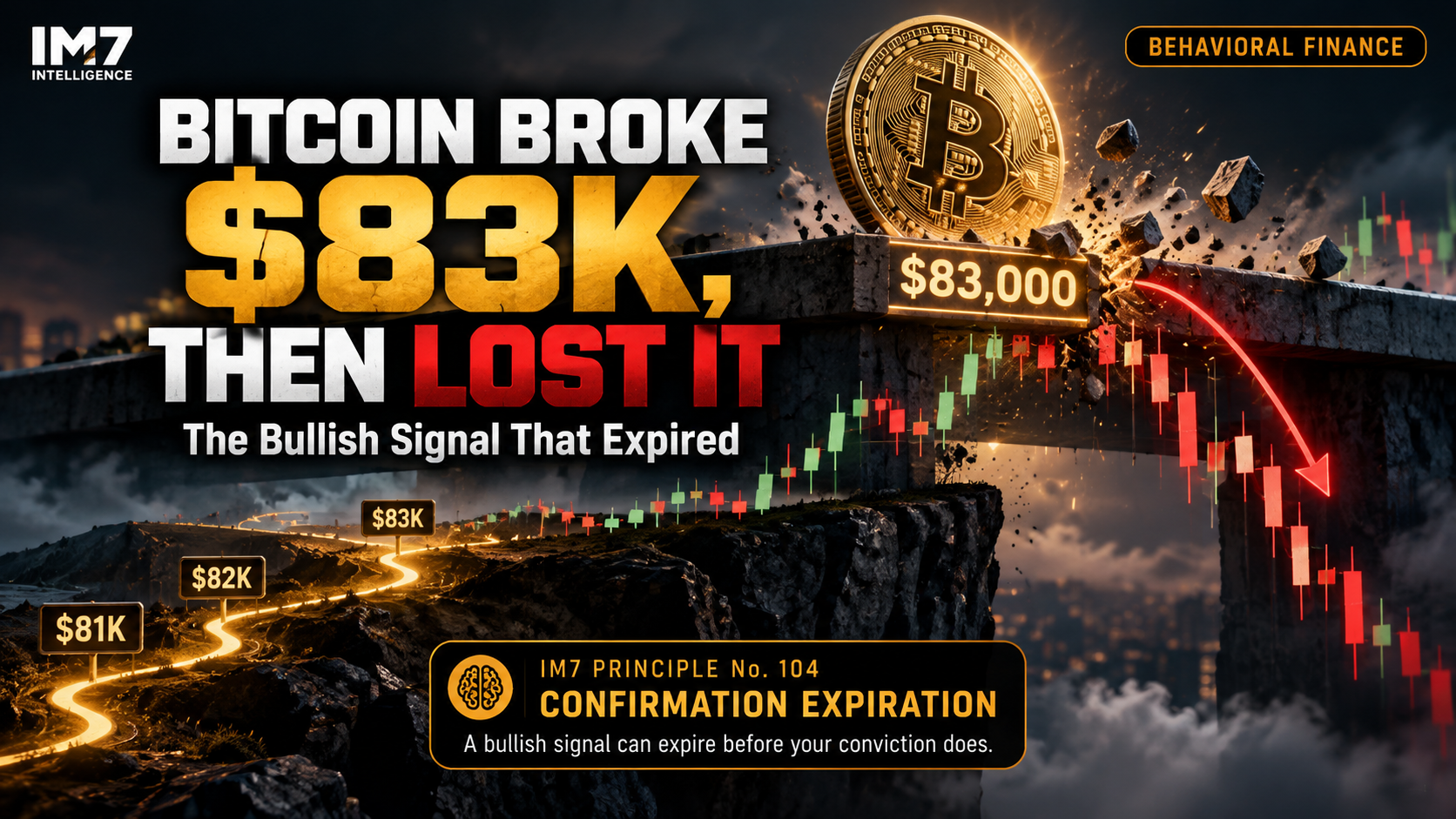
Bitcoin Broke $83K, Then Lost It: The Bullish Signal That Expired
Bitcoin surged above $83,000 before reversing below $82,000, exposing a familiar trading psychology trap: treating the first breakout as lasting confirmation. Here's why bullish signals expire, how conviction outlives evidence, and what BTC must prove next.
Oct 19, 20264 min read Market Psychology
Bitcoin Reclaimed $82K, Then Lost It. What Did Traders Miss?
Bitcoin briefly climbed above $82K before reversing toward $81K, exposing the gap between short-term optimism and broader market structure. IM7 Principle No. 103 explores the Time-Horizon Conflict: why traders mistake a temporary bounce for meaningful recovery before sustained buying and structural confirmation emerge.
Oct 18, 20263 min read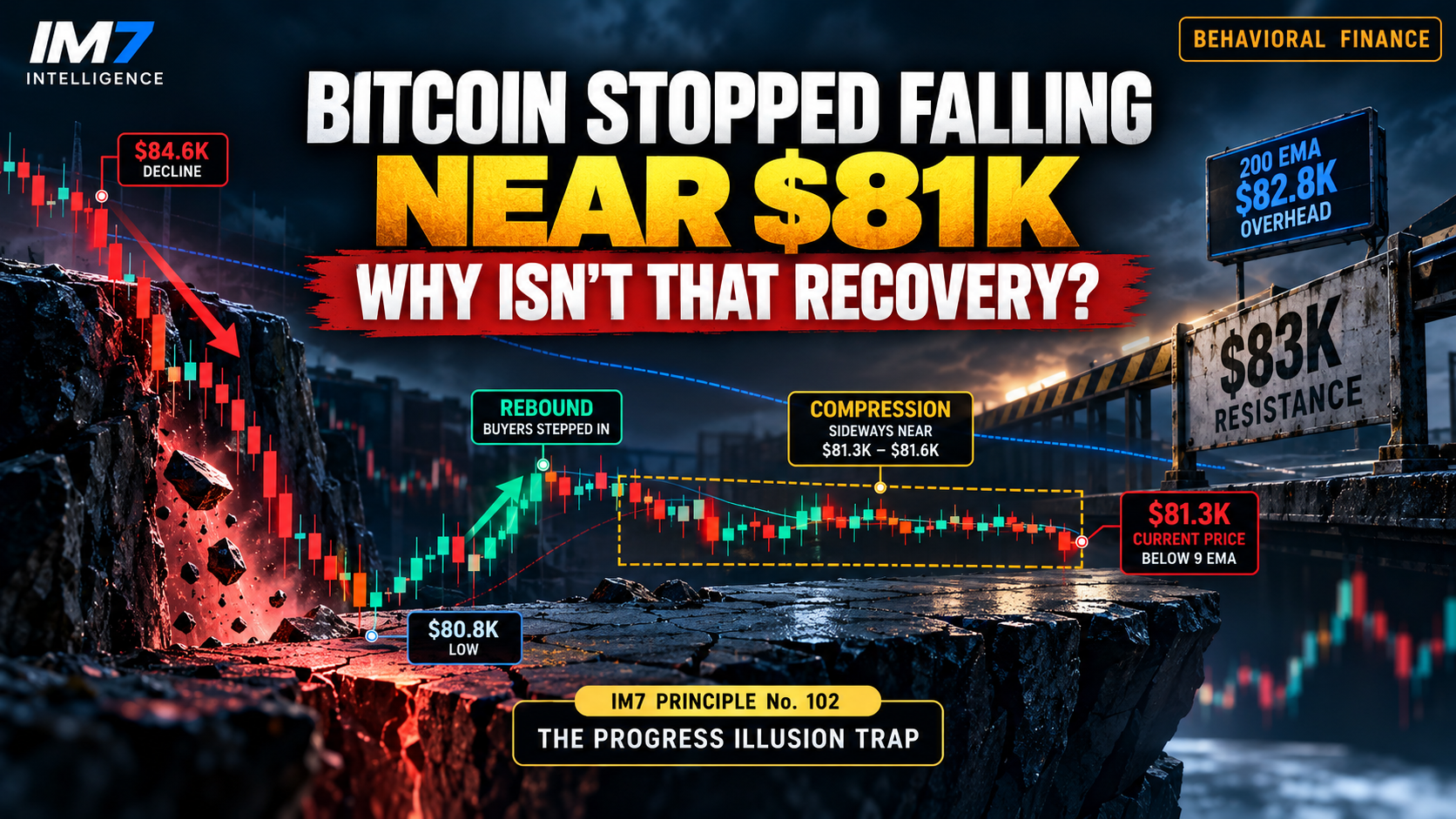 Market Psychology
Bitcoin Stopped Falling Near $81K. Why Isn't That Recovery?
Bitcoin stabilized near $81K after a sharp selloff, but the two-hour chart still showed limited recovery progress beneath key moving averages. IM7 Principle No. 102 explores why traders mistake slowing losses for renewed buying strength—and how to distinguish stabilization from genuine recovery.
Oct 17, 20265 min read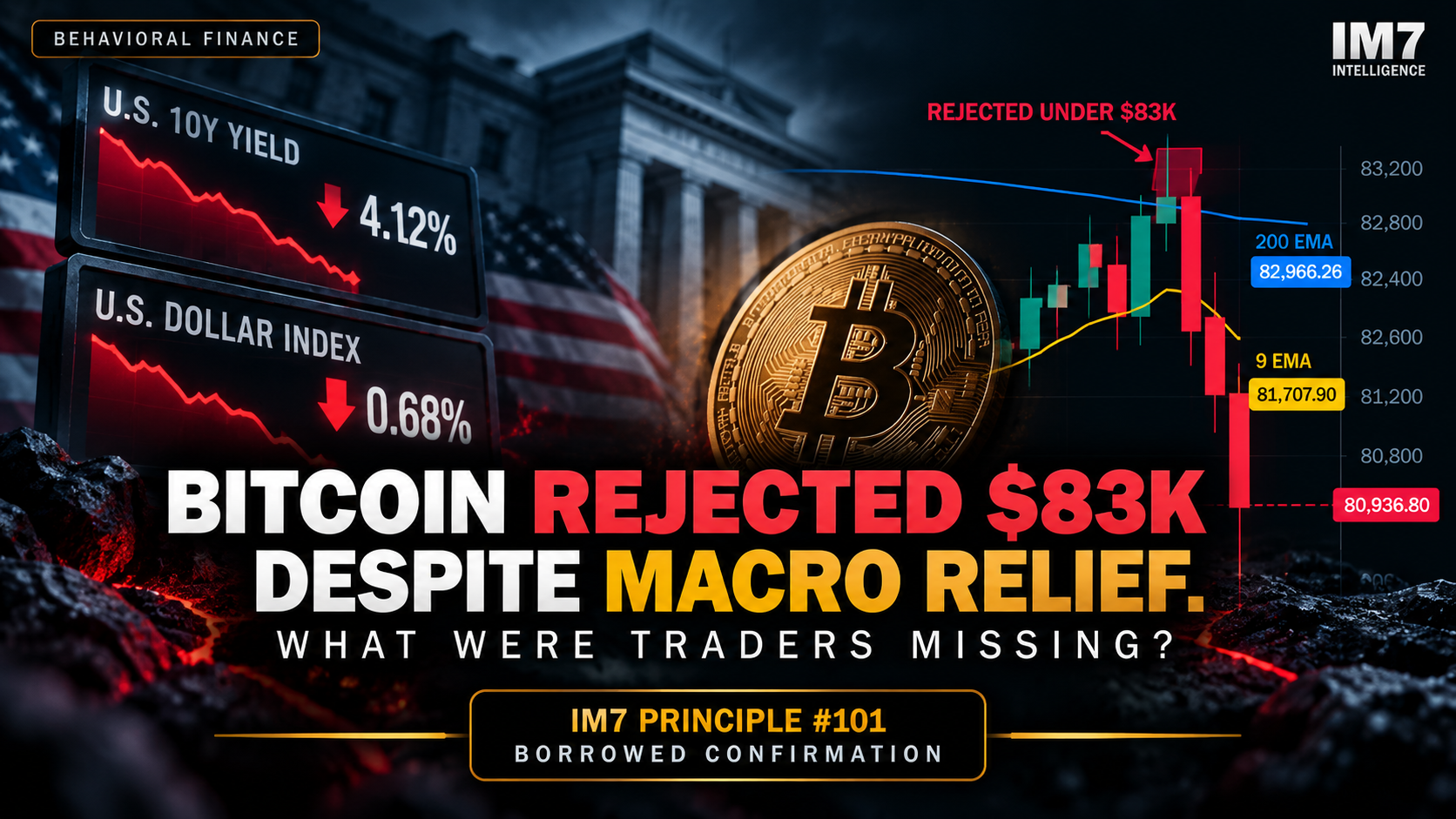 Market Psychology
Bitcoin Rejected $83K Despite Macro Relief. What Were Traders Missing?
Treasury yields and the dollar weakened, yet Bitcoin's recovery stalled beneath $83K before price retreated toward $81K. IM7 Intelligence examines Borrowed Confirmation: the psychological trap of treating favorable signals in one market as proof of demand in another.
Oct 16, 20265 min read Market Psychology
Bitcoin Broke $80K. Why Did Traders Keep Trusting It?
Bitcoin's reported break below $80K challenged a support level traders had repeatedly trusted. A sharp rebound followed, but did buyers return or did forced selling simply end? IM7 Intelligence examines the Support Memory Trap and why familiar price levels can create dangerous confidence.
Oct 15, 20266 min read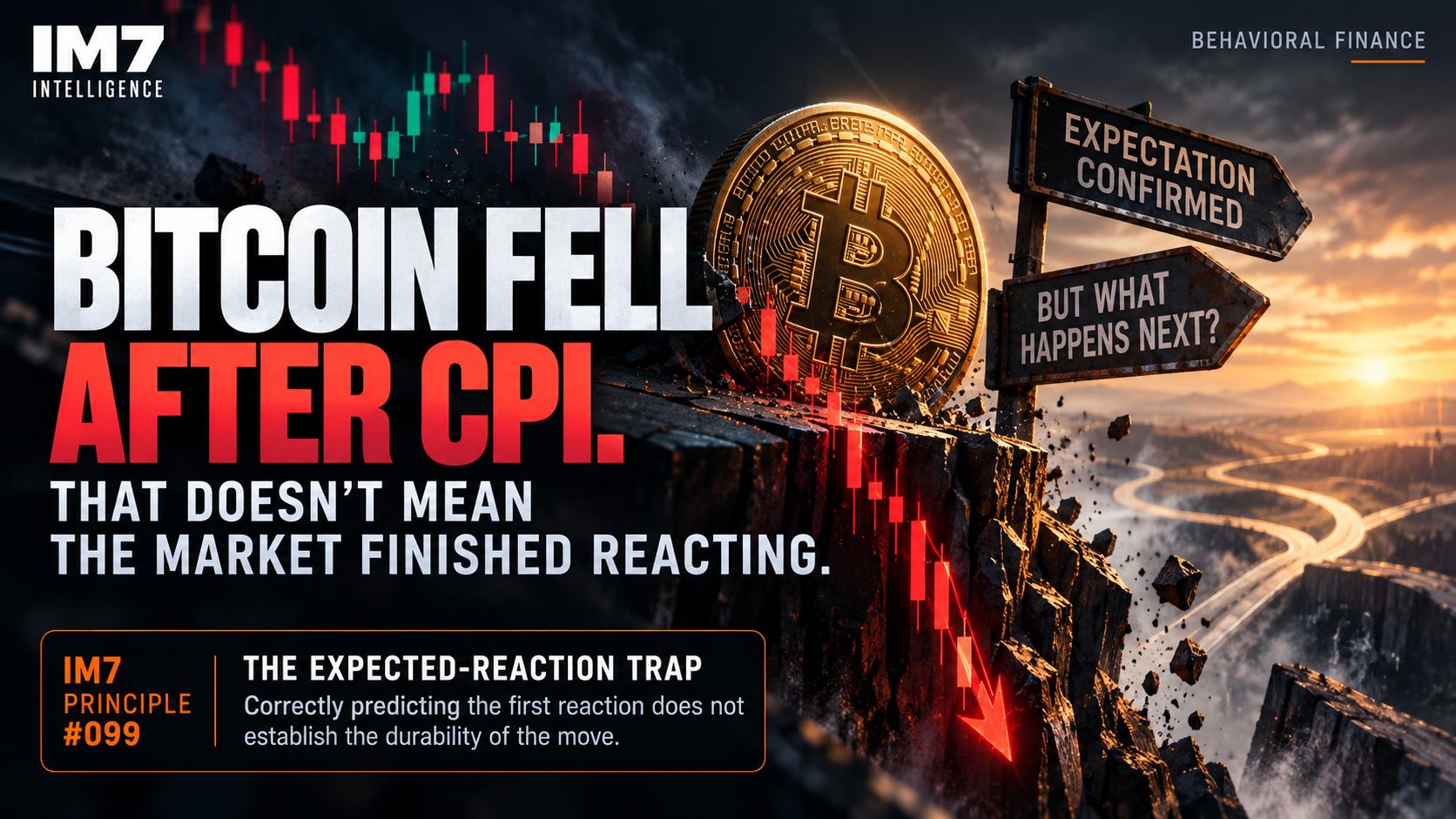 Market Psychology
Bitcoin Fell After CPI. That Doesn't Mean the Market Finished Reacting.
Bitcoin dropped below $82K after hotter-than-expected inflation data rattled financial markets. Traders anticipated the selloff, but correctly predicting the first reaction doesn't prove what happens next. IM7 Intelligence examines the Expected-Reaction Trap and the evidence needed to distinguish an initial CPI shock from lasting seller control.
Oct 14, 20264 min read Market Psychology
Bitcoin Got Macro Relief. Why Didn't Buyers Take Control?
Bitcoin rebounded from the $81K area but stalled near $84K despite easing macro pressure. IM7 Intelligence explores the Relief–Proof Inversion: why reduced selling pressure doesn't automatically create sustained buying demand.
Oct 13, 20265 min read Market Psychology
Bitcoin Traders Hit the Gas and Bought Crash Insurance
Bitcoin rejected $84K, dropped toward $82.3K, and bounced back near $83K. Meanwhile, a derivatives snapshot showed traders adding leveraged exposure as demand for downside protection increased. IM7 Intelligence examines the Conviction–Insurance Split—and why bullish positioning doesn't necessarily mean confidence without fear.
Oct 12, 20267 min read Market Psychology
Bitcoin Bounced Again — Traders Called It Recovery
Bitcoin bounced from roughly $81.4K toward $83.2K, but the move stalled back near $82.5K before reclaiming the levels lost earlier in the week. The behavioral mistake is treating relief from selling as proof that buyers have regained control. Relief describes what stopped happening; recovery requires evidence of what buyers can actually accomplish.
Oct 9, 20264 min read Market Psychology
Bitcoin's $81K Buy Wall Looked Safe — Until Price Reached It
Bitcoin traded through the highly visible $81K bid wall, exposing a common behavioral error: traders treated resting liquidity as a guaranteed defense. A visible bid can show where buyers might act, but only execution, absorption, and a sustained response reveal whether they actually took control.
Oct 8, 20264 min read Market Psychology
Bitcoin Liquidated $550M in Longs — The Bottom Was Assumed
Bitcoin wiped out roughly $550M in long positions, yet the rebound failed to hold $84K. The liquidation removed forced sellers — but traders treated their disappearance as proof that durable buyers had arrived.
Oct 7, 20264 min read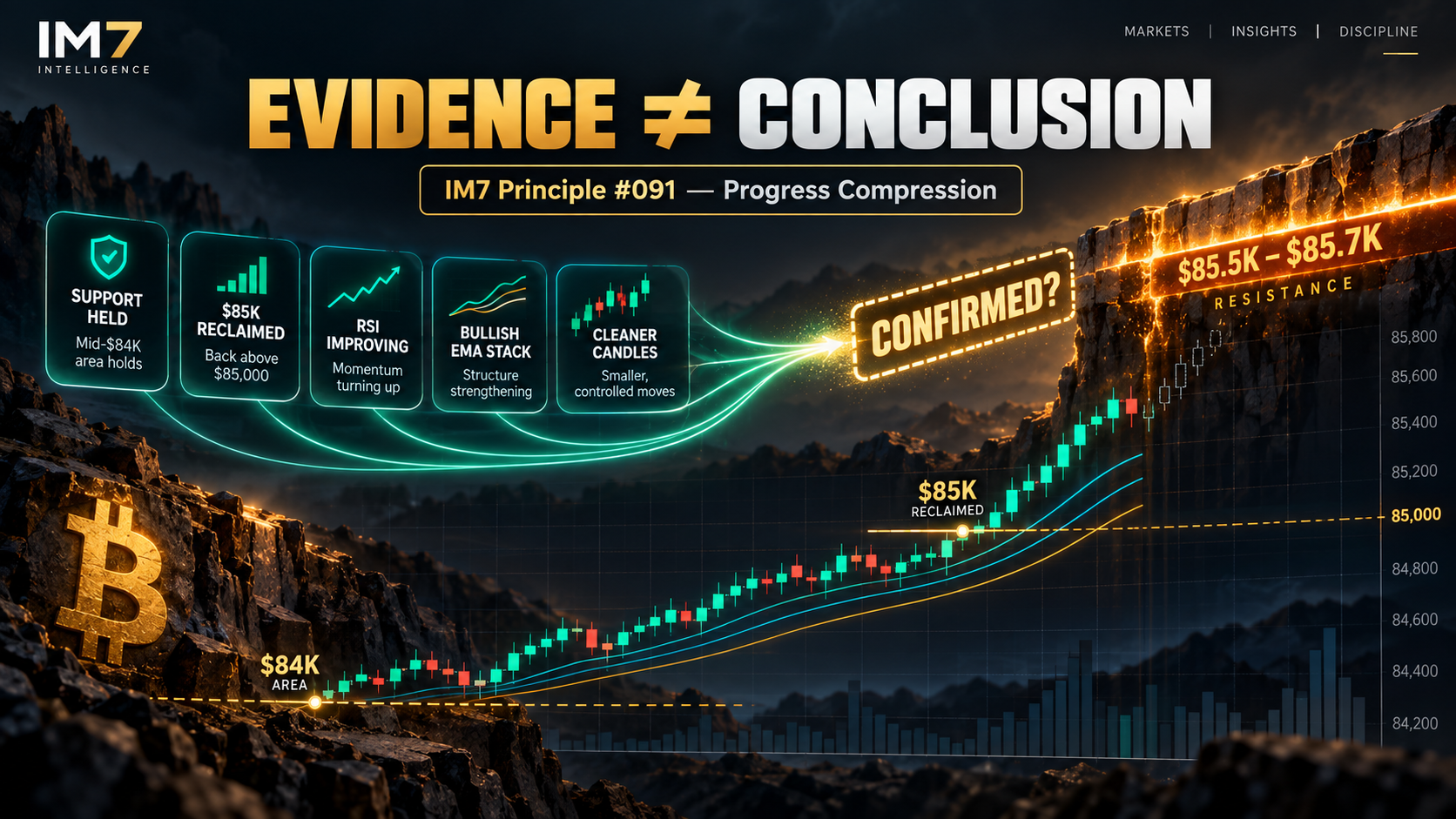 Market Psychology
Bitcoin Improved Everywhere — Except Where It Mattered
Bitcoin reclaimed $85K and continued a controlled recovery, but the prior $85.5K–$85.7K rejection zone remained unresolved. The behavioral trap is Progress Compression: combining several legitimate improvements into one conclusion that the market has not actually earned. Progress can accumulate without confirmation.
Oct 4, 20264 min read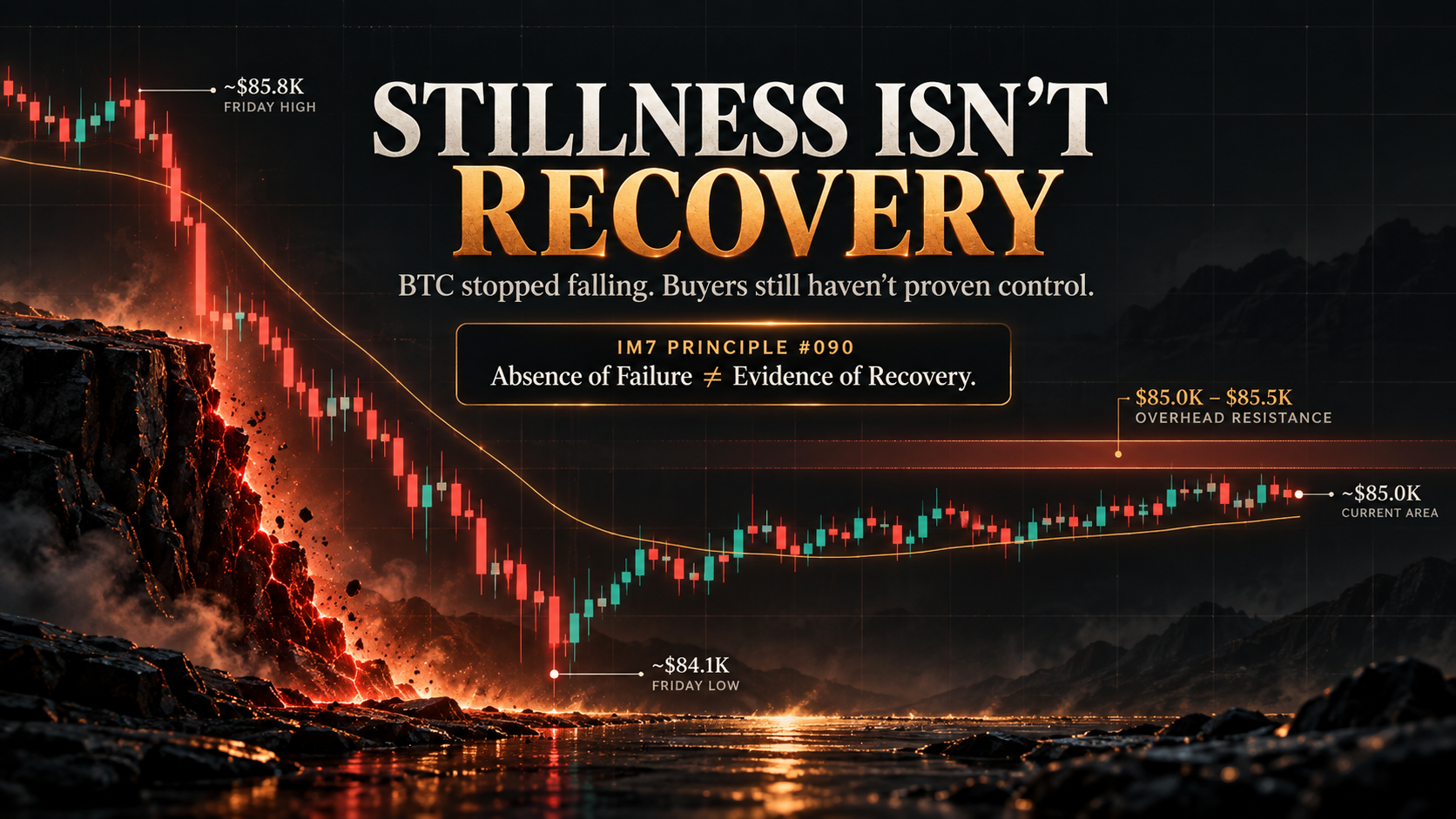 Market Psychology
Bitcoin Stopped Falling — Traders Called It Bullish
Bitcoin stopped falling after Friday’s sharp flush and spent hours stabilizing around the mid-$84K area. The behavioral trap is treating the absence of further downside as proof that buyers have regained control. Calm can reduce uncertainty without confirming recovery.
Oct 3, 20264 min read Market Psychology
Bitcoin Finally Gave Traders Proof — Then Made Them Pay for It
Bitcoin broke through the level traders had been watching and pushed toward $87K, only to pull back sharply afterward. The behavioral trap is Proof-Chasing: traders often wait for the market to look obvious before acting, then confuse confirmation with urgency. Proof should improve confidence — not make the decision more expensive.
Oct 2, 20264 min read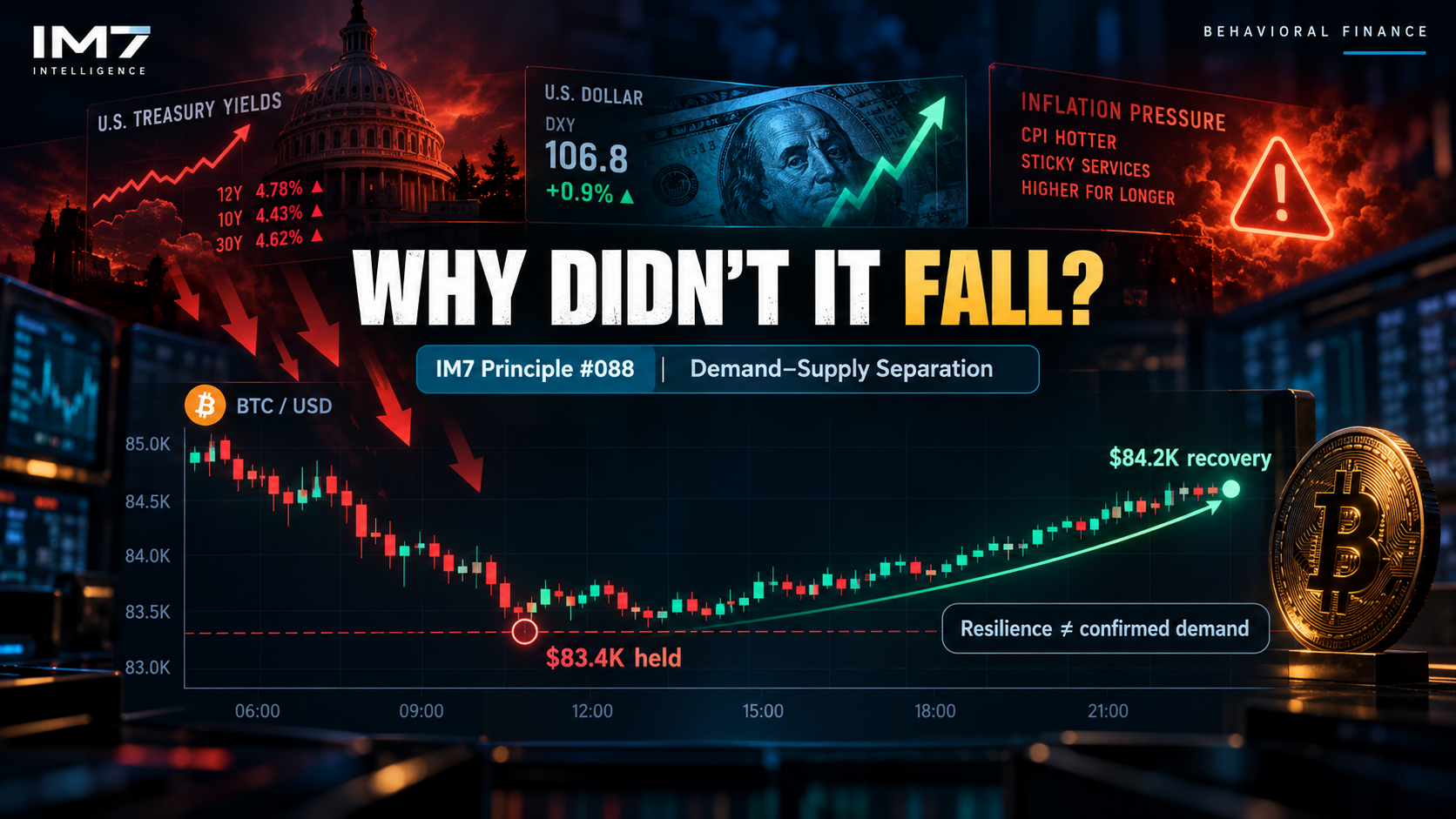 Market Psychology
Bitcoin Had Every Reason to Fall — So Why Didn’t It?
Bitcoin faced a hostile macro backdrop — higher Treasury yields, stronger economic data, and a firmer dollar — yet price refused to break lower. The behavioral trap is assuming that “not falling” automatically means buyers are in control. Sometimes resilience reflects real demand; other times it simply means sellers are absent.
Oct 1, 20265 min read Market Psychology
Bitcoin Got Good News — Then Gave Half the Move Back
Bitcoin broke higher after cooler PCE data, then quickly gave back a large part of the move. The behavioral mistake was treating one resolved uncertainty as full confirmation. Good news can justify a breakout without proving the market will accept higher prices.
Sep 30, 20266 min read Market Psychology
Bitcoin Spent Hours Rallying — One Candle Erased Almost All of It
Bitcoin rallied above $84K, then gave back nearly the entire move in one 2-hour candle. The lesson wasn’t about direction — it was about conviction quality. Traders often let fast price movement strengthen their confidence before the evidence actually improves.
Sep 29, 20265 min read Market Psychology
Bitcoin Bounced From $82.6K—But a Correct Thesis Still Became a Bad Trade
Bitcoin’s bounce from $82.6K exposed a distinction traders often learn too late: a correct market thesis cannot rescue poor entry, excessive leverage, or weak position sizing. The first bounce showed relief. The retest will reveal whether buyers actually returned.
Sep 28, 20266 min read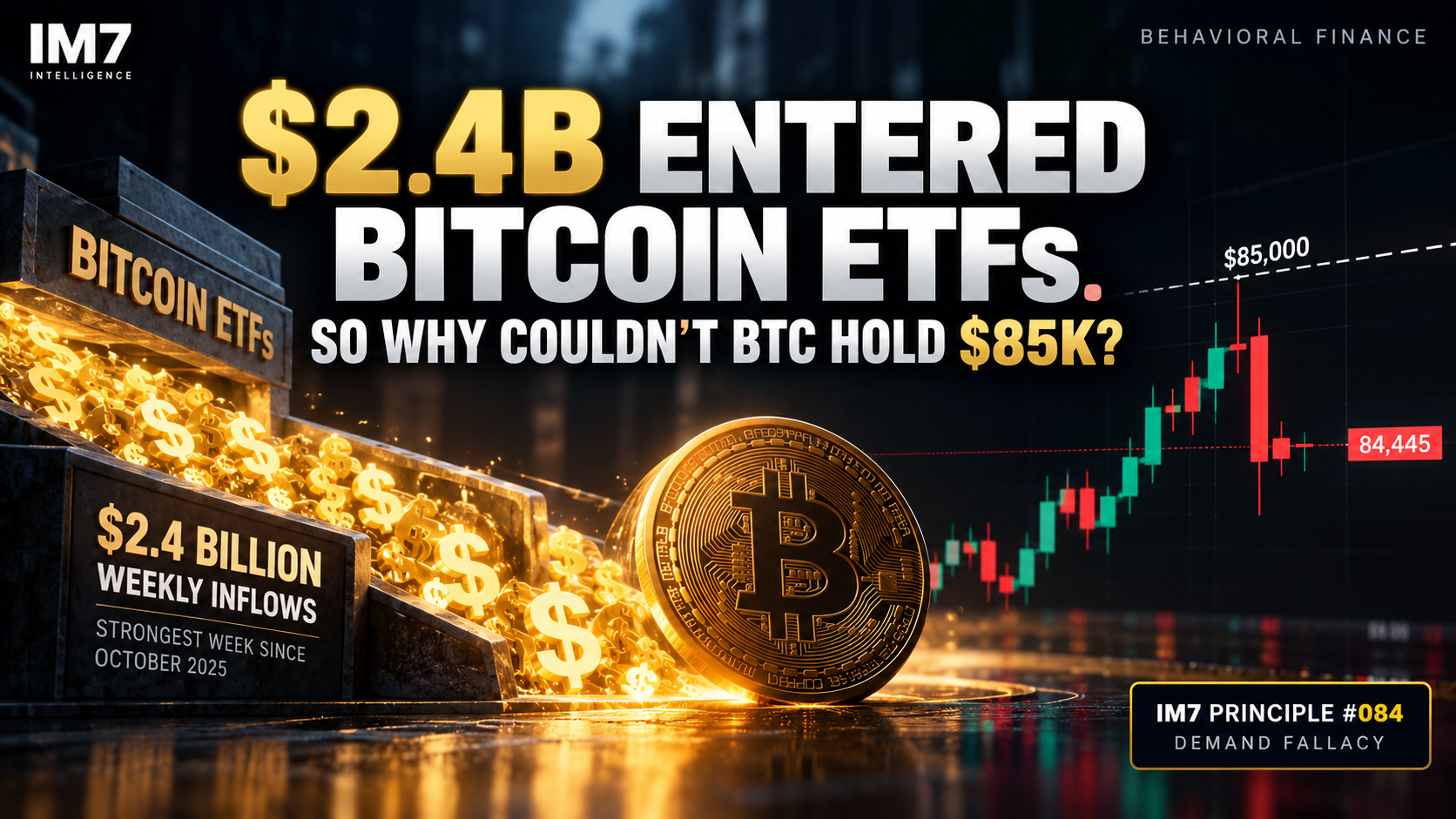 Market Psychology
$2.4B Flowed Into Bitcoin ETFs. So Why Couldn't Bitcoin Hold $85K?
U.S. spot Bitcoin ETFs attracted roughly $2.4 billion in net inflows during the week, yet Bitcoin failed to sustain its move through $85K. Demand Fallacy explains why traders can mistake the size of buying pressure for proof of the market outcome instead of asking whether that demand actually changed price behavior.
Sep 27, 20265 min read Market Psychology
You’re Still Trading Monday’s Evidence. It’s Saturday.
Bitcoin gave traders powerful evidence earlier this week. But markets keep producing new information after a thesis is formed. Evidence Has a Half-Life explains what happens when traders keep giving old evidence the same weight while newer evidence is telling them to update.
Sep 26, 20265 min read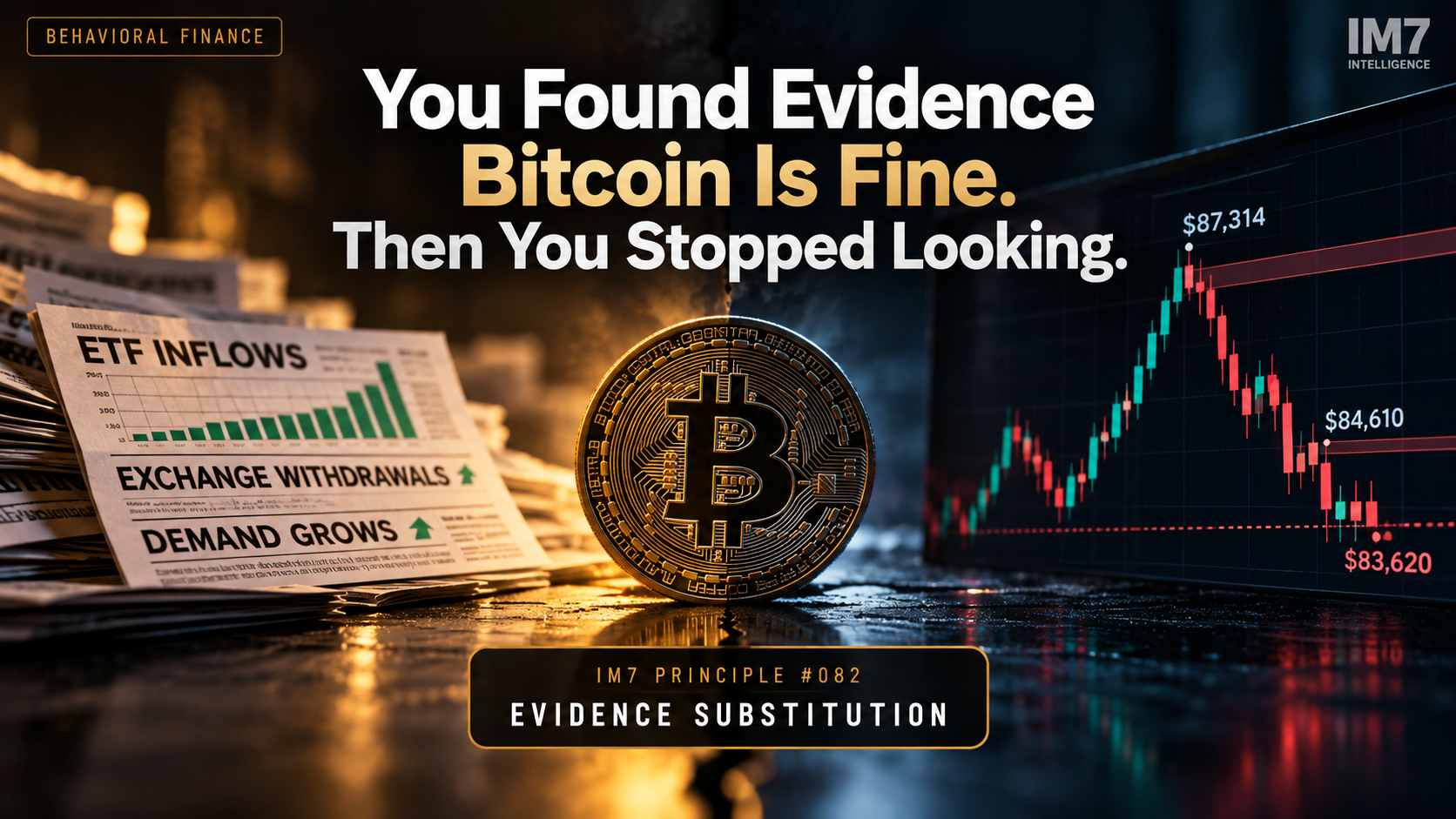 Market Psychology
You Found Evidence Bitcoin Is Fine. Then You Stopped Looking.
Bitcoin traders have real evidence supporting both sides of the current debate. The behavioral mistake begins when supporting evidence becomes a reason to stop looking. Evidence Substitution explains why evidence that agrees with your position is not the same as evidence that the market has confirmed it.
Sep 25, 20265 min read Market Psychology
Bitcoin Stopped Falling. You Called It a Recovery.
IM7 Principle #081 — Relief Is Not Recovery
Sep 24, 20264 min read Market Psychology
You Got the Confirmation. Then One Pullback Made You Doubt It.
Bitcoin delivered the confirmation traders demanded, but the first uncomfortable pullback quickly changed how that evidence felt. Confirmation Fragility explains why traders often trust evidence only while price continues rewarding them—and mistake discomfort for invalidation.
Sep 23, 20263 min read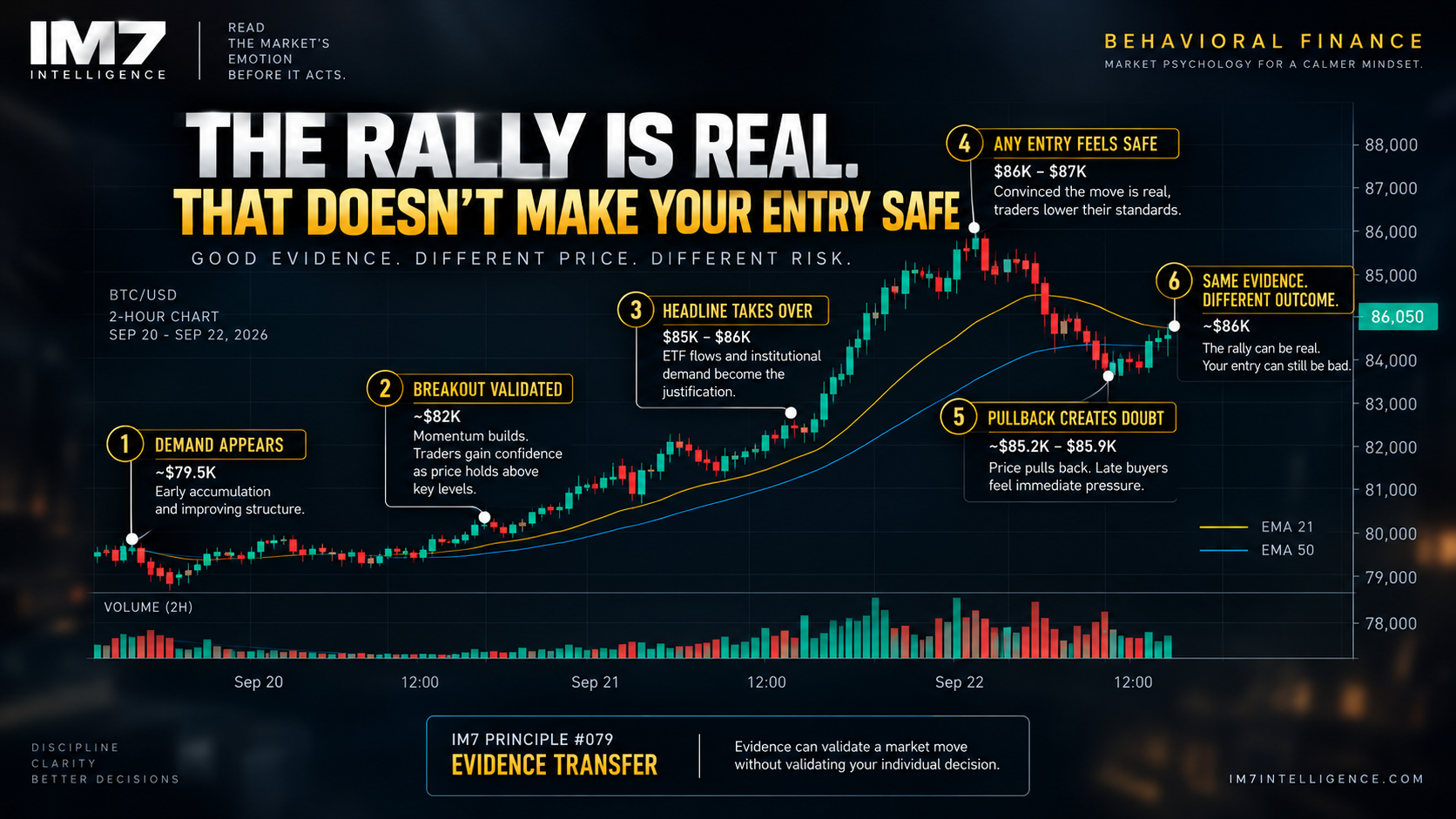 Market Psychology
The Rally Is Real. That Doesn’t Make Your $86K Entry Safe.
Bitcoin’s rally has real evidence behind it, including strong ETF demand. But evidence that validates the move does not automatically validate a late entry. Traders get into trouble when they transfer confidence in the market to confidence in the price they are paying.
Sep 22, 20264 min read Market Psychology
You Needed Proof at $76K. At $86K, You Stopped Asking.
Bitcoin climbed from $76K toward $86K, but something changed faster than price: traders’ standards for confirmation. The higher Bitcoin went, the less proof they demanded. That isn’t greater certainty. It’s confirmation giving way to fear of missing out.
Sep 21, 20264 min read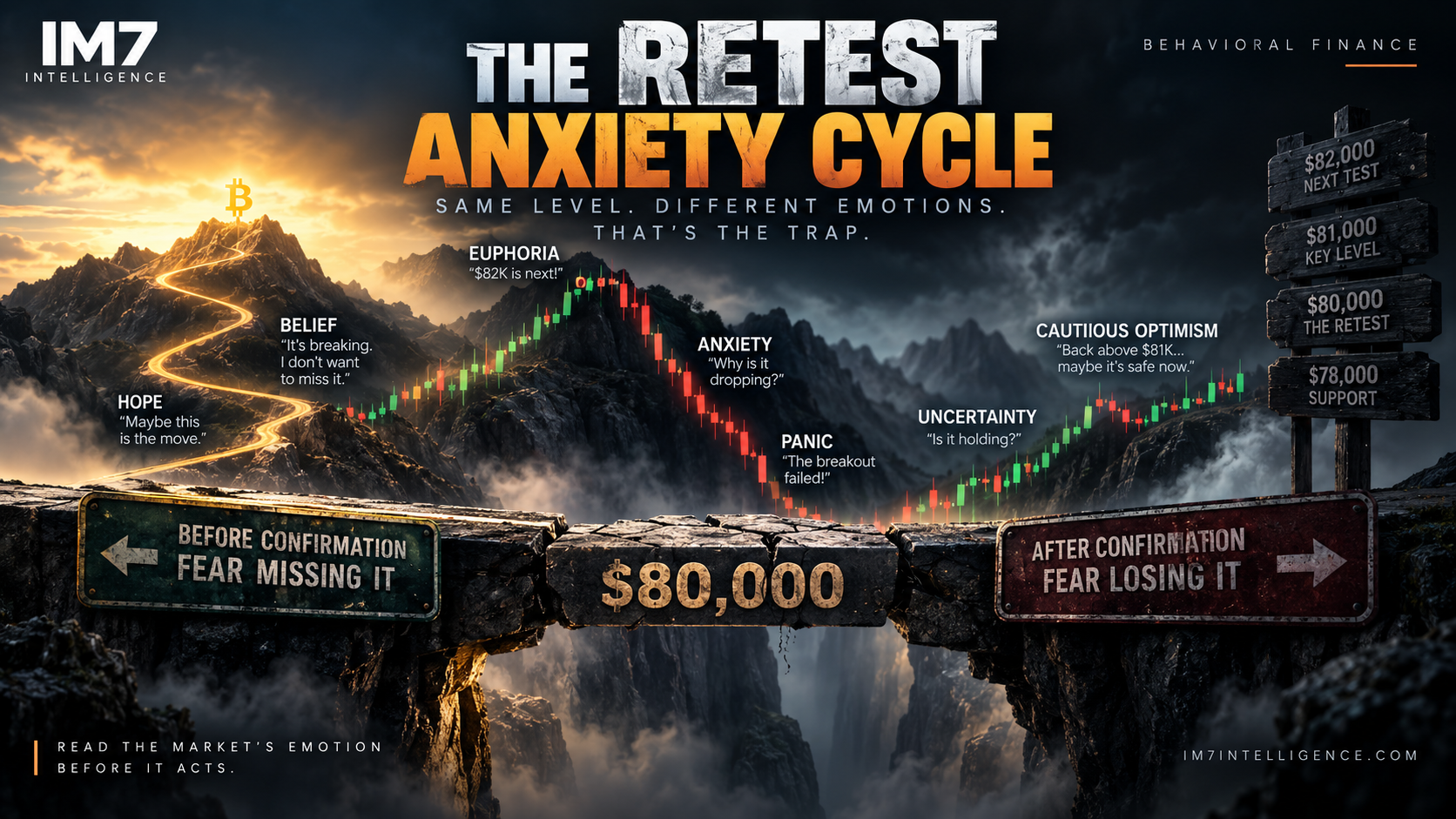 Market Psychology
Bitcoin Retests $80K: When Discomfort Feels Like Invalidation
Bitcoin pulled back toward $80K after advancing toward $82K, then recovered above $81K. The Retest Anxiety Trap begins when traders mistake the discomfort of renewed uncertainty for evidence that the breakout has failed.
Sep 20, 20266 min read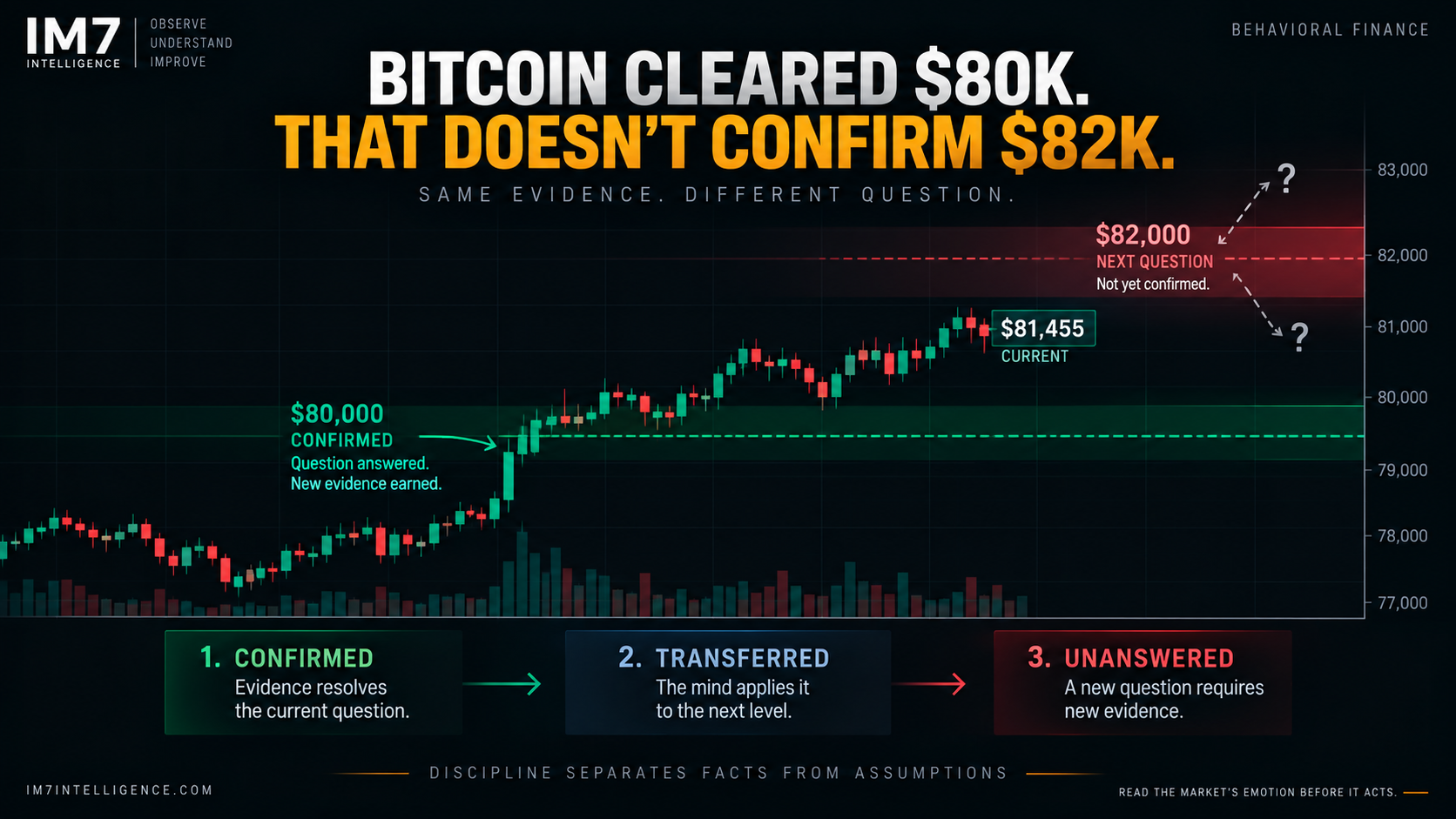 Market Psychology
Bitcoin Cleared $80K. That Doesn't Confirm $82K.
Bitcoin cleared $80K and continued toward $81.5K, giving traders meaningful new evidence. But confirmation at one level does not automatically confirm the next. Confirmation Transfer occurs when traders take evidence that resolved yesterday’s uncertainty and mistakenly apply it to tomorrow’s unanswered question.
Sep 19, 20267 min read Market Psychology
Bitcoin Breaks $80K as ETF Flows Flip Positive
Bitcoin surged through $80K as U.S. spot Bitcoin ETF flows flipped from $295.9 million of net outflows to $159.5 million of net inflows. The move matters because the evidence around price changed too: institutional demand improved while Bitcoin pushed into a new short-term range. The behavioral lesson is simple — when the evidence changes, the market story should be allowed to change with it.
Sep 18, 20266 min read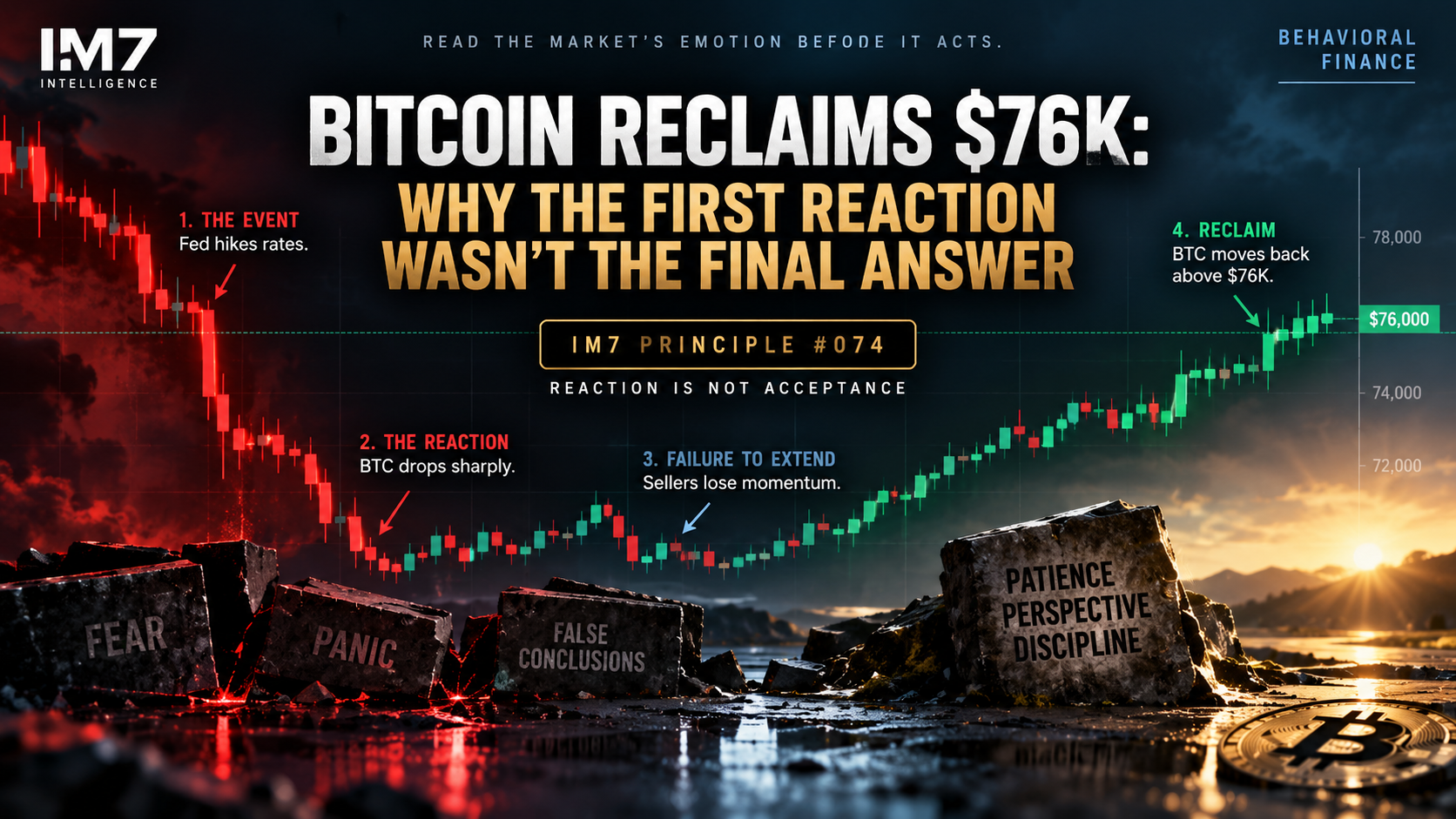 Market Psychology
Bitcoin Reclaims $76K: Why the First Reaction Wasn't the Final Answer
Bitcoin dropped after the Fed decision, giving traders an immediate bearish story to believe. But price later reclaimed the $76K area. The behavioral mistake isn't reacting to new information — it's treating the first reaction as the market's final conclusion. This is why reaction should never be confused with acceptance.
Sep 17, 20264 min read Market Psychology
Bitcoin Below $76K: When Your Belief Outlives the Level
Bitcoin broke below the $76K area after repeated defenses had trained traders to trust the level. Now the behavioral risk changes: instead of questioning the old belief, traders may interpret every bounce as evidence that the familiar floor is returning. This is how a market thesis can survive after the evidence that created it has changed.
Sep 16, 20265 min read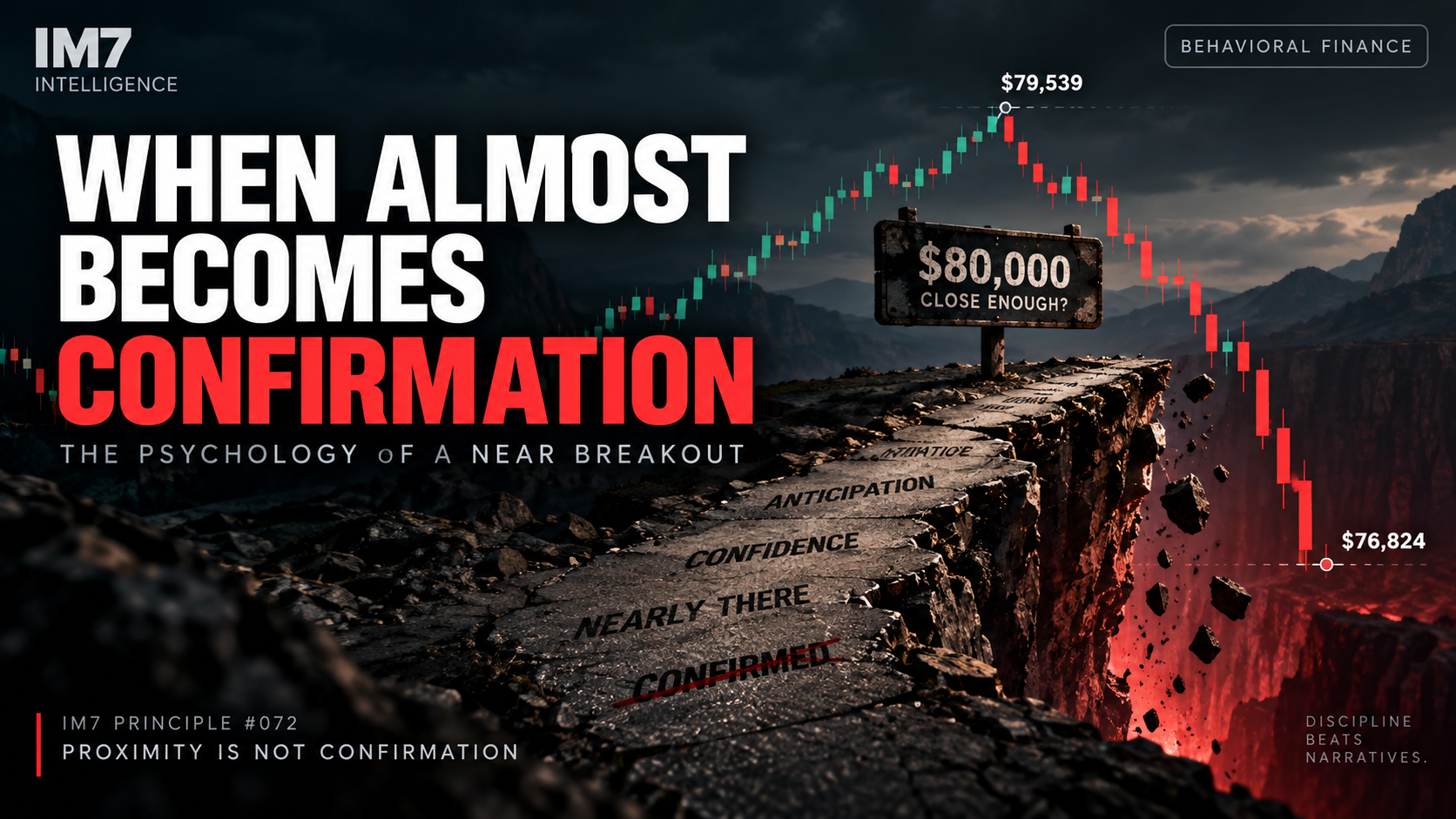 Market Psychology
Bitcoin Near $80K: When Almost Becomes Confirmation
Bitcoin pushed toward $80K before reversing back below $77K. The behavioral mistake happened before the decline: traders began treating proximity as confirmation. When “almost there” becomes “good enough” in the mind, anticipation quietly replaces evidence.
Sep 15, 20265 min read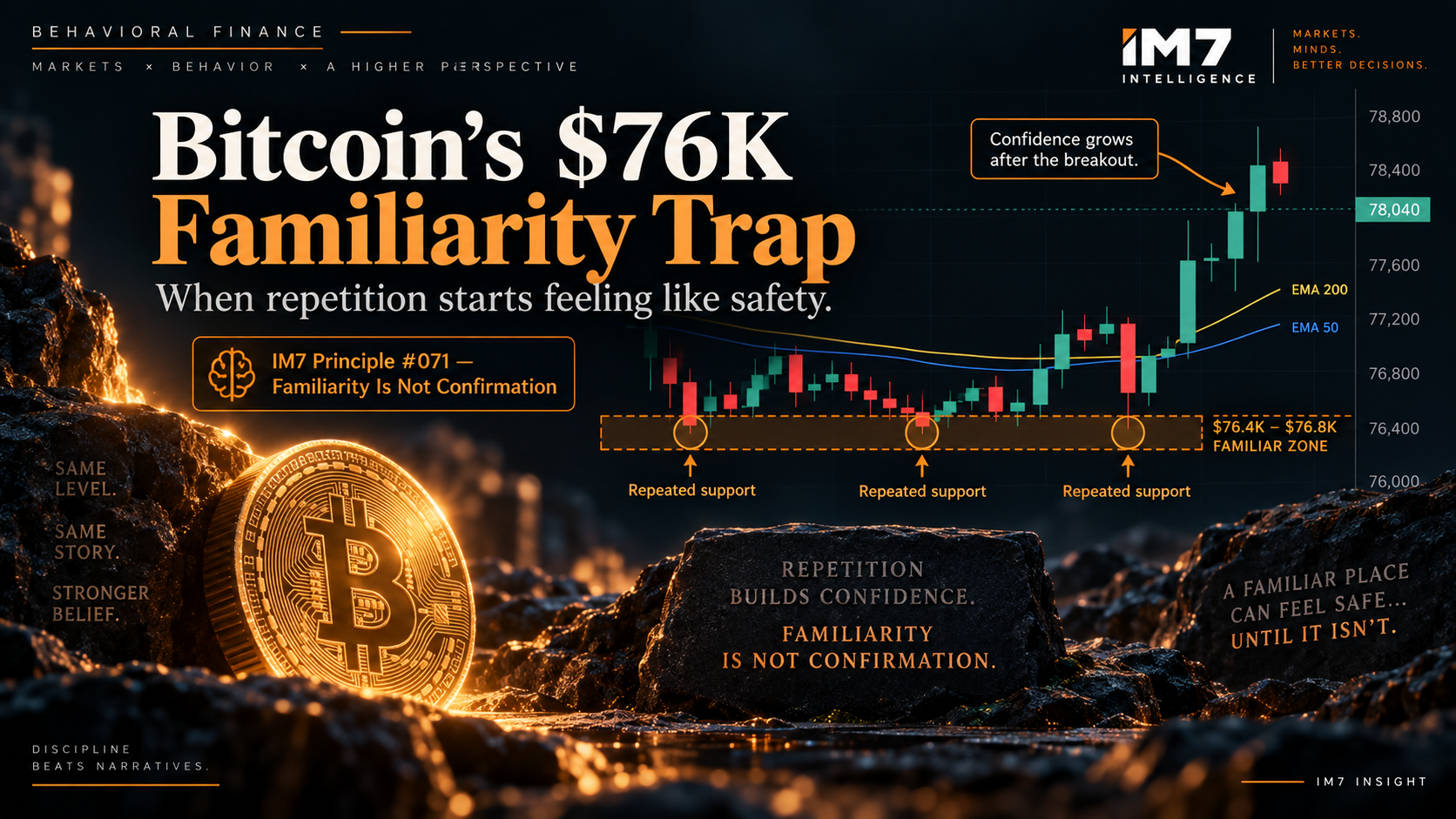 Market Psychology
Bitcoin’s $76K Familiarity Trap: When Repetition Starts Feeling Like Safety
Bitcoin has defended the $76K area repeatedly, and each successful bounce makes traders more confident that the level is “safe.” But repetition can create false certainty. This article breaks down the familiarity trap behind repeated support tests and why a streak should never be mistaken for a rule.
Sep 14, 20264 min read Market Psychology
Bitcoin Below $77K: When Weekend Silence Looked Like Safety
Bitcoin’s quiet weekend encouraged traders to believe the escalating oil and shipping risks had already been absorbed. But with major traditional markets closed, the silence reflected incomplete participation—not confirmed resilience.
Sep 13, 20265 min read Market Psychology
Bitcoin ETF Outflows: Four Red Days Didn’t Carry Equal Weight
Bitcoin ETFs recorded four consecutive outflow days, but the final outflow collapsed to just $13.2 million after a $282.7 million withdrawal. The streak looked increasingly bearish while the force behind it was sharply fading—revealing why direction without magnitude can mislead traders.
Sep 12, 20265 min read Market Psychology
Bitcoin Rallied After Hot CPI: When Bad News Stops Working
Hot CPI, rising yields, and higher rate-hike odds appeared bearish for Bitcoin—yet BTC reversed its initial flush and reclaimed $79K. The reaction exposed the danger of trading a headline without watching whether price continues to obey it.
Sep 11, 20264 min read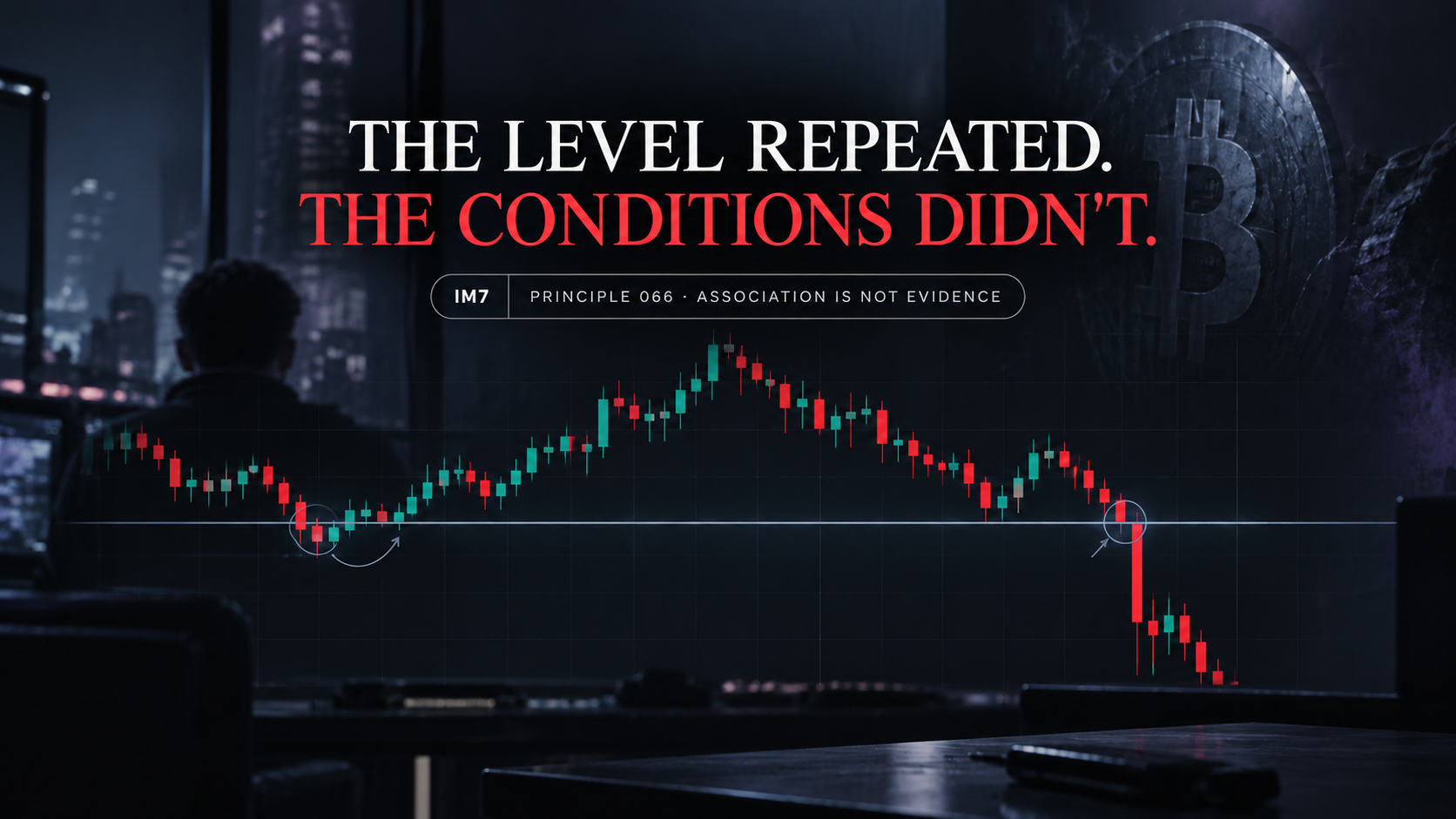 Market Psychology
Bitcoin’s $77.3K Breakdown: The Level Repeated, the Conditions Didn’t
Bitcoin broke $77.3K after holding the same zone the day before, exposing the danger of trusting a level without checking what changed underneath it.
Sep 10, 20263 min read Market Psychology
Broken Isn’t Accepted: How Bitcoin Trapped Breakdown Traders
Bitcoin swept below support near $77.56K, prompting traders to call for a deeper breakdown. When price reclaimed $79K, the move revealed a critical distinction: a level can be broken without being accepted. This is how certainty traps traders on both sides of a failed breakdown.
Sep 9, 20263 min read Market Psychology
Support Felt Certain: How Repeated Tests Trapped Bitcoin Bulls
Bitcoin repeatedly defended $78K until traders began treating support as inevitable. When oil approached $100 and macro pressure intensified, that confidence became vulnerable—revealing how repetition creates false certainty before structure actually confirms it.
Sep 8, 20265 min read Market Psychology
Bitcoin Wasn’t Hacked: How the $320M Liquid Incident Triggered Category Contagion
A $320 million security incident involving Liquid Network sparked misleading “Bitcoin hack” reactions. The event reveals how category contagion causes traders to transfer fear from adjacent infrastructure to Bitcoin itself.
Sep 7, 20263 min read Market Psychology
$1B Came In. Bitcoin Still Dropped $2K.
Nearly $1 billion in recent Bitcoin ETF inflows did not prevent a sharp $2,000 decline. The behavioral trap is the Institutional Safety Illusion: visible institutional demand can make downside feel more protected than the evidence justifies.
Sep 6, 20264 min read Market Psychology
Bitcoin Changed $2,000. Trader Certainty Changed Everything.
Bitcoin went from “breakout confirmed” above $81K to “breakout failed” near $79K in less than a day. The deeper behavioral signal is how quickly one jobs report and one large red candle overrode the market thesis traders had just formed.
Sep 5, 20263 min read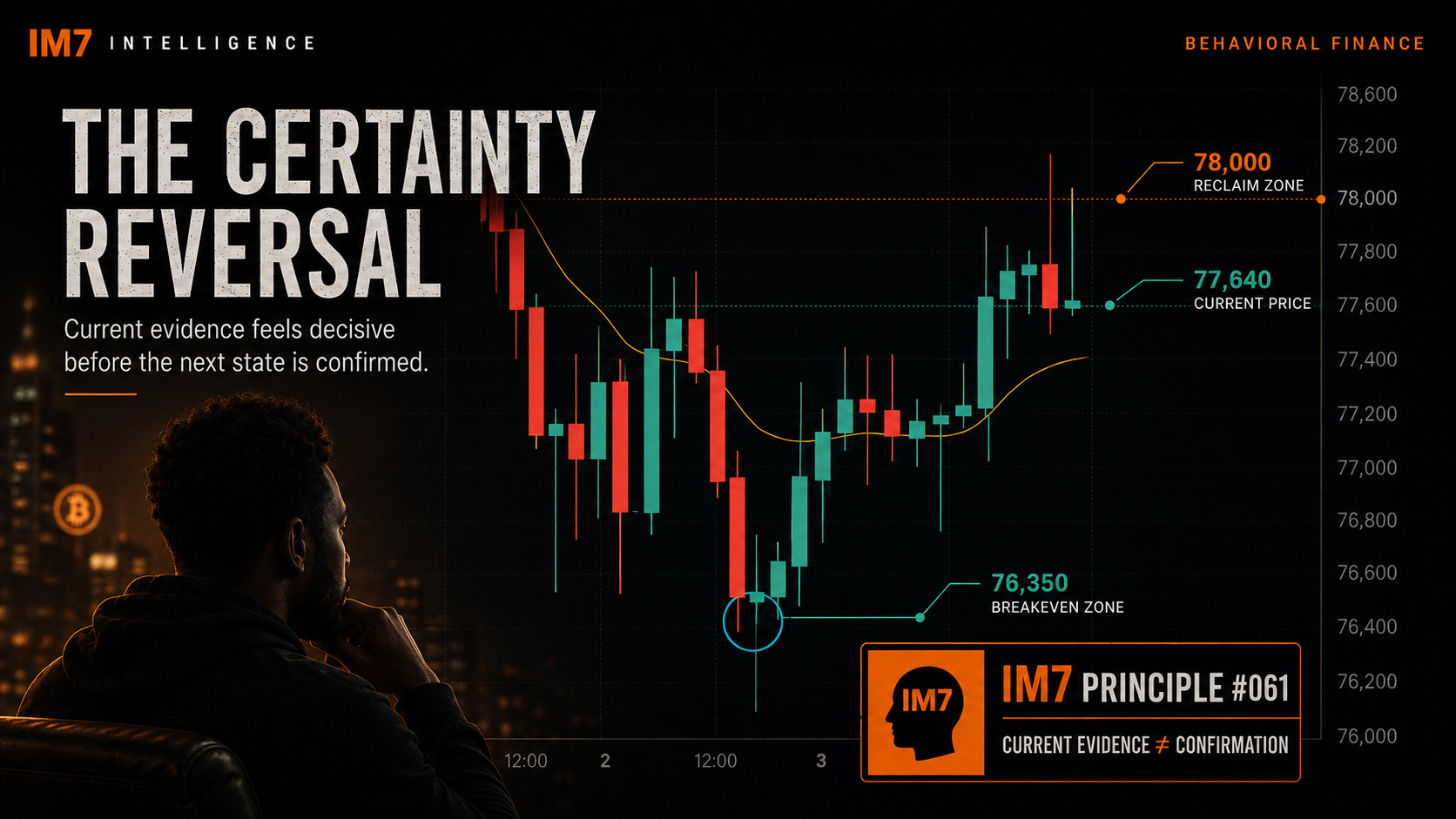 Market Psychology
Yesterday Bears Were Certain. Today Bulls Are.
Bitcoin bounced from roughly $76.35K toward $77.64K after yesterday’s breakdown. The bigger behavioral risk is how quickly traders convert each new move into certainty about what comes next.
Sep 3, 20263 min read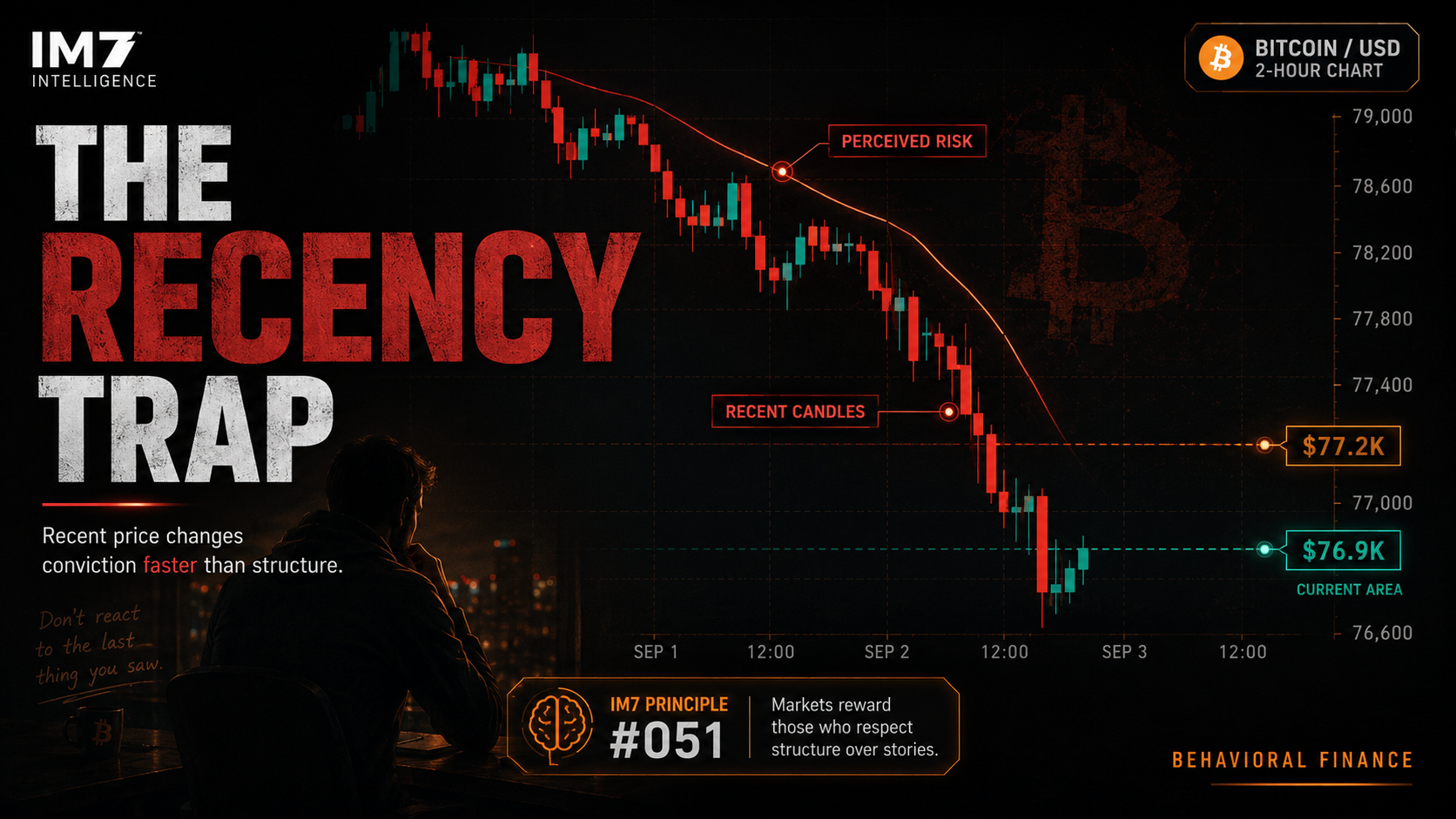 Market Psychology
Why Bitcoin Felt Safe at $80K and Dangerous at $76K
Bitcoin fell from the upper-$78K range toward $76.9K, and trader perception shifted with it. IM7 examines the Bitcoin Recency Loop: how recent candles change perceived risk faster than market structure actually changes.
Sep 2, 20263 min read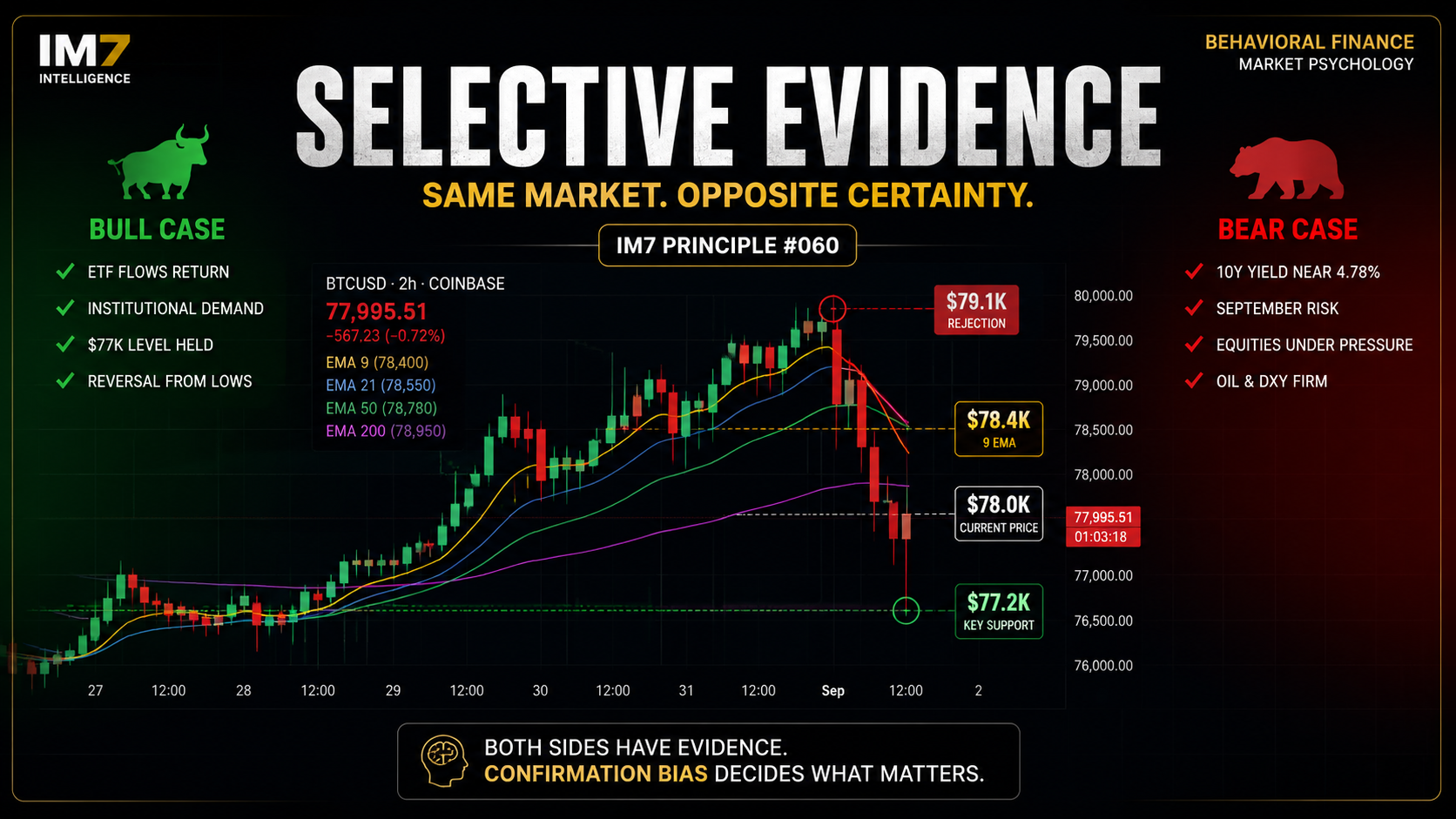 Market Psychology
Bitcoin Gave Bulls and Bears Evidence. Both Used It Wrong.
Bitcoin is caught between bullish ETF demand and a worsening macro backdrop. The bigger behavioral risk is not choosing the wrong side — it is selectively using evidence to defend the side you already believe.
Sep 1, 20263 min read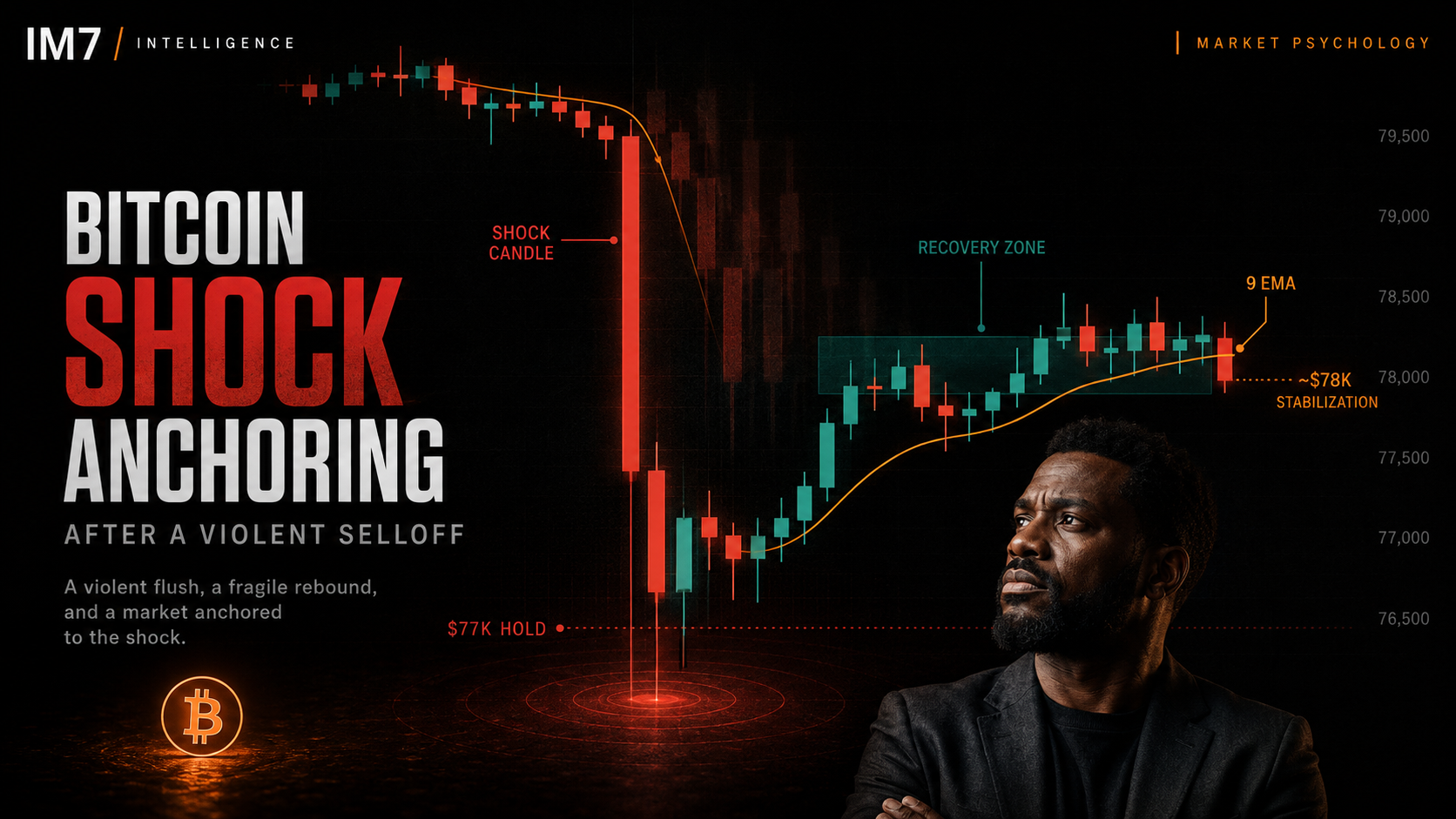 Market Psychology
The Shock Anchor: Why Bitcoin Traders Keep Trading the Crash After It Ends
Bitcoin’s violent selloff may be over, but traders can remain psychologically anchored to the shock candle long after price enters a new phase. IM7 examines why recent fear can distort how every bounce and consolidation is interpreted.
Aug 30, 20263 min read Market Psychology
The Recency Reset: Why Bitcoin Traders Flip Their Entire Thesis After One Selloff
A single sharp adverse move can trigger a psychological shock that causes traders to abandon a higher-timeframe thesis too quickly. IM7 examines how recency bias turns one Bitcoin selloff into a complete rewrite of market conviction.
Aug 29, 202610 min read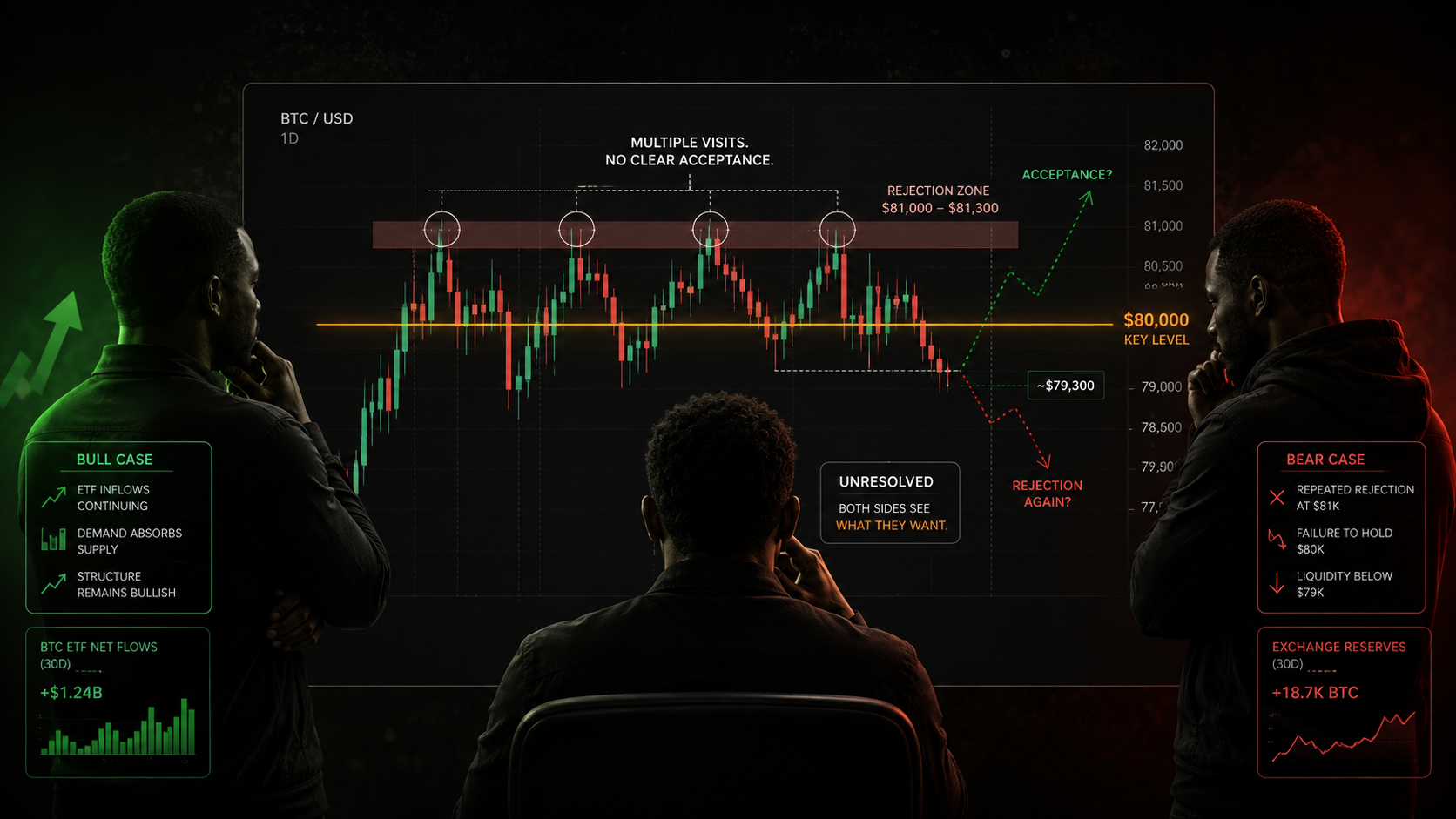 Market Psychology
The Confirmation Bias Trap: Why Bulls and Bears See Different Bitcoin Markets
Bitcoin rejected near $81K again while ETF inflows remained strong, giving bulls and bears legitimate evidence for opposite conclusions. IM7 examines how confirmation bias turns an unresolved market into two completely different realities.
Aug 28, 20265 min read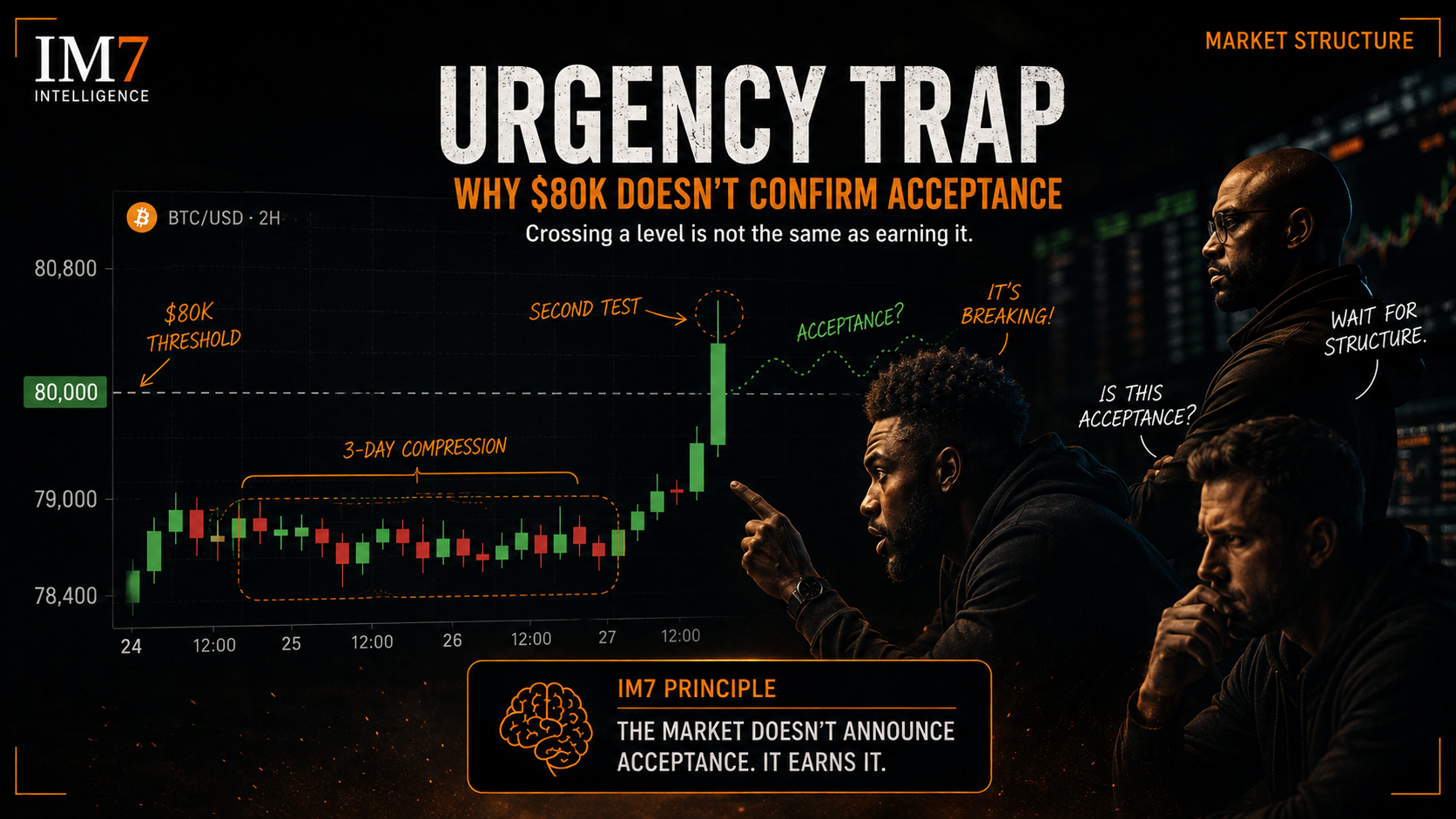 Market Psychology
The Urgency Trap: Why Bitcoin Crossing $80K Does Not Confirm Acceptance
Bitcoin pushed back through $80,000 after days of compression, but the behavioral risk is shifting from impatience to urgency. IM7 examines why crossing a level is not the same as establishing acceptance above it.
Aug 27, 20263 min read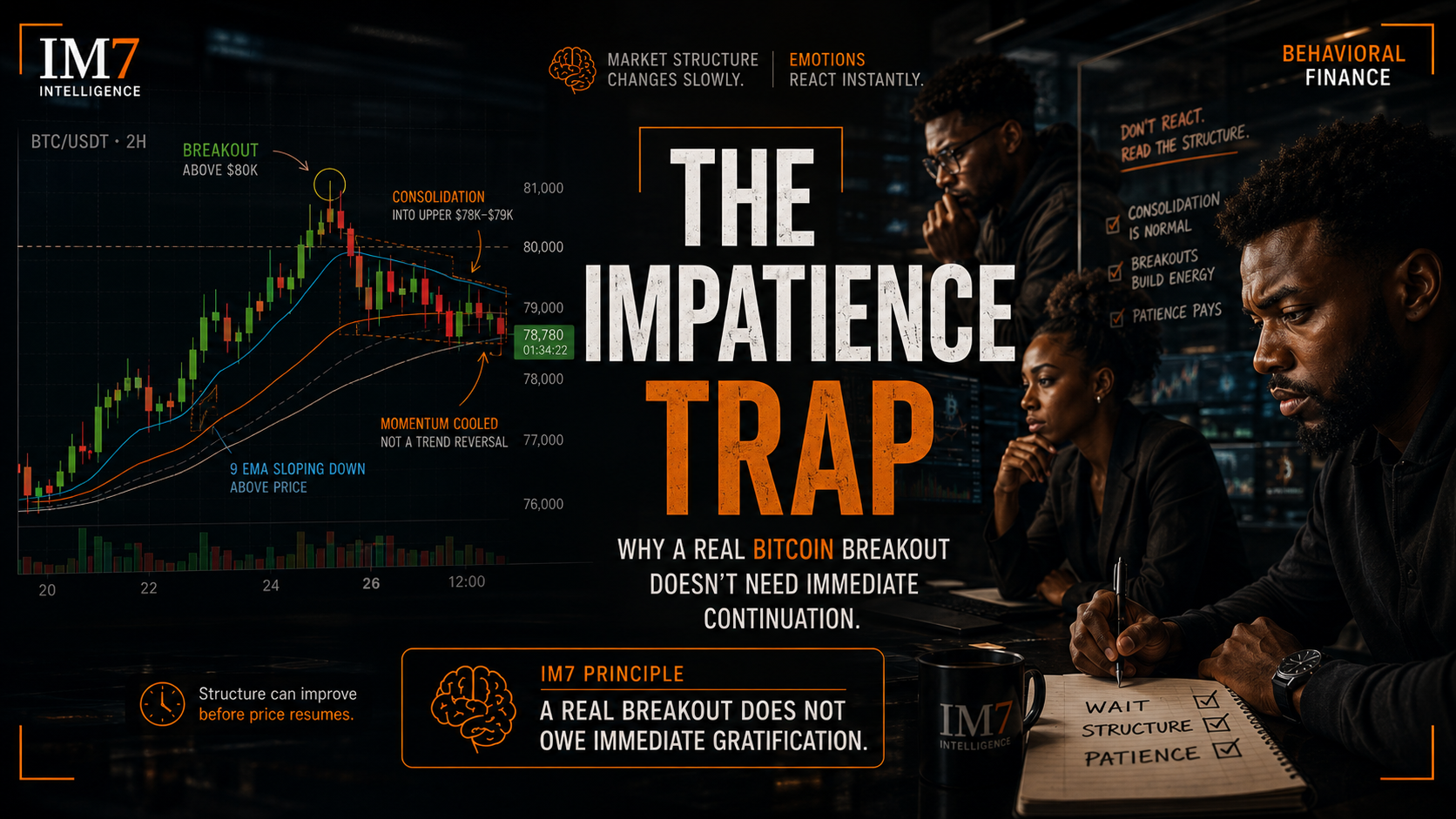 Market Psychology
The Impatience Trap: Why a Real Bitcoin Breakout Doesn't Need Immediate Continuation
Bitcoin broke above major structure and briefly cleared $80K, but the pause that followed exposed a new behavioral trap: traders often mistake the absence of immediate continuation for evidence that the breakout failed.
Aug 26, 202612 min read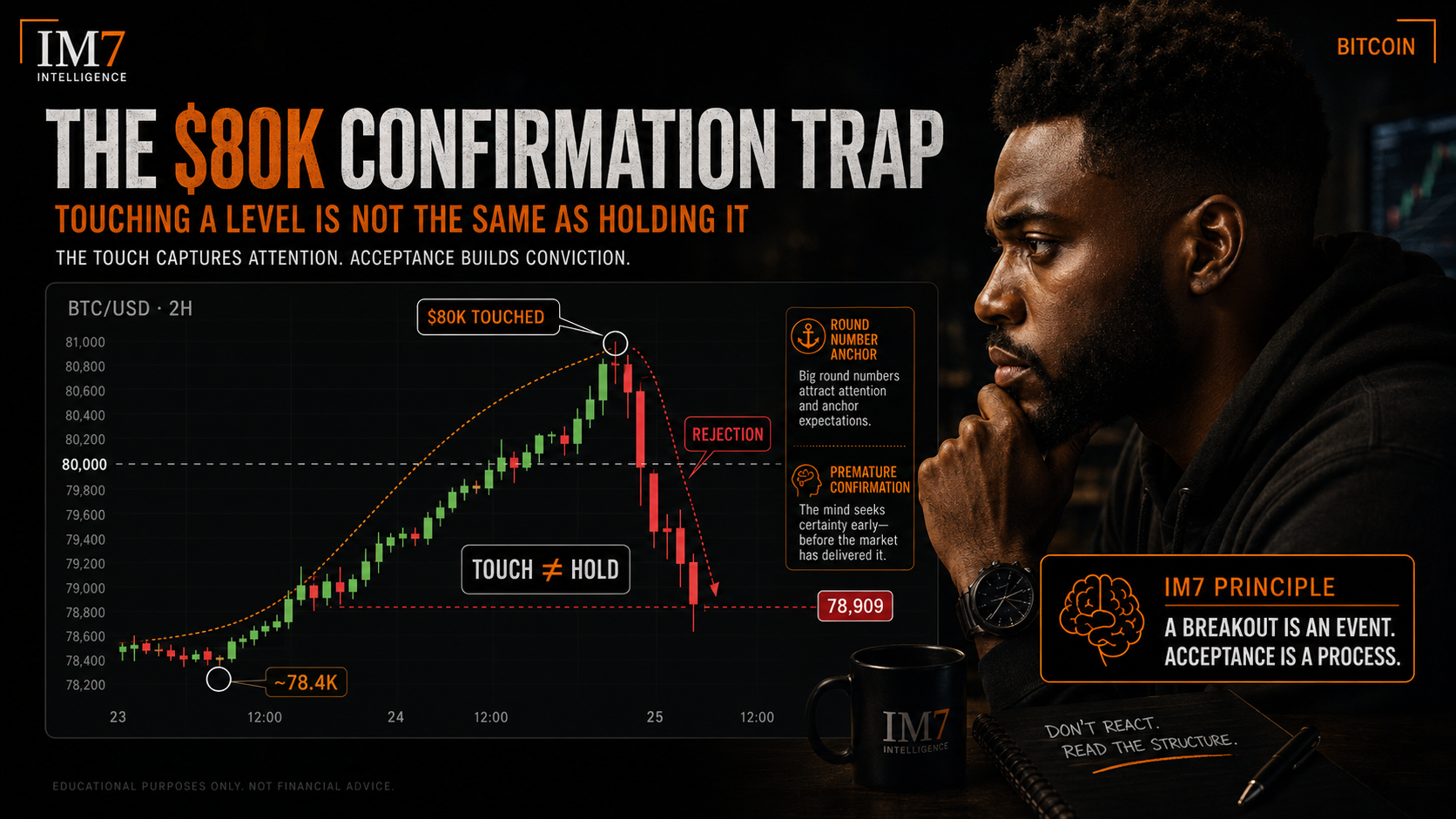 Market Psychology
The $80K Confirmation Trap: Why Touching a Level Is Not the Same as Holding It
Bitcoin touched the $80K milestone, but the sharp rejection that followed exposed a behavioral trap: traders often confuse reaching a level with proving acceptance above it. A breakout is an event. Acceptance is a process.
Aug 25, 20269 min read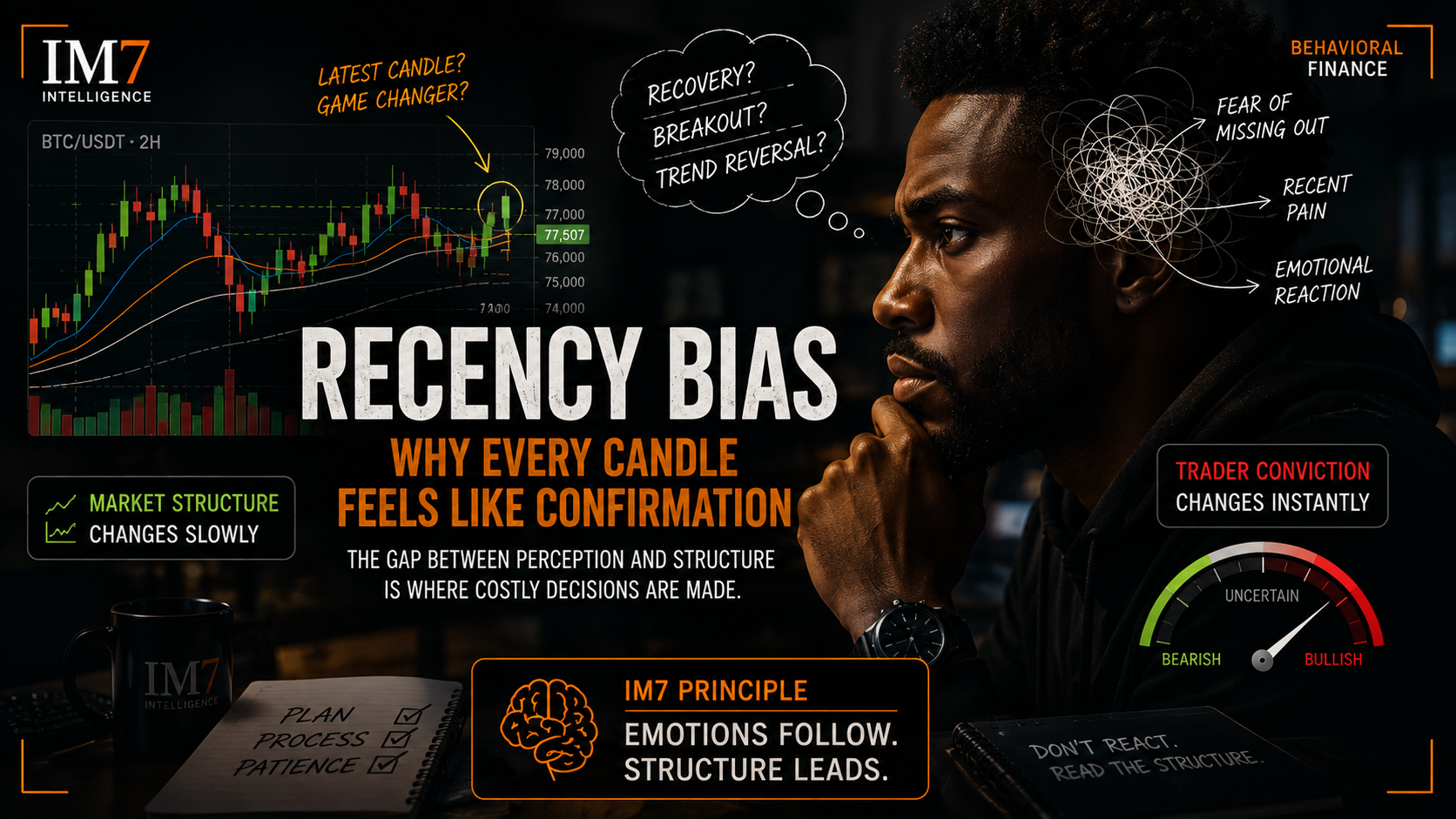 Market Psychology
The Recency Trap: When Every Bitcoin Candle Feels Like Confirmation
Bitcoin’s volatile swings are making every new candle feel like confirmation. But when a trader’s conviction changes faster than the market structure, recency bias may be driving the interpretation.
Aug 24, 202617 min read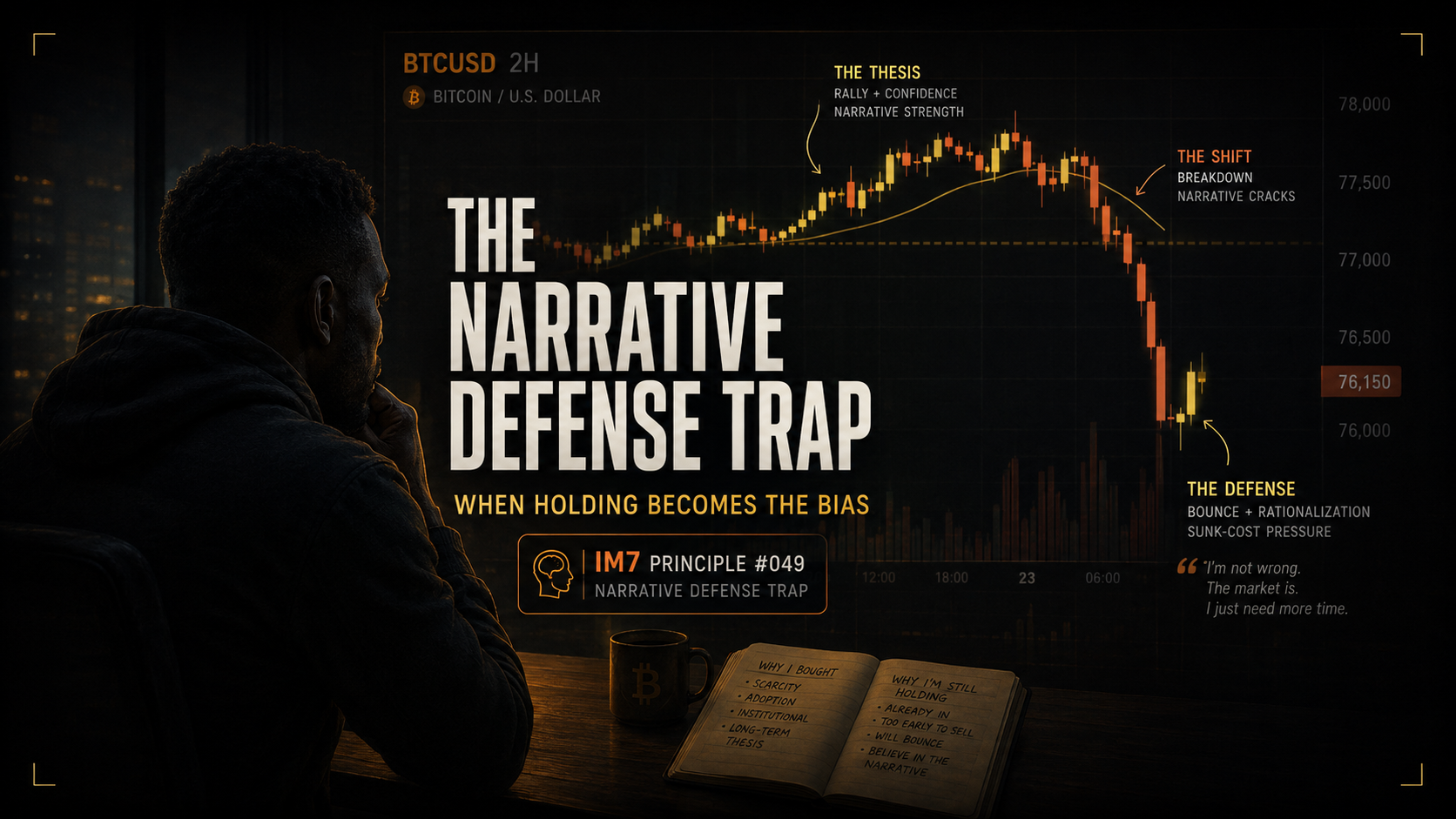 Market Psychology
The Cost of Narrative Defense: When Holding Becomes the Bias
Bitcoin’s sharp pullback has turned yesterday’s narrative defense into a more expensive behavioral problem. When traders hold because exiting would make the loss feel real, sunk cost can replace objective reassessment.
Aug 23, 202614 min read Market Psychology
Yesterday’s Rally Was Real — Today’s Evidence Is Different
Bitcoin’s rally had real catalysts and genuine upside strength. But as price pulls back from recent highs, traders face a different behavioral test: whether they can update a previously rewarded thesis when new evidence begins to conflict with it.
Aug 22, 202610 min read Market Psychology
Bitcoin's Strength: When Momentum Tests Process Discipline
Bitcoin is exhibiting considerable upside strength. That observable momentum can create psychological pressure for traders, especially when a strong move begins to feel like permission to loosen entry standards. The critical distinction is between acknowledging market strength and allowing that strength to dictate execution quality.
Aug 21, 202615 min read Market Psychology
The Salience Trap: Why One Giant Bitcoin Candle Feels Like Certainty
A recent Bitcoin candle surged from below $70,000 to above $71,000 and visually dominated the surrounding chart. Large moves like this can become psychologically dominant, increasing salience, urgency, and the temptation to mistake visual magnitude for confirmation.
Aug 20, 202610 min read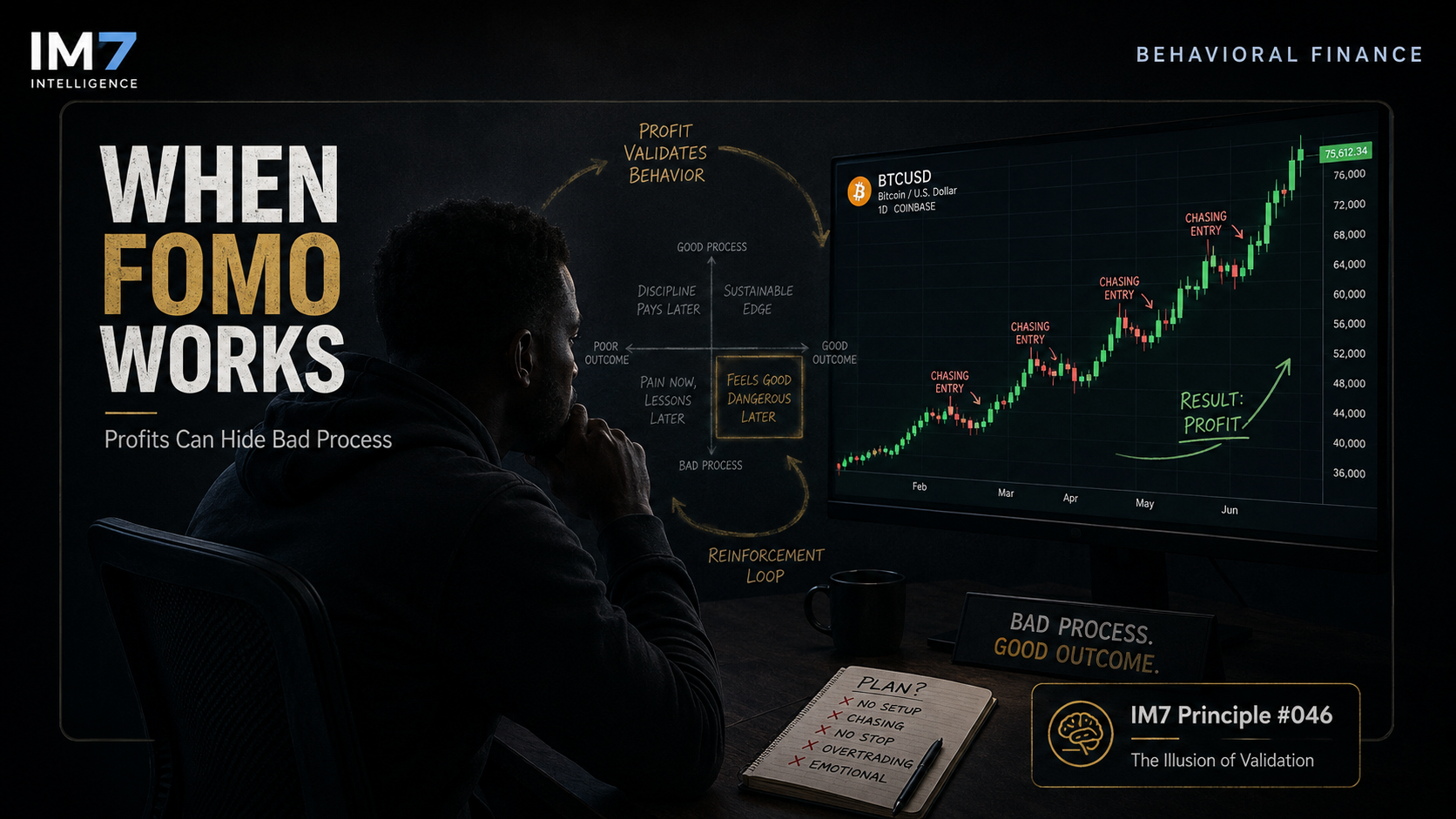 Market Psychology
When FOMO Works: How Profitable Trades Reinforce Bad Process
When a rushed Bitcoin entry makes money, the profitable outcome can reinforce the wrong lesson. Outcome bias can turn an impulsive decision into a behavior the trader becomes more willing to repeat—even when the original process was weak.
Aug 19, 202610 min read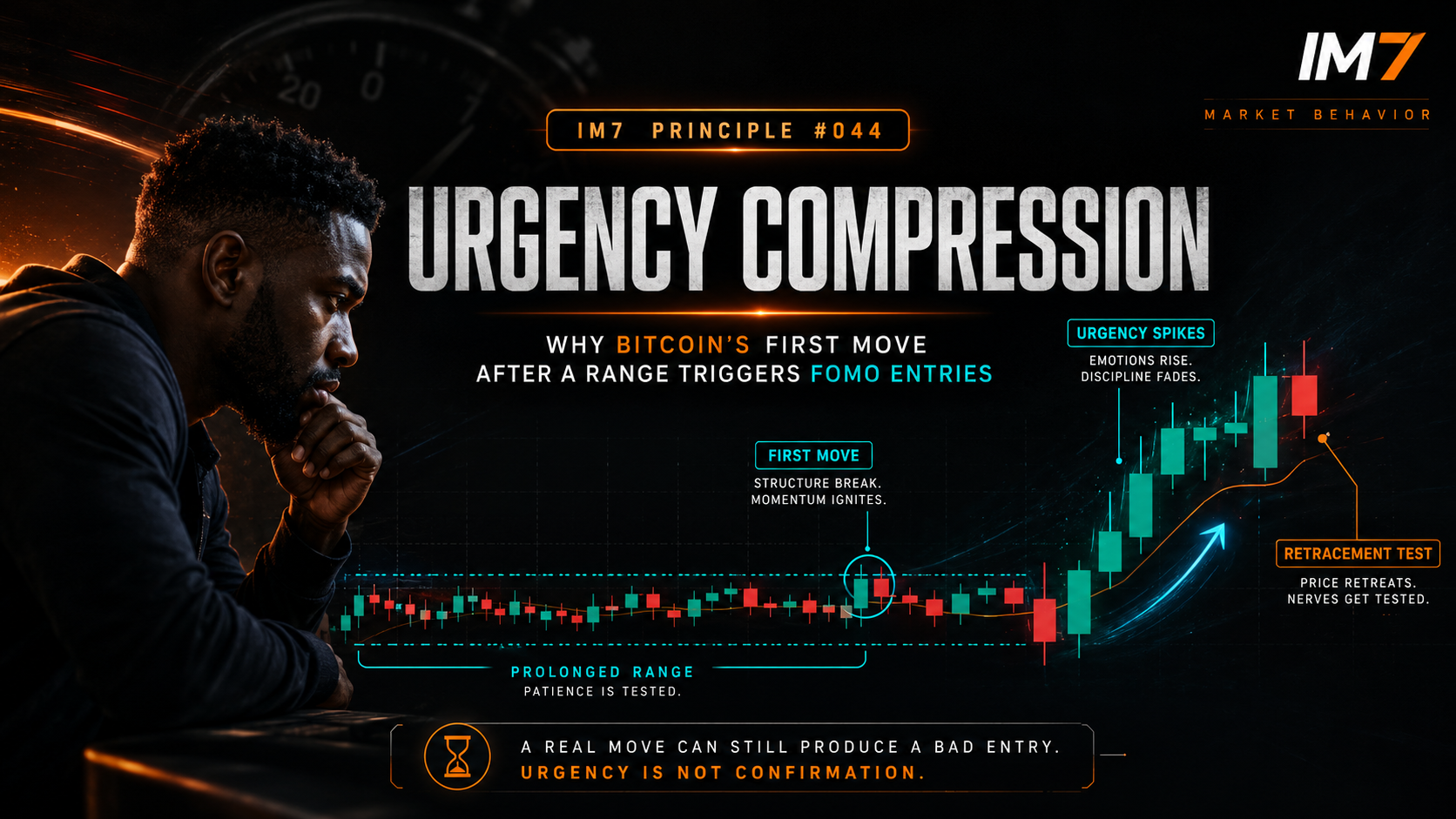 Market Psychology
Urgency Compression: Why Bitcoin’s First Move After a Range Triggers FOMO Entries
After weeks of consolidation, a few green Bitcoin candles can make waiting feel unbearable. The move may be real, but urgency can still turn the first available entry into a poor one. A real move does not automatically make the first entry a good entry.
Aug 17, 202611 min read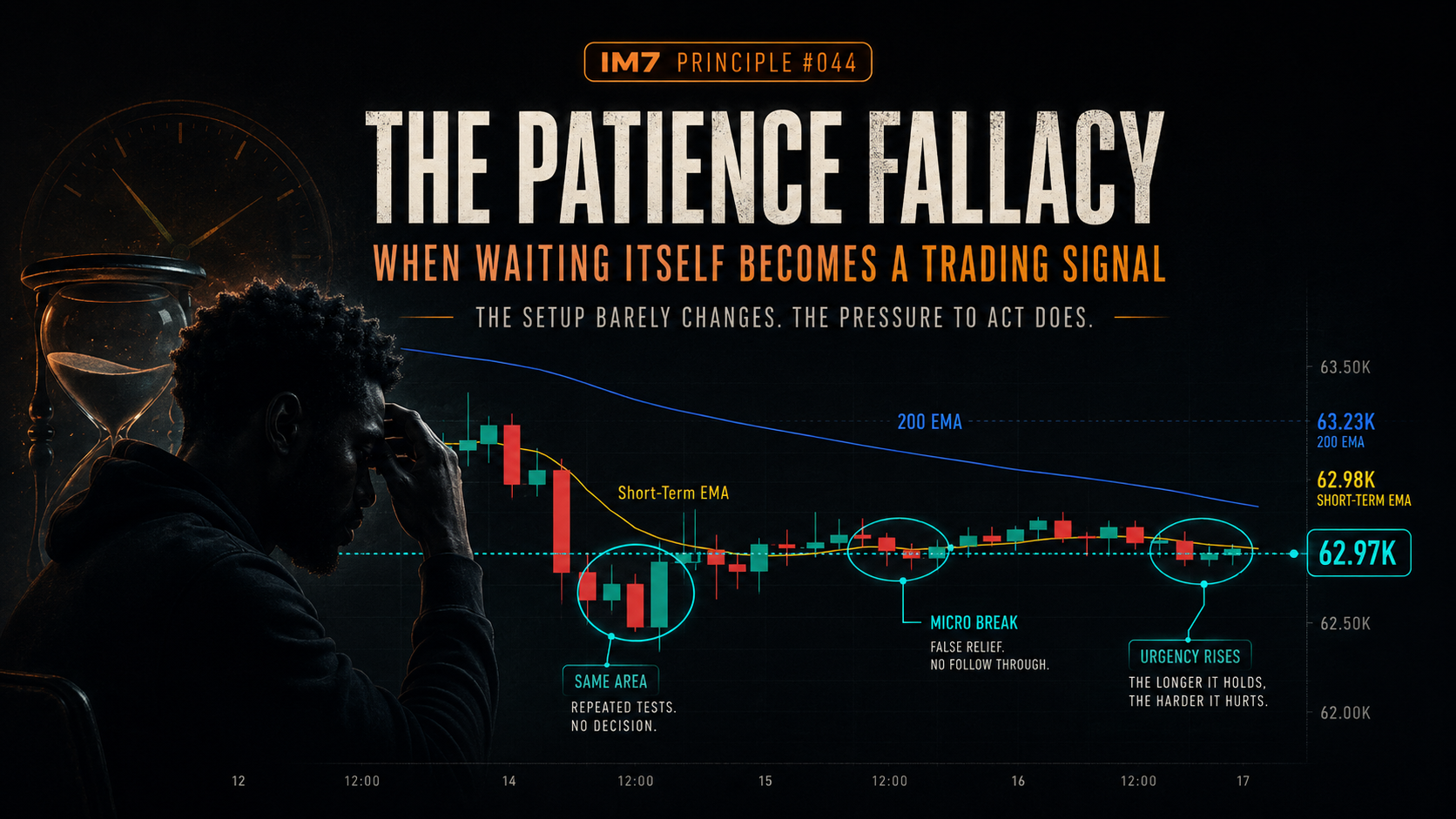 Market Psychology
The Patience Fallacy: When Waiting Itself Becomes a Trading Signal
Week one: I’ll wait for confirmation. Week two: It has to move soon. Week three: That candle looks like a signal. The chart barely changed, but the urgency did. Prolonged Bitcoin consolidation can make waiting feel like evidence—and boredom feel like a trading signal.
Aug 16, 20268 min read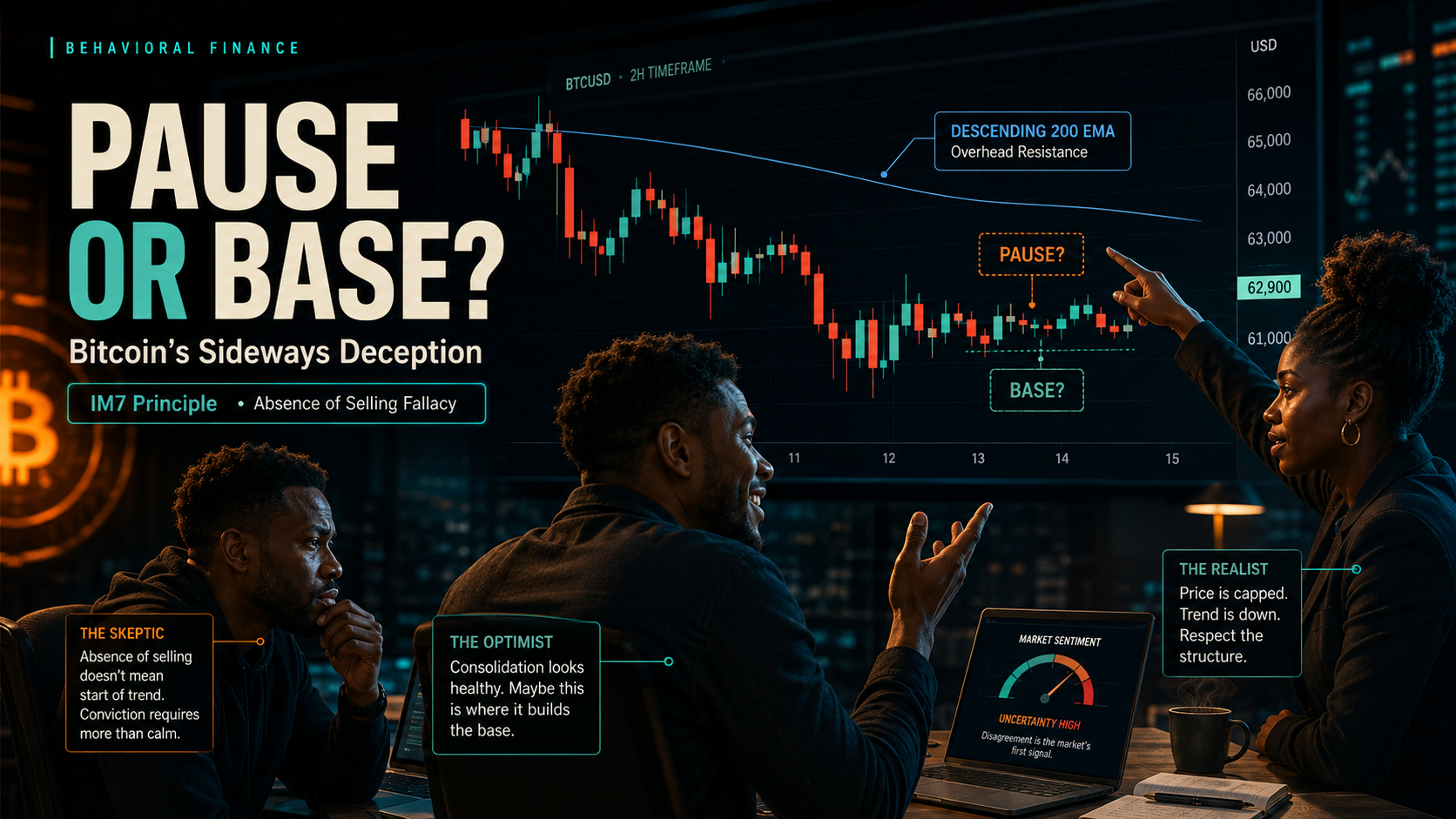 Market Psychology
Bitcoin's Sideways Deception: Why a Pause Feels Like a Base
After a recent decline, Bitcoin stabilized near $62.9K, creating the appearance of a developing base. But the absence of aggressive selling is not the same as evidence that buyers have taken control. Sideways price action can create premature confidence before the market has actually confirmed direction.
Aug 15, 202610 min read