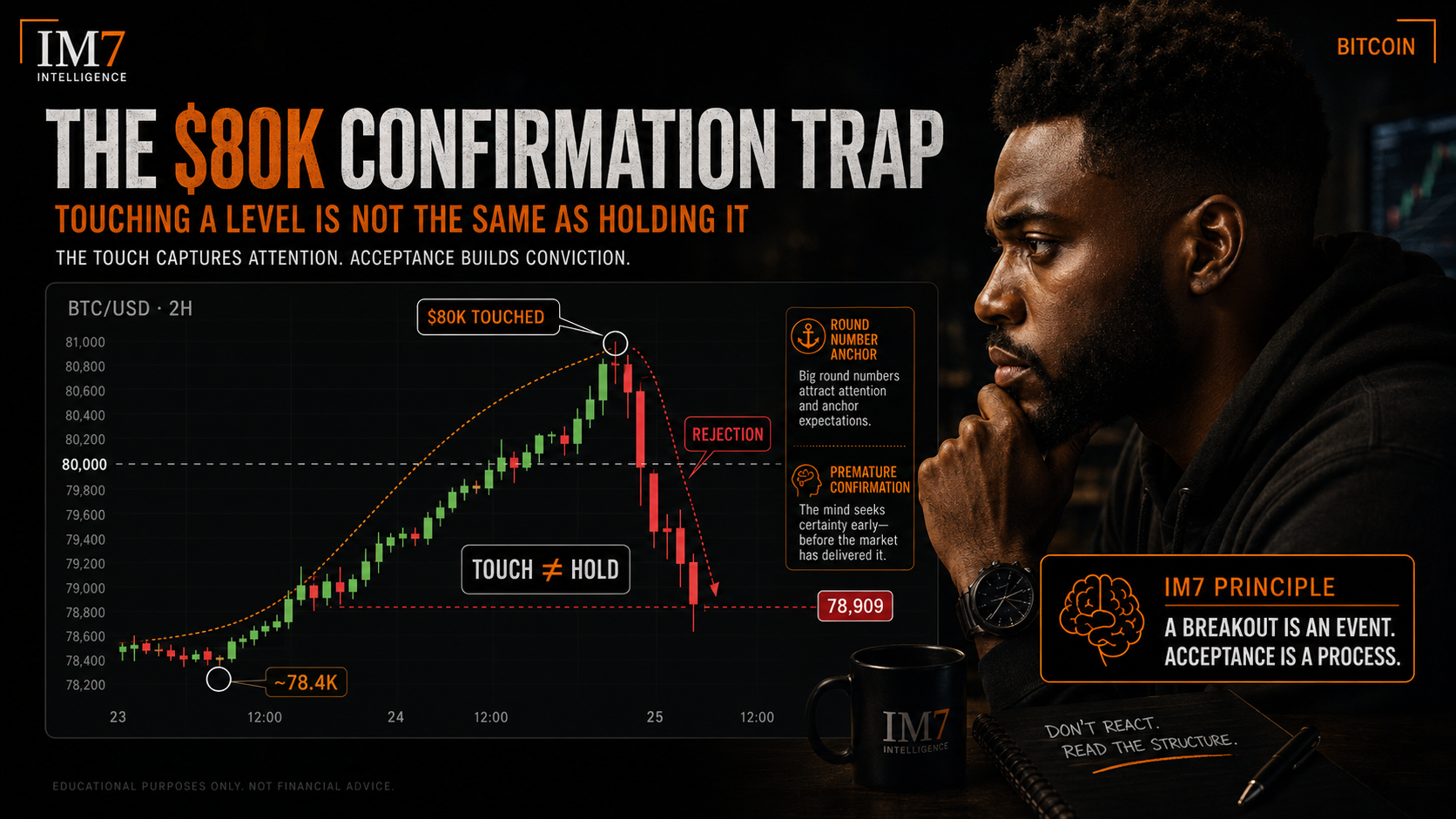
The $80K Confirmation Trap: Why Touching a Level Is Not the Same as Holding It
- Reading time
- 9 min read
- Word count
- 1,943 words
- Published
Bitcoin touched the $80K milestone, but the sharp rejection that followed exposed a behavioral trap: traders often confuse reaching a level with proving acceptance above it. A breakout is an event. Acceptance is a process.
On this page
- Executive Summary
- IM7 Principle #052 — The Confirmation Trap
- Market Context
- Where Behavioral Pressure Began
- What the Market Wanted You to Believe
- Behavioral Observation
- Behavioral Chart 01 — Level Touch vs. Perceived Confirmation
- Cognitive Bias Breakdown
- 1. Anchoring Bias
- 2. Confirmation Bias
- 3. Expectation Reversal
- Behavioral Model 01 — The Milestone-to-Confirmation Loop
- The Professional Read
- Behavioral Chart 02 — Touch Event vs. Acceptance Process
- Decision Framework
- 1. Identify the Event
- 2. Define Acceptance Beforehand
- 3. Separate Contact From Control
- 4. Watch the Next Few Candles
- 5. Reassess Narrative Strength
- Risk Management Lesson
- Behavioral Model 02 — Event vs. Process Decision Filter
- Event-Based Thinking
- Process-Based Thinking
- What the Rejection Does Not Prove
- What the Bias Is Not
- IM7 Quote
- IM7 Observation
- IM7 Decision Rule
Executive Summary
Bitcoin’s recent rally pushed price from roughly $78,400 into the psychologically significant $80,000–$80,800 zone.
For many traders, that brief move above $80,000 felt like confirmation.
The level had been reached. The milestone had been touched. The next leg higher seemed validated.
Then the market reversed sharply.
Price was rejected back toward $78,900, erasing much of the breakout enthusiasm and exposing a familiar behavioral error: traders often confuse a price event with a structural process.
That distinction matters.
A level getting touched is an event. A level getting accepted is a process.
The touch attracts attention. The hold earns conviction.
This article examines why psychologically important round numbers create premature certainty, how anchoring and confirmation bias amplify that certainty, and why disciplined traders must separate milestone contact from market acceptance.
IM7 Principle #052 — The Confirmation Trap
A breakout is an event. Acceptance is a process.
Markets frequently produce price actions that appear decisive in the moment but have not yet earned structural significance.
A touch above a major level can feel like proof. A close above it can feel even stronger. But unless the market demonstrates sustained acceptance, the apparent breakout may remain only a test.
The behavioral mistake occurs when traders assign structural meaning to a move that has not yet structurally matured.
Market Context
On the 2-hour Bitcoin chart, price rallied from approximately $78,400 into the $80,000–$80,800 region.
That rally created a strong directional sequence:
- higher price progression,
- visible upside momentum,
- growing attention around the $80,000 round number,
- and the sense that Bitcoin was entering a new leg higher.
However, the market did not maintain those gains.
A sharp rejection followed, bringing price back toward $78,900. The current chart also shows price trading below the 9 EMA near $79,270, indicating that short-term momentum weakened after the milestone test.
These observations tell us what happened.
They do not, by themselves, prove:
- that the larger rally has failed,
- that Bitcoin must continue lower,
- that the rejection was only a fakeout,
- or that the next breakout attempt will automatically succeed.
The behavioral opportunity is not in guessing the next candle.
It is in interpreting the psychological trap created by the last few candles correctly.
Where Behavioral Pressure Began
The strongest conditions for confidence began before price actually touched $80,000.
They began during the clean upside sequence from roughly $78,400 into $79,800.
That move created a visible directional narrative:
- momentum was present,
- upside continuation looked orderly,
- and the round number ahead gave traders a natural destination.
When price finally pushed through the milestone zone, confidence intensified.
The number itself mattered.
Not only because it was resistance, but because round numbers behave like psychological landmarks.
They do not feel like ordinary prices.
They feel like achievements.
That is where the pressure began to change.
Traders stopped asking:
“What still needs to happen?”
and began assuming:
“It already happened.”
That shift is where the confirmation trap begins.
What the Market Wanted You to Believe
When Bitcoin first moved through $80,000, the market offered a simple, emotionally satisfying story:
“Bitcoin touched $80K, so the next leg higher is confirmed.”
That story was attractive because it resolved uncertainty.
It gave traders a clean interpretation:
- the level broke,
- the path was open,
- the move was validated.
But the market did not confirm the story.
It only produced the event that made the story feel convincing.
That is the difference between touching a level and establishing acceptance above it.
The touch captures the imagination quickly.
Acceptance takes time.
Behavioral Observation
The rejection from the $80,000–$80,800 zone reveals how quickly traders anchor to a milestone.
Before the reversal, traders were not simply watching price.
They were watching a destination.
That matters because destination-thinking changes interpretation.
A round number like $80,000 creates a before/after framework:
- before $80K = still approaching,
- after $80K = breakout confirmed.
That binary interpretation is psychologically efficient but structurally dangerous.
The market does not always treat round numbers as confirmations.
Sometimes it treats them as tests.
The rejection reminds us that reaching a milestone is not the same as proving that the market is willing to trade comfortably above it.
Behavioral Chart 01 — Level Touch vs. Perceived Confirmation
Chart concept: A conceptual chart comparing the moment price touches a major level with the much larger jump in trader certainty that often occurs immediately afterward.
IM7 read: Perceived confirmation tends to spike much faster than structural evidence.
Key takeaway: The first touch often creates more conviction than the market has actually earned.
Cognitive Bias Breakdown
The behavior around $80,000 reflects a combination of Anchoring Bias, Confirmation Bias, and Expectation Reversal.
1. Anchoring Bias
Anchoring bias occurs when people rely too heavily on an initial reference point when making judgments.
In this case, $80,000 becomes the anchor.
Because it is round, visible, and psychologically important, it immediately becomes the focal point of interpretation.
Instead of evaluating the quality of acceptance above the level, traders often treat the level itself as the answer.
2. Confirmation Bias
Once traders believe that the touch confirms the move, they begin interpreting evidence in that direction.
A small continuation move becomes proof. A minor pause becomes healthy consolidation. Any nearby bullish signal gets absorbed into the same narrative.
Contradictory evidence receives less weight until the rejection becomes too large to ignore.
3. Expectation Reversal
When price fails to hold above the milestone, the emotional story often flips quickly.
What looked like confirmation now looks like failure.
What felt bullish now feels like a trap.
The structure may still be unresolved, but trader interpretation has already reversed.
That is expectation reversal: conviction changing faster than the market’s actual structural evidence.
Behavioral Model 01 — The Milestone-to-Confirmation Loop
Model sequence:
- Price approaches a major round number
- Traders assign psychological importance to the level
- Level gets touched
- Traders upgrade the touch into confirmation
- Conviction increases prematurely
- Rejection appears
- Narrative flips from breakout confidence to fakeout fear
IM7 read: The milestone itself becomes the emotional trigger, not the quality of trade above it.
Key takeaway: The closer price gets to a psychologically important level, the more vulnerable traders become to confusing contact with confirmation.
The Professional Read
A disciplined professional would not ignore the $80,000 breakout attempt.
But they also would not automatically reward it with structural status.
The professional question is not:
“Did price touch the level?”
It is:
“Did the market establish acceptance above the level?”
That means looking for evidence such as:
- multiple candles holding above the level,
- sustained trade around it,
- constructive retests,
- reduced rejection behavior,
- and evidence that buyers are defending the area after the initial push.
A sharp rejection back below the level weakens the argument for acceptance.
It does not necessarily destroy the larger bullish thesis.
It simply means the event did not yet mature into the process.
Behavioral Chart 02 — Touch Event vs. Acceptance Process
Chart concept: A two-phase conceptual chart showing:
- Phase 1: Touch Event — first contact with a major level
- Phase 2: Acceptance Process — repeated successful trade above the level, retest behavior, and sustained holding
IM7 read: Traders often stop the analysis at Phase 1 even though Phase 2 is where structural confirmation actually develops.
Key takeaway: Breakout attention is earned quickly. Breakout validation is earned slowly.
Decision Framework
When Bitcoin or any other asset reaches a major psychological level, use this framework:
1. Identify the Event
What exactly happened?
Did price touch the level? Close above it? Wick through it? Reject from it?
Be precise.
2. Define Acceptance Beforehand
Do not define acceptance emotionally after the move.
Specify in advance what would count as real acceptance on your timeframe, such as:
- two or more closes above the level,
- a successful retest,
- sustained trade duration,
- or orderly continuation after the break.
3. Separate Contact From Control
Ask:
“Did price merely visit the level, or did the market demonstrate control above it?”
That is the central distinction.
4. Watch the Next Few Candles
The first touch creates the story. The next few candles test the story.
5. Reassess Narrative Strength
If price rapidly falls back below the level, reduce confidence in the original interpretation.
Do not defend the milestone just because it felt important.
Risk Management Lesson
The $80,000 rejection highlights a common execution mistake: deploying conviction too aggressively at the point of emotional maximum confidence.
This usually looks like:
- chasing the breakout,
- increasing size the moment the milestone is touched,
- treating the level itself as confirmation,
- or failing to define what would invalidate the move.
A more disciplined risk approach would treat the first touch as information, not as a final answer.
That means:
- smaller initial risk,
- clearer invalidation,
- delayed size increase until acceptance improves,
- and more patience between event and commitment.
The less mature the breakout, the more disciplined the risk should be.
Behavioral Model 02 — Event vs. Process Decision Filter
Model comparison:
Event-Based Thinking
- Price touched the level
- Story forms immediately
- Conviction rises quickly
- Risk often increases too early
Process-Based Thinking
- Price touched the level
- Acceptance criteria are checked
- Structure is observed
- Conviction increases only if the market earns it
IM7 read: Event-based traders react to significance. Process-based traders wait for validation.
Key takeaway: If the interpretation changes faster than the evidence, conviction is likely ahead of structure.
What the Rejection Does Not Prove
The rejection from $80,000 does not automatically prove:
- that the larger rally has failed,
- that Bitcoin cannot reclaim the level,
- that the move was meaningless,
- or that a deeper decline is guaranteed.
Likewise, the initial touch did not prove:
- that the next leg higher was confirmed,
- that breakout continuation was inevitable,
- or that the milestone had become support.
The disciplined conclusion is narrower:
The touch was real. The acceptance remains unproven.
What the Bias Is Not
This analysis does not mean traders should ignore major levels.
Round numbers matter.
Breakouts matter.
Momentum matters.
The issue is not whether the level was important.
The issue is whether importance was confused with confirmation.
A trader can rationally respond to a breakout attempt.
The behavioral error occurs when the first touch is given more authority than the market has actually earned.
IM7 Quote
“The touch captures the eye. The hold earns conviction.”
IM7 Observation
The $80,000 event was not simply a test of Bitcoin.
It was a test of interpretation.
Price did what markets often do around major milestones: it reached a psychologically significant level, attracted attention, triggered conviction, and then forced traders to discover whether their confidence was based on structure or excitement.
This pattern will repeat.
Not just at $80,000.
At every major round number, prior high, headline level, and heavily watched milestone.
The opportunity for disciplined traders is not to eliminate emotional reaction.
It is to delay conviction until the market earns it.
IM7 Decision Rule
Never treat a touched level as a held level until the market proves acceptance.
Before upgrading a breakout into confirmation, ask:
- Did price touch the level, or did it hold above it?
- What specific evidence would count as acceptance on my timeframe?
- Has the market traded above the level long enough to justify stronger conviction?
- Did the latest candles strengthen structure, or only strengthen emotion?
If the answer is still mostly:
“It touched the level, so it must be confirmed,”
then the event is probably being confused with the process.
A breakout is an event. Acceptance is a process.
How did this land?
What emotion or bias did this article help you recognize?
References
- [1]Tversky, A., & Kahneman, D. (1974). Judgment under Uncertainty: Heuristics and Biases. Science. American Association for the Advancement of Science. DOI: 10.1126/science.185.4157.1124.
- [2]Nickerson, R. S. (1998). Confirmation bias: A ubiquitous phenomenon in many guises. Review of General Psychology. American Psychological Association. DOI: 10.1037/1089-2680.2.2.175.
Pass the signal forward.
IM7 Intelligence studies financial markets through the lens of psychology rather than prediction. Our research focuses on behavioral finance, crowd psychology, sentiment, and decision-making to help readers understand why markets move—not just where they move.
IM7 Intelligence publishes educational research on market psychology, behavioral finance, and investor behavior. Nothing published by IM7 Intelligence constitutes financial, investment, tax, or legal advice. Always conduct your own research before making financial decisions.
Read the market's emotion before it acts.
Where this article sits in the map.
- Confirmation BiasYou are here
- Behavioral Finance
- Risk Management
- Fear
Curated paths, not random articles.
Behavior read in real time.

Ismael Mercius
Ismael Mercius is the founder of IM7 Intelligence, where he writes about crypto market psychology, behavioral finance, and the sentiment cycles that drive digital asset prices. His work focuses on how traders actually make decisions — and the recurring errors that show up in their P&L.
- Crypto market psychology
- Behavioral finance
- Market sentiment analysis
- Trader behavior & decision-making