Case Studies

Case studies are how IM7 tests its framework against history. Each one revisits a specific moment — a top, a flush, a euphoria phase — and traces the behavioral fingerprints that were visible in real time, not the story assembled after the fact.

What a case study looks like at IM7

We start with the tape and the positioning data of the moment, not the narrative. Then we identify the dominant biases in play, the crowd's dominant trade, and where the disciplined operator sat. The goal is a repeatable behavioral signature, not a war story.
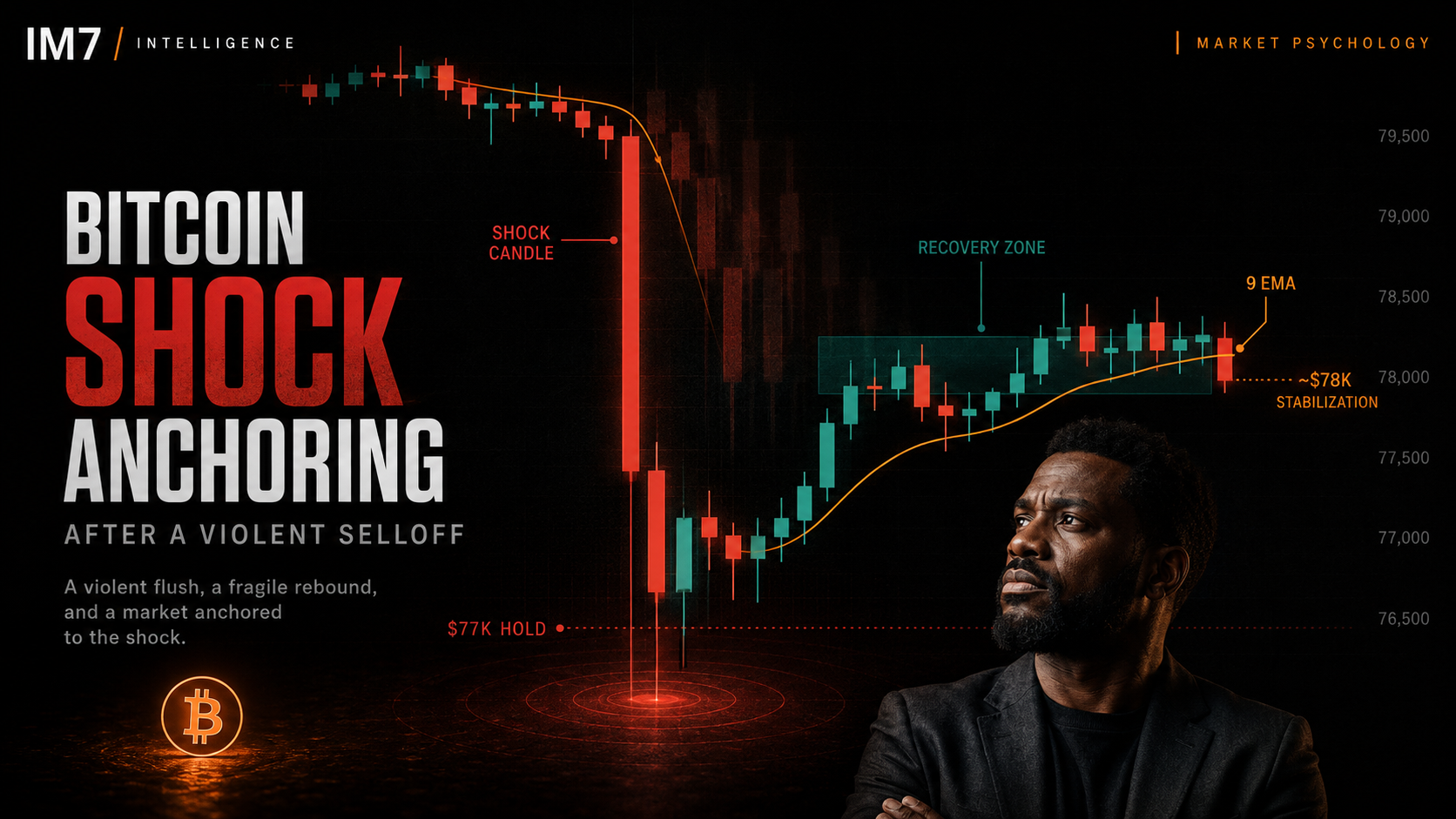
Why history rhymes in crypto

Bitcoin cycles differ in cause but repeat in behavior. The vocabulary — capitulation, euphoria, disbelief — describes emotional states that recur regardless of the fundamental catalyst. Case studies build the muscle memory to recognize them earlier next time.

How to read the archive

Each case study links back to the IM7 Principle it most clearly illustrates and to the Behavioral Model that best structures the decision. Read them alongside the Principle Library to see the theory in the wild.

From the archive

When "Fine" Becomes Expensive: How Status Quo Bias Traps Bitcoin Traders After Support Breaks
Behavioral Finance

When "Fine" Becomes Expensive: How Status Quo Bias Traps Bitcoin Traders After Support Breaks

This article explores how status quo bias and other cognitive pitfalls can lead Bitcoin traders to cling to outdated theses, even after critical technical support breaks. We examine the psychological journey from comfort to re-evaluation, using a recent Bitcoin price action as a case study. Understanding these biases is crucial for effective risk management and adaptive decision-making in volatile markets.

Why Sideways Markets Feel Harder Than Crashes: The Psychology of Waiting and Expectation Bias
Psychology

Why Sideways Markets Feel Harder Than Crashes: The Psychology of Waiting and Expectation Bias

Sideways markets can often feel more emotionally taxing than sharp crashes, despite the absence of dramatic losses. This article explores the psychological underpinnings of why periods of consolidation, exemplified by Bitcoin's recent price action, challenge traders' emotional resilience more than volatile downturns. We delve into expectation bias, impatience, and the urge to overtrade when the market goes quiet.

The Silent Killer of Trading Accounts: Why Sideways Markets Are More Dangerous Than Crashes
Psychology

The Silent Killer of Trading Accounts: Why Sideways Markets Are More Dangerous Than Crashes

While dramatic market crashes often grab headlines, it's the prolonged, range-bound sideways markets that silently decimate more trading accounts. This article explores the psychological pitfalls that make low-volatility periods uniquely challenging for traders, using a recent Bitcoin 2-hour chart as a case study to illustrate these behavioral traps.

Panic Wicks: Why Short-Lived Crashes Lead to Long-Lasting Regret in Trading
Behavioral Finance

Panic Wicks: Why Short-Lived Crashes Lead to Long-Lasting Regret in Trading

Temporary price volatility, often seen as 'panic wicks' on charts, can trigger a flood of emotional decisions leading to significant losses. This article explores the psychological mechanisms behind these reactions, using a recent Bitcoin price movement as a case study. Understanding these behaviors is crucial for making more rational trading choices.

The Unassuming Peak: Why the Most Dangerous Candle Never Looks Dangerous
Behavioral Finance

The Unassuming Peak: Why the Most Dangerous Candle Never Looks Dangerous

In the volatile world of finance, market tops often manifest not with dramatic crashes, but with small, ordinary-looking candles on a chart. This article explores the psychological reasons why these subtle signals are consistently missed by even experienced investors and traders. We delve into hindsight bias, confirmation bias, and the emotional biases that cloud our judgment at critical junctures.

The Silent Trap: Why Traders Lose the Most Money in Boring Markets
Behavioral Finance

The Silent Trap: Why Traders Lose the Most Money in Boring Markets

Sideways markets, often perceived as safe, can be fertile ground for significant trading errors. This article unpacks the psychological traps of boredom and impatience that lead traders to overtrade and abandon positions right before major market moves.

Crowd Conviction and the Four Market Regimes
Behavioral Finance

Crowd Conviction and the Four Market Regimes

Markets do not have prices. They have regimes. A simple four-regime framework based on crowd conviction can clarify almost any chart.

Narrative Density: The Hidden Signal at Market Tops
Sentiment

Narrative Density: The Hidden Signal at Market Tops

When everyone is telling the same story, the story is already priced in. Narrative density is the most underrated sentiment signal in crypto.

Why Retail Buys Tops and Sells Bottoms
Behavioral Finance

Why Retail Buys Tops and Sells Bottoms

The crowd is not stupid. It is structurally late. We map the behavioral pipeline that makes retail buy euphoria and sell despair — and how to step outside it.