The Shock Anchor: Why Bitcoin Traders Keep Trading the Crash After It Ends
AI Generated • IM7 Intelligence
- Reading time
- 3 min read
- Word count
- 692 words
- Published
Bitcoin’s violent selloff may be over, but traders can remain psychologically anchored to the shock candle long after price enters a new phase. IM7 examines why recent fear can distort how every bounce and consolidation is interpreted.
Executive Summary
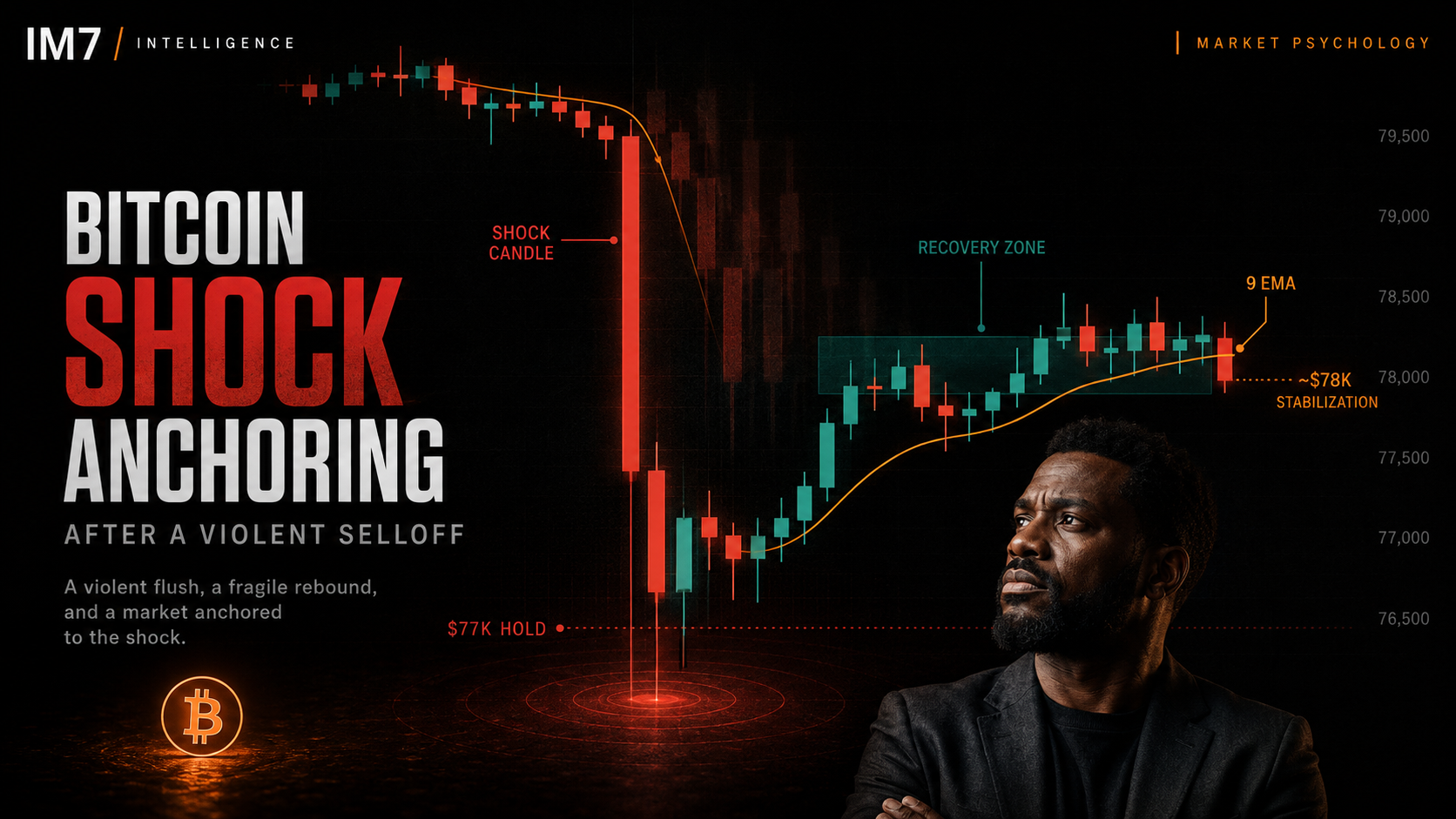
Bitcoin’s sharp selloff from the upper-$79K/$80K region toward $77K was the dramatic part of the story.
What happened after the selloff may be more useful.
Price stopped falling vertically, mixed candles began forming, and Bitcoin worked back toward the $78K area while the 9 EMA moved closer to price.
That does not confirm a recovery.
It also does not confirm that the breakdown must continue.
The behavioral risk now is shock anchoring: traders keep using Friday’s collapse as the reference point for every candle that follows.
Bears see every bounce as fake.
Bulls see the first hold near $77K as proof the dip is over.
Both may be forcing a conclusion before the market has provided enough evidence.
IM7 Principle — The Shock Anchor
When an emotionally intense market event becomes the dominant reference point, traders can continue interpreting new evidence through the old shock even after market conditions begin to change.
The dramatic candle tells you what happened. The candles after it tell you what changed.
What Changed in Bitcoin
The selloff materially weakened the short-term picture.
Bitcoin lost momentum, moved below the short-term 9 EMA, and experienced a fast downside expansion.
But the market then entered a different phase.
Instead of continuing vertically lower, price began stabilizing around the upper-$77K region and recovering toward $78K.
That shift matters because the market is no longer behaving exactly as it did during the shock.
The correct question is no longer simply:
“Why did Bitcoin fall?”
It is:
“What has Bitcoin proven since the fall stopped?”
The Behavioral Mechanism
A violent market event is unusually memorable.
It is fast.
It is visually obvious.
It creates financial pain.
That combination gives it more psychological weight than an ordinary candle.
The sequence becomes:
Shock Event → Emotional Salience → New Reference Point → Every New Candle Compared With the Crash → Selective Interpretation → Premature Conclusion
For bears, the anchor becomes the collapse.
A green candle looks insignificant compared with the red candle that came before it.
A sideways range becomes “consolidation before another drop.”
A recovery becomes “just a dead-cat bounce.”
For bulls, a second anchor can form around the first successful hold near $77K.
Then the logic becomes:
“$77K held once, so the bottom is confirmed.”
Different conclusion.
Same mistake.
Both sides are allowing one emotionally important reference point to substitute for evidence accumulation.
Professional Read
The selloff should not be ignored.
It changed the evidence.
But professionals continually update how much weight older information deserves as new evidence arrives.
The shock candle explains how Bitcoin arrived here.
The post-shock candles describe the current state.
Right now, the market is better described as post-shock reassessment than confirmed recovery or confirmed continuation lower.
Price interacting again with the 9 EMA is information.
The lack of immediate downside continuation is information.
Neither is a verdict.
What matters next is whether Bitcoin can rebuild lost structure or whether renewed selling produces another decisive deterioration.
Decision Framework
When a dramatic candle is still controlling your interpretation, ask:
If not, stop analyzing the market as though it is.
- Is the shock still happening?
Less dramatic candles can contain more relevant current information.
- What evidence has appeared since?
Define it before fear defines it for you.
- What would confirm renewed weakness?
Define that too.
- What would confirm structural repair?
- Am I forcing a bullish or bearish conclusion because uncertainty feels uncomfortable?
Sometimes unresolved is the correct answer.
What This Does Not Prove
The stabilization near $77K-$78K does not prove the bottom is in.
The prior collapse does not prove every bounce will fail.
A first interaction with the 9 EMA does not confirm recovery.
And the absence of another immediate selloff does not automatically mean buyers have regained control.
The market still has to earn the next conclusion.
IM7 Decision Rule
Do not ask only:
“What did the crash prove?”
Ask:
“What has the market proven since the crash stopped?”
The most useful information from this week may not be the shock candle.
It may be what happened after it stopped.
How did this land?
What emotion or bias did this article help you recognize?
Pass the signal forward.
IM7 Intelligence studies financial markets through the lens of psychology rather than prediction. Our research focuses on behavioral finance, crowd psychology, sentiment, and decision-making to help readers understand why markets move—not just where they move.
IM7 Intelligence publishes educational research on market psychology, behavioral finance, and investor behavior. Nothing published by IM7 Intelligence constitutes financial, investment, tax, or legal advice. Always conduct your own research before making financial decisions.
Read the market's emotion before it acts.
Where this article sits in the map.
- Behavioral FinanceYou are here
- Confirmation Bias
- Sentiment
- Risk Management
Curated paths, not random articles.
Behavior read in real time.

Ismael Mercius
Ismael Mercius is the founder of IM7 Intelligence, where he writes about crypto market psychology, behavioral finance, and the sentiment cycles that drive digital asset prices. His work focuses on how traders actually make decisions — and the recurring errors that show up in their P&L.
- Crypto market psychology
- Behavioral finance
- Market sentiment analysis
- Trader behavior & decision-making