Bitcoin Spent Hours Rallying — One Candle Erased Almost All of It
AI Generated • IM7 Intelligence
- Reading time
- 5 min read
- Word count
- 1,106 words
- Published
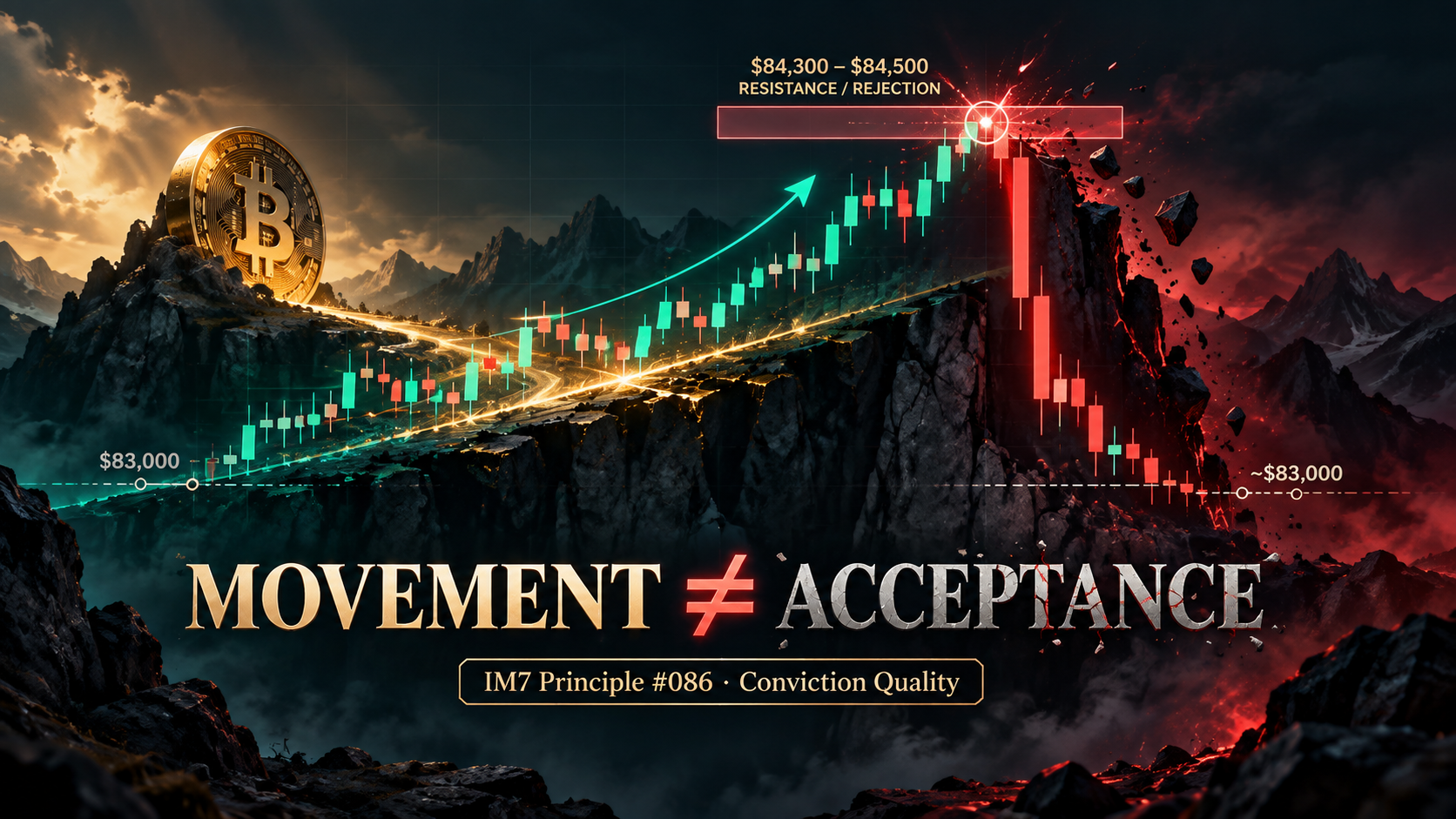
Bitcoin rallied above $84K, then gave back nearly the entire move in one 2-hour candle. The lesson wasn’t about direction — it was about conviction quality. Traders often let fast price movement strengthen their confidence before the evidence actually improves.
Executive Summary
Bitcoin spent hours rebuilding confidence above $84K, then gave back nearly the entire advance in one aggressive 2-hour candle. The reversal exposed a common behavioral error: traders often let price acceleration strengthen conviction before the underlying evidence improves. The important question was never whether Bitcoin could rally — it was whether buyers could prove acceptance above the reclaimed area. For the next decision, separate movement from evidence and require the market to earn your confidence.
IM7 Principle
IM7 Principle #18 — Conviction Quality. Conviction should strengthen when evidence improves, not simply when price moves in your preferred direction. Two traders can reach the same conclusion while relying on completely different levels of evidence.
Market Context
Bitcoin pushed from the low-$83K area into roughly $84.3K before the move was sharply reversed. The rally improved short-term sentiment, but price failed to establish durable acceptance above the reclaim zone and quickly rotated back toward $83K.
The most important feature of the tape was not the size of the rally. It was what happened after price reached the upper part of the move.
Sellers responded aggressively near the same area that had already acted as resistance, and one 2-hour candle removed most of the progress buyers had made during the prior several hours.
The lower wick near $82.8K–$83K showed that buyers were still willing to respond at lower prices. But a response is not the same thing as control.
The market therefore remained caught between two observable behaviors:
- Buyers continued defending the lower-$83K region.
- Sellers continued rejecting attempts to hold materially higher.
That is not confirmation in either direction. It is unresolved evidence.
What The Market Wanted You To Believe
"The recovery is confirmed."
The climb through $84K created a powerful visual message.
Green candles were expanding. Price was moving quickly. Recent weakness appeared to be disappearing.
That combination naturally encourages traders to upgrade their confidence.
But the market had not yet proven that buyers could hold the reclaimed area.
The rally rewarded optimism temporarily, but the next 2-hour candle punished anyone who treated movement itself as confirmation.
The behavioral trap was subtle:
The trader did not necessarily make a bad observation.
Bitcoin was showing strength.
The mistake was allowing that observation to become a stronger conclusion than the evidence justified.
Behavioral Observation
Watch what happens to trader confidence when price begins moving quickly in the direction they already want.
The chart often changes less than the trader's interpretation does.
A slow move above resistance may still be treated cautiously.
A fast move through the same area suddenly feels convincing.
That is the behavior to watch:
The faster price moves, the faster traders stop asking for proof.
On the chart, look for three things:
- A rapid move into or above a known resistance area.
- Expanding confidence before acceptance is established.
- A sharp reversal that exposes how little structural evidence actually changed.
The important signal is not merely the reversal.
It is the gap between how confident traders became and how much evidence the market actually produced.
Cognitive Bias Breakdown
This is a form of recency bias combined with outcome substitution.
Recency bias causes people to overweight what just happened. A sequence of strong green candles can quickly become more influential than the broader context that existed before the rally.
Outcome substitution happens when the brain replaces a difficult question with an easier one.
The difficult question is:
"Has Bitcoin established acceptance above this level?"
The easier question becomes:
"Does Bitcoin look strong right now?"
Those are not the same question.
Behavioral research has repeatedly shown that people rely on simplified mental shortcuts when evaluating uncertain situations Tversky & Kahneman, 1974.
On this chart, the shortcut was obvious.
Price accelerated upward.
Confidence increased.
But the evidence required to validate that confidence — sustained acceptance above the reclaimed zone — never fully appeared.
Then one candle exposed the difference.
The Professional Read
A disciplined professional separates three things that inexperienced traders often combine:
Movement. Evidence. Conviction.
Movement tells you what price is doing.
Evidence tells you whether the market is proving a thesis.
Conviction determines how much confidence you place in that thesis.
Those three variables should not rise automatically together.
Bitcoin moving from roughly $83K to $84.3K was movement.
Holding above the reclaimed area, surviving a retest, and showing continued demand would have produced stronger evidence.
Only then would stronger conviction have been justified.
Instead, the rally reached resistance and was aggressively rejected.
A professional does not need to label that move bullish or bearish immediately.
The more useful observation is simpler:
The market had not yet earned the confidence the rally created.
Decision Framework
Before increasing conviction after a fast move, ask:
- What specific evidence improved?
- Did price merely touch the level, or hold it?
- Did the market survive the first retest?
- Did sellers disappear, or simply wait higher?
- Is my confidence coming from structure or candle size?
- What evidence would weaken my interpretation?
- Would I believe the same thesis if the last candle were red instead of green?
If the answer depends primarily on the color or speed of the last candle, conviction is probably running ahead of evidence.
Risk Management Lesson
Poor conviction quality becomes dangerous when it changes position size.
A trader who feels increasingly certain during a fast rally may:
- increase size,
- tighten their tolerance for contradictory evidence,
- chase price,
- remove patience from the process,
- or reinterpret resistance as confirmation.
That creates asymmetric behavioral risk.
The market does not need to completely invalidate the thesis to hurt the trader.
It only needs to expose that the trader sized the position for a level of certainty the evidence never supported.
Risk should respond to evidence quality, not emotional confidence.
IM7 Quote
"A faster candle does not make stronger evidence."
IM7 Observation
Bitcoin's rally changed the appearance of the chart faster than it changed the underlying evidence.
That difference matters.
The move above $84K encouraged traders to behave as though the market had already answered the important question.
It had not.
The real question was whether higher prices could be accepted after the excitement faded.
The reversal showed that sellers were still willing to challenge that assumption.
Meanwhile, the response near $83K showed buyers had not disappeared either.
The result was not clarity.
It was a reminder that conviction should remain conditional until the market proves more.
IM7 Decision Rule
Do not increase conviction unless the market produces new evidence.
If the only thing that changed is the speed, size, or color of the candle, treat confidence as emotional until structure confirms otherwise.
How did this land?
What emotion or bias did this article help you recognize?
References
- [1]Tversky, A. & Kahneman, D. (1974). Judgment under Uncertainty: Heuristics and Biases. Science. American Association for the Advancement of Science. DOI: 10.1126/science.185.4157.1124. https://www.science.org/doi/10.1126/science.185.4157.1124
- [2]
Pass the signal forward.
IM7 Intelligence studies financial markets through the lens of psychology rather than prediction. Our research focuses on behavioral finance, crowd psychology, sentiment, and decision-making to help readers understand why markets move—not just where they move.
IM7 Intelligence publishes educational research on market psychology, behavioral finance, and investor behavior. Nothing published by IM7 Intelligence constitutes financial, investment, tax, or legal advice. Always conduct your own research before making financial decisions.
Read the market's emotion before it acts.
Where this article sits in the map.
- Confirmation BiasYou are here
- Behavioral Finance
- Risk Management
- Fear
Curated paths, not random articles.
Behavior read in real time.

Ismael Mercius
Ismael Mercius is the founder of IM7 Intelligence, where he writes about crypto market psychology, behavioral finance, and the sentiment cycles that drive digital asset prices. His work focuses on how traders actually make decisions — and the recurring errors that show up in their P&L.
- Crypto market psychology
- Behavioral finance
- Market sentiment analysis
- Trader behavior & decision-making