Bitcoin Reclaims $76K: Why the First Reaction Wasn't the Final Answer
AI Generated • IM7 Intelligence
- Reading time
- 4 min read
- Word count
- 939 words
- Published
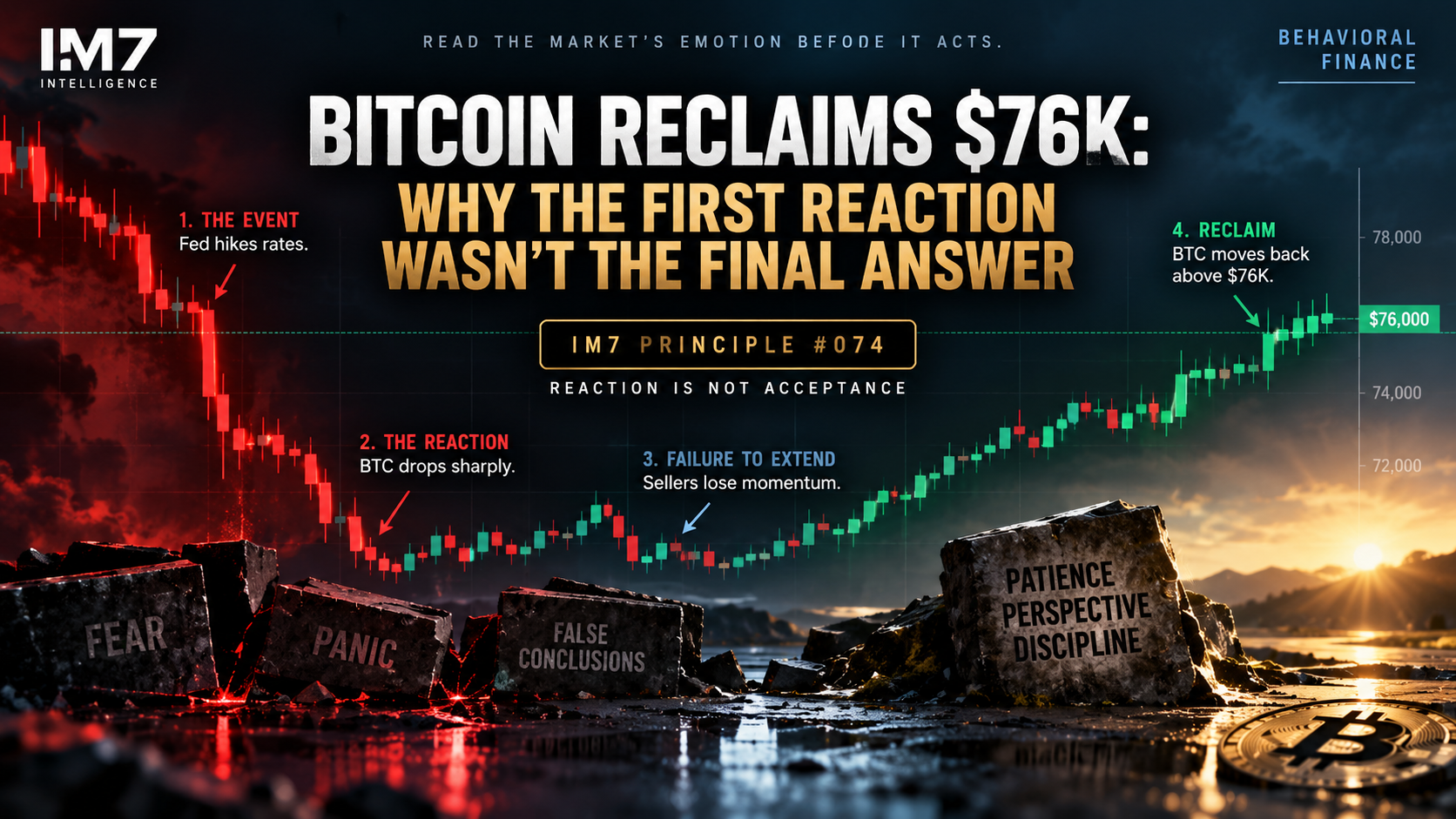
Bitcoin dropped after the Fed decision, giving traders an immediate bearish story to believe. But price later reclaimed the $76K area. The behavioral mistake isn't reacting to new information — it's treating the first reaction as the market's final conclusion. This is why reaction should never be confused with acceptance.
Executive Summary
Bitcoin's first reaction to the latest Fed decision pushed price lower and gave traders an immediate story: hawkish policy meant the move should continue. Instead, BTC later recovered the $76K area, exposing a familiar decision error — treating an initial reaction as if the market had already reached a conclusion. The lesson is not that the rebound is bullish or that the first move was "wrong." It is that reaction and acceptance are different forms of evidence, and disciplined decisions require knowing which one you are observing.
IM7 Principle
IM7 Principle #074 — Reaction Is Not Acceptance
The first move after new information shows how participants initially respond. Acceptance requires something more durable: evidence that the market can continue operating around the new price regime after the emotional reaction has passed.
Market Context
Bitcoin entered the session already dealing with uncertainty around the $76K area.
The Fed decision introduced another piece of information for traders to process. BTC initially moved lower, reinforcing the simplest available interpretation: restrictive policy pressure equals weaker risk assets.
That reaction was real.
What became questionable was the conclusion traders could attach to it.
The subsequent tape recovered from the initial decline and BTC moved back through the $76K area. On the 2-hour chart, the sequence matters more than any individual candle:
news → immediate selloff → failure to extend → recovery → reclaim attempt.
None of those observations independently establishes the next directional move. Together, however, they show that the market's interpretation was still developing after the first reaction.
What The Market Wanted You To Believe
"The first move settled the argument."
A sharp candle following an important event feels unusually authoritative.
The timing creates a powerful causal story: the news happened, price moved, therefore the market has delivered its verdict.
That sequence can encourage traders to stop gathering evidence precisely when evidence is still developing.
Then price recovered.
The recovery does not prove the opposite thesis. It simply demonstrates why the original conclusion was premature.
The first move was information.
It was not yet acceptance.
Behavioral Observation
Watch what happens psychologically when a major headline and a large candle appear together.
Uncertainty suddenly feels smaller.
Traders begin explaining the move almost immediately. The candle becomes evidence for the explanation, and the explanation makes the candle feel even more convincing.
This feedback loop can transform an observation —
"Bitcoin dropped after the announcement."
— into a conclusion —
"The market has decided this is bearish."
The chart provides a useful warning sign: when an event-driven move cannot continue expanding and price begins reclaiming territory from the initial reaction, the original interpretation deserves reassessment.
That does not make the reversal correct.
It means the market has supplied contradictory evidence.
Cognitive Bias Breakdown
This behavior combines recency weighting with premature closure.
Recent, vivid information naturally receives disproportionate attention. A major policy announcement followed immediately by a large candle is both recent and emotionally salient, making it easy to overweight relative to the evidence that existed before it.
Behavioral research has repeatedly shown that people rely heavily on information that is especially available or salient when making judgments Tversky & Kahneman, 1974.
Markets add another problem: traders want uncertainty resolved quickly.
The first coherent explanation therefore becomes psychologically valuable.
Once the explanation feels complete, waiting for additional evidence can feel unnecessary.
But markets do not owe traders immediate narrative closure.
The Professional Read
A disciplined operator separates event, reaction, and acceptance.
The event is what happened.
The reaction is what participants did immediately afterward.
Acceptance is whether subsequent trading behavior supports the new interpretation.
That distinction prevents two opposite mistakes.
The first is chasing the initial move because it feels confirmed.
The second is automatically fading the initial move because "first reactions are usually wrong."
Neither is the lesson.
The professional question is simpler:
Did subsequent price behavior strengthen the initial interpretation, weaken it, or leave the evidence unresolved?
That keeps analysis attached to observable behavior rather than narrative.
Decision Framework
Before treating an event-driven move as meaningful confirmation, ask:
- What actually changed? Separate the event from the story being told about it.
- What was the immediate reaction? Describe price behavior without interpreting it yet.
- Did the move persist? Look for continuation rather than assuming one candle establishes acceptance.
- Did price reclaim the displaced area? A reclaim is contradictory evidence that requires reassessment.
- Am I updating because evidence changed — or because the newest candle feels important?
- What evidence would invalidate my current interpretation? Define it before emotion defines it for you.
Risk Management Lesson
The greatest risk around major events is often not choosing the "wrong" direction.
It is increasing conviction faster than the evidence justifies.
Event volatility can make uncertainty look like confirmation. Position sizing, patience, and confirmation standards should reflect that uncertainty rather than the emotional intensity of the candle.
When information is still being processed, confidence should remain conditional.
IM7 Quote
"Markets don't finish their sentence in one candle."
IM7 Observation
Bitcoin's recovery of the $76K area does not erase the initial selloff, and the initial selloff does not invalidate the recovery.
Both belong to the same information-processing sequence.
The behavioral edge comes from resisting the pressure to declare the sequence finished before the market has demonstrated acceptance.
Yesterday's evidence can change.
Today's interpretation must be allowed to change with it.
IM7 Decision Rule
Never promote an event reaction into confirmation until subsequent price behavior supports the same interpretation.
Treat the first move as evidence to investigate, not a verdict you are required to defend.
How did this land?
What emotion or bias did this article help you recognize?
References
- [1]Tversky, A. & Kahneman, D. (1974). Judgment under Uncertainty: Heuristics and Biases. Science. American Association for the Advancement of Science. DOI: 10.1126/science.185.4157.1124. https://doi.org/10.1126/science.185.4157.1124 (accessed 2026-09-17)
Pass the signal forward.
IM7 Intelligence studies financial markets through the lens of psychology rather than prediction. Our research focuses on behavioral finance, crowd psychology, sentiment, and decision-making to help readers understand why markets move—not just where they move.
IM7 Intelligence publishes educational research on market psychology, behavioral finance, and investor behavior. Nothing published by IM7 Intelligence constitutes financial, investment, tax, or legal advice. Always conduct your own research before making financial decisions.
Read the market's emotion before it acts.
Where this article sits in the map.
- Confirmation BiasYou are here
- Behavioral Finance
- Risk Management
- Fear
Curated paths, not random articles.
Behavior read in real time.

Ismael Mercius
Ismael Mercius is the founder of IM7 Intelligence, where he writes about crypto market psychology, behavioral finance, and the sentiment cycles that drive digital asset prices. His work focuses on how traders actually make decisions — and the recurring errors that show up in their P&L.
- Crypto market psychology
- Behavioral finance
- Market sentiment analysis
- Trader behavior & decision-making