Bitcoin Gave Bulls and Bears Evidence. Both Used It Wrong.
AI Generated • IM7 Intelligence
- Reading time
- 3 min read
- Word count
- 582 words
- Published
Bitcoin is caught between bullish ETF demand and a worsening macro backdrop. The bigger behavioral risk is not choosing the wrong side — it is selectively using evidence to defend the side you already believe.
Bitcoin entered September with both sides convinced they had the better argument.
The bulls had reasons.
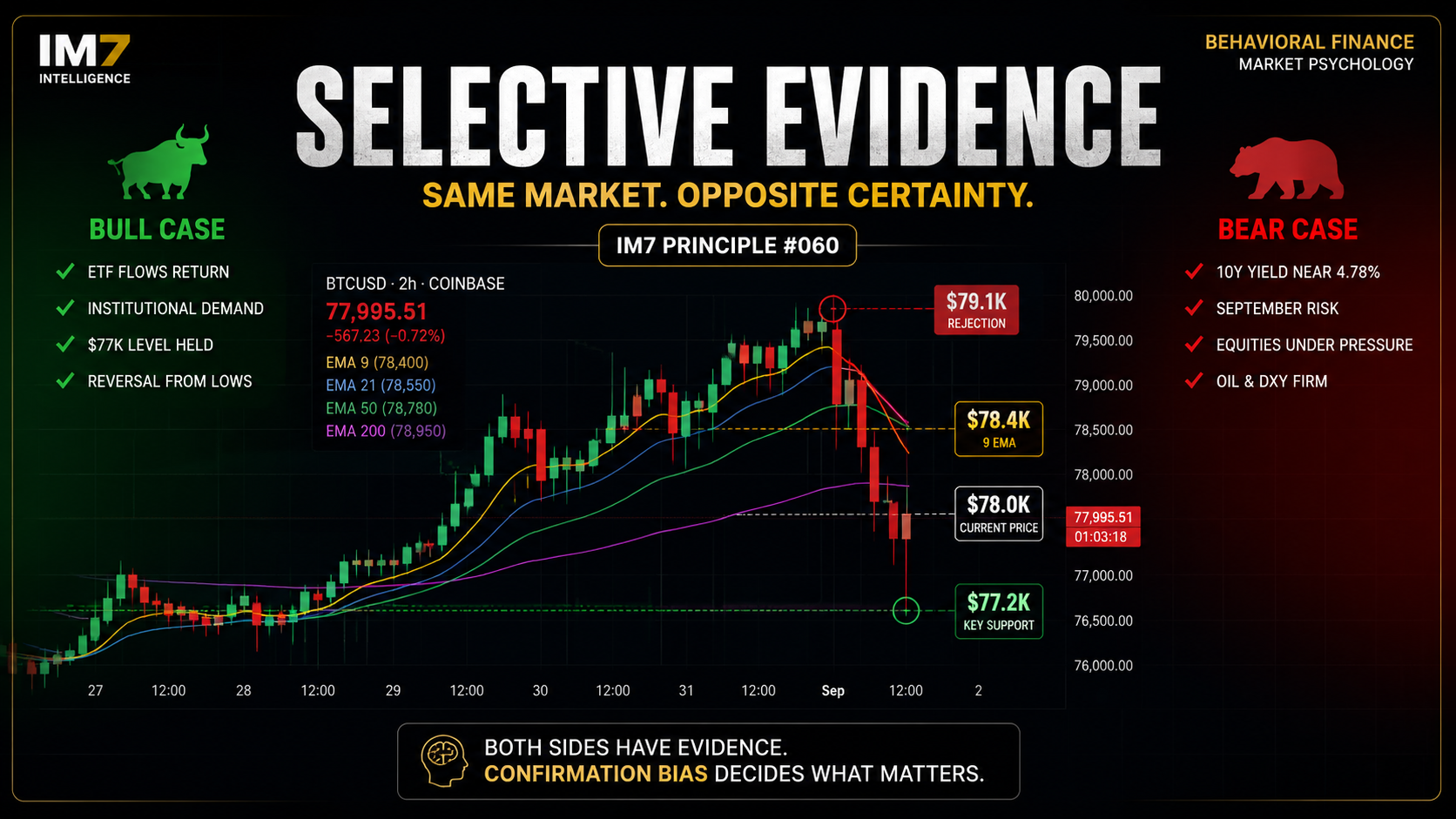
ETF inflows had returned. Strategy continued buying. The $77K area had survived another test.
The bears had reasons too.
Treasury yields were elevated. Equities were under pressure. Oil remained high. The macro backdrop looked increasingly restrictive.
The problem was not that one side had evidence and the other did not.
The problem was that both sides had evidence — and each side was selecting only the part that supported what they already believed.
That is confirmation bias.
IM7 Principle
Selective evidence is not analysis. It is conviction dressed as research.
A trader can look at real data and still reach a distorted conclusion.
The distortion happens when the mind stops asking:
“What does all of the evidence say?”
and starts asking:
“Which evidence proves I was right?”
That difference is small in language and expensive in markets.
What the Chart Is Showing
Bitcoin pushed toward the $79K area before selling back toward $78K to start September.
That reversal matters because the market is still sitting inside an unresolved zone.
The bullish case has not disappeared.
Neither has the bearish case.
Bitcoin has not provided enough structural confirmation for either side to claim certainty.
That is exactly where confirmation bias becomes most dangerous.
When evidence is mixed, traders often become more selective — not less.
The bull notices ETF demand and support holding.
The bear notices rising yields and weak equities.
Both may be looking at legitimate information.
Neither is analyzing the full picture.
The Behavioral Trap
Confirmation bias does not require fake information.
That is what makes it dangerous.
The data can be completely real.
The error is in how the trader weighs it.
A bullish trader may say:
“ETF inflows are back. Demand is clearly strong.”
A bearish trader may say:
“Yields are rising. Bitcoin has to fall.”
Both statements may contain truth.
Neither is enough on its own.
Markets are rarely controlled by a single variable.
When traders reduce a complicated environment to one confirming piece of evidence, confidence can rise faster than understanding.
Same Market. Opposite Certainty.
Imagine two traders opening the same chart.
One immediately looks at institutional demand.
The other immediately looks at macro pressure.
They see the same price.
They see the same candles.
But they walk away with opposite conclusions.
That is not because the market changed between them.
It is because their attention did.
The market did not tell one trader to be bullish and the other to be bearish.
Their existing beliefs decided which evidence felt important.
The Better Question
Instead of asking:
“Which side is right?”
Ask:
“What evidence would force my current view to change?”
That question is harder.
It is also much more useful.
A bullish thesis should have conditions that invalidate it.
A bearish thesis should too.
If no evidence can change your position, you are no longer analyzing the market.
You are defending an identity.
What Matters Next
The highest-value information now is not which narrative sounds strongest.
It is what Bitcoin proves around the current structure.
Can buyers defend the lower support zone?
Can price regain stronger acceptance above the short-term resistance area?
Does leverage rebuild faster than structure improves?
Do macro pressures continue while Bitcoin refuses to break?
Those questions create information.
Certainty does not.
IM7 Rule: selective evidence is not analysis. It is conviction dressed as research.
How did this land?
What emotion or bias did this article help you recognize?
References
- [1]radingView. (2026). BTC/USD 2-Hour Chart.. (accessed September 1, 2026.)
- [2]IM7 Intelligence. (2026). Morning Bitcoin Market Research.. (accessed September 1, 2026.)
- [3]U.S. (2026). spot Bitcoin ETF flow data,. (accessed August 31, 2026.)
- [4]U.S. (2026). Treasury market data, . (accessed September 1, 2026.)
Pass the signal forward.
IM7 Intelligence studies financial markets through the lens of psychology rather than prediction. Our research focuses on behavioral finance, crowd psychology, sentiment, and decision-making to help readers understand why markets move—not just where they move.
IM7 Intelligence publishes educational research on market psychology, behavioral finance, and investor behavior. Nothing published by IM7 Intelligence constitutes financial, investment, tax, or legal advice. Always conduct your own research before making financial decisions.
Read the market's emotion before it acts.
Where this article sits in the map.
- Confirmation BiasYou are here
- Behavioral Finance
- Risk Management
- Fear
Curated paths, not random articles.
Behavior read in real time.

Ismael Mercius
Ismael Mercius is the founder of IM7 Intelligence, where he writes about crypto market psychology, behavioral finance, and the sentiment cycles that drive digital asset prices. His work focuses on how traders actually make decisions — and the recurring errors that show up in their P&L.
- Crypto market psychology
- Behavioral finance
- Market sentiment analysis
- Trader behavior & decision-making