Bitcoin Stopped Falling — Traders Called It Bullish
AI Generated • IM7 Intelligence
- Reading time
- 4 min read
- Word count
- 925 words
- Published
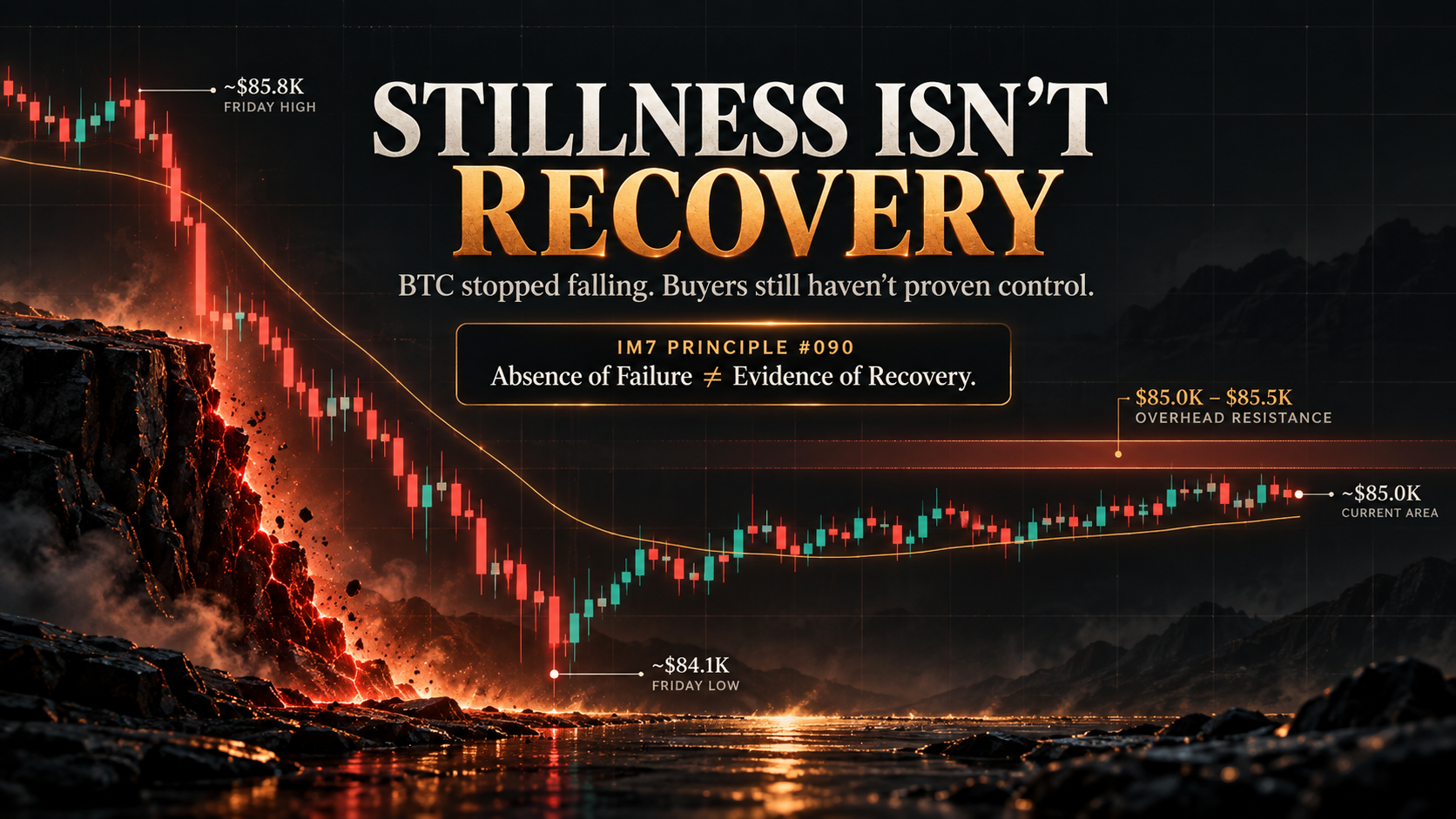
Bitcoin stopped falling after Friday’s sharp flush and spent hours stabilizing around the mid-$84K area. The behavioral trap is treating the absence of further downside as proof that buyers have regained control. Calm can reduce uncertainty without confirming recovery.
Executive Summary
Bitcoin stopped falling after Friday’s sharp rejection and spent much of Saturday stabilizing around the mid-$84K area. That pause reduced fear, but it did not automatically prove that buyers had regained control. The behavioral mistake is subtle: once the market stops delivering negative evidence, traders often start treating the absence of failure as positive confirmation. The next decision should separate stability from recovery and require new evidence before upgrading conviction.
IM7 Principle
IM7 Principle #090 — Absence of Failure ≠ Evidence of Recovery.
A market can stop deteriorating without demonstrating renewed strength. When selling pressure fades, traders often mistake relief from further damage for proof that the underlying structure has improved.
Market Context
Bitcoin entered the weekend after a violent rejection from the upper-$86K region and a sharp move back toward the low-$84K area.
Saturday’s tape looked very different.
Instead of another large directional move, BTC spent hours grinding between roughly $84.4K and $85K through smaller, overlapping candles.
The 2-hour chart showed stabilization.
It did not show a decisive reclaim of the prior breakout area.
The $85K–$85.5K region remained important overhead, while price action became quieter and less directional.
Weekend conditions also matter.
Participation and liquidity are typically thinner than during active weekday sessions, which can make calm price action look more meaningful than it actually is.
The market stopped falling.
That is observable.
The explanation for why it stopped falling is still incomplete.
What The Market Wanted You To Believe
"The recovery is confirmed."
After a fast decline, stillness feels constructive.
Red candles disappear.
Volatility contracts.
Price stops making new lows.
The emotional pressure decreases.
That relief can quickly turn into a story:
“Support held.”
Then:
“Buyers are back.”
Then:
“The recovery has started.”
But those are progressively stronger claims.
The tape only proved the first thing:
the decline paused.
It did not automatically prove the rest.
A market can stop falling because buyers aggressively defend price.
It can also stop falling because sellers temporarily exhaust themselves.
Those are different conditions.
Behavioral Observation
The crowd becomes vulnerable when the market stops doing something painful.
During the decline, traders ask:
“How much lower can this go?”
Once price stabilizes, the question quietly changes:
“Is this the bottom?”
That transition matters.
The mind does not like unresolved conditions.
When fresh bearish evidence disappears, traders often fill the vacuum with a bullish explanation.
On the chart, watch for:
- a sharp decline,
- an initial stabilization zone,
- smaller and overlapping candles,
- reduced downside momentum,
- no decisive reclaim of resistance,
- and increasing confidence despite limited new evidence.
The behavioral trap begins when:
“It stopped getting worse”
becomes:
“It is getting better.”
Those statements are not equivalent.
Cognitive Bias Breakdown
This is a form of substitution under uncertainty.
The difficult question is:
“Have buyers regained enough control to produce a durable recovery?”
That requires multiple pieces of evidence.
The easier question is:
“Did price stop falling?”
The brain substitutes the easier question for the harder one.
If the answer is yes, conviction rises.
That shortcut reduces psychological discomfort, but it can produce a false sense of confirmation.
Tversky and Kahneman showed how people often simplify difficult judgments by relying on easier mental substitutes when uncertainty is high Tversky & Kahneman, 1974.
In trading, that shortcut can turn the absence of bad news into imagined good news.
The Professional Read
A disciplined professional does not ignore stabilization.
Stopping the decline matters.
It is information.
But the professional labels it correctly:
“Downside momentum weakened.”
Not:
“Recovery confirmed.”
That distinction preserves optionality.
The next questions become:
- Can price reclaim overhead resistance?
- Does the market accept higher prices?
- Do pullbacks attract buyers?
- Does strength persist when normal liquidity returns?
- Does the next test produce continuation or another rejection?
The professional read stays narrow until the evidence broadens.
Decision Framework
When a market stops falling, ask:
1. What stopped happening?
- New lows?
- Aggressive selling?
- Volatility expansion?
2. What new positive evidence appeared?
- Strong reclaim?
- Higher highs?
- Successful retest?
- Sustained demand?
3. Am I observing improvement or just relief?
4. Has resistance changed behavior?
- Still rejecting?
- Being accepted?
- Not tested yet?
5. Would I call this recovery if the previous decline had not been emotionally painful?
That last question matters.
Relief can distort interpretation.
Risk Management Lesson
The danger is increasing risk before the structure actually improves.
After a sharp decline, traders often become eager to “catch the recovery” as soon as selling pauses.
That can lead to:
- premature position sizing,
- interpreting chop as accumulation,
- ignoring unresolved resistance,
- using emotional relief as confirmation,
- and treating the absence of new lows as an entry signal.
Risk should expand only when evidence improves.
Not simply when discomfort decreases.
A quieter market may reduce immediate danger.
It does not automatically improve the underlying setup.
IM7 Quote
"The absence of bad news is not the presence of good evidence."
IM7 Observation
Friday delivered dramatic information.
Saturday delivered almost none.
That is exactly why the quieter session is behaviorally interesting.
When price stops falling, the chart leaves a blank space.
The trader’s mind wants to fill it.
Bullish traders call the pause accumulation.
Bearish traders call it exhaustion.
But the professional does not need either story yet.
The market has only shown that the previous selling pressure stopped extending.
That matters.
But it is not the same as proving recovery.
IM7 Decision Rule
Do not upgrade a market from “stable” to “recovering” until new positive evidence appears.
The absence of further failure can reduce concern, but it should not increase conviction by itself.
How did this land?
What emotion or bias did this article help you recognize?
References
- [1]Tversky, A. & Kahneman, D. (1974). Judgment under Uncertainty: Heuristics and Biases. Science. American Association for the Advancement of Science. DOI: 10.1126/science.185.4157.1124. https://www.science.org/doi/10.1126/science.185.4157.1124
- [2]Reuters (2026). Stocks rise after weak US jobs data but bonds resume selling. Reuters. Reuters. https://www.reuters.com/world/china/global-markets-wrapup-1-2026-10-02/
Pass the signal forward.
IM7 Intelligence studies financial markets through the lens of psychology rather than prediction. Our research focuses on behavioral finance, crowd psychology, sentiment, and decision-making to help readers understand why markets move—not just where they move.
IM7 Intelligence publishes educational research on market psychology, behavioral finance, and investor behavior. Nothing published by IM7 Intelligence constitutes financial, investment, tax, or legal advice. Always conduct your own research before making financial decisions.
Read the market's emotion before it acts.
Where this article sits in the map.
- Confirmation BiasYou are here
- Behavioral Finance
- Risk Management
- Fear
Curated paths, not random articles.
Behavior read in real time.

Ismael Mercius
Ismael Mercius is the founder of IM7 Intelligence, where he writes about crypto market psychology, behavioral finance, and the sentiment cycles that drive digital asset prices. His work focuses on how traders actually make decisions — and the recurring errors that show up in their P&L.
- Crypto market psychology
- Behavioral finance
- Market sentiment analysis
- Trader behavior & decision-making