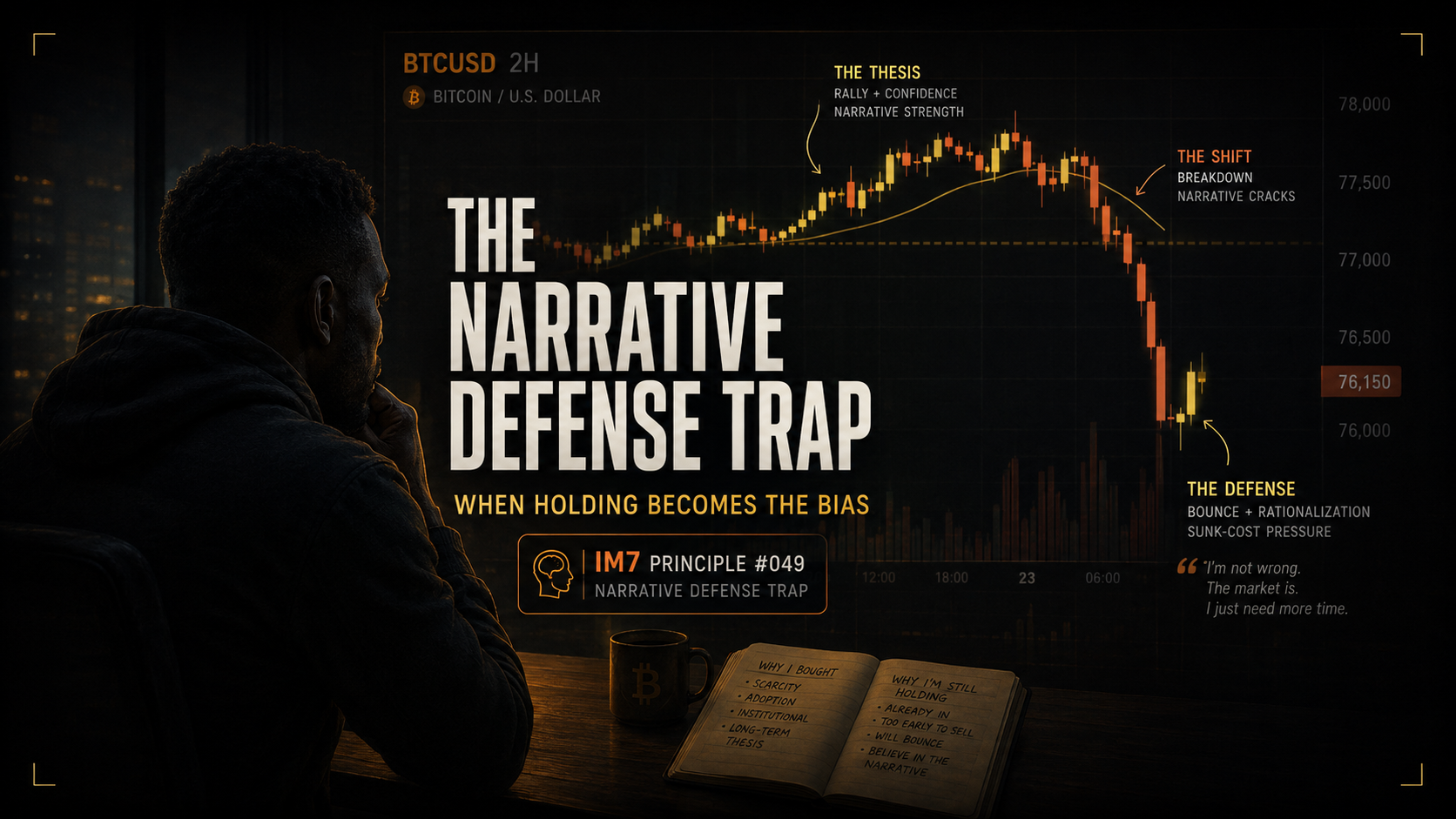
The Cost of Narrative Defense: When Holding Becomes the Bias
AI Generated • IM7 Intelligence
- Reading time
- 14 min read
- Word count
- 2,950 words
- Published
Bitcoin’s sharp pullback has turned yesterday’s narrative defense into a more expensive behavioral problem. When traders hold because exiting would make the loss feel real, sunk cost can replace objective reassessment.
- #anchoring
- #behavioral finance
- #bitcoin
- #bitcoin pullback
- #bitcoin trading
- #breakeven bias
- #confirmation bias
- #decision making
- #IM7 Intelligence
- #loss aversion
- #market psychology
- #market structure
- #narrative defense
- #risk management
- #sunk cost bias
- #sunk cost effect
- #thesis updating
- #trader psychology
- #trading discipline
- #trading psychology
On this page
- Executive Summary
- IM7 Principle #050 — The Cost of Narrative Defense
- Market Context
- Yesterday’s Thesis and Today’s Position Are Different Problems
- Original Question
- Current Question
- What the Trader May Want to Believe
- Chart Concept
- Line 1 — Evidence Supporting the Original Thesis
- Line 2 — Commitment Pressure
- IM7 Read
- Key Takeaway
- Disclaimer
- Behavioral Observation
- Cognitive Bias Breakdown
- In Trading Terms
- Narrative Defense
- Loss Aversion
- Chart Concept
- Current Market Evidence
- Original Entry Price
- Desired Breakeven Price
- Behavioral Distortion
- IM7 Read
- Key Takeaway
- Disclaimer
- Behavioral Model 01 — The Narrative-to-Sunk-Cost Sequence
- 1. Thesis Forms
- 2. Market Rewards the Thesis
- 3. Exposure Expands or Commitment Deepens
- 4. Evidence Changes
- 5. Narrative Defense Begins
- 6. Adverse Movement Increases the Cost
- 7. Sunk-Cost Thinking Appears
- 8. The Past Controls the Next Decision
- Interrupt Question
- Behavioral Model 02 — The Fresh-Decision Test
- Step 1 — Remove History
- Step 2 — Rebuild the Thesis
- Step 3 — Reprice the Risk
- Step 4 — Compare the Decision
- Yes
- No
- Uncertain
- IM7 Rule
- Analysis Mode
- Primary Question
- Attention
- Relationship to Being Wrong
- Risk Behavior
- Goal
- Narrative Defense Mode
- Primary Question
- Attention
- Relationship to Being Wrong
- Risk Behavior
- Goal
- Sunk-Cost Mode
- Primary Question
- Attention
- Relationship to Being Wrong
- Risk Behavior
- Goal
- Diagnostic Question
- The Professional Read
- 1. What happened?
- 2. What does the current structure support?
- 3. What part of my decision is being influenced by my own position history?
- The Breakeven Trap
- Decision Framework
- 1. Perform the No-Position Test
- 2. Identify the Current Thesis
- 3. Separate Loss From Future Risk
- 4. Stop Asking the Market to Repair the Past
- 5. Define What Changes the Decision
- 6. Reassess the Position Independently
- Risk Management Lesson
- What the Bounce Does Not Prove
- What Sunk Cost Is Not
- IM7 Quote
- IM7 Observation
- IM7 Decision Rule
Executive Summary
Bitcoin’s recent sequence has moved through three distinct behavioral phases.
First, strong upside momentum rewarded bullish interpretations.
Second, the pullback introduced conflicting evidence and tested whether traders could update a previously successful thesis.
Now the decision problem has changed again.
After trading near $78,750, Bitcoin retraced sharply and reached an intrabar low near $75,600 before bouncing back toward the mid-$76,000s on the 2-hour chart.
The rally was real.
The subsequent decline was also real.
The behavioral danger emerges when a trader stops evaluating the current trade and begins evaluating how painful it would feel to abandon it.
That transition can sound like:
“The rally is still valid.”
then:
“I’ve already held through most of the drop.”
then:
“Selling now would make the loss real.”
At that point, the original thesis may no longer be the only variable influencing the decision.
Past time, past conviction, previous unrealized profit, and accumulated losses can begin functioning like reasons to continue.
They are not.
This report examines the transition from Narrative Defense into Sunk-Cost Pressure: the moment when preserving a previously rewarded story becomes financially and psychologically expensive.
The central lesson is:
The narrative that made the entry feel right can become the same narrative that makes the exit feel wrong.
IM7 Principle #050 — The Cost of Narrative Defense
The longer a trader defends a previously rewarded thesis after evidence changes, the easier it becomes to treat accumulated time, conviction, and loss as reasons to remain committed.
Narrative Defense protects the story.
Sunk-cost pressure protects what has already been invested in that story.
The distinction matters.
A trader may begin with a legitimate thesis.
That thesis may even be rewarded.
But once conditions change, previous effort and previous correctness have no independent claim on the next decision.
The relevant question is not:
“How much have I already put into this?”
It is:
“Would the evidence available now justify continuing this exposure from here?”
Market Context
Bitcoin recently rallied into approximately the $78,750 region before retracing sharply.
On the current 2-hour chart, observable features include:
- a decline from the recent high,
- multiple large bearish candles,
- an intrabar wick toward approximately $75,600,
- price trading below the short-term 9 EMA during the decline,
- and a subsequent green bounce toward roughly $76,600.
These observations indicate a meaningful change in short-term price structure relative to the recent expansion phase.
They do not, by themselves, prove:
- that the larger bullish thesis has failed,
- that Bitcoin has entered a sustained downtrend,
- that the bounce will fail,
- that sellers have permanent control,
- or what any specific trader should do next.
The relevant behavioral fact is simpler:
A decision made near the recent highs is now being evaluated under materially different market conditions.
That change requires reassessment.
Yesterday’s Thesis and Today’s Position Are Different Problems
One of the easiest mistakes in trading is assuming that proving the original thesis was reasonable also proves the current position should remain open.
It does not.
Consider the distinction.
Original Question
“Was there evidence supporting Bitcoin’s rally?”
There was genuine upside strength.
Current Question
“Does my current exposure still make sense given the evidence available now?”
That question must be answered again.
A previously valid thesis does not automatically validate indefinite exposure.
Markets evolve.
The quality of the original reasoning and the quality of the current holding decision are separate variables.
What the Trader May Want to Believe
After a sharp decline, several narratives can preserve the original position:
“It’s just a shakeout.”
“The rally is still intact.”
“I’ve already held through the worst part.”
“I’ll sell when it gets back to my entry.”
“One green candle and we’re right back.”
Any one of those statements may ultimately prove correct.
That is not the behavioral issue.
The issue is whether those statements emerged from current evidence or from a desire to avoid realizing that the decision environment changed.
A narrative becomes dangerous when its primary function shifts from explaining the market to protecting the position.
Chart Concept
Title: Thesis Strength vs. Commitment Pressure
X-axis: Progression of the Trade
Y-axis: Relative Influence on the Decision
Use two conceptual lines.
Line 1 — Evidence Supporting the Original Thesis
This rises during the rally as price confirms the directional view.
After conditions change, its immediate influence declines or becomes less certain.
Line 2 — Commitment Pressure
Commitment pressure begins relatively low.
It rises as the trader accumulates:
- time in the position,
- emotional attachment,
- unrealized gains or losses,
- previous validation,
- and psychological investment in being correct.
The key behavioral danger appears when:
Commitment pressure becomes stronger than the current evidence supporting the trade.
That is the Sunk-Cost Zone.
IM7 Read
A trade can become psychologically harder to exit at exactly the same time that its current evidence becomes weaker.
Key Takeaway
The amount already invested in a decision does not increase the quality of the decision from this point forward.
Disclaimer
This is an IM7 conceptual framework. Commitment pressure is illustrative and is not measured trader-sentiment data, an empirical probability, or a market forecast.
Behavioral Observation
The current bounce creates an especially useful behavioral test.
After a rapid decline, a green candle can produce relief.
Relief matters because the trader is no longer evaluating the position under maximum immediate pain.
The question becomes:
Does the bounce improve the thesis, or does it simply make continuing to hold feel easier?
Those are different effects.
A bounce can change market structure.
A bounce can also change emotion.
The chart alone cannot tell us which psychological response any individual trader is experiencing.
That is why the process must return to evidence.
Cognitive Bias Breakdown
The central established principle here is the Sunk Cost Effect.
Sunk costs are resources already spent and unrecoverable.
Rationally, they should not determine whether additional resources should be committed.
Behaviorally, they often do.
In Trading Terms
The trader may think:
“I’ve already lost this much.”
“I’ve already waited this long.”
“I was right about the original move.”
“I can’t exit now.”
None of those statements describes the prospective quality of the trade.
They describe its history.
That distinction is fundamental.
Narrative Defense
Narrative Defense adds another layer.
The trader is not merely protecting money already committed.
They may also be protecting:
- the original analysis,
- their confidence,
- the feeling of having understood the market,
- or the identity associated with having been correct.
The decision therefore becomes psychologically expensive to revise.
Loss Aversion
Loss aversion can further amplify the effect.
A realized loss may feel more painful than an equivalent gain feels satisfying.
That can make continuing to hold emotionally preferable even when the trader would not choose the same exposure if starting from cash today.
Chart Concept
Title: Entry Price Is Not a Decision Rule
This chart should distinguish three reference points:
Current Market Evidence
What does the chart support now?
Original Entry Price
Where did the trader enter?
Desired Breakeven Price
Where would the trader prefer to exit without realizing a loss?
The chart should visually show that:
entry price and breakeven preference are psychologically important but do not themselves change market structure.
Behavioral Distortion
As price moves below entry, the trader may increasingly anchor decisions to:
“I’ll sell when I get back to even.”
But the market has no obligation to return to the trader’s cost basis.
The correct analytical question remains:
“Would I initiate or maintain this exposure at the current price given the evidence now?”
IM7 Read
Your entry price matters to your P&L.
It does not become support simply because you bought there.
Key Takeaway
Breakeven is a personal accounting level, not automatically a market signal.
Disclaimer
This is an IM7 conceptual behavioral chart for educational use. It does not claim that any specific price level is support or resistance and does not constitute investment advice.
Behavioral Model 01 — The Narrative-to-Sunk-Cost Sequence
1. Thesis Forms
A trader develops a directional view.
“Bitcoin is showing strong upside momentum.”
↓
2. Market Rewards the Thesis
Price moves favorably.
Confidence increases.
↓
3. Exposure Expands or Commitment Deepens
The trader:
- holds longer,
- enters later,
- increases conviction,
- or becomes more attached to the outcome.
↓
4. Evidence Changes
Price retraces.
Short-term structure deteriorates relative to the previous expansion.
↓
5. Narrative Defense Begins
The internal question shifts from:
“What is the market doing now?”
to:
“Why should the original rally still be valid?”
↓
6. Adverse Movement Increases the Cost
The position becomes more uncomfortable.
Exiting now feels worse than exiting earlier would have.
↓
7. Sunk-Cost Thinking Appears
The trader thinks:
“I’ve already held this far.”
“I can’t sell here.”
“I need it to get back to my entry.”
↓
8. The Past Controls the Next Decision
The decision is now influenced by money, time, and conviction already committed rather than only by prospective evidence.
Interrupt Question
“If I had no position right now, would I deliberately choose this exact exposure at this price, with this risk?”
That is one of the cleanest ways to expose sunk-cost influence.
If the answer is no, then:
“But I’m already in it”
is not sufficient justification for continuing.
Behavioral Model 02 — The Fresh-Decision Test
Every holding decision should be temporarily reframed as a new decision.
Step 1 — Remove History
Ignore:
- entry price,
- previous profit,
- previous loss,
- how long the trade has been open,
- and whether the original thesis was once correct.
Ask:
“What do I see right now?”
Step 2 — Rebuild the Thesis
Identify:
- current structure,
- current momentum,
- current invalidation,
- current volatility,
- current reward-to-risk,
- and relevant external evidence.
Ask:
“What does the current evidence support?”
Step 3 — Reprice the Risk
Ask:
“If I opened this exposure now, how much risk would I deliberately accept?”
If that number differs substantially from the risk currently being carried, the position deserves review.
Step 4 — Compare the Decision
Ask:
“Would I enter this trade now?”
Possible answers:
Yes
The current evidence independently supports the exposure.
Continue according to process.
No
The position is being maintained for reasons that may no longer justify a fresh entry.
Reassess according to the strategy.
Uncertain
Reduce confidence.
Uncertainty itself is information.
IM7 Rule
Every open trade must periodically earn the right to remain open.
Past validation does not grant permanent permission.
I do think a third model is justified for this article, because it performs a distinct diagnostic job rather than repeating the first two.
Use a three-column comparison.
Analysis Mode
Primary Question
“What does the current evidence support?”
Attention
Current structure.
Relationship to Being Wrong
Accepts revision.
Risk Behavior
Adjusts with evidence.
Goal
Accuracy.
Narrative Defense Mode
Primary Question
“Why should my original thesis still be right?”
Attention
Evidence preserving the story.
Relationship to Being Wrong
Resists revision.
Risk Behavior
May delay adaptation.
Goal
Protect the thesis.
Sunk-Cost Mode
Primary Question
“How can I avoid wasting what I’ve already lost or invested?”
Attention
Entry price, past loss, time invested, breakeven.
Relationship to Being Wrong
Exiting feels like making the previous cost permanent.
Risk Behavior
May remain exposed because leaving feels too painful.
Goal
Recover the past.
Diagnostic Question
Ask:
“Am I protecting the process, protecting the story, or trying to recover what is already gone?”
That single question can identify which mental mode is driving the decision.
The Professional Read
A disciplined operator does not automatically interpret a sharp decline as proof that the entire bullish thesis has failed.
They also do not automatically interpret a bounce as proof that the prior thesis has recovered.
Instead, they separate three questions:
1. What happened?
Bitcoin rallied and subsequently retraced materially.
2. What does the current structure support?
That must be evaluated using current evidence.
3. What part of my decision is being influenced by my own position history?
This is the behavioral question.
Professionals understand that:
The market does not know your entry price.
It does not know:
- where you bought,
- what you previously earned,
- what you lost,
- or where you need price to return to feel whole.
Those are personal reference points.
They matter for accounting and risk management.
They do not automatically matter to the market.
The Breakeven Trap
One of the most common sunk-cost expressions is:
“I’ll just wait until I get back to even.”
Breakeven feels neutral.
Psychologically, it is not.
It can become a powerful anchor because exiting at zero feels fundamentally different from accepting a loss.
But imagine a trader with no position.
Would that trader say:
“This price is attractive because someone else happened to buy here earlier?”
Probably not.
That illustrates the problem.
The trader’s entry price has become part of the decision even though it may have no relevance to current market structure.
Decision Framework
1. Perform the No-Position Test
Ask:
“If I were completely flat, what would I do here?”
Do not automatically copy the answer.
Use the discrepancy as information.
2. Identify the Current Thesis
Write one sentence:
“I am still holding because…”
Then inspect the reason.
Evidence-based answers reference current conditions.
Sunk-cost answers frequently reference history.
Examples:
Evidence-based:
“The structure still meets the conditions defined by my strategy.”
Potential sunk-cost reasoning:
“I’ve already held this far.”
3. Separate Loss From Future Risk
The loss already incurred or currently unrealized is not identical to the risk remaining from this moment forward.
Ask:
“What can I still lose from here?”
That is the prospective risk.
4. Stop Asking the Market to Repair the Past
A trade should not be maintained solely because the trader wants price to restore:
- breakeven,
- pride,
- previous profit,
- or the original thesis.
Markets do not perform psychological repairs.
5. Define What Changes the Decision
Specify:
- what would strengthen the thesis,
- what would weaken it,
- what would invalidate it,
- and what evidence would justify continued exposure.
Without those conditions, “holding” can become the default rather than a deliberate decision.
6. Reassess the Position Independently
Treat the current position as though someone handed it to you today.
Would you keep it?
Reduce it?
Exit it?
Add to it?
The point is not that one answer is universally correct.
The point is forcing the decision to compete against current evidence rather than historical commitment.
Risk Management Lesson
Sunk-cost pressure is especially dangerous because it can distort risk precisely when risk is already increasing.
A trader may respond to a deteriorating position by:
- widening a stop,
- removing a stop,
- adding exposure to lower the average entry,
- waiting for breakeven,
- rejecting new evidence,
- or turning a short-term trade into a long-term investment.
None of those actions is automatically irrational.
Each can exist inside a legitimate strategy.
The behavioral warning appears when the reason changes from:
“My strategy explicitly calls for this.”
to:
“I need this trade to work.”
Need is not evidence.
What the Bounce Does Not Prove
The current bounce does not automatically prove:
- that the decline is finished,
- that the bullish trend has resumed,
- that recent lows will hold,
- or that the previous thesis has been restored.
Likewise, the decline does not automatically prove:
- that the broader rally was false,
- that Bitcoin must continue lower,
- or that bullish exposure is necessarily incorrect.
The disciplined conclusion is narrower:
A bounce creates new information and a new decision point.
It does not remove the need to reassess.
What Sunk Cost Is Not
Sunk cost should not be used as a simplistic accusation whenever someone continues holding a losing position.
Holding can be completely rational when:
- the thesis remains intact,
- risk remains within predefined limits,
- the strategy expected volatility of this magnitude,
- and the current evidence still supports the trade.
The behavioral problem is not:
“The position is losing, therefore holding is biased.”
The behavioral problem is:
“I would no longer choose this exposure based on current evidence, but I continue primarily because of what I have already invested in it.”
That is a much higher standard.
IM7 Quote
“The narrative that made the entry feel right can become the same narrative that makes the exit feel wrong.”
“Past commitment is history. Current risk is a decision.”
IM7 Observation
Narrative Defense becomes especially difficult once money is attached to it.
Before the trade, changing your mind costs almost nothing.
After entry, changing your mind may mean accepting:
- a loss,
- a missed opportunity,
- a flawed execution,
- or the possibility that a previously successful interpretation no longer applies.
That creates psychological friction.
The more the position moves against the trader, the easier it can become to think about what has already happened rather than what happens next.
That is how a market thesis becomes a sunk-cost problem.
The solution is not automatic selling.
The solution is fresh evaluation.
The trader must repeatedly separate:
what happened before
from
what is justified now.
The rally was real.
The drop was real.
The bounce is real.
None of those facts gets permanent authority over the next decision.
IM7 Decision Rule
Do not use what you have already invested as evidence for what you should risk next.
Ask:
If I had no position right now, would I choose this exact exposure?
Then ask:
What does the current evidence support?
And finally:
What risk am I accepting from this moment forward?
If the only argument for staying is:
“I’ve already held this far,”
then the past may be controlling a decision that belongs to the present.
Reassess the trade.
>
Do not ask the market to repay your history.
How did this land?
What emotion or bias did this article help you recognize?
- #anchoring
- #behavioral finance
- #bitcoin
- #bitcoin pullback
- #bitcoin trading
- #breakeven bias
- #confirmation bias
- #decision making
- #IM7 Intelligence
- #loss aversion
- #market psychology
- #market structure
- #narrative defense
- #risk management
- #sunk cost bias
- #sunk cost effect
- #thesis updating
- #trader psychology
- #trading discipline
- #trading psychology
References
- [1]Arkes, H. R., & Blumer, C. (1985). The Psychology of Sunk Cost. Organizational Behavior and Human Decision Processes,.
- [2]Kahneman, D., & Tversky, A. (1979). Prospect Theory: An Analysis of Decision under Risk. Econometrica,.
- [3]Nickerson, R. S. (1988). Confirmation Bias: A Ubiquitous Phenomenon in Many Guises. Review of General Psychology, .
Pass the signal forward.
IM7 Intelligence studies financial markets through the lens of psychology rather than prediction. Our research focuses on behavioral finance, crowd psychology, sentiment, and decision-making to help readers understand why markets move—not just where they move.
IM7 Intelligence publishes educational research on market psychology, behavioral finance, and investor behavior. Nothing published by IM7 Intelligence constitutes financial, investment, tax, or legal advice. Always conduct your own research before making financial decisions.
Read the market's emotion before it acts.
Where this article sits in the map.
- Confirmation BiasYou are here
- Behavioral Finance
- Risk Management
- Fear
Curated paths, not random articles.
Behavior read in real time.

Ismael Mercius
Ismael Mercius is the founder of IM7 Intelligence, where he writes about crypto market psychology, behavioral finance, and the sentiment cycles that drive digital asset prices. His work focuses on how traders actually make decisions — and the recurring errors that show up in their P&L.
- Crypto market psychology
- Behavioral finance
- Market sentiment analysis
- Trader behavior & decision-making