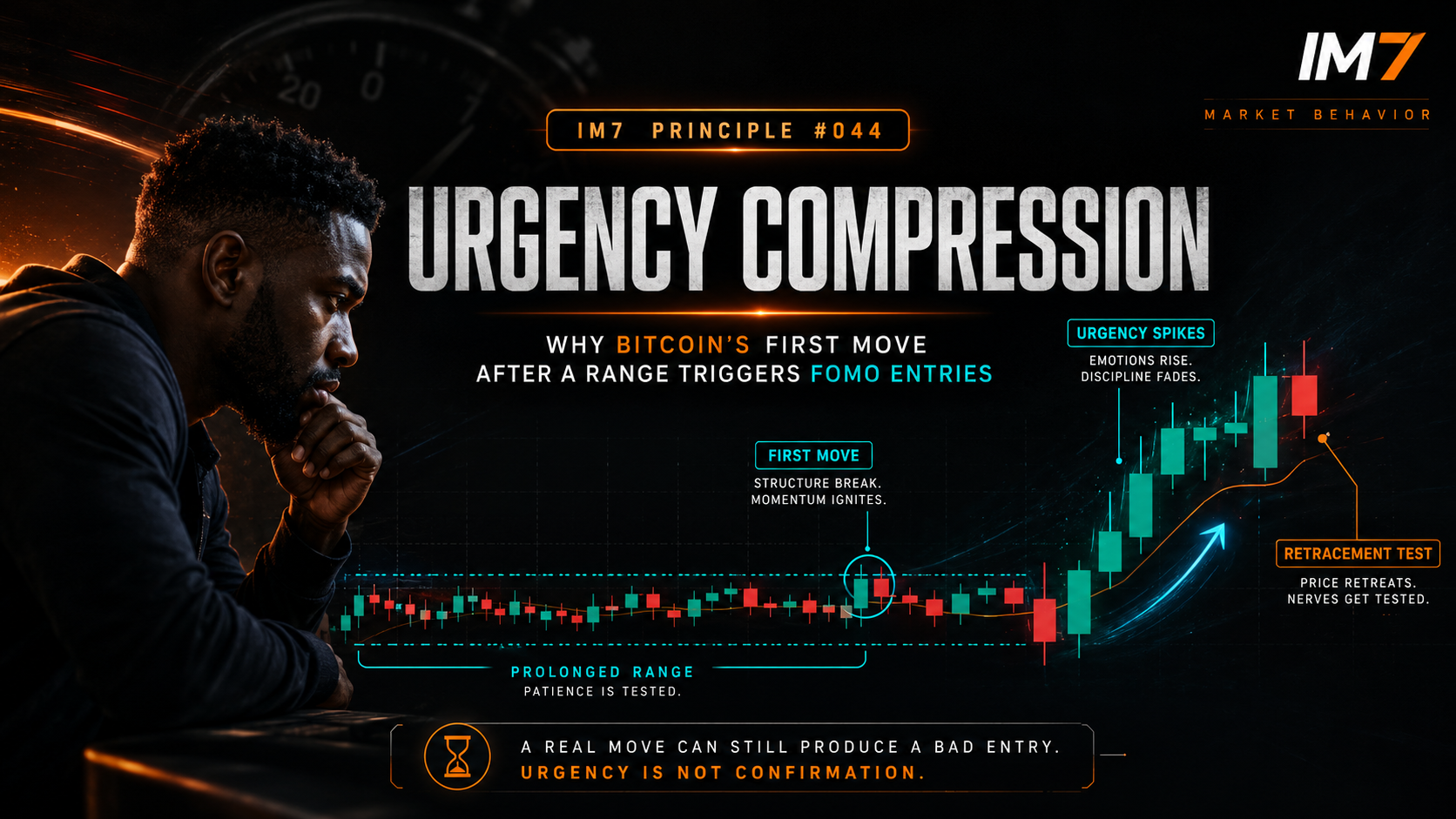
Urgency Compression: Why Bitcoin’s First Move After a Range Triggers FOMO Entries
- Reading time
- 11 min read
- Word count
- 2,330 words
- Published
After weeks of consolidation, a few green Bitcoin candles can make waiting feel unbearable. The move may be real, but urgency can still turn the first available entry into a poor one. A real move does not automatically make the first entry a good entry.
On this page
- Executive Summary
- IM7 Principle #044 — The Patience Fallacy
- Market Context
- What the chart establishes
- What the chart does not establish
- What the Trader Wants to Believe
- Behavioral Observation
- When the Market Accelerates, Decision Time Compresses
- Patience
- Urgency
- IM7 Read
- Cognitive Bias Breakdown
- Action Bias
- Fear of Missing Out
- Recency and Salience
- Stage 1 — Waiting
- Stage 2 — Expansion
- Stage 3 — Salience
- Stage 4 — FOMO
- Stage 5 — Threshold Reduction
- Stage 6 — Rapid Entry
- Stage 7 — Decision Test
- Interrupt Point
- The Professional Read
- Question 1
- Question 2
- Being Right About Direction Does Not Validate Execution
- Correct Direction + Poor Entry
- IM7 Read
- Decision Framework
- 1. Define Entry Conditions Before Expansion
- 2. Identify What Actually Changed
- 3. Re-Test the Original Standard
- 4. Separate Direction From Entry
- 5. Audit Urgency
- The Price Changed Gradually. The Interpretation Changed Rapidly.
- Candle 1
- Candle 2
- Candle 3
- Red Candle
- IM7 Read
- Risk Management Lesson
- Market Speed
- Psychological Speed
- Decision Error
- Professional Alternative
- IM7 Rule
- IM7 Quote
- IM7 Observation
- Scenario A
- Scenario B
- Correct Evaluation
- IM7 Read
- IM7 Decision Rule
- “What changed in the market?”
- “What changed in me?”
Executive Summary
After an extended period of Bitcoin consolidation, price finally expanded.
Several strong green candles pushed Bitcoin from roughly $62.6K toward $63.6K before a large red candle retraced a meaningful portion of that move.
The expansion was real.
But a real market move does not automatically make the first available entry a good one.
Prolonged waiting creates a second variable that does not appear directly on the chart: psychological pressure.
A trader can spend days or weeks maintaining discipline, only to accelerate the decision process when price finally becomes exciting.
IM7 defines this mechanism as Urgency Compression:
Accumulated waiting can accelerate a decision faster than new evidence justifies.
The danger is not necessarily being wrong about direction.
The danger is allowing the fear of missing a valid move to weaken the standards used to enter it.
Three weeks of discipline can disappear in three green candles.
IM7 Principle #044 — The Patience Fallacy
Time spent waiting is not evidence accumulated. Prolonged uncertainty can increase the pressure to act without improving the quality of the underlying setup.
Urgency Compression represents the next stage of the Patience Fallacy.
During consolidation, prolonged waiting can make inactivity increasingly uncomfortable.
When price finally expands, that stored pressure does not automatically disappear.
It can convert into urgency.
The trader who previously demanded confirmation may suddenly feel that waiting for additional evidence creates a greater risk:
missing the move entirely.
That psychological transition can occur much faster than the underlying evidence improves.
Market Context
Bitcoin recently produced a clear short-term expansion from approximately $62.6K toward $63.6K.
The visible sequence included several consecutive bullish 2-hour candles following a quieter period of price action.
Price then printed a large bearish candle that retraced a substantial portion of the most recent upward push, bringing Bitcoin back toward approximately $63.25K.
What the chart establishes
- Bitcoin produced several consecutive bullish candles.
- The move represented a meaningful increase in short-term directional movement.
- Price reached approximately $63.6K during the sequence.
- A subsequent bearish candle retraced part of the advance.
- The retracement does not, by itself, establish whether the broader move will continue or fail.
What the chart does not establish
The visible price action alone cannot tell us:
- why individual participants entered;
- whether buying was primarily driven by FOMO;
- whether the pullback represents a failed breakout, ordinary volatility, or a future retest;
- whether the next move will be higher or lower.
That distinction matters.
IM7 analyzes the behavioral risk created by the setup without pretending the chart reveals the internal state of every participant.
What the Trader Wants to Believe
“I waited this long. I’m not missing it now.”
This belief contains the core psychological tension.
One strong green candle attracts attention.
A second creates momentum.
A third can transform observation into urgency.
The market may genuinely be changing.
But something else can change simultaneously:
the amount of evidence the trader is willing to accept before acting.
That creates a dangerous overlap between a valid market event and an increasingly emotional decision process.
The question is no longer simply:
“Is Bitcoin moving?”
The better question becomes:
“Has the quality of my entry improved as quickly as my desire to participate?”
Those are not the same thing.
Behavioral Observation
The important sequence is not simply:
consolidation → expansion → retracement.
Behaviorally, it can become:
waiting → attention → urgency → rationalization → action.
The first strong candle changes the emotional environment.
Additional bullish candles make the move increasingly visible.
For someone who has already spent significant time watching the range, each additional candle can increase the perceived cost of remaining on the sidelines.
The internal dialogue changes rapidly:
Before the move: “I’ll wait for confirmation.”
First candle: “Something is happening.”
Second candle: “This might finally be it.”
Third candle: “I’m going to miss it.”
That is Urgency Compression.
The market becomes faster, and the trader allows the reasoning process to become faster with it.
The subsequent red candle does not prove the move was false.
It demonstrates why market direction and entry quality must be evaluated independently.
When the Market Accelerates, Decision Time Compresses
This chart compares two psychological variables across prolonged consolidation and the eventual price expansion.
X-axis: Time / market progression Y-axis: Relative psychological intensity
Patience
During the early range, patience remains relatively high.
As inactivity persists, maintaining the same level of restraint can become increasingly difficult.
Urgency
Urgency remains relatively low while price is inactive.
Once directional candles appear, urgency can rise rapidly.
The critical point occurs when:
urgency accelerates faster than evidence quality.
IM7 Read
The market finally became more active. That does not automatically mean the decision should become less deliberate.
Key annotation: Market movement accelerates → decision time compresses
Cognitive Bias Breakdown
Urgency Compression is an IM7 behavioral mechanism, not an established academic cognitive bias.
The mechanism can be understood through several established behavioral concepts.
Action Bias
Action bias describes situations in which taking action can become psychologically preferable to remaining inactive, even when additional action is not necessarily justified by the available evidence.
During prolonged market inactivity, the desire to finally participate can become stronger once movement appears.
The important distinction is not that all trading is action bias.
It is that the desire to act can begin influencing the evidence threshold required to justify action.
Fear of Missing Out
FOMO introduces another pressure:
“What if the opportunity disappears before I participate?”
The trader is no longer evaluating only the risk of entering.
They are also experiencing the perceived risk of not entering.
That changes the decision frame.
A trade that previously required more confirmation can suddenly feel urgent because every additional candle appears to reduce the remaining opportunity.
Recency and Salience
Several strong directional candles are visually and psychologically prominent.
They can dominate attention because they are more dramatic than the quieter candles that preceded them.
The recent movement becomes easier to remember, easier to emotionally weight, and easier to extrapolate.
That does not mean the move is invalid.
It means the trader must distinguish:
new information
from
new emotional intensity.
Stage 1 — Waiting
Market: Low directional activity Trader: Patient, selective Thought: “I’ll wait for confirmation.”
↓
Stage 2 — Expansion
Market: First strong directional candle Trader: Attention rises Thought: “Something is happening.”
↓
Stage 3 — Salience
Market: Additional green candles Trader: Opportunity becomes increasingly visible Thought: “This might finally be it.”
↓
Stage 4 — FOMO
Market: Price continues moving without the trader Trader: Remaining inactive begins feeling costly Thought: “I’m going to miss it.”
↓
Stage 5 — Threshold Reduction
The original entry criteria begin weakening.
Evidence that previously would have been considered incomplete starts feeling sufficient.
↓
Stage 6 — Rapid Entry
The trader acts primarily because the perceived cost of waiting has increased.
↓
Stage 7 — Decision Test
The first meaningful retracement arrives.
The trader now discovers whether conviction came from:
structure
or
urgency.
Interrupt Point
Before execution, ask:
“Would I take this exact entry if I had not spent weeks waiting for this move?”
If the answer changes because of the waiting period, psychological pressure has entered the decision.
The Professional Read
A disciplined trader does not need to deny that the move is meaningful.
The professional separates two questions.
Question 1
Did market conditions change?
The strong bullish sequence suggests that short-term price behavior changed relative to the preceding quieter structure.
Question 2
Does that change justify this exact entry, at this exact location, under this exact risk structure?
That requires a separate judgment.
The first question concerns directional information.
The second concerns execution quality.
Professionals do not automatically require an arbitrary number of confirmation candles, a mandatory retest, or one universal breakout pattern.
Different strategies legitimately use different entry criteria.
The discipline lies elsewhere:
The standards applied after price accelerates should not become weaker simply because the trader is afraid of missing the move.
A real breakout can still be chased.
A correct directional thesis can still produce poor execution.
And a profitable trade can still originate from a flawed decision process.
Being Right About Direction Does Not Validate Execution
Market direction and entry quality should be treated as separate variables.
| | Good Entry | Poor Entry | | --------------------- | ------------------------------------- | ---------------------------------- | | Correct Direction | Strong process + favorable outcome | Right direction, weak execution | | Wrong Direction | Controlled risk + disciplined process | Weak process + unfavorable outcome |
The most deceptive quadrant is:
Correct Direction + Poor Entry
A trader may chase a move, receive a favorable outcome, and conclude that the decision was good because the market continued higher.
That creates a dangerous lesson.
The result can validate behavior that should have been questioned.
IM7 Read
Correct direction does not automatically equal correct execution.
The quality of a decision must be evaluated independently from what happens afterward.
Decision Framework
1. Define Entry Conditions Before Expansion
Determine what constitutes a valid entry while emotions are relatively neutral.
Possible criteria may include:
- market structure;
- acceptance beyond a predefined level;
- momentum conditions;
- invalidation point;
- minimum risk-to-reward;
- strategy-specific confirmation.
The exact criteria depend on the trading system.
The important part is defining them before urgency appears.
2. Identify What Actually Changed
Ask:
“What new market information exists now?”
Price moving quickly is new information.
Feeling afraid of missing the move is not.
Keep the two separate.
3. Re-Test the Original Standard
Would this exact setup qualify if you had opened the chart five minutes ago?
If the answer is no, ask why watching the market for several weeks should make weaker evidence acceptable.
Elapsed time alone should not rewrite the strategy.
4. Separate Direction From Entry
A bullish thesis does not mean every bullish candle is a good buying location.
A trader can be:
right about direction
and
wrong about execution.
That distinction protects the process from outcome bias.
5. Audit Urgency
Before acting, ask:
“Am I entering because the setup improved—or because I am afraid the opportunity will leave without me?”
The question does not prohibit action.
It identifies what is driving it.
The Price Changed Gradually. The Interpretation Changed Rapidly.
Candle 1
Price: First meaningful push Internal interpretation: “Interesting.”
Candle 2
Price: Continuation Internal interpretation: “It’s moving.”
Candle 3
Price: Additional continuation Internal interpretation: “I’m going to miss it.”
Red Candle
Price: Partial retracement Internal interpretation: “Did I just chase?”
IM7 Read
The candles changed.
But the psychological meaning assigned to each candle may have changed even faster.
Urgency can compound faster than evidence.
Risk Management Lesson
Urgency Compression creates a risk-management problem because emotional acceleration can weaken selectivity.
The strongest concern is not that every FOMO-driven trader automatically:
- increases position size;
- widens stops;
- abandons risk limits.
Those outcomes cannot be assumed.
The more defensible risk is simpler:
A lower-quality entry may receive capital before the trader completes the same evaluation normally required by the strategy.
That can affect:
- entry location;
- risk-to-reward;
- invalidation clarity;
- selectivity;
- willingness to remain flat;
- consistency of execution.
Risk allocation should remain tied to predefined account risk and strategy criteria.
It should not increase merely because price has become exciting.
Urgency Compression creates two different speeds.
Market Speed
Price begins moving quickly.
↓
Psychological Speed
Fear of missing the move rises even faster.
↓
Decision Error
The trader assumes:
faster market = faster decision required
But those variables are not automatically linked.
Professional Alternative
Fast market
does not require
careless reasoning.
The trader may legitimately need to make a timely decision.
But speed and discipline are not opposites.
IM7 Rule
Do not let the speed of the market determine the quality of your reasoning.
IM7 Quote
“Three weeks of discipline can disappear in three green candles.”
“The market finally moved. The mistake was assuming the first move had to be your entry.”
IM7 Observation
The most important distinction in this Bitcoin sequence is between:
market validity
and
entry validity.
The bullish expansion may eventually prove meaningful.
The red candle may eventually prove temporary.
The market may continue higher, return to the previous range, or produce a different structure entirely.
None of those future outcomes change the behavioral lesson.
A trader can correctly identify that market conditions are changing and still enter from urgency rather than process.
That matters because profitable outcomes can hide poor decision quality.
If a rushed entry happens to work, the trader may learn:
“When Bitcoin starts moving after a long range, I need to get in immediately.”
The next market may punish that lesson.
Professional decision-making therefore evaluates the process independently from the outcome.
A real move can still produce a bad entry.
Scenario A
Poor process → rushed entry → profitable outcome
Danger: Bad behavior gets reinforced.
Scenario B
Strong process → disciplined entry → losing outcome
Danger: Good behavior gets abandoned because one trade failed.
Correct Evaluation
Judge:
Was the decision supported by the predefined evidence available at the time?
Not:
Did the trade make money?
IM7 Read
Outcome determines P&L. Process determines whether the behavior deserves to be repeated.
IM7 Decision Rule
Never let accumulated waiting become part of the evidence for entering.
When a market finally moves after prolonged consolidation, ask:
“What changed in the market?”
Then ask:
“What changed in me?”
Do not confuse the two.
And before committing capital:
“Would I take this exact entry if I had not spent weeks waiting for it?”
If the answer is no, the waiting period may be influencing the decision more than the setup itself.
Three weeks of waiting does not make the first candle the right entry.
It only makes it feel more urgent.
How did this land?
What emotion or bias did this article help you recognize?
References
- [1]Baron, J., & Ritov, I. (2004). Action bias in decision making. Journal of Behavioral Decision Making.
- [2]Panchen, A. (2017). Fear of Missing Out (FOMO): A serious problem, but how can we help?. The Psychologist. British Psychological Society. https://thepsychologist.bps.org.uk/volume-30/august-2017/fear-missing-out-fomo-serious-problem-how-can-we-help
- [3]Kahneman, D., & Tversky, A. (1974). Judgment under uncertainty: Heuristics and biases. Science. DOI: 10.1126/science.185.4157.1124.
Pass the signal forward.
IM7 Intelligence studies financial markets through the lens of psychology rather than prediction. Our research focuses on behavioral finance, crowd psychology, sentiment, and decision-making to help readers understand why markets move—not just where they move.
IM7 Intelligence publishes educational research on market psychology, behavioral finance, and investor behavior. Nothing published by IM7 Intelligence constitutes financial, investment, tax, or legal advice. Always conduct your own research before making financial decisions.
Read the market's emotion before it acts.
Where this article sits in the map.
- Confirmation BiasYou are here
- Behavioral Finance
- Risk Management
- Fear
Curated paths, not random articles.
Behavior read in real time.

Ismael Mercius
Ismael Mercius is the founder of IM7 Intelligence, where he writes about crypto market psychology, behavioral finance, and the sentiment cycles that drive digital asset prices. His work focuses on how traders actually make decisions — and the recurring errors that show up in their P&L.
- Crypto market psychology
- Behavioral finance
- Market sentiment analysis
- Trader behavior & decision-making