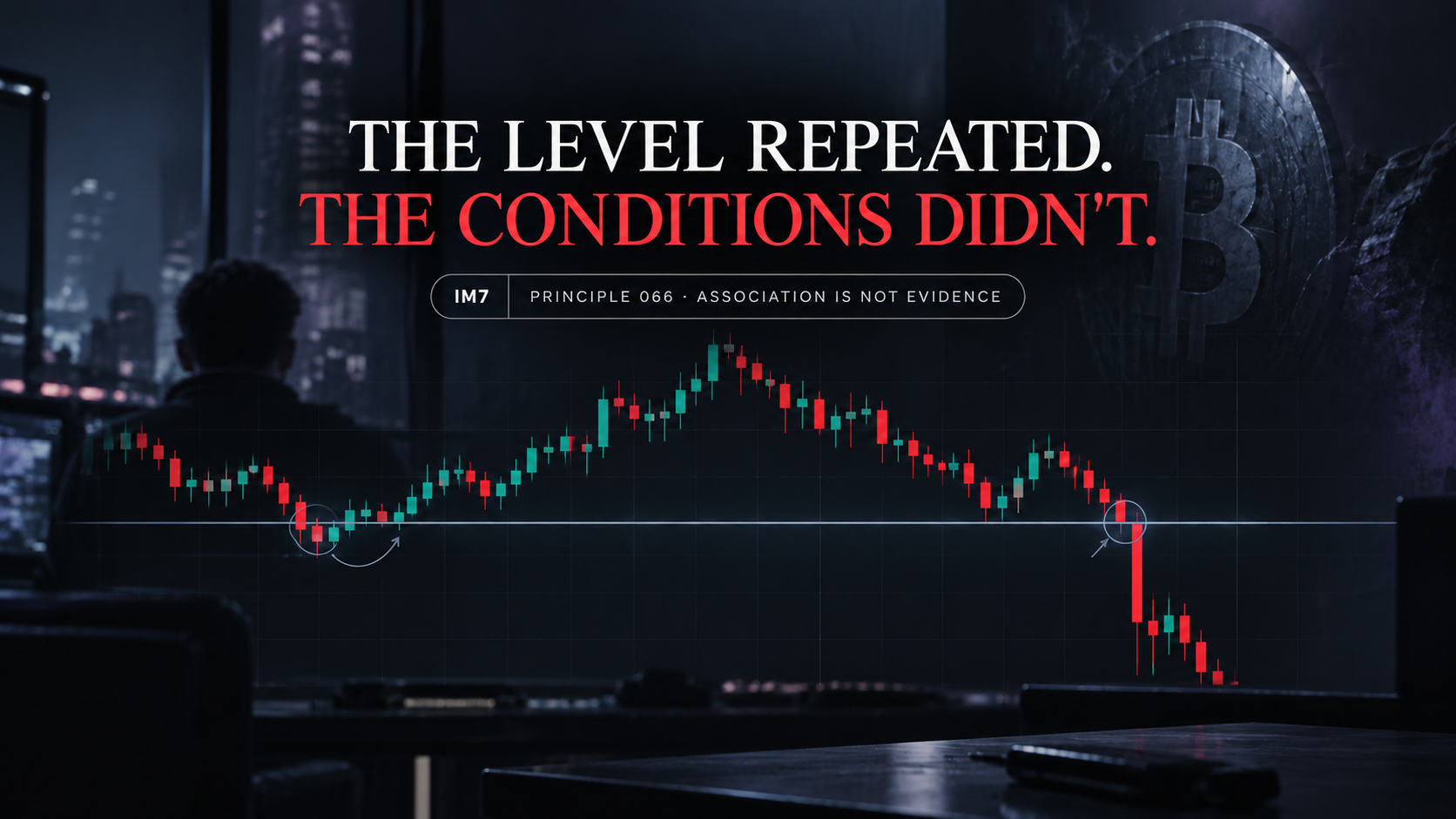
Bitcoin’s $77.3K Breakdown: The Level Repeated, the Conditions Didn’t
AI Generated • IM7 Intelligence
- Reading time
- 3 min read
- Word count
- 544 words
- Published
Bitcoin broke $77.3K after holding the same zone the day before, exposing the danger of trusting a level without checking what changed underneath it.
Executive Summary
Bitcoin broke through the $77.3K support zone after defending the same area the day before. Traders who trusted yesterday’s bounce treated the repeated level as a guarantee, even though the macro conditions had changed. Price fell toward $77.1K while the 9 EMA remained above price and sloped lower. The lesson is simple: a repeated level does not create repeated conditions.
IM7 Principle
IM7 Principle #066 — A Break Is Not Acceptance.
A level can be pierced or swept without becoming accepted at the new price. Confirmation requires sustained participation, not one reaction or a familiar-looking setup.
Market Context
BTC was trading near $77.1K after breaking below $77.3K. Price sat beneath the declining 9 EMA near $77.8K, showing short-term momentum had weakened. The prior day’s support reaction created bullish memory, but hotter inflation data and higher rate expectations changed the environment. Liquidity below the level became more relevant as buyers were forced to reassess their positions.
What The Market Wanted You To Believe
“Yesterday’s support held, so it will hold again.”
The tape invited traders to trust the level’s history instead of checking the conditions surrounding the retest. The market punished that assumption when $77.3K broke and price continued lower.
Behavioral Observation
The crowd anchored to the previous bounce. Traders saw the same price zone and mentally replayed yesterday’s reaction, expecting another defense.
Before the breakdown appeared, the warning signs were visible:
- The 9 EMA was sloping lower.
- Price was trading beneath short-term momentum.
- The macro backdrop had become more restrictive.
- Buyers were relying on memory instead of fresh confirmation.
The chart did not repeat the behavior. Traders repeated the expectation.
Cognitive Bias Breakdown
Anchoring occurs when people give too much weight to an earlier reference point when judging new information. Here, yesterday’s successful defense of $77.3K became the reference point for today’s decision.
The price was similar, but the conditions were not. The falling 9 EMA, weaker momentum, and hotter inflation backdrop made the second test a different event. The market did not owe traders the same outcome simply because the level looked familiar Tversky & Kahneman, 1974.
The Professional Read
A disciplined professional treats yesterday’s bounce as evidence—not proof. They ask what changed in liquidity, momentum, macro expectations, and participation before assigning meaning to the same price zone.
The professional does not ask, “Did this level hold before?” They ask, “Is the market defending it now?”
Decision Framework
- Mark the prior reaction zone.
- Compare today’s momentum with yesterday’s momentum.
- Check whether macro conditions changed.
- Watch for sustained acceptance, not a single wick.
- Define invalidation before committing capital.
- Reduce confidence when the evidence is mixed.
Risk Management Lesson
A familiar level can create false confidence and oversized positioning. When conditions change, keep size smaller, wait for confirmation, and avoid treating historical support as automatic protection.
IM7 Quote
“The level repeated. The conditions didn’t.”
IM7 Observation
The market did not invalidate the idea of support because support had never been guaranteed. It exposed the trader’s assumption that yesterday’s reaction was a rule.
IM7 Decision Rule
Never trust a repeated level until the current conditions confirm the current reaction.
Wait for sustained acceptance and fresh participation before treating the move as valid evidence.
How did this land?
What emotion or bias did this article help you recognize?
References
- [1]Tversky, Amos; Kahneman, Daniel (1974). Judgment under Uncertainty: Heuristics and Biases. Science, Vol. 185, No. 4157, pp. 1124–1131. Science, Vol. 185, No. 4157, pp. 1124–1131. DOI: 10.1126/science.185.4157.1124. https://www.science.org/doi/10.1126/science.185.4157.1124
Pass the signal forward.
IM7 Intelligence studies financial markets through the lens of psychology rather than prediction. Our research focuses on behavioral finance, crowd psychology, sentiment, and decision-making to help readers understand why markets move—not just where they move.
IM7 Intelligence publishes educational research on market psychology, behavioral finance, and investor behavior. Nothing published by IM7 Intelligence constitutes financial, investment, tax, or legal advice. Always conduct your own research before making financial decisions.
Read the market's emotion before it acts.
Where this article sits in the map.
- Confirmation BiasYou are here
- Behavioral Finance
- Risk Management
- Fear
Curated paths, not random articles.
Behavior read in real time.

Ismael Mercius
Ismael Mercius is the founder of IM7 Intelligence, where he writes about crypto market psychology, behavioral finance, and the sentiment cycles that drive digital asset prices. His work focuses on how traders actually make decisions — and the recurring errors that show up in their P&L.
- Crypto market psychology
- Behavioral finance
- Market sentiment analysis
- Trader behavior & decision-making