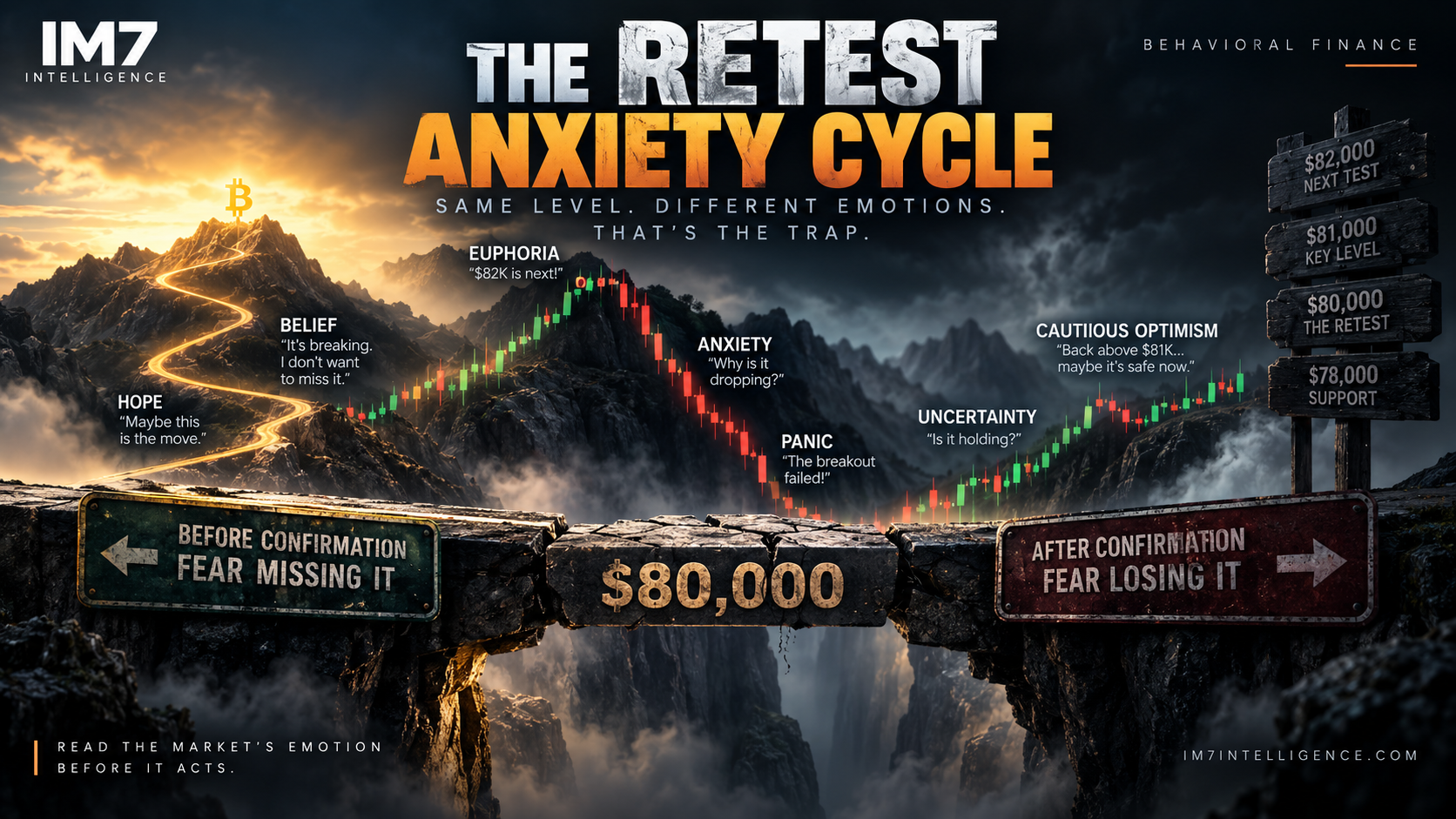
Bitcoin Retests $80K: When Discomfort Feels Like Invalidation
AI Generated • IM7 Intelligence
- Reading time
- 6 min read
- Word count
- 1,412 words
- Published
Bitcoin pulled back toward $80K after advancing toward $82K, then recovered above $81K. The Retest Anxiety Trap begins when traders mistake the discomfort of renewed uncertainty for evidence that the breakout has failed.
Executive Summary
Bitcoin's break above $80K was followed by an advance toward the upper-$81K area, then a sharp pullback that brought price back toward the level traders had spent days watching. Instead of immediately establishing below $80K, Bitcoin recovered and moved back above $81K, reopening the question of whether the pullback represented failure or simply renewed uncertainty.
That sequence exposes a behavioral trap: once traders finally receive the confirmation they wanted, they can become more sensitive to anything that threatens to take it away. The same $80K level that previously represented opportunity can suddenly represent danger.
The lesson is not that every retest will hold. It is that emotional discomfort during a retest is not, by itself, evidence of invalidation.
IM7 Principle
IM7 Principle #077 — Discomfort Is Not Invalidation
When price revisits a recently confirmed level, renewed uncertainty can feel like evidence that the original thesis has failed. But emotional discomfort describes the trader's internal state; invalidation requires observable market evidence.
Confirmation does not eliminate uncertainty. It changes what you are uncertain about.
Market Context
Bitcoin's recent sequence matters because the evidence has changed several times.
BTC first pushed through $80K and continued toward the upper-$81K area. That was meaningful information: the market was no longer merely approaching $80K; it had traded through it and continued higher.
The external evidence changed as well.
U.S. spot Bitcoin ETFs recorded approximately $450.4 million in net outflows on September 15 and another $295.9 million in outflows on September 16. Flows then reversed to approximately $159.5 million of net inflows on September 17 and $324.6 million on September 18 [Farside Investors, 2026].
Those flows do not prove why Bitcoin moved, and they do not guarantee that the move continues. They simply belong in the evidence ledger because the institutional-flow backdrop improved alongside price.
Then came the test.
After reaching the upper-$81K area, Bitcoin retraced sharply toward $80K. On the September 20 two-hour chart, price traded down into the low-$80K area before recovering. A subsequent two-hour candle opened near $80,874, traded as high as approximately $81,210, and moved back above $81K.
That recovery matters.
But it does not settle every question.
$80K has accumulated more evidence.
$81K is being revisited.
$82K remains a separate question.
That distinction is where the behavioral lesson begins.
What The Market Wanted You To Believe
"If Bitcoin comes back to $80K, the breakout failed."
Before the breakout, traders could look at $80K and demand more evidence.
"Show me it can break."
"Show me buyers will stay."
"Show me this isn't another fake move."
Then Bitcoin moved through the level.
The psychological problem begins when the market eventually does what was requested: it returns uncertainty to the exact area traders wanted tested.
Suddenly the standard changes.
Before confirmation, uncertainty was considered normal.
After confirmation, uncertainty feels threatening.
A red candle carries more emotional weight because there is now something to lose: the confidence the breakout created.
The market does not need to invalidate anything for that fear to appear.
It only needs to make the trader uncertain again.
Behavioral Observation
This is the Retest Anxiety Trap.
You demanded proof at $80K. Now Bitcoin is testing $80K again—and suddenly the test you wanted feels like the failure you feared.
Watch what happens psychologically when a market moves through an important level.
Before the break, attention is directed toward opportunity:
"What if it finally goes?"
"What if I miss it?"
"What if this is the move?"
After the break, the reference point changes.
Now attention moves toward preservation:
"What if it gives everything back?"
"What if the breakout fails?"
"What if I believed too early?"
The chart may be testing the same price area, but the trader is no longer experiencing the same psychological event.
Before the breakout, $80K represented something to gain.
After the breakout, $80K can feel like something that might be lost.
That is why the same level can produce opposite emotions.
Cognitive Bias Breakdown
Loss aversion helps explain why this transition can feel so powerful.
Prospect Theory showed that people evaluate outcomes relative to reference points and that losses can carry disproportionate psychological weight compared with comparable gains Kahneman & Tversky, 1979.
Applied carefully to this market sequence, the relevant reference point can change after confirmation.
Before Bitcoin clears $80K, the trader may primarily experience the possibility of missing an upside move.
Once Bitcoin clears $80K and advances, the psychological frame changes. The trader now possesses something that did not exist before: confidence in the breakout.
A pullback threatens that confidence.
The trader therefore isn't only watching price fall.
They may feel as though something already "earned" is being taken away.
That creates an important distinction:
Price returning toward a level is market information.
Fear created by that return is psychological information.
Those are not interchangeable.
The Retest Anxiety Trap occurs when the second is mistaken for the first.
The Professional Read
A disciplined read does not need to decide that every retest is healthy.
It also does not need to treat every pullback as failure.
Instead, it separates what happened from what the observer felt about what happened.
Bitcoin cleared $80K.
That happened.
Bitcoin continued into the upper-$81K area.
That happened.
Bitcoin then retraced sharply toward $80K.
That happened.
Price subsequently recovered back above $81K.
That happened.
"This feels dangerous" is not another piece of market evidence.
Neither is "the breakout definitely survived."
Those are interpretations.
The professional task is to continue observing what price does around the level without allowing the emotional intensity of the retest to answer the question prematurely.
This is also where IM7 Principle #077 connects directly with the previous two principles.
Principle #075 said:
New Evidence Requires a New Read.
Principle #076 added:
Confirmation Doesn't Transfer.
Now Principle #077 adds the other side:
Discomfort Is Not Invalidation.
Update when the evidence changes.
Do not extend confirmation farther than the evidence supports.
But do not erase valid evidence simply because uncertainty becomes uncomfortable again.
Decision Framework
When a confirmed level is being retested, run five questions before changing the interpretation:
1. What actually changed?
Separate the price movement from your emotional reaction to it.
2. What evidence originally supported the thesis?
Ask whether that evidence has actually disappeared or whether price has simply become uncomfortable.
3. Is the market testing the level or establishing beyond it?
A touch, wick, or temporary move is not automatically the same as sustained acceptance or rejection.
4. Am I reacting to evidence or to the fear of losing previous confirmation?
This is the central Retest Anxiety question.
5. What observable condition would genuinely change the read?
Define that before the emotional pressure of the next candle makes the decision for you.
The objective is not to predict whether the retest succeeds.
The objective is to keep the evidence standard consistent while the retest unfolds.
Risk Management Lesson
Retest Anxiety becomes dangerous when emotional discomfort changes behavior faster than market evidence changes.
A trader who sizes too aggressively can make every ordinary pullback feel existential.
A trader who mentally converts confirmation into certainty can experience any retracement as betrayal.
And a trader without predefined invalidation criteria may repeatedly move between FOMO and panic depending on the color of the latest candle.
Risk management therefore has a psychological function in addition to a financial one.
Position sizing, predefined conditions and patience create enough emotional distance to observe new information without needing every candle to provide reassurance.
The goal is not to feel nothing.
The goal is to prevent the feeling from becoming the evidence.
IM7 Quote
"You feared missing it. Now you fear keeping it. Same market, opposite fear."
IM7 Observation
Bitcoin's return toward $80K created a useful behavioral test precisely because $80K had recently become a source of confidence.
The pullback threatened that confidence.
But the subsequent recovery above $81K demonstrates why emotional conclusions made during the sharpest part of a retest can be premature.
That does not confirm $82K.
It does not guarantee $80K will continue holding.
It simply means the evidence ledger must remain intact.
The advance mattered.
The pullback mattered.
The recovery matters.
The next evidence will matter too.
A disciplined observer does not need to erase one observation to acknowledge another.
IM7 Decision Rule
Never use emotional discomfort as a substitute for market invalidation.
When a confirmed level is retested, identify what objectively changed first. Change the interpretation only when the evidence changes with it.
How did this land?
What emotion or bias did this article help you recognize?
References
- [1]Kahneman, D. & Tversky, A. (1979). Prospect Theory: An Analysis of Decision under Risk. Econometrica. The Econometric Society. DOI: 10.2307/1914185. https://doi.org/10.2307/1914185 (accessed 2026-09-20)
- [2]Farside Investors (2026). Bitcoin ETF Flow. Farside Investors. Farside Investors. https://farside.co.uk/btc/ (accessed 2026-09-20)
Pass the signal forward.
IM7 Intelligence studies financial markets through the lens of psychology rather than prediction. Our research focuses on behavioral finance, crowd psychology, sentiment, and decision-making to help readers understand why markets move—not just where they move.
IM7 Intelligence publishes educational research on market psychology, behavioral finance, and investor behavior. Nothing published by IM7 Intelligence constitutes financial, investment, tax, or legal advice. Always conduct your own research before making financial decisions.
Read the market's emotion before it acts.
Where this article sits in the map.
- Confirmation BiasYou are here
- Behavioral Finance
- Risk Management
- Fear
Curated paths, not random articles.
Behavior read in real time.

Ismael Mercius
Ismael Mercius is the founder of IM7 Intelligence, where he writes about crypto market psychology, behavioral finance, and the sentiment cycles that drive digital asset prices. His work focuses on how traders actually make decisions — and the recurring errors that show up in their P&L.
- Crypto market psychology
- Behavioral finance
- Market sentiment analysis
- Trader behavior & decision-making