You Needed Proof at $76K. At $86K, You Stopped Asking.
AI Generated • IM7 Intelligence
- Reading time
- 4 min read
- Word count
- 811 words
- Published
Bitcoin climbed from $76K toward $86K, but something changed faster than price: traders’ standards for confirmation. The higher Bitcoin went, the less proof they demanded. That isn’t greater certainty. It’s confirmation giving way to fear of missing out.
Executive Summary
Bitcoin’s climb from roughly $76K to above $86K changed more than price. It changed how much evidence traders felt they needed before acting.
Near $76K, uncertainty demanded confirmation: reclaim the level, hold it, retest it, prove the recovery. As price moved higher, those requirements gradually disappeared. The market had not eliminated uncertainty — rising price had made waiting psychologically harder.
That matters because confidence created by price movement can feel almost identical to confidence created by evidence.
IM7 Principle
IM7 Principle #18 — Confirmation Escalation
When uncertainty is uncomfortable, traders keep demanding additional proof before acting. But as price moves farther without them, fear of missing out can reverse the process: the evidence threshold falls precisely as the cost of being wrong increases.
Market Context
Bitcoin advanced from the mid-$76K region toward $86K, producing a rapid repricing after a period in which traders repeatedly questioned whether recovery attempts represented genuine acceptance.
The important observation is not simply that price rose.
It is how the same market participant can require multiple layers of confirmation at lower prices, then become willing to act with fewer conditions after a large move has already occurred.
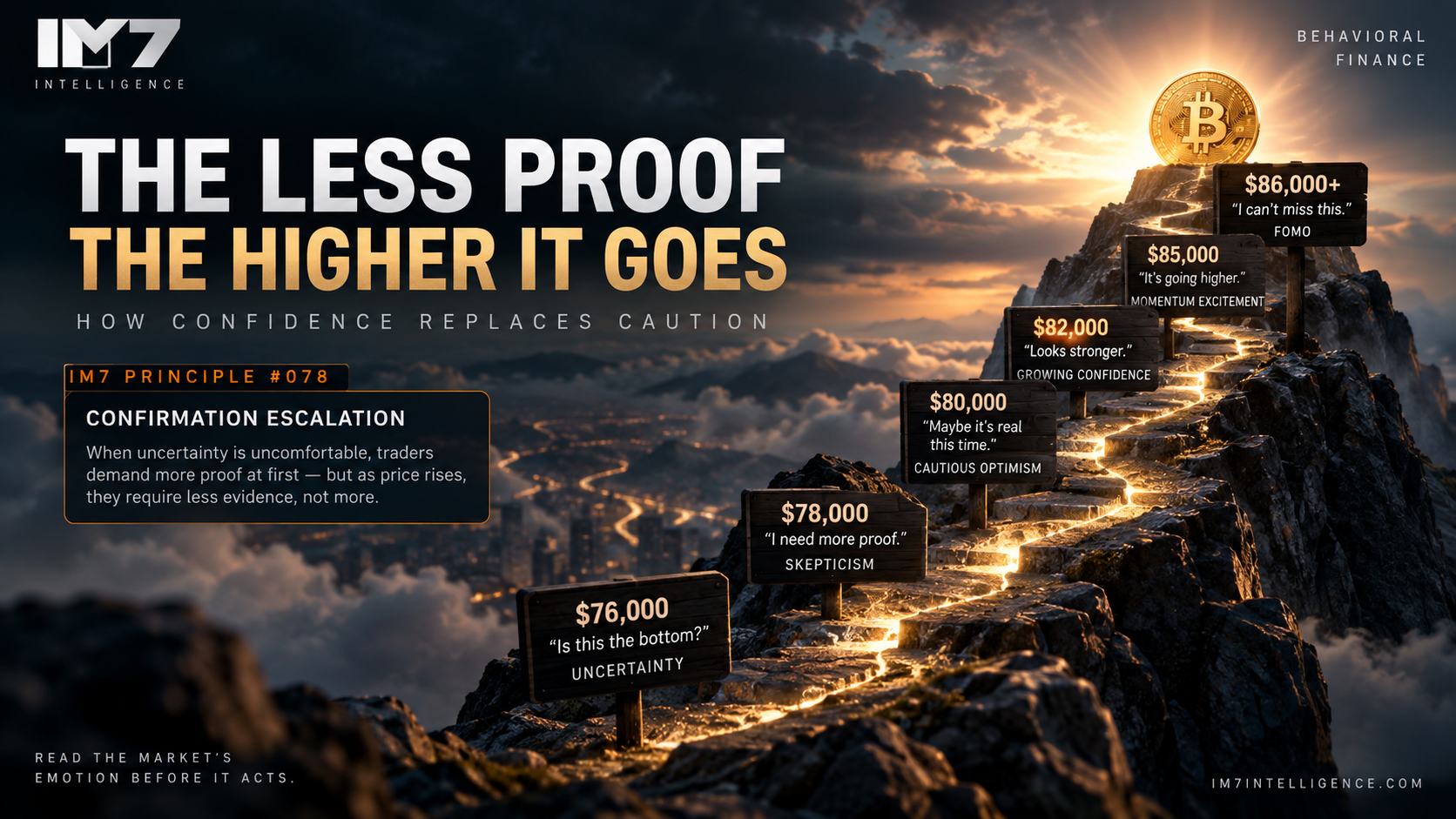
That behavioral transition is visible in the staircase higher.
What The Market Wanted You To Believe
"Now it's obvious."
Every successful reclaim made the recovery appear progressively easier to trust.
At $76K, traders could identify reasons to wait.
At $78K, they wanted another hold.
At $80K, they wanted acceptance.
At $82K, they wanted continuation.
But eventually the repeated evidence created a different psychological pressure: waiting itself began to feel dangerous.
The question quietly changed from:
"What evidence would prove this move?"
to:
"What if it keeps going without me?"
Those are not the same decision.
Behavioral Observation
Watch what happens to your standard of proof as price moves farther away from the level where you originally hesitated.
If every higher price makes you require less evidence rather than more, your decision process may no longer be responding primarily to market information.
It may be responding to the emotional cost of being left behind.
The chart matters because the rising candles do not merely represent price appreciation.
They represent accumulating psychological pressure on everyone who remained undecided.
Cognitive Bias Breakdown
This behavior combines several familiar tendencies.
Recency bias makes the latest price action disproportionately influential. After several successful advances, continuation becomes easier to imagine than failure.
[FOMO](/library/fomo) adds urgency. The potential pain of missing further upside begins competing with the original concern about downside risk.
[Confirmation bias](/library/confirmation-bias) can then change roles. Instead of searching for evidence that the recovery is legitimate, traders begin selectively noticing evidence supporting the decision they increasingly want to make.
The dangerous part is that none of these processes necessarily feel emotional.
They can feel like growing confidence.
The Professional Read
A disciplined operator separates price confirmation from emotional permission.
A rising market can provide legitimate new information. Reclaims, holds, acceptance and failed breakdowns can all alter the evidence.
But a professional asks a second question:
Did my thesis improve — or did watching price leave without me simply make waiting more uncomfortable?
That distinction protects the decision process from being rewritten by the candle currently on the screen.
Decision Framework
Before acting after a large move, ask:
- What evidence was I originally waiting for?
- Has that evidence actually appeared?
- Have my requirements changed since price moved higher?
- If they changed, what new information justified the change?
- Would I make the same decision if I had not watched the entire move happen without me?
If you cannot identify the new evidence, increased confidence may be emotional rather than analytical.
Risk Management Lesson
Price moving in the direction you expected does not automatically reduce future uncertainty.
Yet traders frequently respond to a large move by increasing conviction, abandoning confirmation requirements or taking more risk because the outcome suddenly feels obvious.
Risk discipline requires the opposite distinction:
Evidence can improve while uncertainty still exists.
Position sizing and confirmation standards should respond to the quality of evidence — not the discomfort of missing the move.
IM7 Quote
"You needed proof when it was cheap. You stopped needing it when it got expensive."
IM7 Observation
The most revealing moment is not when traders hesitate near the lows.
It is when they suddenly stop hesitating after price has already moved substantially.
That transition tells you something important about the source of their confidence.
Sometimes the market finally provided the evidence they required.
Sometimes price simply applied enough psychological pressure that they stopped requiring evidence at all.
Knowing which one happened is part of reading behavior before acting on emotion.
IM7 Decision Rule
Never lower your standard of evidence simply because price moved farther without you.
If your requirements change, identify the specific new market evidence that justified the change before acting.
How did this land?
What emotion or bias did this article help you recognize?
References
- [1]Przybylski, A. K., Murayama, K., DeHaan, C. R., & Gladwell, V. (2013). Motivational, emotional, and behavioral correlates of fear of missing out. Computers in Human Behavior. Elsevier. DOI: 10.1016/j.chb.2013.02.014. https://doi.org/10.1016/j.chb.2013.02.014
Pass the signal forward.
IM7 Intelligence studies financial markets through the lens of psychology rather than prediction. Our research focuses on behavioral finance, crowd psychology, sentiment, and decision-making to help readers understand why markets move—not just where they move.
IM7 Intelligence publishes educational research on market psychology, behavioral finance, and investor behavior. Nothing published by IM7 Intelligence constitutes financial, investment, tax, or legal advice. Always conduct your own research before making financial decisions.
Read the market's emotion before it acts.
Where this article sits in the map.
- BitcoinYou are here
- Liquidity
- Market Structure
- Volatility
- Risk Management
Curated paths, not random articles.
Behavior read in real time.

Ismael Mercius
Ismael Mercius is the founder of IM7 Intelligence, where he writes about crypto market psychology, behavioral finance, and the sentiment cycles that drive digital asset prices. His work focuses on how traders actually make decisions — and the recurring errors that show up in their P&L.
- Crypto market psychology
- Behavioral finance
- Market sentiment analysis
- Trader behavior & decision-making