Bitcoin Finally Gave Traders Proof — Then Made Them Pay for It
AI Generated • IM7 Intelligence
- Reading time
- 4 min read
- Word count
- 757 words
- Published
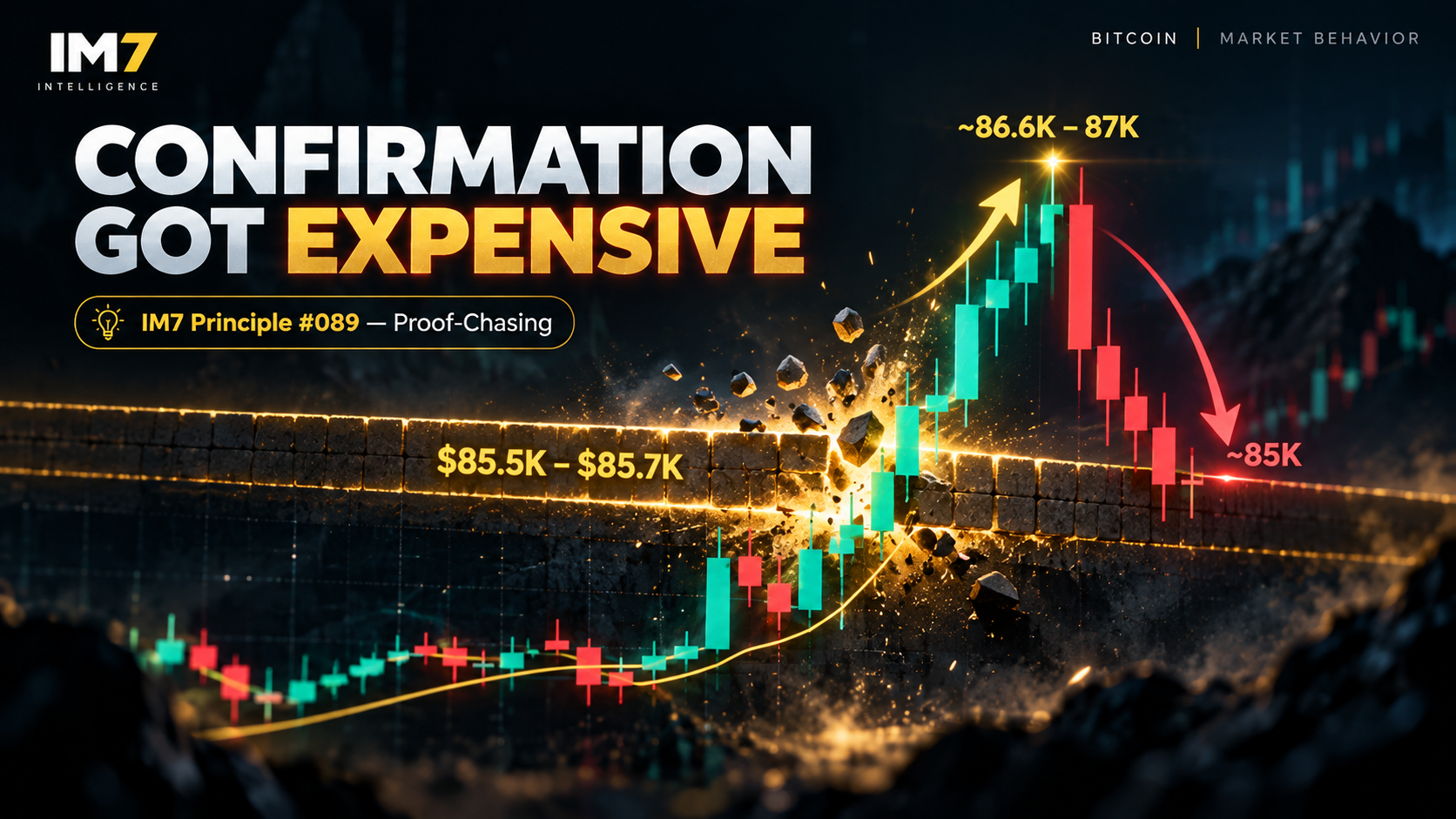
Bitcoin broke through the level traders had been watching and pushed toward $87K, only to pull back sharply afterward. The behavioral trap is Proof-Chasing: traders often wait for the market to look obvious before acting, then confuse confirmation with urgency. Proof should improve confidence — not make the decision more expensive.
Executive Summary
Bitcoin pushed through the level traders had been waiting on and reached nearly $87K before pulling back sharply. The move exposed a familiar behavioral problem: traders often feel safest only after the market has already made the opportunity obvious. Confirmation can improve confidence, but it can also create urgency at exactly the moment price has become more expensive. The next decision should separate better evidence from the emotional pressure to act immediately.
IM7 Principle
IM7 Principle #089 — Proof-Chasing.
The more obvious a thesis becomes, the more traders feel compelled to act. Confirmation should improve decision quality, not create urgency simply because the evidence now feels comfortable.
Market Context
Bitcoin moved from the mid-$84K area through the $85.5K region and accelerated toward $87K before reversing sharply.
The important sequence was:
- resistance finally broke,
- momentum expanded quickly,
- confidence increased with price,
- and the first meaningful pullback arrived almost immediately afterward.
The breakout was real.
The question became whether traders were using confirmation to improve their read — or using it as permission to chase.
What The Market Wanted You To Believe
"Now it’s finally safe."
That is the emotional promise of an obvious breakout.
Yesterday, the evidence was uncomfortable.
Today, price moved far enough that the thesis became easier to believe.
But comfort has a cost.
The more proof traders demand before acting, the more likely they are to arrive after much of the repricing has already occurred.
The market did not punish confirmation.
It punished the assumption that confirmation requires immediate action.
Behavioral Observation
Watch how trader urgency changes after price clears a level everyone has been watching.
Before the breakout:
“I need more proof.”
After the breakout:
“I can’t miss this.”
That transition is Proof-Chasing.
The evidence improves — but emotional urgency often increases even faster.
On the chart, look for:
- a long-watched resistance level,
- a decisive breakout,
- rapid acceleration,
- expanding confidence,
- and a pullback immediately after the move becomes obvious.
The behavioral question is not:
“Was the breakout real?”
It is:
“Did confirmation improve the decision, or just make the trader feel late?”
Cognitive Bias Breakdown
Proof-Chasing combines several familiar tendencies.
People dislike uncertainty, so they delay action until enough evidence appears to make the decision feel comfortable.
But once uncertainty drops, [FOMO](/library/fomo) and recency bias can replace caution.
The difficult question is:
“What does this new evidence change about the quality of the thesis?”
The easier question becomes:
“If this is finally confirmed, shouldn’t I act now?”
Those are not the same question.
The market can confirm a thesis while simultaneously making the trade less attractive from a risk perspective.
The Professional Read
A disciplined professional treats confirmation as information — not an alarm bell.
The breakout above resistance improves the evidence.
That does not automatically mean urgency should increase.
A professional asks:
- What was confirmed?
- How far has price already traveled?
- What changed in the risk/reward?
- What happens on the first retest?
- Am I responding to evidence or to fear of being left behind?
The breakout can be valid while the immediate decision still requires patience.
Decision Framework
When a major level breaks, ask:
- What exactly was confirmed?
- How much repricing already occurred before I received that confirmation?
- Has my confidence improved more than the setup itself?
- Am I acting because the evidence improved or because the move now feels obvious?
- Would I still make the same decision if price stopped moving for the next hour?
Confirmation should narrow uncertainty.
It should not eliminate discipline.
Risk Management Lesson
The most dangerous moment for position sizing is often when conviction feels easiest.
After a breakout, traders may:
- increase size,
- chase extended candles,
- tighten emotional tolerance,
- assume the move must continue,
- or ignore how much price has already traveled.
Better evidence does not automatically justify greater exposure.
Risk should reflect the current setup — not the emotional relief of finally being proven right.
IM7 Quote
"The market charges for certainty."
IM7 Observation
Yesterday, Bitcoin was holding while many traders remained skeptical.
Today, the move became obvious.
That is exactly when the psychological pressure changed.
The market did not suddenly become easier to understand.
It simply became easier to believe.
That distinction matters.
The professional uses confirmation to update the thesis.
The crowd often uses confirmation to justify urgency.
IM7 Decision Rule
When confirmation arrives, update your confidence before changing your urgency.
If the evidence improved but the setup became significantly more expensive, reassess the decision instead of automatically chasing the proof.
How did this land?
What emotion or bias did this article help you recognize?
References
- [1]U.S. Bureau of Labor Statistics (2026). The Employment Situation — September 2026. U.S. Bureau of Labor Statistics. U.S. Bureau of Labor Statistics. https://www.bls.gov/news.release/archives/empsit_10022026.htm (accessed 2026-10-02)
- [2]Kahneman, D. (2011). Thinking, Fast and Slow. Book. Farrar, Straus and Giroux. https://us.macmillan.com/books/9780374533557/thinkingfastandslow/
Pass the signal forward.
IM7 Intelligence studies financial markets through the lens of psychology rather than prediction. Our research focuses on behavioral finance, crowd psychology, sentiment, and decision-making to help readers understand why markets move—not just where they move.
IM7 Intelligence publishes educational research on market psychology, behavioral finance, and investor behavior. Nothing published by IM7 Intelligence constitutes financial, investment, tax, or legal advice. Always conduct your own research before making financial decisions.
Read the market's emotion before it acts.
Where this article sits in the map.
- Confirmation BiasYou are here
- Behavioral Finance
- Risk Management
- Fear
Curated paths, not random articles.
Behavior read in real time.

Ismael Mercius
Ismael Mercius is the founder of IM7 Intelligence, where he writes about crypto market psychology, behavioral finance, and the sentiment cycles that drive digital asset prices. His work focuses on how traders actually make decisions — and the recurring errors that show up in their P&L.
- Crypto market psychology
- Behavioral finance
- Market sentiment analysis
- Trader behavior & decision-making