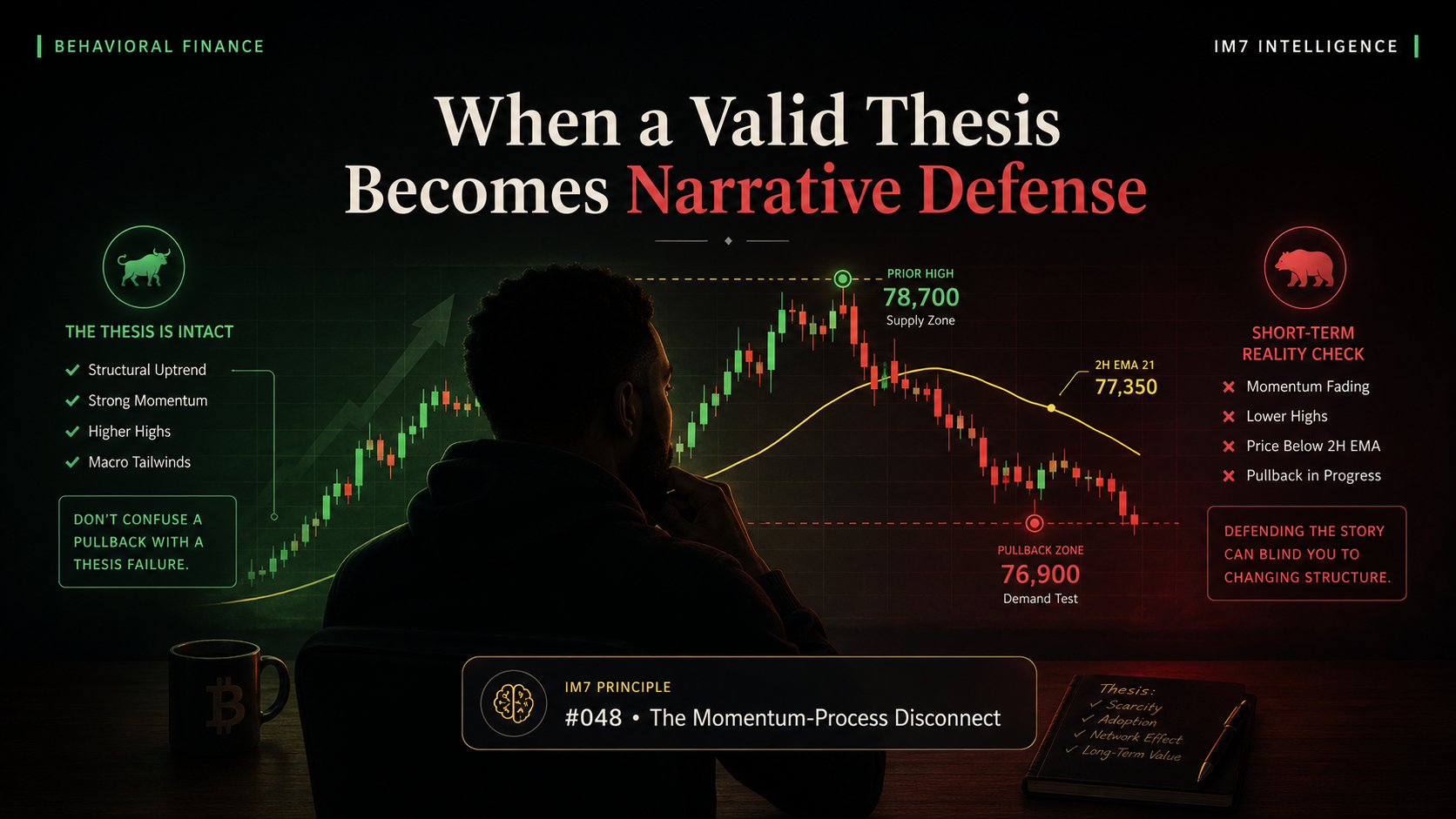
Yesterday’s Rally Was Real — Today’s Evidence Is Different
AI Generated • IM7 Intelligence
- Reading time
- 10 min read
- Word count
- 2,115 words
- Published
Bitcoin’s rally had real catalysts and genuine upside strength. But as price pulls back from recent highs, traders face a different behavioral test: whether they can update a previously rewarded thesis when new evidence begins to conflict with it.
- #behavioral finance
- #belief updating
- #bitcoin
- #bitcoin pullback
- #bitcoin trading
- #cognitive dissonance
- #confirmation bias
- #decision making
- #IM7 Intelligence
- #market psychology
- #market structure
- #narrative defense
- #outcome bias
- #process discipline
- #recency bias
- #risk management
- #thesis updating
- #trader psychology
- #trading discipline
- #trading psychology
On this page
- Executive Summary
- IM7 Principle — Narrative Defense
- Market Context
- The Previous Thesis Had Real Support
- What Yesterday Can Make You Want to Believe Today
- Behavioral Observation
- Behavioral Chart 01 — Previous Validation vs. Current Evidence
- Chart Concept
- Line 1 — Influence of Previous Validation
- Line 2 — Current Contradictory Evidence
- Narrative Defense Zone
- IM7 Read
- Key Takeaway
- Disclaimer
- Cognitive Bias Breakdown
- Confirmation Bias
- Recency and Outcome Reinforcement
- Cognitive Dissonance
- Behavioral Model 01 — The Narrative Defense Sequence
- 1. Thesis Forms
- 2. Market Rewards the Thesis
- 3. Outcome Reinforces Belief
- 4. New Evidence Appears
- 5. Cognitive Discomfort Rises
- 6. Narrative Defense Begins
- 7. Updating Slows
- Interrupt Question
- The Professional Read
- Fact 1
- Fact 2
- Fact 3
- Current Structure vs. Historical Narrative
- Historical Narrative
- Current Observation
- Behavioral Error
- Decision Framework
- 1. Restate the Current Facts Without the Thesis
- 2. Separate Old Evidence From New Evidence
- 3. Define What Would Change Your Mind
- 4. Remove Outcome Attachment
- 5. Reduce Confidence Before Reversing Direction
- 6. Let Current Evidence Earn Current Confidence
- Risk Management Lesson
- Behavioral Model 02 — Analysis vs. Defense
- Analysis Mode
- Defense Mode
- IM7 Decision Rule
- What This Pullback Does Not Prove
- IM7 Quote
- IM7 Observation
- IM7 Decision Rule
Executive Summary
Bitcoin’s recent rally was real.
The move had genuine upside strength, supportive market catalysts, and enough continuation to reward bullish interpretations.
That matters.
But a thesis that was rewarded yesterday still has to survive today’s evidence.
As Bitcoin pulls back from recent highs and trades below short-term momentum levels, the behavioral challenge changes. The question is no longer whether the rally happened.
The question becomes:
Can the trader update a previously validated thesis when new evidence begins to conflict with it?
This report examines the transition from confidence to Narrative Defense — the point where a trader stops evaluating the current structure and begins protecting a conclusion that was previously rewarded.
The central distinction is simple:
Yesterday’s move was real. Today’s structure is different.
Both can be true at the same time.
IM7 Principle — Narrative Defense
A previously rewarded thesis can become psychologically harder to revise when new evidence begins to conflict with it.
Narrative Defense occurs when the objective subtly changes.
Instead of asking:
“What does the current evidence support?”
the trader begins asking:
“Why should my previous view still be right?”
That shift matters because analysis and defense are not the same cognitive task.
Analysis looks for information.
Defense looks for justification.
A thesis should not become permanent simply because it was profitable, accurate, or emotionally satisfying yesterday.
Market Context
Bitcoin recently experienced a strong upside expansion into the upper-$78,000 region.
The rally was not imaginary.
The observable market structure showed substantial upward movement, with Bitcoin reaching approximately $78,750 before beginning to retrace.
At the time of this analysis, price had moved back toward the upper-$76,000 region.
The chart also showed price trading below the 9-period EMA, around $77,095.
These are observable facts.
They do not, by themselves, confirm:
- a trend reversal,
- the end of the rally,
- renewed bearish control,
- broad trader panic,
- or the future direction of Bitcoin.
The relevant structural observation is more limited:
The price conditions visible today are different from the conditions visible near the recent high.
That is enough to create a behavioral decision problem.
The Previous Thesis Had Real Support
It is important not to rewrite history simply because price has pulled back.
The recent rally had legitimate supportive factors.
Bitcoin had strong upside price action, significant institutional attention, and broader crypto participation during the advance.
A bullish interpretation was not inherently irrational.
Traders who respected the strength were responding to real information.
The behavioral mistake does not begin with having believed the rally.
It begins when yesterday’s evidence becomes a reason to avoid processing today’s evidence.
This distinction prevents behavioral analysis from becoming permanently bearish.
A thesis can have been correct.
A market move can have been genuine.
And the evidence can still change afterward.
What Yesterday Can Make You Want to Believe Today
Once a market thesis has been rewarded, it becomes psychologically easier to preserve.
The internal narrative may sound like:
“This is just a pullback.”
“The move is still intact.”
“Bitcoin was strong yesterday.”
Each statement may ultimately prove correct.
But none of them removes the obligation to evaluate current structure.
That is where Narrative Defense begins.
The trader uses a previous fact:
“The rally was strong.”
to answer a different question:
“What should I do now?”
Those questions are related.
They are not identical.
Behavioral Observation
A previously successful interpretation can create an unusual cognitive burden.
When the market agrees with a thesis, confidence rises.
When new evidence later conflicts with that thesis, the trader now has something to lose psychologically.
Not just money.
Identity.
Confidence.
The feeling of being correct.
That can produce a shift from evaluation toward defense.
The trader begins collecting evidence selectively.
Evidence supporting the thesis feels important.
Evidence challenging it feels temporary, irrelevant, or premature.
That process does not require conscious stubbornness.
It can happen gradually.
A trader may believe they are still analyzing while actually spending most of their attention protecting an existing conclusion.
Behavioral Chart 01 — Previous Validation vs. Current Evidence
Chart Concept
Title: Previous Validation vs. Current Evidence
X-axis: Time / Market Progression
Y-axis: Relative Influence on Judgment
The chart should show two conceptual lines.
Line 1 — Influence of Previous Validation
This rises sharply as the rally rewards the trader’s original thesis.
It remains psychologically elevated even after price conditions begin changing.
Line 2 — Current Contradictory Evidence
This begins low but increases as new market information develops.
Examples may include:
- failure to recover recent highs,
- weaker short-term structure,
- trading below a short-term EMA,
- or continued retracement.
Narrative Defense Zone
The important gap appears when:
previous validation continues dominating judgment even as current contradictory evidence increases.
That gap represents the Narrative Defense Zone.
IM7 Read
A thesis becomes dangerous when its historical success receives more weight than its current evidence.
Key Takeaway
Being right before does not reduce the need to update now.
Disclaimer
This is an IM7 conceptual behavioral framework. The psychological relationships shown are illustrative and do not represent measured trader sentiment, empirical probabilities, or a market forecast.
Cognitive Bias Breakdown
Narrative Defense can involve several established behavioral mechanisms.
Confirmation Bias
Once a trader has adopted a thesis, information supporting that thesis may receive greater attention than information challenging it.
A bullish trader may interpret a pullback as temporary while treating every recovery candle as confirmation.
The same behavior can occur in bearish positioning.
The issue is not the direction of the thesis.
It is asymmetric evidence processing.
Recency and Outcome Reinforcement
Recent successful outcomes can increase confidence in the interpretation that produced them.
If the previous bullish read was rewarded repeatedly, that history becomes cognitively powerful.
The trader may begin believing:
“My interpretation has been right, so it is probably still right.”
That conclusion may be reasonable.
But it still has to be tested against new information.
Cognitive Dissonance
Contradictory evidence creates discomfort when it conflicts with a strongly held view.
Narrative Defense offers a psychological solution:
reinterpret the new information in a way that preserves the old thesis.
The discomfort falls.
The analytical quality may fall with it.
Behavioral Model 01 — The Narrative Defense Sequence
1. Thesis Forms
The trader develops a market interpretation.
Example:
“Bitcoin is displaying strong bullish momentum.”
↓
2. Market Rewards the Thesis
Price moves in the expected direction.
Confidence increases.
↓
3. Outcome Reinforces Belief
The trader becomes increasingly comfortable with the interpretation.
The thesis begins feeling proven.
↓
4. New Evidence Appears
Price behavior changes.
The market does not necessarily reverse, but the current evidence is less supportive than before.
↓
5. Cognitive Discomfort Rises
The trader now faces conflicting information.
Changing the thesis feels psychologically costly.
↓
6. Narrative Defense Begins
The trader searches for reasons the original view should remain valid.
Questions shift from:
“What changed?”
to:
“Why is this probably temporary?”
↓
7. Updating Slows
New evidence receives less weight than previous validation.
The trader becomes increasingly attached to the narrative rather than the current structure.
Interrupt Question
“If I had no position and no previous opinion, would I interpret this chart the same way right now?”
That question removes historical attachment from the decision.
If the answer changes significantly, Narrative Defense may be influencing the read.
The Professional Read
A disciplined market operator separates three facts.
Fact 1
The rally was strong.
Fact 2
The rally may still ultimately continue.
Fact 3
Current structure can still require reassessment.
None of these statements cancels the others.
A professional does not need to declare:
“The rally is over.”
in order to recognize that the evidence has changed.
Likewise, acknowledging changing structure does not require immediately reversing the thesis.
Professional updating occurs incrementally.
The question becomes:
“How much confidence does the current evidence justify now?”
not:
“Was my previous thesis right or wrong?”
That difference matters.
The first question is adaptive.
The second can become defensive.
Current Structure vs. Historical Narrative
A useful distinction is:
Historical Narrative
“Bitcoin rallied strongly.”
True.
Current Observation
“Bitcoin has pulled back from the recent high and is currently trading in a different short-term structure.”
Also true.
Behavioral Error
“Because the first statement is true, the second one does not matter.”
That is Narrative Defense.
A trader should not erase previous context.
But previous context should not erase current information either.
Decision Framework
1. Restate the Current Facts Without the Thesis
Describe the market without using words such as:
- bullish,
- bearish,
- strong,
- weak,
- healthy,
- failed.
Example:
“Bitcoin traded near $78,750 and has since retraced toward the upper-$76,000 region.”
This creates a neutral starting point.
2. Separate Old Evidence From New Evidence
Create two columns mentally or physically.
Previous evidence
- strong expansion,
- higher prices,
- successful continuation.
Current evidence
- retracement from recent high,
- changed short-term candle structure,
- price below the short-term EMA at the time observed.
Then ask which evidence is relevant to the current decision.
3. Define What Would Change Your Mind
A thesis without an update condition can become a belief system.
Ask:
“What evidence would materially weaken this thesis?”
and:
“What evidence would strengthen it again?”
Define both before the next candle appears.
4. Remove Outcome Attachment
Ask:
“Would I defend this interpretation this strongly if the previous trade had lost money?”
If not, previous success may be influencing current judgment.
5. Reduce Confidence Before Reversing Direction
Updating does not require flipping from bullish to bearish.
Confidence can move from:
high conviction
to:
moderate conviction
to:
uncertain
without immediately changing directional bias.
That flexibility is often more rational than forcing a binary conclusion.
6. Let Current Evidence Earn Current Confidence
Yesterday’s evidence earned yesterday’s confidence.
Today’s confidence must be earned again.
Risk Management Lesson
Narrative Defense becomes financially dangerous when confidence remains high while market conditions change.
A trader may:
- hold the same position size despite increasing uncertainty,
- move a stop because the original thesis “should still work,”
- add exposure to defend an existing position,
- ignore deteriorating reward-to-risk,
- or delay an exit because acknowledging changed evidence feels like admitting the original thesis was wrong.
But updating a thesis does not invalidate the original analysis.
Markets change.
Good decisions can become outdated.
A trader’s responsibility is not to remain consistent with yesterday’s opinion.
It is to remain consistent with the process.
Behavioral Model 02 — Analysis vs. Defense
Analysis Mode
Question: What does the current evidence support?
Behavior:
- looks for confirming and conflicting information,
- adjusts confidence,
- accepts uncertainty,
- defines conditions that would change the thesis,
- separates previous outcome from current structure.
Goal: Accuracy.
Defense Mode
Question: Why should my previous view still be right?
Behavior:
- emphasizes supportive evidence,
- minimizes contradictory evidence,
- delays updating,
- treats changing the thesis as failure,
- uses previous success as current justification.
Goal: Consistency with the previous belief.
IM7 Decision Rule
Analysis protects the process. Defense protects the story.
The trader must decide which one is being protected.
What This Pullback Does Not Prove
The current pullback does not automatically prove:
- that Bitcoin’s rally has failed,
- that the broader bullish structure has ended,
- that the recent catalysts no longer matter,
- that sellers control the market,
- that a larger correction must follow,
- or that bearish positioning is now preferable.
That is not the argument.
The argument is more disciplined:
Current evidence deserves to be evaluated on its own terms.
The rally does not need to be declared false for the thesis to require updating.
IM7 Quote
“Yesterday’s move was real. Today’s structure is different.”
“Update the thesis. Don’t defend it.”
IM7 Observation
One of the hardest moments in market decision-making occurs after a thesis has been rewarded.
Before success, uncertainty is obvious.
After success, uncertainty can become psychologically inconvenient.
The trader now has evidence that they were right.
That evidence matters.
But it can also become an anchor.
When new information emerges, the mind may treat the update as a threat to the previous victory.
That is where analysis can quietly become Narrative Defense.
The goal is not to forget the rally.
The goal is not to become bearish simply because price retraced.
The goal is to let new evidence change confidence when it deserves to.
Yesterday’s move was real.
Today’s structure is different.
Tomorrow’s evidence will be different again.
The process must be capable of updating with all three.
IM7 Decision Rule
Update the thesis when the evidence changes. Do not defend yesterday’s conclusion simply because it was previously rewarded.
Ask:
What did I believe before?
What evidence supported it?
What evidence exists now?
What would I believe if I had no previous position or opinion?
Then make the current decision from the current evidence.
Yesterday’s move was real.
>
Today’s structure is different.
>
Read what is — not only what was.
How did this land?
What emotion or bias did this article help you recognize?
- #behavioral finance
- #belief updating
- #bitcoin
- #bitcoin pullback
- #bitcoin trading
- #cognitive dissonance
- #confirmation bias
- #decision making
- #IM7 Intelligence
- #market psychology
- #market structure
- #narrative defense
- #outcome bias
- #process discipline
- #recency bias
- #risk management
- #thesis updating
- #trader psychology
- #trading discipline
- #trading psychology
References
- [1]Nickerson, R. S. (1998). Confirmation Bias: A Ubiquitous Phenomenon in Many Guises. Review of General Psychology,.
- [2]Festinger, L. (1957). A Theory of Cognitive Dissonance. Stanford University Press..
- [3]Baron, J., & Hershey, J. C. (1988). Outcome Bias in Decision Evaluation. Journal of Personality and Social Psychology,.
Pass the signal forward.
IM7 Intelligence studies financial markets through the lens of psychology rather than prediction. Our research focuses on behavioral finance, crowd psychology, sentiment, and decision-making to help readers understand why markets move—not just where they move.
IM7 Intelligence publishes educational research on market psychology, behavioral finance, and investor behavior. Nothing published by IM7 Intelligence constitutes financial, investment, tax, or legal advice. Always conduct your own research before making financial decisions.
Read the market's emotion before it acts.
Where this article sits in the map.
- Confirmation BiasYou are here
- Behavioral Finance
- Risk Management
- Fear
Curated paths, not random articles.
Behavior read in real time.

Ismael Mercius
Ismael Mercius is the founder of IM7 Intelligence, where he writes about crypto market psychology, behavioral finance, and the sentiment cycles that drive digital asset prices. His work focuses on how traders actually make decisions — and the recurring errors that show up in their P&L.
- Crypto market psychology
- Behavioral finance
- Market sentiment analysis
- Trader behavior & decision-making