Bitcoin Had Every Reason to Fall — So Why Didn’t It?
AI Generated • IM7 Intelligence
- Reading time
- 5 min read
- Word count
- 1,151 words
- Published
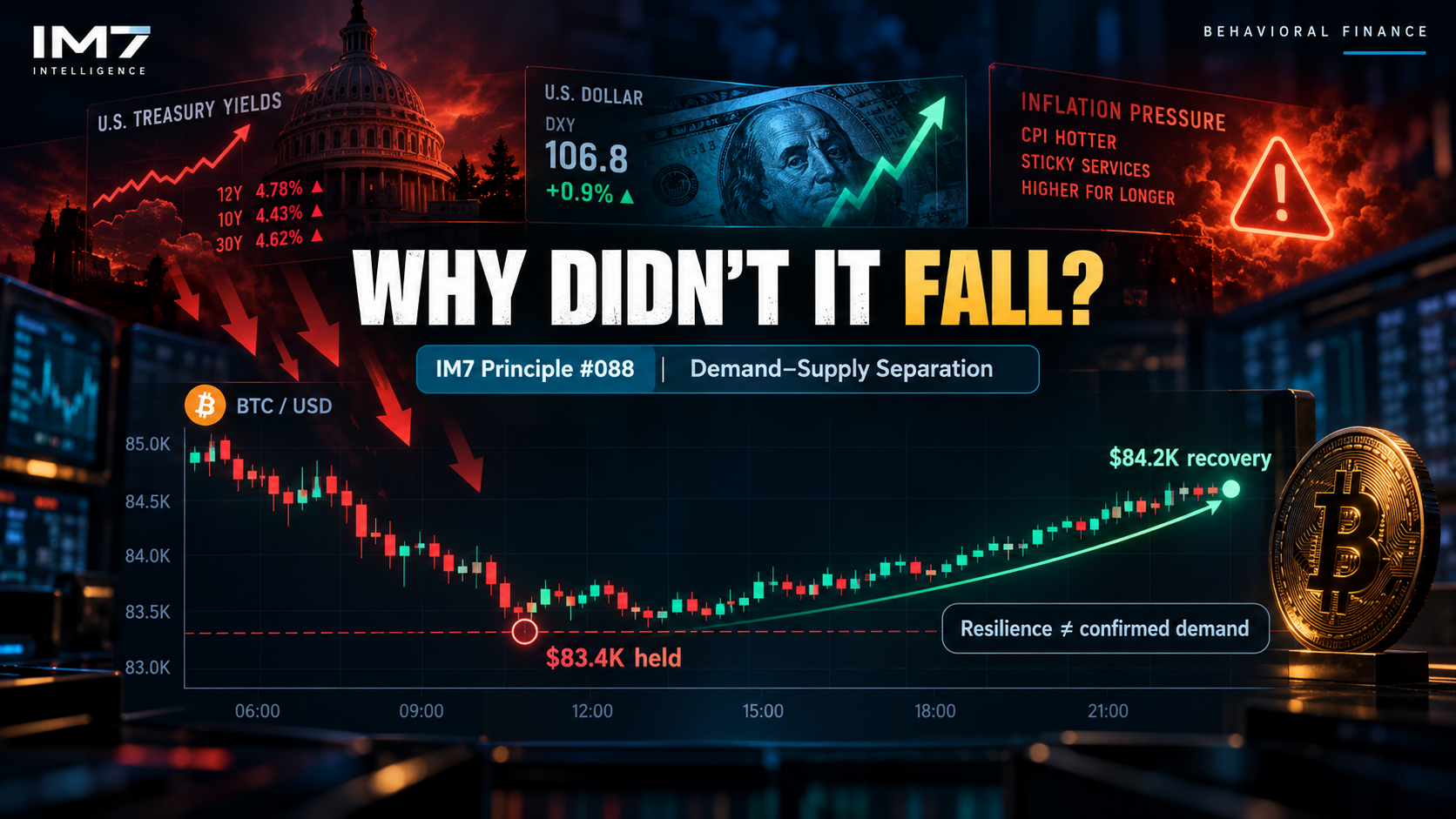
Bitcoin faced a hostile macro backdrop — higher Treasury yields, stronger economic data, and a firmer dollar — yet price refused to break lower. The behavioral trap is assuming that “not falling” automatically means buyers are in control. Sometimes resilience reflects real demand; other times it simply means sellers are absent.
Executive Summary
Bitcoin entered the session with several reasons traders could use to justify weakness: elevated Treasury yields, a stronger dollar, and firm economic data. Instead of breaking lower, BTC recovered from roughly $83.4K and worked back toward $84.2K. That resilience matters, but it creates a behavioral trap: traders can mistake the absence of aggressive selling for proof of strong demand. For the next decision, separate what price refused to do from what buyers have actually proven they can do.
IM7 Principle
IM7 Principle #088 — Demand–Supply Separation.
A market can remain firm because buyers are aggressively demanding higher prices or because sellers simply are not pressing their advantage. Similar price behavior can come from very different underlying forces.
Market Context
Bitcoin spent much of the session recovering from the low-$83K region toward approximately $84.2K.
The important feature was not the size of the advance. It was the environment in which the advance occurred.
The macro backdrop was uncomfortable for risk assets: Treasury yields remained elevated, the dollar was firm, and incoming economic data gave traders reasons to remain cautious about rates.
Yet Bitcoin did not respond with sustained downside acceleration.
Instead, the 2-hour chart showed a gradual sequence of higher candles following the earlier decline.
That produced an obvious narrative:
Bitcoin is absorbing bad news. Therefore Bitcoin must be strong.
But price strength alone does not reveal which side of the market is responsible.
There are at least two ways a market can refuse to fall:
- Buyers aggressively step in and overwhelm available supply.
- Sellers simply stop becoming more aggressive.
Both can produce higher prices.
They do not carry the same behavioral information.
What The Market Wanted You To Believe
"Bitcoin ignored the bad news, so buyers must be in control."
That interpretation feels reasonable.
The market received information traders could frame negatively.
Bitcoin did not collapse.
Price instead recovered toward $84.2K.
When a market refuses to behave the way the news seems to demand, traders naturally assign meaning to that refusal.
The danger begins when resilience becomes certainty.
A market that refuses to fall has provided information.
It has shown that sellers were unable — or unwilling — to produce sustained downside under those conditions.
What it has not automatically proven is that buyers are prepared to aggressively pay higher and higher prices.
The difference sounds small.
For risk management, it is enormous.
Behavioral Observation
Watch how quickly traders upgrade their interpretation after a market survives negative information.
Before the test:
"This could send Bitcoin lower."
After Bitcoin survives it:
"Bitcoin is strong."
Then:
"Buyers are clearly in control."
Three different claims get compressed into one.
The first describes a possible catalyst.
The second describes observed resilience.
The third attempts to explain why the resilience occurred.
That final step is where traders often outrun the evidence.
On the chart, look for:
- negative or restrictive macro information,
- an expected downside response,
- price refusing to accelerate lower,
- a gradual recovery,
- and growing trader confidence before demand has been independently demonstrated.
The behavioral question is not simply:
"Did Bitcoin fall?"
It is:
"What prevented Bitcoin from falling?"
Cognitive Bias Breakdown
The brain strongly prefers explanations over unresolved ambiguity.
If negative news appears and price refuses to fall, the simplest explanation becomes:
"Buyers are strong."
But markets are not forced to provide such a clean answer.
Sometimes the absence of the expected outcome becomes more psychologically powerful than the evidence supporting an alternative explanation.
This resembles representativeness and substitution in judgment under uncertainty: people often replace a difficult question with an easier one when evaluating incomplete information Tversky & Kahneman, 1974.
The difficult question is:
"Is active demand overpowering available supply?"
The easier question is:
"Did price fall after bad news?"
If the answer to the second question is no, the mind is tempted to answer the first question yes.
That leap is the bias.
The Professional Read
A disciplined professional separates resilience from demand.
Resilience is observable.
Bitcoin received information that could have encouraged selling and nevertheless remained firm.
That matters.
Demand is a deeper conclusion.
To infer stronger demand, the professional wants additional evidence such as:
- sustained willingness to transact at higher prices,
- successful acceptance above previous resistance,
- constructive behavior after pullbacks,
- repeated defense accompanied by expansion rather than mere stabilization,
- or continued progress when sellers return.
Until then, the correct observation is narrower:
The market was given a reason to fall and did not fully take it.
That is useful information without pretending it answers every question.
Professionals do not need certainty where the tape only provides evidence.
Decision Framework
When price refuses to respond to negative information, ask:
1. What was the expected response?
- Was there actually a credible reason for selling?
2. What did price refuse to do?
- Break support?
- Accelerate lower?
- Sustain a rejection?
3. What replaced the expected move?
- Aggressive buying?
- Slow stabilization?
- Short covering?
- Simple lack of follow-through?
4. Has demand been demonstrated separately?
- Are higher prices being accepted?
- Are pullbacks being defended?
- Is price progressing when sellers return?
5. Am I observing resilience or explaining it?
- Observation comes first.
- Explanation requires additional evidence.
If the only evidence for strong demand is that price did not fall, the conclusion is incomplete.
Risk Management Lesson
The danger of confusing absent supply with active demand is that it encourages traders to size positions for strength that has not yet been demonstrated.
A trader may see resilience and respond by:
- increasing position size,
- chasing a slow recovery,
- assuming every pullback will be defended,
- widening invalidation,
- or treating the next resistance level as inevitable.
But a quiet seller is not the same thing as an aggressive buyer.
If the market is rising primarily because selling pressure temporarily disappeared, the structure can change quickly when supply returns.
Position size should therefore reflect what has been proven — not the most optimistic explanation for what has been observed.
IM7 Quote
"Silence from sellers is not the same as demand from buyers."
IM7 Observation
Bitcoin's refusal to break lower under an unfavorable macro backdrop is information worth respecting.
But the useful insight is narrower than the bullish story traders may want to tell.
The market demonstrated resilience.
It did not automatically demonstrate dominant demand.
That distinction keeps the analysis behavioral rather than predictive.
The next meaningful information comes when the market is challenged again.
If buyers continue accepting higher prices when supply returns, the evidence improves.
If progress disappears as soon as sellers become active, then today's resilience may have reflected an absence of pressure rather than overwhelming demand.
Either way, the professional does not need to guess.
The structure will provide more evidence.
IM7 Decision Rule
When price refuses to fall, record the resilience first and explain it second.
Do not label absent selling as strong demand until subsequent market behavior demonstrates that buyers can actively sustain higher prices.
How did this land?
What emotion or bias did this article help you recognize?
References
- [1]Tversky, A. & Kahneman, D. (1974). Judgment under Uncertainty: Heuristics and Biases. Science. American Association for the Advancement of Science. DOI: 10.1126/science.185.4157.1124. https://www.science.org/doi/10.1126/science.185.4157.1124
- [2]Reuters (2026). Yields fall after US 10-year hits highest since 2002; stocks, euro also decline. Reuters. Reuters. https://www.reuters.com/world/china/global-markets-global-markets-2026-10-01/
Pass the signal forward.
IM7 Intelligence studies financial markets through the lens of psychology rather than prediction. Our research focuses on behavioral finance, crowd psychology, sentiment, and decision-making to help readers understand why markets move—not just where they move.
IM7 Intelligence publishes educational research on market psychology, behavioral finance, and investor behavior. Nothing published by IM7 Intelligence constitutes financial, investment, tax, or legal advice. Always conduct your own research before making financial decisions.
Read the market's emotion before it acts.
Where this article sits in the map.
- Confirmation BiasYou are here
- Behavioral Finance
- Risk Management
- Fear
Curated paths, not random articles.
Behavior read in real time.

Ismael Mercius
Ismael Mercius is the founder of IM7 Intelligence, where he writes about crypto market psychology, behavioral finance, and the sentiment cycles that drive digital asset prices. His work focuses on how traders actually make decisions — and the recurring errors that show up in their P&L.
- Crypto market psychology
- Behavioral finance
- Market sentiment analysis
- Trader behavior & decision-making