Bitcoin Cleared $80K. That Doesn't Confirm $82K.
AI Generated • IM7 Intelligence
- Reading time
- 7 min read
- Word count
- 1,553 words
- Published
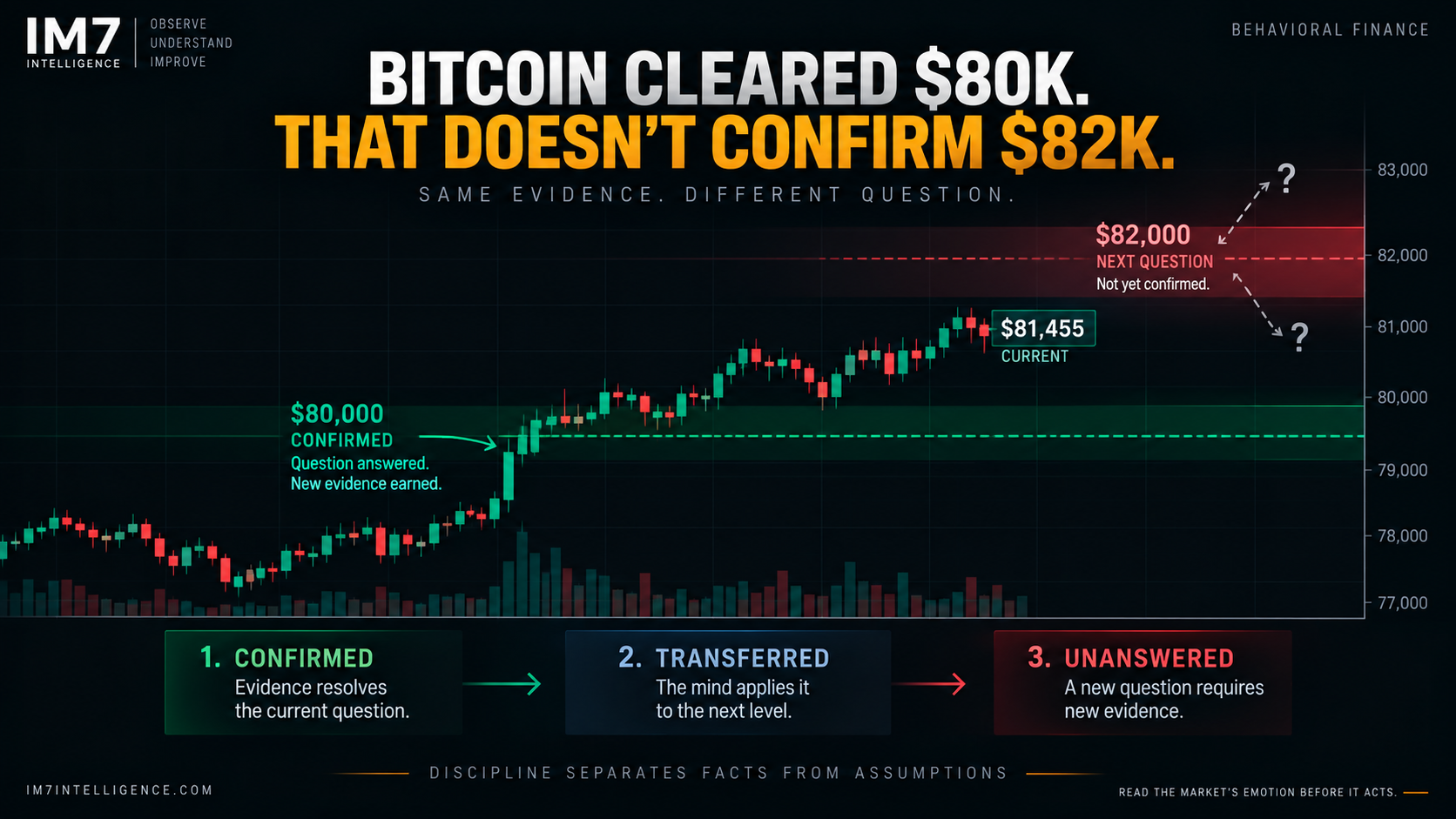
Bitcoin cleared $80K and continued toward $81.5K, giving traders meaningful new evidence. But confirmation at one level does not automatically confirm the next. Confirmation Transfer occurs when traders take evidence that resolved yesterday’s uncertainty and mistakenly apply it to tomorrow’s unanswered question.
Executive Summary
Bitcoin has continued higher after clearing $80K, trading around $81,455 on the current 2-hour chart while the latest completed U.S. spot Bitcoin ETF session recorded another $324.6 million of net inflows [Farside Investors, 2026]. That is meaningful new evidence, and it strengthens the recovery case that developed as Bitcoin moved back through $80K.
But stronger evidence at one level does not automatically confirm the next.
This creates a behavioral mistake IM7 calls Confirmation Transfer: taking evidence that successfully resolved one market question and mentally applying it to a different question that has not yet been resolved. Bitcoin proved something important at $80K. What happens around the upper $81Ks and $82K is a new test requiring its own evidence.
IM7 Principle
IM7 Principle #076 — Confirmation Doesn't Transfer
Evidence that resolves one market question cannot automatically resolve the next.
Confirmation belongs to the condition that produced it. When the market reaches a new level, the evidence ledger begins again.
Market Context
Bitcoin's evidence set has improved materially.
Earlier in the week, BTC was trading in the mid-$70Ks while U.S. spot Bitcoin ETFs experienced significant net outflows. Farside Investors recorded $450.4 million of net outflows on September 15 and another $295.9 million on September 16.
Then both price behavior and ETF flows changed.
Net ETF flows reversed to +$159.5 million on September 17 and strengthened further to +$324.6 million on September 18 [Farside Investors, 2026].
Bitcoin simultaneously recovered through $80K and continued higher.
On the current 2-hour chart, BTC is trading around $81,455. Price remains above $80K, and the visible structure shows a sequence of higher trading levels following the breakout.
That deserves acknowledgment.
The $80K question is no longer the same question it was several sessions ago.
But Bitcoin is now approaching another area where fresh evidence must be evaluated. Previous candles on the chart show upper wicks in the higher-$81K region, while $82K remains ahead of current price.
The current 2-hour candle is also still open.
So there are two statements that can be true simultaneously:
Bitcoin has produced materially stronger bullish evidence.
And:
That evidence does not pre-confirm every level above it.
The distinction between those statements is where today's behavioral lesson begins.
What The Market Wanted You To Believe
"$80K broke. $82K–$85K is next."
This belief is psychologically attractive because it contains a piece of truth.
Bitcoin did clear $80K.
Price did continue higher.
ETF flows did improve.
The mistake occurs when the brain converts those observations from evidence about the current recovery into certainty about the next unresolved level.
That transformation can happen almost invisibly.
Before $80K is cleared, traders demand evidence.
They watch the level.
They question whether price can establish itself above it.
They look for continuation.
Then the evidence arrives.
But instead of recording:
"$80K has become better supported."
the mind jumps to:
"Then $82K should break too."
The evidence has traveled farther than the market has.
IM7 calls this Confirmation Transfer.
The confirmation itself may be legitimate.
The transfer is the error.
Behavioral Observation
Watch what happens to the trader's standard of proof after the market validates an important part of their thesis.
Before confirmation, uncertainty feels obvious.
After confirmation, uncertainty can suddenly feel unnecessary.
The trader stops asking:
"What evidence would confirm the next condition?"
and starts thinking:
"The market already proved me right."
But markets do not provide unlimited confirmation.
Evidence is conditional.
A successful reclaim of $80K tells us something about $80K and about the strength of the recovery into and beyond that level.
It does not automatically tell us how buyers and sellers will behave at $82K.
That requires observation.
On the chart, look for the moment when a trader mentally moves several steps ahead of price.
The chart says:
$81,455.
The mind says:
$85,000.
That distance is where Confirmation Transfer operates.
Cognitive Bias Breakdown
Confirmation Transfer is an IM7 behavioral framework, not a standard academic bias by that name.
One psychological mechanism that helps explain it is the representativeness heuristic.
Tversky and Kahneman showed that people often judge uncertain situations by how closely they resemble an existing pattern or expectation, sometimes giving insufficient weight to other relevant information Tversky & Kahneman, 1974.
In markets, a sequence can begin to feel self-validating.
Bitcoin reclaims one level.
Then another.
Then $80K.
Each successful step makes continuation resemble the pattern the trader now expects.
The brain begins compressing separate questions into one narrative:
"Bitcoin is breaking resistance."
That description may accurately summarize what has happened.
But it can become dangerous when it replaces the more precise questions:
Which level has actually been cleared?
What evidence established that conclusion?
Does the same evidence exist at the next level?
Similarity is not identity.
The fact that $80K was successfully negotiated does not mean $82K will behave identically.
The market must provide that evidence separately.
The Professional Read
A disciplined professional does not respond to this chart by denying the rally.
That would create the opposite error.
Bitcoin's move through $80K matters.
The continued advance matters.
Two consecutive positive ETF-flow sessions matter, particularly after the substantial outflows immediately preceding them.
The evidence ledger should therefore be updated.
But the professional also separates observations from extrapolations.
Observation:
Bitcoin cleared $80K and continued toward $81.5K.
Observation:
Spot Bitcoin ETF net flows improved for two consecutive completed sessions.
Observation:
The current 2-hour structure is stronger than it was when Bitcoin traded below $80K.
Extrapolation:
Therefore $82K must break.
Extrapolation:
Therefore $85K is confirmed.
Those final statements require information the market has not yet supplied.
The professional does not need to become skeptical of strength.
The professional simply refuses to spend the same piece of evidence twice.
$80K earned its evidence.
The next question must earn its own.
Decision Framework
When price confirms an important condition and immediately approaches another, ask:
- What exactly did the market just prove?
- Which level or condition did that evidence apply to?
- What am I now assuming because of that confirmation?
- Does the next level have independent supporting evidence?
- Am I observing continuation or mentally projecting it?
- Is the relevant candle or market condition actually complete?
- What evidence would make me update again?
Then separate the market into three categories:
Confirmed: What the market has already demonstrated.
Developing: What current price behavior is beginning to suggest.
Unanswered: What still requires evidence.
That separation prevents one successful read from becoming permission to stop evaluating the market.
Risk Management Lesson
Confirmation can increase confidence.
It should not eliminate uncertainty.
That distinction matters for risk because confidence often expands faster than evidence after a successful market call.
A trader who waited patiently for $80K may become less patient immediately afterward.
Position size can increase.
Standards for confirmation can weaken.
Future levels can begin to feel inevitable.
The psychological sequence becomes:
Evidence → confidence → extrapolation → excess certainty.
The problem is not the initial confidence.
The problem is allowing confidence earned under one set of conditions to govern risk under another.
Every new market condition introduces new uncertainty.
Risk management should recognize that reset.
The market can be stronger than yesterday without tomorrow's outcome being predetermined.
IM7 Quote
"Confirmation has an address. Don't forward it to the next level."
IM7 Observation
Bitcoin has earned more confidence than it had several sessions ago.
That should be stated plainly.
Price moved through $80K and continued higher. Spot Bitcoin ETF net flows reversed from substantial outflows to two consecutive positive sessions, including +$324.6 million on September 18 [Farside Investors, 2026].
Ignoring those developments because the market was previously weak would violate IM7 Principle #075:
New Evidence Requires a New Read.
But Principle #075 creates another responsibility.
Once the thesis has been updated, the trader cannot convert that update into unlimited certainty.
That is where Principle #076 begins.
Confirmation Doesn't Transfer.
The evidence supporting $80K does not disappear because Bitcoin approaches $82K.
It remains valid evidence about what already occurred.
But $82K introduces another question.
If Bitcoin develops convincing evidence above that area, the disciplined response is not disbelief.
It is another update.
If the market fails to establish itself there, that is new information too.
The framework therefore works in both directions.
No permanent bullishness.
No permanent bearishness.
No automatic skepticism.
No automatic extrapolation.
Just a continuously updated evidence ledger.
Yesterday's confirmation becomes part of the record.
It does not become tomorrow's answer.
Key Takeaways
- Bitcoin's move through $80K represents meaningful evidence of improved price behavior.
- U.S. spot Bitcoin ETF net flows strengthened from +$159.5 million on September 17 to +$324.6 million on September 18.
- Recognizing stronger bullish evidence is different from assuming unlimited continuation.
- IM7 defines Confirmation Transfer as applying evidence that resolved one market question to a different question that remains unresolved.
- A confirmed level can increase confidence without eliminating uncertainty at the next level.
- Separate what is confirmed, developing, and unanswered.
- Do not lower your standard of evidence simply because the previous market question resolved successfully.
- If new evidence develops around the next level, update again.
IM7 Decision Rule
Never spend the same confirmation twice.
Use evidence to answer the specific market question that produced it. When price reaches the next important condition, require new evidence and update from there.
How did this land?
What emotion or bias did this article help you recognize?
References
- [1]Tversky, A. & Kahneman, D. (1974). Judgment under Uncertainty: Heuristics and Biases. Science. American Association for the Advancement of Science. DOI: 10.1126/science.185.4157.1124. https://doi.org/10.1126/science.185.4157.1124 (accessed 10.1126/science.185.4157.1124)
- [2]Farside Investors (2026). Bitcoin ETF Flow. Farside Investors. Farside Investors. https://farside.co.uk/btc/
Pass the signal forward.
IM7 Intelligence studies financial markets through the lens of psychology rather than prediction. Our research focuses on behavioral finance, crowd psychology, sentiment, and decision-making to help readers understand why markets move—not just where they move.
IM7 Intelligence publishes educational research on market psychology, behavioral finance, and investor behavior. Nothing published by IM7 Intelligence constitutes financial, investment, tax, or legal advice. Always conduct your own research before making financial decisions.
Read the market's emotion before it acts.
Where this article sits in the map.
- Confirmation BiasYou are here
- Behavioral Finance
- Risk Management
- Fear
Curated paths, not random articles.
Behavior read in real time.

Ismael Mercius
Ismael Mercius is the founder of IM7 Intelligence, where he writes about crypto market psychology, behavioral finance, and the sentiment cycles that drive digital asset prices. His work focuses on how traders actually make decisions — and the recurring errors that show up in their P&L.
- Crypto market psychology
- Behavioral finance
- Market sentiment analysis
- Trader behavior & decision-making