Yesterday Bears Were Certain. Today Bulls Are.
AI Generated • IM7 Intelligence
- Reading time
- 3 min read
- Word count
- 540 words
- Published
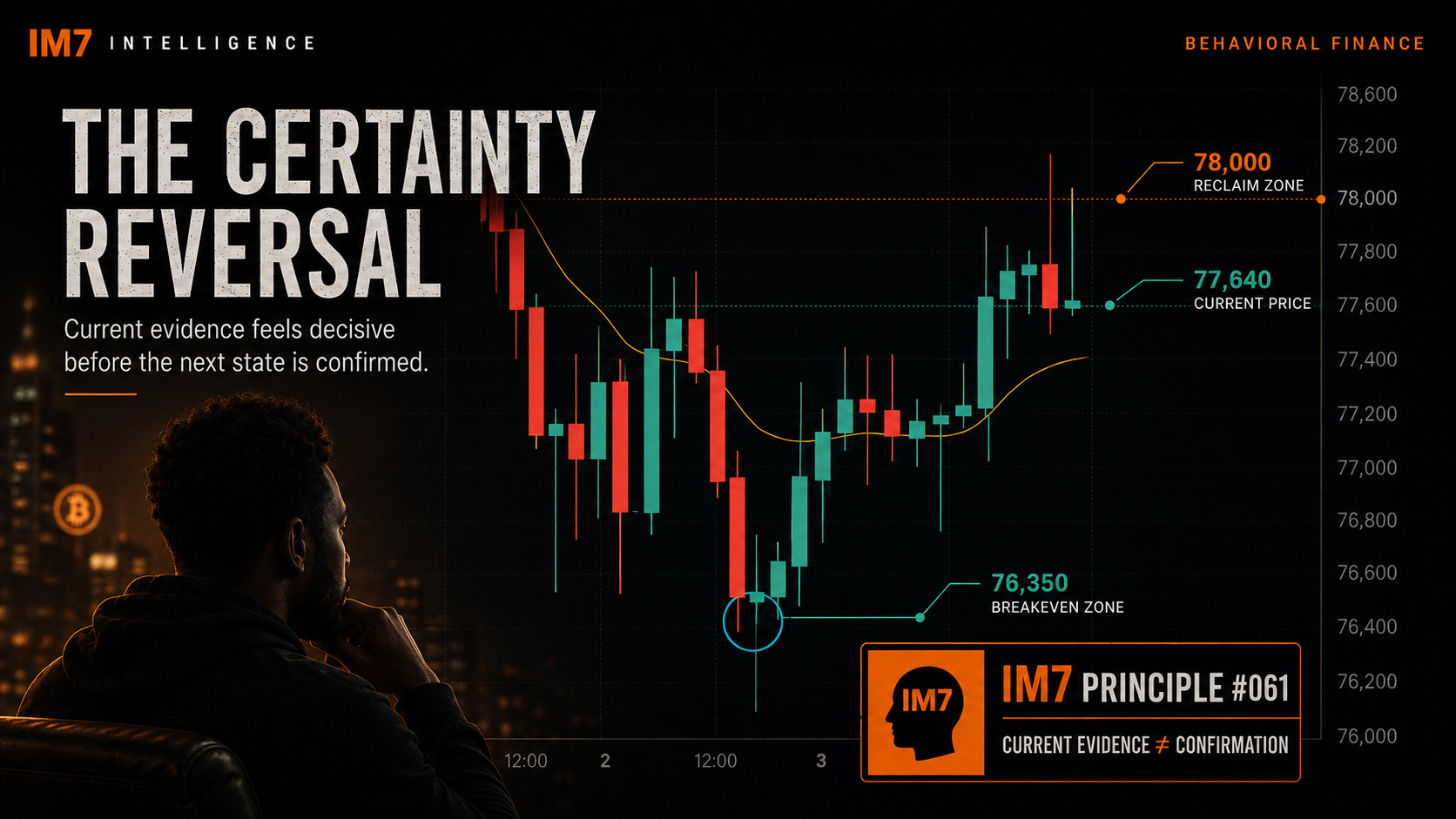
Bitcoin bounced from roughly $76.35K toward $77.64K after yesterday’s breakdown. The bigger behavioral risk is how quickly traders convert each new move into certainty about what comes next.
Yesterday, Bitcoin’s breakdown made the bearish case feel obvious.
Today, the bounce makes the bullish case feel obvious.
Same market.
Different candles.
Different certainty.
That is the problem.
The market did not suddenly become easy to read. Traders simply updated their confidence faster than the evidence justified.
The Certainty Reversal
Bitcoin dropped toward the $76.35K area, then recovered toward the upper-$77K range.
That move was enough to flip the emotional narrative.
Yesterday:
“The recovery is broken.”
Today:
“The dip held. We’re fine.”
Both conclusions feel persuasive because both are based on real price action.
But real evidence is not the same as complete evidence.
A market can provide valid information without providing a final answer.
That distinction matters because traders often skip it.
Current Evidence Is Not Future Confirmation
A red candle can confirm that sellers were aggressive.
It cannot confirm that the next several candles will also be red.
A bounce can confirm that buyers responded.
It cannot confirm that the broader recovery has resumed.
This is where traders make one of their most expensive mistakes:
They convert information about the current state into certainty about the next state.
That is not forecasting.
It is extrapolation.
Why Certainty Moves Faster Than Price
Bitcoin may move $1,000 or $1,500.
Trader conviction can move much further.
That happens because the newest information receives disproportionate psychological weight.
A sharp decline makes bearish evidence easier to notice.
A sharp recovery makes bullish evidence easier to notice.
The structure may still be unresolved, but confidence behaves as if a verdict has already arrived.
That is the Recency Loop in real time.
Recent price action changes expectations.
Expectations change perceived risk.
Perceived risk changes positioning.
Then new price action reinforces the new belief.
The loop keeps running until the market forces another update.
The Breakeven Decision
The $76.35K area matters for another reason.
It sits near an active-investor cost basis identified in the current research.
That creates a specific psychological pressure.
When price returns toward where traders bought, many are no longer asking:
“What is Bitcoin worth?”
They are asking:
“Can I get out whole?”
That breakeven mindset can affect supply independently of the broader thesis.
Some holders sell because relief becomes more important than conviction.
Others hold because they refuse to realize a loss.
The result is a decision zone where psychology can matter as much as the level itself.
What the Bounce Actually Tells Us
The bounce tells us buyers responded.
That matters.
It also tells us yesterday’s bearish certainty was premature.
But it does not prove that the next major move is higher.
The higher-value question is whether Bitcoin can build sustained acceptance above the next structural levels rather than simply touching them.
A wick is evidence.
Acceptance is stronger evidence.
Continuation is stronger still.
That is how confidence should be built: progressively, not emotionally.
The Better Decision Framework
Instead of asking:
“Which side is right now?”
Ask:
“What has actually been confirmed?”
That question forces a separation between:
- what price just did
- what structure has changed
- what remains unresolved
- what would invalidate the current thesis
That separation is where disciplined analysis begins.
IM7 Rule: current evidence tells you what happened. It does not guarantee what happens next.
How did this land?
What emotion or bias did this article help you recognize?
References
- [1]TradingView.. BTC/USD 2-Hour Chart.. (accessed September 3, 2026.)
- [2]IM7 Intelligence.. Morning Bitcoin Market Research.. (accessed September 3, 2026.)
- [3]Active-investor Bitcoin cost-basis data identifying the $76.35K area as a key breakeven zone..
- [4]U.S. (2026). spot Bitcoin ETF flow data,. (accessed September 2–3, 2026.)
Pass the signal forward.
IM7 Intelligence studies financial markets through the lens of psychology rather than prediction. Our research focuses on behavioral finance, crowd psychology, sentiment, and decision-making to help readers understand why markets move—not just where they move.
IM7 Intelligence publishes educational research on market psychology, behavioral finance, and investor behavior. Nothing published by IM7 Intelligence constitutes financial, investment, tax, or legal advice. Always conduct your own research before making financial decisions.
Read the market's emotion before it acts.
Where this article sits in the map.
- Confirmation BiasYou are here
- Behavioral Finance
- Risk Management
- Fear
Curated paths, not random articles.
Behavior read in real time.

Ismael Mercius
Ismael Mercius is the founder of IM7 Intelligence, where he writes about crypto market psychology, behavioral finance, and the sentiment cycles that drive digital asset prices. His work focuses on how traders actually make decisions — and the recurring errors that show up in their P&L.
- Crypto market psychology
- Behavioral finance
- Market sentiment analysis
- Trader behavior & decision-making