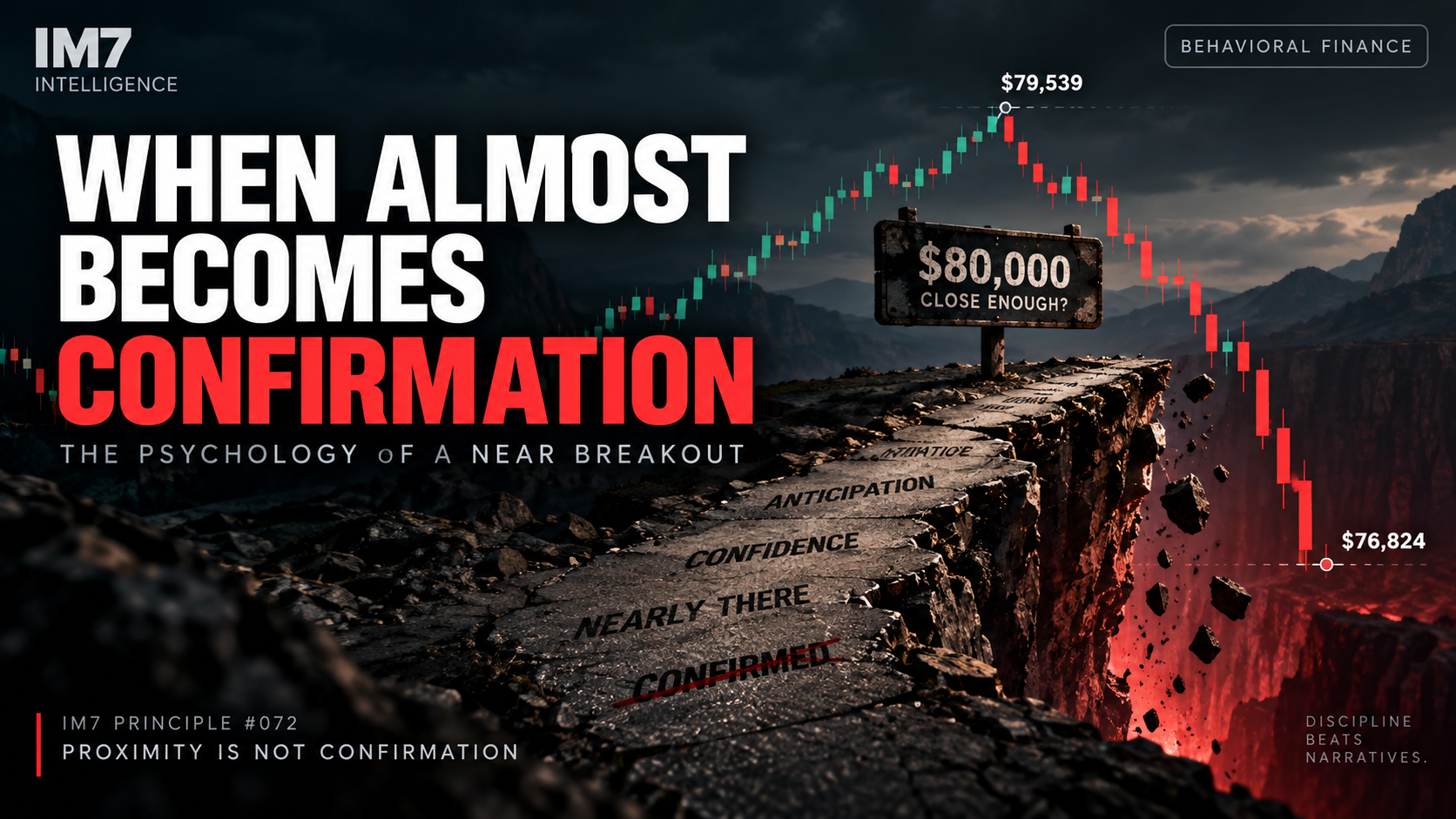
Bitcoin Near $80K: When Almost Becomes Confirmation
AI Generated • IM7 Intelligence
- Reading time
- 5 min read
- Word count
- 983 words
- Published
Bitcoin pushed toward $80K before reversing back below $77K. The behavioral mistake happened before the decline: traders began treating proximity as confirmation. When “almost there” becomes “good enough” in the mind, anticipation quietly replaces evidence.
Executive Summary
Bitcoin pushed toward $80K before reversing sharply and falling back below $77K. The behavioral mistake was not the decline itself — it was allowing proximity to a psychologically important level to feel like confirmation before the market demonstrated acceptance. As price moved closer to $80K, the remaining distance felt increasingly insignificant, making anticipation easier to justify. The lesson is simple: a market can approach your condition without satisfying it.
IM7 Principle
IM7 Principle #072 — Proximity Is Not Confirmation.
The closer price gets to an expected outcome, the easier it becomes to mentally complete the move before the market does. Evidence should be judged by whether the required condition occurred — not by how close price came to producing it.
Market Context
Bitcoin advanced from the upper-$76K area through $77K and $78K before extending into the upper-$79K region.
The advance created a sequence of higher prices that increasingly focused attention on the psychologically significant $80K area.
But approaching a level and establishing acceptance around or beyond it are different market events.
The advance subsequently stalled below $80K. The 2-hour structure then shifted into consecutive downside candles, with price moving back through areas recently reclaimed during the advance and returning below $77K.
The observable sequence was therefore:
advance → proximity → failure to establish acceptance → reversal.
That sequence matters more than whether $80K looked inevitable while price was approaching it.
What The Market Wanted You To Believe
"It's basically through $80K."
The closer Bitcoin moved toward $80K, the easier that statement became to believe.
At $77K, $80K still looked like a destination.
Above $78K, it looked achievable.
In the upper-$79K region, the remaining distance could begin to feel irrelevant.
That is where observation can quietly become anticipation.
The market had already rewarded bullish expectations during the advance, making it psychologically easier to assume that the final part of the move would follow.
But the market does not recognize "basically."
A condition either occurred or it did not.
When price subsequently reversed below $77K, traders who had mentally promoted proximity into confirmation were forced to confront the difference.
Behavioral Observation
Watch for the moment traders stop describing what price has done and begin speaking as though the next condition has already happened.
Language often reveals the shift first:
"It's basically there."
"Close enough."
"It's obviously going through."
"We already broke it."
The emotion underneath those statements is impatience.
Waiting becomes increasingly difficult because the trader feels that the remaining uncertainty is too small to matter.
But small distance does not necessarily mean small risk.
The closer the anticipated outcome appears, the more disciplined the trader must become about distinguishing evidence from expectation.
Cognitive Bias Breakdown
The core behavioral mechanism is substitution.
When the correct question is difficult —
"Has the market actually demonstrated the confirmation my process requires?"
—the mind can replace it with an easier question:
"Does this look close enough to what I expected?"
Research on judgment under uncertainty shows that people frequently rely on mental shortcuts when evaluating uncertain outcomes [Tversky & Kahneman, 1974].
Markets make this particularly dangerous because price continuously provides visual progress toward a target.
Every candle closer to the expected level can feel like additional confirmation even when the actual decision condition remains unmet.
That creates a subtle progression:
Expectation → Approach → Anticipation → Mental Confirmation → Action
The error occurs at mental confirmation.
Nothing necessarily changed in the trader's written rules.
The trader simply stopped requiring the market to satisfy them.
The Professional Read
A disciplined operator does not ask whether price came close enough.
The question is whether the predetermined condition actually occurred.
If the process requires a break, a touch is insufficient.
If it requires a close, trading above the level intraperiod is insufficient.
If it requires acceptance, briefly crossing the level is insufficient.
The professional does not need to predict whether the market will eventually confirm.
The professional simply refuses to promote incomplete evidence into completed evidence.
That distinction protects the decision process from anticipation.
Decision Framework
Before acting on an approaching level, ask:
- What exactly constitutes confirmation in my process?
- Did that condition actually occur?
- Am I reacting to evidence or anticipating the next candle?
- Would I make the same decision if price were farther from the level?
- Has proximity increased my confidence without adding new evidence?
- Am I using phrases such as "basically," "almost," or "close enough"?
- Did price merely approach the level, or establish the acceptance my thesis requires?
- If the market reverses here, can I explain why I acted before confirmation?
If the answer depends on what price should do next, confirmation has probably not occurred yet.
Risk Management Lesson
Anticipation often changes risk before traders realize it.
A trader who believes confirmation has already happened may increase size, loosen invalidation criteria, chase price, or abandon the patience built into the original plan.
That means premature confirmation creates two risks simultaneously:
market risk and decision-process risk.
Position sizing should respond to demonstrated evidence, not psychological closeness.
If uncertainty remains unresolved, risk should still reflect that uncertainty.
IM7 Quote
"The market doesn't grade on close enough."
IM7 Observation
The important part of Bitcoin's move was not simply that price approached $80K and subsequently declined.
It was how quickly proximity could change the interpretation of incomplete evidence.
As the distance narrowed, traders needed less imagination to picture the breakout and therefore less psychological justification to act as though it had happened.
The subsequent reversal exposed the distinction.
Price was close.
The condition was incomplete.
Those two statements can exist simultaneously.
The professional advantage comes from refusing to erase the distance between them.
IM7 Decision Rule
Never mentally complete a market condition the market has not completed itself.
Define confirmation before the test, then judge the evidence against that definition without lowering the standard because price came close.
How did this land?
What emotion or bias did this article help you recognize?
References
- [1]Kahneman, D. & Frederick, S. (2002). Representativeness Revisited: Attribute Substitution in Intuitive Judgment. Heuristics and Biases: The Psychology of Intuitive Judgment. Cambridge University Press. DOI: 10.1017/CBO9780511808098.004. https://doi.org/10.1017/CBO9780511808098.004 (accessed 2026-09-15)
Pass the signal forward.
IM7 Intelligence studies financial markets through the lens of psychology rather than prediction. Our research focuses on behavioral finance, crowd psychology, sentiment, and decision-making to help readers understand why markets move—not just where they move.
IM7 Intelligence publishes educational research on market psychology, behavioral finance, and investor behavior. Nothing published by IM7 Intelligence constitutes financial, investment, tax, or legal advice. Always conduct your own research before making financial decisions.
Read the market's emotion before it acts.
Where this article sits in the map.
- Confirmation BiasYou are here
- Behavioral Finance
- Risk Management
- Fear
Curated paths, not random articles.
Behavior read in real time.

Ismael Mercius
Ismael Mercius is the founder of IM7 Intelligence, where he writes about crypto market psychology, behavioral finance, and the sentiment cycles that drive digital asset prices. His work focuses on how traders actually make decisions — and the recurring errors that show up in their P&L.
- Crypto market psychology
- Behavioral finance
- Market sentiment analysis
- Trader behavior & decision-making