The Confirmation Bias Trap: Why Bulls and Bears See Different Bitcoin Markets
AI Generated • IM7 Intelligence
- Reading time
- 5 min read
- Word count
- 1,115 words
- Published
Bitcoin rejected near $81K again while ETF inflows remained strong, giving bulls and bears legitimate evidence for opposite conclusions. IM7 examines how confirmation bias turns an unresolved market into two completely different realities.
Executive Summary
Bitcoin is giving bulls and bears something they both want: evidence.
Bulls can point to persistent ETF inflows, repeated recoveries, and continued demand around the broader breakout structure.
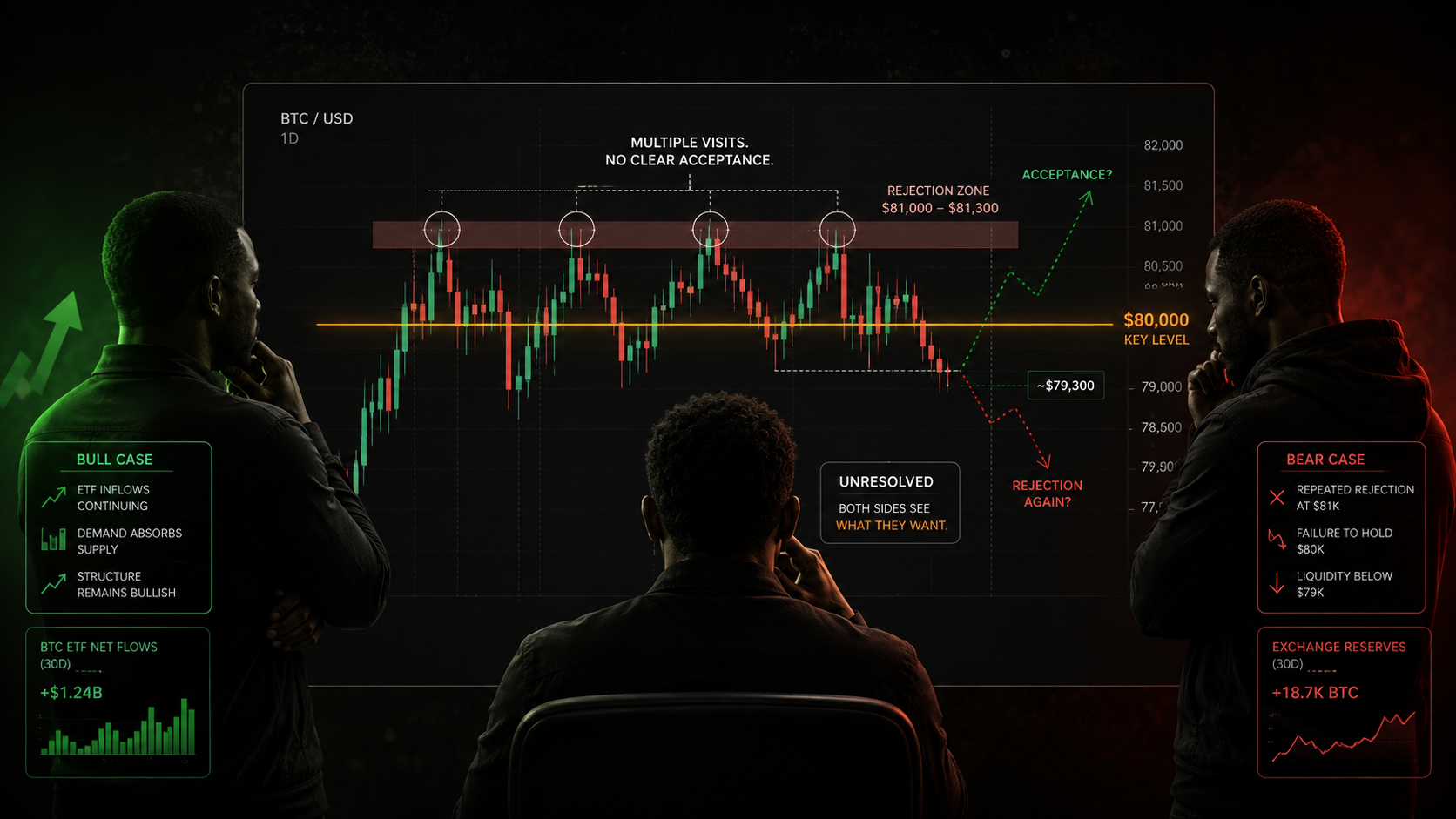
Bears can point to two sharp rejections near the $81,000 area and Bitcoin’s inability to establish sustained value above $80,000.
Both sets of facts are real.
The behavioral problem begins when traders stop evaluating the full evidence set and start selecting only the information that supports the conclusion they already prefer.
That is confirmation bias.
The market remains unresolved.
The mind does not like unresolved.
So it manufactures certainty.
IM7 Principle
When both sides can find evidence for certainty, the market may still be unresolved.
Market Context
Bitcoin pushed into the $81,000 area again before reversing sharply back below $80,000.
That move matters because the market has now produced repeated tests of the same upper resistance zone without establishing durable acceptance above it.
At the same time, supportive evidence remains present.
Spot demand and ETF flows continue to give bulls legitimate reasons to remain constructive.
Repeated rejection from the same supply area gives bears legitimate reasons to remain cautious.
This is exactly the type of environment where confirmation bias becomes dangerous.
The chart is not giving one clean story.
It is giving multiple pieces of evidence that require interpretation.
Where Behavioral Pressure Began
The pressure began during the consolidation base near the high-$78K to low-$79K region.
That range created anticipation.
Once Bitcoin pushed above $80,000, traders naturally began looking for evidence that their preferred thesis had been validated.
Bulls saw the breakout as the beginning of acceptance.
Bears saw the first rejection as proof that the move was unsustainable.
The second test of the $81K area intensified both beliefs.
Instead of reducing certainty, additional conflicting evidence increased conviction on both sides.
That is the behavioral tension.
Cognitive Bias Breakdown
Confirmation bias occurs when people favor information that supports an existing belief while discounting evidence that challenges it.
In this market, the same chart can produce two completely different internal narratives.
Bull narrative:
ETF inflows remain strong.
Price continues to revisit the upper range.
Demand keeps returning.
Therefore, acceptance above $80K is only a matter of time.
Bear narrative:
Bitcoin has rejected near $81K twice.
Price cannot sustain trading above $80K.
Each breakout loses momentum.
Therefore, the entire move was false.
Both narratives contain valid observations.
Neither is complete.
The bias appears when traders treat partial evidence as sufficient proof.
Behavioral Chart 01
Behavioral Observation
The most dangerous feature of confirmation bias is not that traders invent evidence.
It is that they often use real evidence selectively.
That makes the bias harder to detect.
A bullish trader does not need to ignore the chart entirely.
They only need to overweight ETF inflows and underweight repeated rejection.
A bearish trader does not need to ignore demand.
They only need to overweight the rejection zone and underweight the persistence of buying pressure.
The result is two traders looking at the same market and believing the other person is ignoring reality.
In truth, both may be filtering reality.
Behavioral Model 01
Same Market, Different Evidence
The behavioral mechanism can be expressed as:
Same Market → Conflicting Evidence → Selective Attention → Preferred Interpretation → Premature Certainty
This process explains why unresolved markets can create unusually strong opinions.
Ambiguity should reduce conviction.
Confirmation bias often does the opposite.
The more mixed the evidence becomes, the harder traders search for the piece that allows them to remain certain.
Behavioral Chart 02
Professional Read
The current market does not require a bullish or bearish emotional commitment.
It requires evidence management.
Repeated visits above $80K are meaningful, but they are not the same as sustained acceptance.
Repeated rejection near $81K is meaningful, but it does not automatically invalidate the broader structure.
The professional question is not:
“Which side has evidence?”
Both sides do.
The better question is:
“Which evidence will become structurally dominant?”
If Bitcoin begins sustaining value above $80K and successful retests convert the area into support, the bullish evidence strengthens.
If price repeatedly fails at the upper zone and begins losing the prior consolidation base, the bearish evidence strengthens.
Until then, certainty should remain proportional to the quality of the evidence.
Behavioral Model 02
The Evidence Filter
A disciplined process separates observation from interpretation.
Observation: Bitcoin tested the $81K area again.
Interpretation: “That proves the rally is finished.”
Observation: ETF inflows remain supportive.
Interpretation: “That proves $80K must eventually hold.”
The first statement in each pair describes evidence.
The second turns evidence into certainty.
That distinction is where discipline lives.
Decision Framework
Before increasing conviction, ask:
- What evidence supports my current thesis?
- What evidence directly contradicts it?
- Am I weighting both sets of evidence fairly?
- Would I interpret this same chart differently if I had entered from the opposite side?
- What specific market behavior would prove my current interpretation wrong?
If the answer to the fifth question is unclear, the thesis may have become an identity rather than an analysis.
Risk Management Lesson
Confirmation bias becomes expensive when position size grows faster than evidence quality.
A trader who believes the market has already confirmed their view is more likely to:
Add aggressively.
Move stops.
Ignore contradictory information.
Hold losing positions longer.
Treat new evidence as temporary noise.
Risk management should become more disciplined when evidence is mixed, not less.
Unresolved structure is not a reason to abandon a thesis.
It is a reason to reduce certainty.
What This Market Does Not Prove
Two rejections near $81K do not prove the entire breakout has failed.
ETF inflows do not prove Bitcoin must continue higher.
Trading above $80K temporarily does not prove acceptance.
Trading below $80K after a rejection does not prove acceptance is impossible.
The market is still testing the boundary between expansion and rejection.
What Confirmation Bias Is Not
Confirmation bias does not mean having a market opinion is wrong.
It does not mean bulls and bears should remain neutral forever.
It does not require abandoning a thesis every time contradictory evidence appears.
The problem begins when contradictory evidence is dismissed simply because it is inconvenient.
A strong thesis should survive examination.
It should not require selective vision.
IM7 Observation
When traders argue most aggressively about what a chart “obviously” means, the structure is often less resolved than either side wants to admit.
The market does not reward certainty.
It rewards adaptation.
IM7 Decision Rule
Do not ask only:
“What proves me right?”
Ask:
“What evidence would prove me wrong?”
If you cannot answer that clearly, you may no longer be analyzing the market.
You may be defending a belief.
How did this land?
What emotion or bias did this article help you recognize?
Pass the signal forward.
IM7 Intelligence studies financial markets through the lens of psychology rather than prediction. Our research focuses on behavioral finance, crowd psychology, sentiment, and decision-making to help readers understand why markets move—not just where they move.
IM7 Intelligence publishes educational research on market psychology, behavioral finance, and investor behavior. Nothing published by IM7 Intelligence constitutes financial, investment, tax, or legal advice. Always conduct your own research before making financial decisions.
Read the market's emotion before it acts.
Where this article sits in the map.
- Behavioral FinanceYou are here
- Confirmation Bias
- Sentiment
- Risk Management
Curated paths, not random articles.
Behavior read in real time.

Ismael Mercius
Ismael Mercius is the founder of IM7 Intelligence, where he writes about crypto market psychology, behavioral finance, and the sentiment cycles that drive digital asset prices. His work focuses on how traders actually make decisions — and the recurring errors that show up in their P&L.
- Crypto market psychology
- Behavioral finance
- Market sentiment analysis
- Trader behavior & decision-making