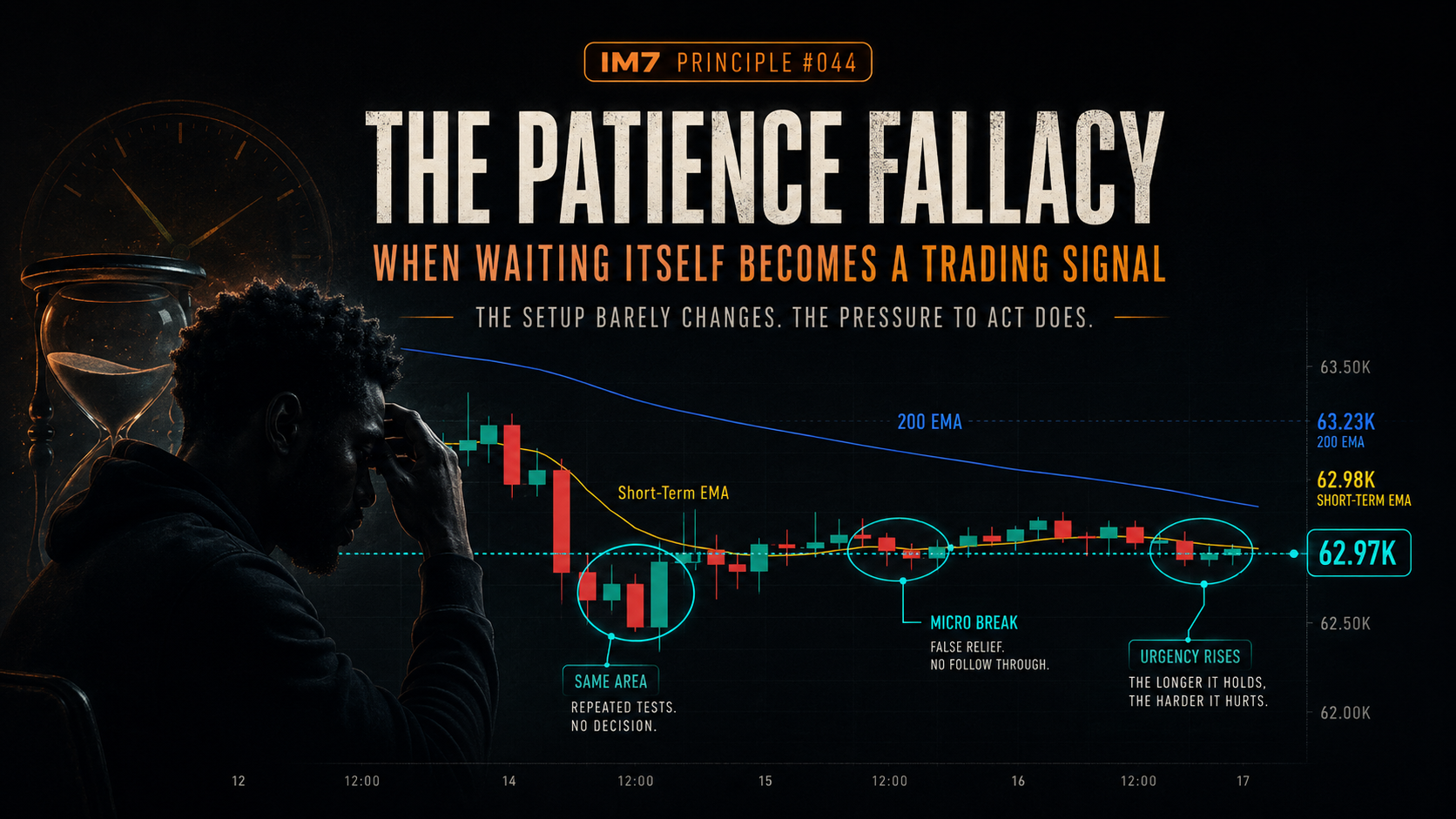
The Patience Fallacy: When Waiting Itself Becomes a Trading Signal
- Reading time
- 8 min read
- Word count
- 1,736 words
- Published
Week one: I’ll wait for confirmation. Week two: It has to move soon. Week three: That candle looks like a signal. The chart barely changed, but the urgency did. Prolonged Bitcoin consolidation can make waiting feel like evidence—and boredom feel like a trading signal.
On this page
- Executive Summary
- IM7 Principle
- The Patience Fallacy
- Market Context
- What is observable
- What is not yet established
- What the Trader Starts Wanting to Believe
- Behavioral Observation
- Cognitive Mechanism
- IM7 Behavioral Mechanism — Boredom Entry
- Behavioral Model 01 — The Patience Decay Loop
- Stage 1 — Neutral Observation
- Stage 2 — Time Accumulates
- Stage 3 — Marginal Movement Appears
- Stage 4 — Rationalization
- Stage 5 — Premature Action
- IM7 Read
- The Professional Read
- Decision Framework
- The Market-Driven Signal Framework
- Risk Management Lesson
- IM7 Quote
- IM7 Observation
- Behavioral Model 02 — Duration Is Not Evidence
- Incorrect Mental Model
- Evidence-Based Model
- IM7 Principle
- Behavioral Chart 01 — Evidence vs. Urgency
- The Longer Traders Wait, the More Urgent the Same Evidence Can Feel
- Behavioral Chart 02 — Decision Threshold Decay
- How Boredom Lowers the Entry Threshold
- Behavioral Chart 03 — Same Candle, Different Interpretation
- The Candle Didn't Change. The Observer Did.
- Behavioral Model 03 — Boredom Entry
- Trigger
- Internal State
- Cognitive Shift
- Evidence Distortion
- Threshold Reduction
- Action
- Potential Outcome
- Interrupt Point
- IM7 Decision Rule
- Before acting after prolonged consolidation, ask:
- Reference
Executive Summary
Extended sideways Bitcoin price action creates a psychological problem that is easy to mistake for a market problem.
The chart can remain largely unchanged while the trader observing it becomes increasingly impatient. As the cost of waiting rises, small candles and marginal attempts at movement can begin to feel more significant than they objectively are.
The central risk is not boredom itself. It is the gradual lowering of the decision threshold.
A trader who initially demanded clear confirmation may eventually accept weaker evidence simply because inactivity has become uncomfortable.
The setup has not necessarily improved. The pressure to act has.
This report examines that shift through the IM7 Behavioral Mechanism Boredom Entry: the tendency to treat the discomfort of inactivity as justification for taking risk.
IM7 Principle
The Patience Fallacy
Time spent waiting is not evidence accumulated.
Waiting can improve discipline.
It does not automatically improve probability.
The longer a trader observes a market, the easier it becomes to unconsciously treat elapsed time as additional evidence that a move is “due.”
But duration alone does not strengthen a setup.
Market Context
Bitcoin is currently trading around the same short-term price area after an extended period of consolidation.
In the observed 2-hour structure, price remains near $62.9K, with the short-term EMA close overhead and the 200 EMA positioned materially higher near $63.24K.
Recent candles remain relatively small compared with a directional expansion.
A brief attempt to trade above the short-term average failed to develop meaningful follow-through before price returned toward the prior area.
What is observable
- Price remains inside a compressed short-term structure.
- Recent attempts at expansion have not established sustained directional follow-through.
- Price remains below the descending 200 EMA shown on the chart.
- The latest structure does not independently confirm a new directional regime.
What is not yet established
The chart does not prove that a breakout is imminent.
It does not prove that buyers or sellers have taken control.
And it does not show that waiting longer makes the next directional attempt more reliable.
What the Trader Starts Wanting to Believe
“I’ve waited long enough, so something has to happen soon.”
That statement sounds like market analysis.
It is actually a statement about the trader’s internal experience.
As consolidation persists, the psychological burden of inactivity can increase.
The progression often looks like this:
Early: “I’ll wait for confirmation.”
Later: “It has to move soon.”
Eventually: “That candle might be the signal.”
The critical shift is subtle.
The trader has not necessarily received stronger evidence.
The standard for what counts as evidence has changed.
Behavioral Observation
The circled area illustrates the problem.
Price briefly pushed above the short-term EMA and local trading area. In a more directional market, that movement might deserve attention.
But the move did not produce durable continuation.
Price returned toward the same structure shortly afterward.
The behavioral danger is not that every failed micro-break represents boredom.
The chart cannot reveal a trader’s internal motivation.
The useful interpretation is narrower:
In prolonged consolidation, marginal movement can become psychologically more persuasive because the observer has become increasingly eager for resolution.
That is where patience begins turning into rationalization.
Cognitive Mechanism
IM7 Behavioral Mechanism — Boredom Entry
Boredom Entry describes a trade initiated partly because inactivity has become uncomfortable rather than because the underlying setup has materially strengthened.
This is an IM7 framework, not a formally established academic bias.
Its supporting mechanisms include:
- Action bias: a preference for acting rather than remaining inactive under some decision conditions.
- Impatience: increasing discomfort with delayed resolution.
- Sensation seeking: preference for stimulation when the environment becomes monotonous.
- Overtrading: increasing participation without a corresponding improvement in opportunity quality.
- Confirmation seeking: assigning greater importance to evidence that justifies the action the trader increasingly wants to take.
Academic work on action versus inaction shows that people can differ meaningfully in their preference for acting or withholding action; the literature does not justify treating every act of trading as “action bias.” The concept should therefore be used as a behavioral lens, not as a diagnosis.
Behavioral Model 01 — The Patience Decay Loop
Stage 1 — Neutral Observation
Market: Little directional change Trader: Comfortable waiting Decision threshold: High
↓
Stage 2 — Time Accumulates
Market: Similar structure Trader: Increasingly restless Decision threshold: Begins falling
↓
Stage 3 — Marginal Movement Appears
Market: Small break or larger candle Trader: Assigns greater significance Decision threshold: Lower than before
↓
Stage 4 — Rationalization
Thought: “I’ve waited this long. Maybe this is finally it.”
↓
Stage 5 — Premature Action
The trader enters before the original confirmation standard has actually been satisfied.
IM7 Read
The market did not necessarily provide more evidence. The trader became willing to accept less.
The Professional Read
A disciplined trader separates elapsed time from new information.
The relevant questions remain:
- Has market structure measurably changed?
- Has price established and maintained a break from the prior range?
- Is there meaningful follow-through?
- Has the original setup criterion actually been satisfied?
- Would this trade still look attractive if the trader had only opened the chart five minutes ago?
That final question is especially useful.
If a setup only feels compelling because someone has watched it for days or weeks, the emotional history of waiting may be influencing the decision.
The professional objective is not infinite patience.
It is consistent standards.
Decision Framework
The Market-Driven Signal Framework
1. Define the trigger before boredom develops
Write down the conditions required for entry before prolonged waiting begins.
Examples may include:
- structural break,
- sustained acceptance beyond a level,
- retest behavior,
- momentum confirmation,
- risk-to-reward threshold.
The exact conditions depend on the trading system.
2. Separate elapsed time from evidence
Ask:
“What objectively changed since my original decision to wait?”
“Three more days passed” is not enough.
3. Re-test the original standard
Would the current candle have qualified as a setup during week one?
If not, it should not suddenly qualify during week three merely because patience has deteriorated.
4. Demand follow-through
A momentary move through a level is an observation.
Continuation, acceptance, or successful retesting provides stronger evidence.
Do not collapse these stages into one.
5. Audit urgency
Before entering, ask:
“Am I responding to market information, or am I responding to how tired I am of waiting?”
That question converts an emotional state into something measurable.
Risk Management Lesson
Boredom becomes especially dangerous when it changes more than entry timing.
It can also weaken:
- position-sizing discipline,
- stop placement,
- selectivity,
- required confirmation,
- willingness to remain flat.
The risk is not necessarily that boredom causes larger positions in every trader.
The more defensible concern is that a lower-quality setup can receive the same risk allocation as a higher-quality setup.
That is a process failure.
Position size should therefore remain tied to:
- predefined account risk,
- setup quality,
- invalidation level,
- expected risk/reward,
not to the emotional urgency to participate.
IM7 Quote
“Boredom is not a signal. But after enough time, it starts feeling like one.”
IM7 Observation
One of the most important variables during prolonged consolidation may not be visible on the chart at all.
It is the condition of the observer.
Price can remain near the same level while:
- patience declines,
- anticipation rises,
- standards loosen,
- and insignificant movement starts feeling important.
That divergence matters.
The trader may believe the market has become more actionable when what has actually changed is their tolerance for inactivity.
This is why prolonged uncertainty requires more than technical discipline.
It requires decision-threshold discipline.
Behavioral Model 02 — Duration Is Not Evidence
Incorrect Mental Model
More time waiting → Move must be closer → Small candle matters more → Entry feels justified
Evidence-Based Model
More time waiting → No automatic change in probability → Require genuinely new market information → Act only if setup criteria improve
IM7 Principle
Time can increase urgency without increasing evidence.
Behavioral Chart 01 — Evidence vs. Urgency
Chart title:
The Longer Traders Wait, the More Urgent the Same Evidence Can Feel
X-axis: Time spent in consolidation
Y-axis: Relative intensity
Plot two conceptual lines:
Objective Evidence
- relatively flat until genuine structural change occurs.
Psychological Urgency
- gradually rising as inactivity persists.
At the far right, highlight the widening gap.
Annotation:
“The setup may be unchanged while the desire to act continues rising.”
IM7 takeaway: Urgency can increase independently of evidence.
Behavioral Chart 02 — Decision Threshold Decay
Chart title:
How Boredom Lowers the Entry Threshold
Show three stages:
| Stage | Required Evidence | Psychological State | | ------------------- | -------------------------- | ------------------- | | Early consolidation | Strong confirmation | Patient | | Mid consolidation | Moderate confirmation | Restless | | Late consolidation | Marginal movement accepted | Urgent |
Highlight the downward movement in the required-evidence threshold.
IM7 takeaway:
The danger is not that the chart became clearer. The trader became easier to convince.
Behavioral Chart 03 — Same Candle, Different Interpretation
Chart title:
The Candle Didn't Change. The Observer Did.
Show the same small breakout candle three times:
Week 1: “Noise.”
Week 2: “Interesting.”
Week 3: “This might finally be it.”
Underneath:
Same magnitude of movement. Different psychological interpretation.
IM7 takeaway:
Elapsed time changes perception faster than it changes evidence.
Behavioral Model 03 — Boredom Entry
Trigger
Prolonged inactivity
↓
Internal State
Boredom + impatience
↓
Cognitive Shift
Waiting begins feeling costly
↓
Evidence Distortion
Minor movement receives exaggerated importance
↓
Threshold Reduction
Previously insufficient evidence becomes “good enough”
↓
Action
Premature entry
↓
Potential Outcome
Trader discovers that internal urgency was mistaken for external confirmation
Interrupt Point
Ask before execution:
“What new evidence exists now that did not exist when I decided to wait?”
If the answer is only time, the setup has not earned the trade.
IM7 Decision Rule
Before acting after prolonged consolidation, ask:
“What changed in the market—not in me?”
If the answer is simply that you are tired of waiting, there is no new signal.
The market does not owe a trader resolution because the trader has already paid for patience.
Reference
Baron, J., & Ritov, I. (2004). Omission bias, individual differences, and normality. Organizational Behavior and Human Decision Processes, 94(2), 74–85.
Use this source cautiously: it discusses omission bias and reports individual differences that include action-biased behavior; it should not be presented as direct empirical proof of boredom-driven cryptocurrency trading.
How did this land?
What emotion or bias did this article help you recognize?
References
- [1]Baron, J., & Ritov, I. (2000). Action bias in decision making. Journal of Risk and Uncertainty. Wiley-Blackwell. DOI: 10.1002/bdm.460.
- [2]Patt, A., & Zeckhauser, R. (2000).
- [3]Baron, J., & Ritov, I. (2004). Omission bias, individual differences, and normality. Organizational Behavior and Human Decision Processes, 9.
Pass the signal forward.
IM7 Intelligence studies financial markets through the lens of psychology rather than prediction. Our research focuses on behavioral finance, crowd psychology, sentiment, and decision-making to help readers understand why markets move—not just where they move.
IM7 Intelligence publishes educational research on market psychology, behavioral finance, and investor behavior. Nothing published by IM7 Intelligence constitutes financial, investment, tax, or legal advice. Always conduct your own research before making financial decisions.
Read the market's emotion before it acts.
Where this article sits in the map.
- Confirmation BiasYou are here
- Behavioral Finance
- Risk Management
- Fear
Curated paths, not random articles.
Behavior read in real time.

Ismael Mercius
Ismael Mercius is the founder of IM7 Intelligence, where he writes about crypto market psychology, behavioral finance, and the sentiment cycles that drive digital asset prices. His work focuses on how traders actually make decisions — and the recurring errors that show up in their P&L.
- Crypto market psychology
- Behavioral finance
- Market sentiment analysis
- Trader behavior & decision-making