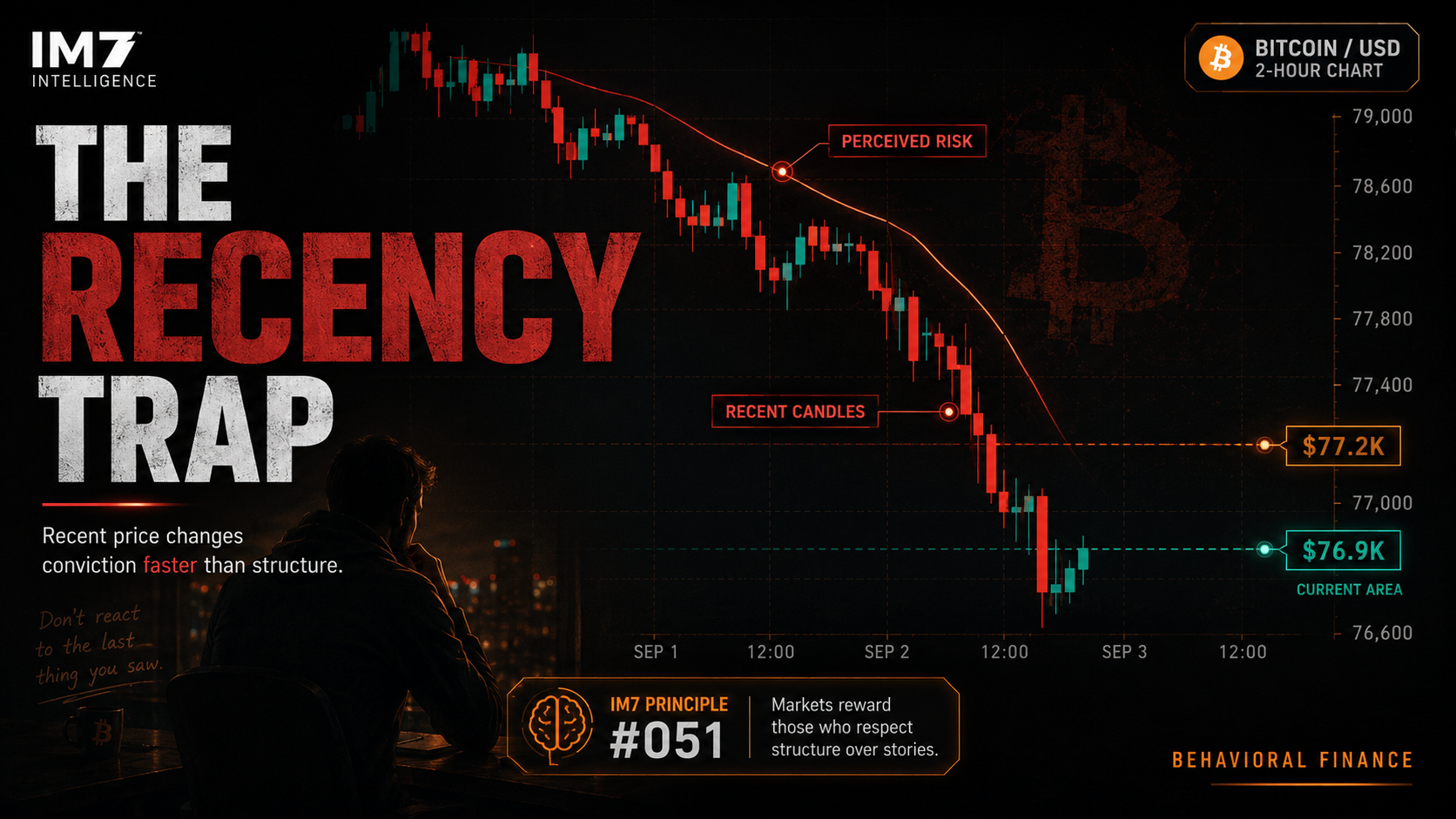
Why Bitcoin Felt Safe at $80K and Dangerous at $76K
AI Generated • IM7 Intelligence
- Reading time
- 3 min read
- Word count
- 647 words
- Published
Bitcoin fell from the upper-$78K range toward $76.9K, and trader perception shifted with it. IM7 examines the Bitcoin Recency Loop: how recent candles change perceived risk faster than market structure actually changes.
Three days ago, Bitcoin near $80K felt strong.
Today, around $76K, the same asset feels dangerous.
That shift feels rational because price changed.
But the deeper behavioral question is whether the underlying risk changed as quickly as the trader’s perception of it.
Often, it did not.
What changed fastest was the recent sequence of candles.
That is the Bitcoin Recency Loop.
IM7 Principle
Perceived risk follows recent price.
When price rises, traders often reduce the amount of danger they perceive.
When price falls, they increase it.
The result is a feedback loop:
Recent returns → expectation revision → perceived risk changes → positioning changes → price reinforces belief
That sequence can make the same market feel safe at a higher price and dangerous at a lower one.
From Confidence to Disconfirmation
Bitcoin’s recent decline from the upper-$78K area toward roughly $76.9K did more than lower price.
It challenged a belief.
After a long stretch of strong institutional demand and repeated support holds, many traders began treating one idea as increasingly permanent:
“Institutions will keep absorbing the dips.”
That belief was reinforced every time the market stabilized.
Eventually, conditional evidence became conviction.
Then the conditions changed.
Price rolled over.
The short-term trend weakened.
The market stopped rewarding the assumption that every dip would be immediately absorbed.
That is where belief disconfirmation begins.
Why Recent Candles Feel So Important
Recency bias causes people to overweight the newest information.
In markets, that usually means the latest candles receive more psychological weight than the larger structure.
At $80K, recent gains made Bitcoin feel resilient.
At $76K, recent losses make Bitcoin feel unstable.
The asset did not become four thousand dollars more dangerous in a few sessions simply because price fell.
But the trader’s perception often changes as if it did.
That is the trap.
The brain treats recent movement as new information about risk, even when part of that movement is simply volatility inside a larger unresolved structure.
The Two Overshoots
The Recency Loop can create opposite mistakes.
Anchored Bulls
Some traders remain attached to the previous narrative.
They see the decline and think:
“This is just another dip. Institutions will catch it.”
They may continue adding because yesterday’s evidence still dominates their thinking.
Recency Bears
Other traders react to the newest candles.
They think:
“The rally was fake. This is going much lower.”
Three red candles suddenly outweigh weeks of prior evidence.
Both reactions can be excessive.
One side refuses to update.
The other updates too aggressively.
Same Bitcoin. Different Risk Perception.
This is the important distinction.
At $80K, traders may have viewed Bitcoin as safer because price was rising.
At $76K, they may view it as riskier because price is falling.
But price and risk are not the same thing.
Higher prices do not automatically mean lower risk.
Lower prices do not automatically mean higher risk.
The disciplined question is:
What actually changed in the structure, [liquidity](/library/liquidity), positioning, and macro environment?
That question is slower than reacting to the candle.
It is also more useful.
What to Watch Now
The current market is testing whether recent selling develops into a larger structural break or remains part of a broader volatile range.
The important information is not simply that Bitcoin fell.
It is whether support continues failing, whether leverage remains stressed, whether institutional demand weakens further, and whether broader macro pressure continues to reinforce the move.
Those variables tell us more than the emotional reaction to the latest red candle.
IM7 Takeaway
The market changes.
Your perception changes faster.
That is why recent price action can make traders feel safest after a rally and most afraid after a decline.
The danger is allowing the latest candles to redefine risk before the evidence earns that conclusion.
IM7 Rule: perceived risk follows recent price. That is the Bitcoin Recency Loop.
How did this land?
What emotion or bias did this article help you recognize?
References
- [1]TradingView. (2026). BTC/USD 2-Hour Chart. . (accessed September 2, 2026)
- [2]IM7 Intelligence. (2026). Morning Bitcoin Market Research.. (accessed September 2, 2026)
- [3]U.S. (2026). spot Bitcoin ETF flow data. (accessed September 2, 2026)
- [4]Carnegie Mellon. University behavioral finance research on recency effects in investor expectations and risk perception..
Pass the signal forward.
IM7 Intelligence studies financial markets through the lens of psychology rather than prediction. Our research focuses on behavioral finance, crowd psychology, sentiment, and decision-making to help readers understand why markets move—not just where they move.
IM7 Intelligence publishes educational research on market psychology, behavioral finance, and investor behavior. Nothing published by IM7 Intelligence constitutes financial, investment, tax, or legal advice. Always conduct your own research before making financial decisions.
Read the market's emotion before it acts.
Where this article sits in the map.
- Confirmation BiasYou are here
- Behavioral Finance
- Risk Management
- Fear
Curated paths, not random articles.
Behavior read in real time.

Ismael Mercius
Ismael Mercius is the founder of IM7 Intelligence, where he writes about crypto market psychology, behavioral finance, and the sentiment cycles that drive digital asset prices. His work focuses on how traders actually make decisions — and the recurring errors that show up in their P&L.
- Crypto market psychology
- Behavioral finance
- Market sentiment analysis
- Trader behavior & decision-making