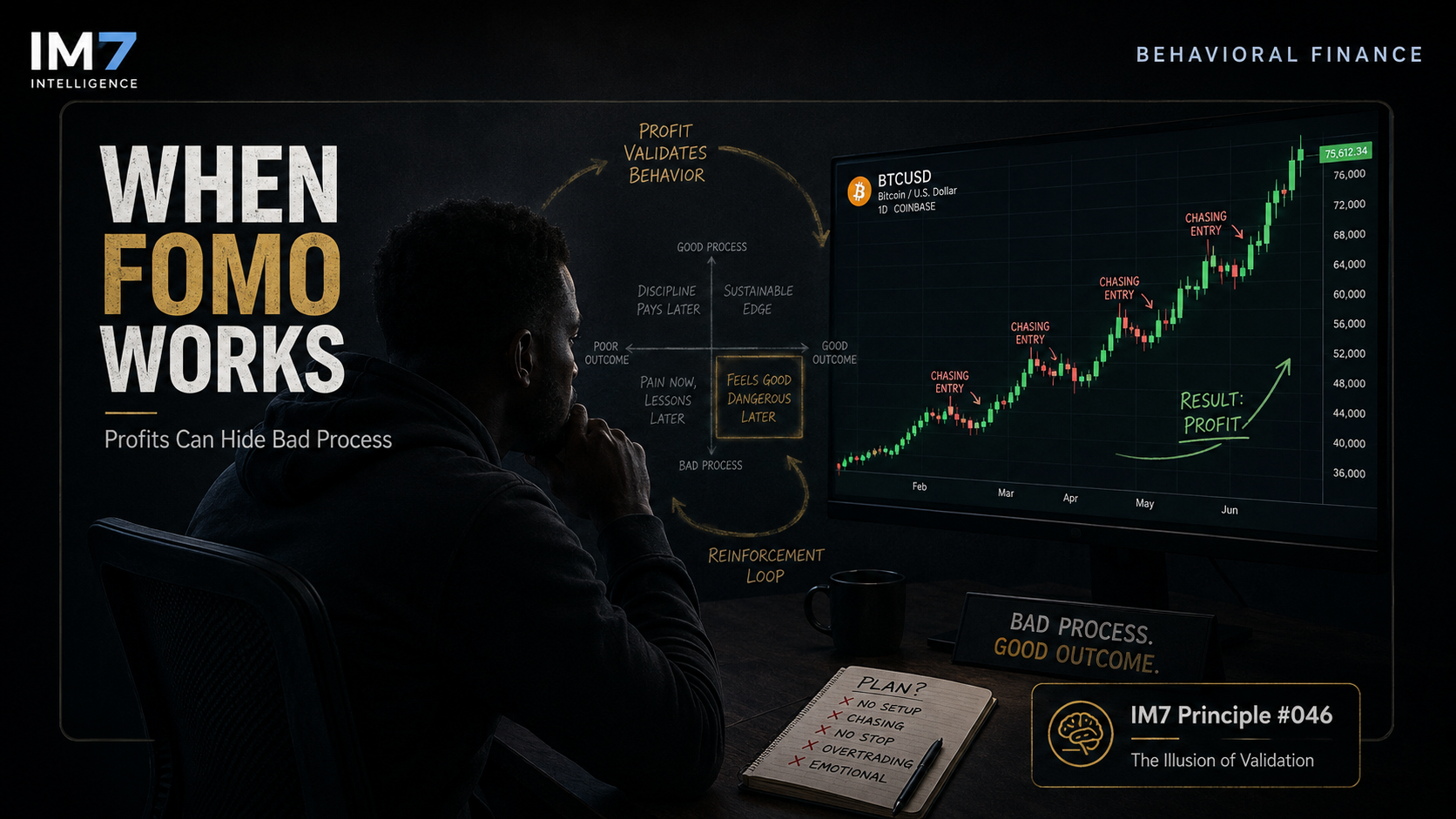
When FOMO Works: How Profitable Trades Reinforce Bad Process
Profitable outcomes from impulsive trading can create a dangerous reinforcement loop, masking underlying poor process and fostering an illusion of validation.
AI Generated • IM7 Intelligence
- Reading time
- 10 min read
- Word count
- 2,113 words
- Published
When a rushed Bitcoin entry makes money, the profitable outcome can reinforce the wrong lesson. Outcome bias can turn an impulsive decision into a behavior the trader becomes more willing to repeat—even when the original process was weak.
- #behavioral finance
- #bitcoin
- #decision quality
- #fomo
- #IM7 Intelligence
- #impulse trading
- #investor psychology
- #market psychology
- #outcome bias
- #process vs outcome
- #profitable mistake
- #recency bias
- #reinforcement learning
- #reinforcement risk
- #risk management
- #strategy drift
- #trader mistakes
- #trading discipline
- #trading process
- #trading psychology
On this page
- Executive Summary
- IM7 Principle
- The Illusion of Validation
- Market Context
- What the chart establishes
- What the chart does not establish
- What the Trader Wants to Believe
- Lesson A
- Lesson B
- Behavioral Observation
- Good Outcomes Can Hide Weak Decisions
- Strong Process + Favorable Outcome
- Strong Process + Unfavorable Outcome
- Weak Process + Unfavorable Outcome
- Weak Process + Favorable Outcome
- IM7 Read
- Cognitive Bias Breakdown
- Outcome Bias
- Reinforcement Learning
- Stage 1 — Missed Opportunity
- Stage 2 — Reactive Entry
- Stage 3 — Favorable Outcome
- Stage 4 — Relief
- Stage 5 — Outcome Bias
- Stage 6 — Reinforcement
- Stage 7 — Strategy Illusion
- Interrupt Point
- The Professional Read
- Was the market thesis correct?
- Was the execution consistent with the strategy?
- Was the trade profitable?
- Repeated Rewards Can Increase Confidence Faster Than Process Quality
- Perceived Skill
- Verified Process Quality
- IM7 Read
- Decision Framework
- 1. Grade the Process Before Looking at P&L
- 2. Separate Trade Quality From Trade Outcome
- 3. Identify Emotional Overrides
- 4. Require Repetition Before Calling Something an Edge
- 5. Protect Against Strategy Drift
- Risk Management Lesson
- Dimension 1 — Process Quality
- Dimension 2 — Outcome
- Most Important Quadrant
- Weak Process + Favorable Outcome
- IM7 Read
- IM7 Quote
- IM7 Observation
- IM7 Decision Rule
- Did the process deserve the outcome?
- Would I defend this exact decision if the trade had lost?
Executive Summary
Bitcoin has continued to advance through a sequence of upward expansions and relatively shallow pullbacks.
In that environment, some aggressive or emotionally accelerated entries may still end profitably.
That creates a behavioral problem that is more subtle than a losing trade.
A losing impulsive trade produces immediate negative feedback.
A profitable impulsive trade can do the opposite: it can make the trader more confident in a decision process that may not have been disciplined, repeatable, or supported by predefined criteria.
This report examines that distinction through two established concepts:
- Outcome Bias
- Reinforcement Learning
Outcome bias describes the tendency to evaluate a decision partly through knowledge of how it turned out rather than solely through the quality of the information and reasoning available when the decision was made Baron & Hershey, 1988.
Reinforcement-learning frameworks describe how rewarded actions can become more likely to be repeated. Real-world research likewise finds that rewarding feedback can promote repetition of behavior.
The central behavioral risk is therefore not simply:
“I chased.”
It is:
“I chased, made money, and now believe the profit proved the decision was good.”
A favorable outcome can validate P&L.
It does not automatically validate process.
IM7 Principle
The Illusion of Validation
A favorable outcome does not prove that the decision process producing it was sound.
Markets contain noise, uncertainty, and outcomes that can temporarily reward weak reasoning.
A trader can:
- violate entry criteria;
- act from urgency;
- abandon a predefined process;
- receive a favorable price move afterward;
and still make money.
The behavioral danger appears when profitability is used as retrospective evidence that the original decision was disciplined.
That converts:
“This trade worked.”
into:
“This is how I should trade.”
Those are different conclusions.
Market Context
The observed Bitcoin 2-hour structure has recently shown continued upward price expansion after several relatively shallow pullbacks.
Price advanced from the lower $63K area through $64K and later toward approximately $65K.
Across the visible sequence, several pauses or retracements were followed by renewed upward movement.
What the chart establishes
- Bitcoin has recently advanced through multiple upward legs.
- Several short-term pullbacks were followed by renewed buying pressure in price.
- The latest visible move pushed price toward approximately $65K.
- Recent aggressive entries could therefore have produced profitable outcomes depending on entry timing and risk management.
What the chart does not establish
The chart alone cannot tell us:
- why individual traders entered;
- whether an entry was driven by FOMO;
- whether a profitable trade followed a disciplined strategy;
- whether aggressive entries will continue to work;
- whether Bitcoin's next move will be higher or lower.
That distinction is essential.
This article is not arguing that recent buyers were wrong.
It examines what can happen psychologically when a weak decision process receives a favorable outcome.
What the Trader Wants to Believe
“The last chase worked, so maybe chasing is part of my edge.”
That belief becomes especially attractive after several favorable outcomes.
Imagine the sequence:
The trader hesitates.
Price continues higher.
They become uncomfortable with missing the move.
They enter later than originally planned.
Price continues upward.
The trade finishes profitable.
The trader now has two possible lessons.
Lesson A
“I made money.”
That is factual.
Lesson B
“The way I entered was good because I made money.”
That conclusion requires more scrutiny.
Profitability tells the trader what happened after execution.
It does not automatically tell them whether the decision was well constructed before execution.
Behavioral Observation
A favorable trend can make process evaluation unusually difficult.
When price continues moving in the trader's favor, weaknesses in execution may remain hidden.
The behavioral sequence can look like this:
1. Hesitation The trader waits while price advances.
2. Urgency The perceived cost of remaining outside the move increases.
3. Reactive entry The trader enters without satisfying the same standards they originally intended to require.
4. Favorable continuation Price moves further in the desired direction.
5. Relief and reward The trader experiences profit rather than punishment.
6. Retrospective validation The successful outcome becomes evidence that the decision was supposedly correct.
The key distinction is:
The market outcome can improve while the quality of the original decision remains unchanged.
Good Outcomes Can Hide Weak Decisions
This chart separates two variables that traders frequently collapse into one:
X-axis: Decision-process quality Y-axis: Trade outcome
The four possible conditions are:
Strong Process + Favorable Outcome
The ideal combination.
The trader followed predefined criteria and the trade also worked.
Strong Process + Unfavorable Outcome
A disciplined decision still produced a loss.
The loss alone does not invalidate the process.
Weak Process + Unfavorable Outcome
The process was poor and the outcome exposed it immediately.
Weak Process + Favorable Outcome
The most behaviorally dangerous quadrant.
The trader receives a reward despite weak execution.
IM7 Read
Profit can conceal process failure more effectively than a loss can.
A losing impulse trade often creates immediate doubt.
A profitable impulse trade can create confidence.
Cognitive Bias Breakdown
Two established behavioral frameworks are particularly useful here.
Outcome Bias
Baron and Hershey's research on decision evaluation showed that knowledge of an outcome can influence how people judge the quality of the decision that preceded it Baron & Hershey, 1988.
The normative problem is straightforward.
A decision should primarily be evaluated using the information that was available when the decision was made.
Information revealed afterward should not retroactively improve the quality of the original reasoning.
Applied to trading:
A rushed entry does not become disciplined merely because price continued higher.
Likewise, a carefully constructed trade does not automatically become irrational because the outcome was a loss.
Reinforcement Learning
Reinforcement learning describes how actions and outcomes can shape future behavior.
Rewarded actions can become more likely to be repeated.
Research on real-world behavior likewise finds that positive rewards can promote repetition of actions, although real human behavior reflects more complex processes than simple reinforcement alone.
This creates a plausible trading loop:
Impulsive action → profit → positive reinforcement → greater willingness to repeat the behavior
That is why successful mistakes can be harder to correct than unsuccessful ones.
Stage 1 — Missed Opportunity
Market: Price moves without the trader.
Internal state: Regret / urgency.
Thought: “I waited too long.”
↓
Stage 2 — Reactive Entry
The trader enters primarily because remaining outside the move feels increasingly costly.
Thought: “I’m not missing the rest of this.”
↓
Stage 3 — Favorable Outcome
Price continues in the desired direction.
The trade becomes profitable.
↓
Stage 4 — Relief
The emotional discomfort of missing the move disappears.
↓
Stage 5 — Outcome Bias
The trader evaluates the decision through the profit:
“It worked, so the entry was good.”
↓
Stage 6 — Reinforcement
The behavior becomes easier to repeat.
Entry standards may gradually weaken.
↓
Stage 7 — Strategy Illusion
The trader begins treating a previously spontaneous action as evidence of skill.
Interrupt Point
Ask:
“If this exact trade had lost money, would I still defend the entry process?”
If the answer changes only because of the outcome, outcome bias may be influencing the evaluation.
The Professional Read
A disciplined trader separates three questions.
Was the market thesis correct?
This concerns direction or structure.
Was the execution consistent with the strategy?
This concerns process.
Was the trade profitable?
This concerns outcome.
All three can produce different answers.
For example:
Correct thesis Weak execution Profitable outcome
is entirely possible.
So is:
Correct thesis Strong execution Losing outcome
because uncertainty remains present in every individual trade.
The professional therefore avoids grading decisions solely through P&L.
Instead, they review whether:
- the entry met predefined conditions;
- risk was defined before execution;
- sizing was consistent with policy;
- the trade was repeatable;
- the decision would still be defensible without knowing the result.
That final test matters.
A process should survive outcome blindness.
Repeated Rewards Can Increase Confidence Faster Than Process Quality
X-axis: Number of profitable impulsive outcomes Y-axis: Relative confidence / perceived validity
Plot two conceptual lines:
Perceived Skill
Can rise quickly after repeated profitable outcomes.
Verified Process Quality
Should rise only when the trader has evidence that the method is:
- predefined;
- repeatable;
- risk-controlled;
- tested across enough observations;
- robust across different market conditions.
The gap between the two represents reinforcement risk.
IM7 Read
Confidence can compound faster than evidence.
Several profitable trades can create a strong internal narrative before the process has actually been validated.
Decision Framework
1. Grade the Process Before Looking at P&L
After execution, first ask:
- Did the setup meet the predefined entry conditions?
- Was the position size appropriate?
- Was invalidation defined?
- Did I follow the actual strategy?
Only then evaluate the result.
This reduces outcome contamination.
2. Separate Trade Quality From Trade Outcome
Use two independent labels.
For example:
Process: Strong / Weak Outcome: Profit / Loss
This creates four possible trade reviews instead of simply:
winner / loser.
3. Identify Emotional Overrides
Ask whether the entry was influenced by:
- fear of missing out;
- urgency;
- regret;
- desire to recover a missed opportunity;
- recent profitable experiences.
Emotion does not automatically invalidate a trade.
But it should not silently redefine the strategy.
4. Require Repetition Before Calling Something an Edge
One profitable chase is an outcome.
Several profitable chases are a pattern.
Neither alone proves a robust strategy.
A genuine edge requires enough observations and a clearly specified process to distinguish repeatable advantage from favorable market conditions or randomness.
5. Protect Against Strategy Drift
If a trade occurred outside the existing process, record it separately.
Do not quietly rewrite the strategy after the fact simply because the trade made money.
If the behavior appears potentially useful, test it deliberately before incorporating it.
Risk Management Lesson
The key risk is process drift.
A profitable impulsive trade can make the trader more willing to weaken future standards.
That may eventually affect:
- entry selectivity;
- position sizing;
- acceptable risk/reward;
- confirmation requirements;
- willingness to remain flat.
The evidence presented here does not justify claiming that every profitable FOMO trade causes larger sizing or looser stops.
The more defensible risk is that:
Rewarded exceptions can gradually become normalized behavior.
Once an exception becomes normal, the original control system has changed.
A disciplined risk framework should therefore distinguish between:
strategy-approved trades
and
profitable deviations from strategy.
Both can make money.
Only one has already earned a place in the process.
Evaluate every trade across two dimensions:
Dimension 1 — Process Quality
Did the decision follow predefined, evidence-based criteria?
Dimension 2 — Outcome
Did the trade produce a favorable or unfavorable result?
This creates four conditions:
| | Favorable Outcome | Unfavorable Outcome | |---|---|---| | Strong Process | Good process, good result | Good process, bad result | | Weak Process | Dangerous validation | Immediate negative feedback |
Most Important Quadrant
Weak Process + Favorable Outcome
This is where the trader is most vulnerable to learning the wrong lesson.
Profit provides emotional confirmation.
The flawed process becomes harder to question.
IM7 Read
The trade that makes money may require more process scrutiny than the one that loses.
A loss naturally invites review.
A win often shuts review down.
IM7 Quote
“The most dangerous bad habit is the one the market pays you for.”
IM7 Observation
Bitcoin's recent advance provides a useful environment for studying process-outcome separation.
Some aggressive entries may have worked.
That fact should not be denied.
The analytical question is different:
What exactly did the profitable outcome validate?
It validated that the trade produced a profit.
It may have validated a directional thesis.
It did not automatically validate:
- the entry standard;
- the sizing;
- the emotional state;
- the timing process;
- the repeatability of the decision.
This distinction becomes especially important during favorable market environments because repeated positive outcomes can hide flaws that become visible only when conditions change.
IM7 does not need to predict when those conditions will change.
The behavioral lesson survives either way.
If the market continues higher, weak processes can continue receiving positive reinforcement.
If conditions change, the difference between a genuine strategy and a reinforced habit may become more visible.
IM7 Decision Rule
Never use profit alone as evidence that a behavior deserves to be repeated.
After every trade, ask:
Did the process deserve the outcome?
Then ask:
Would I defend this exact decision if the trade had lost?
If your evaluation changes only because you know the result, outcome bias may be shaping the lesson you take from the trade.
Outcome determines P&L. Process determines whether the behavior deserves to be repeated.
How did this land?
What emotion or bias did this article help you recognize?
- #behavioral finance
- #bitcoin
- #decision quality
- #fomo
- #IM7 Intelligence
- #impulse trading
- #investor psychology
- #market psychology
- #outcome bias
- #process vs outcome
- #profitable mistake
- #recency bias
- #reinforcement learning
- #reinforcement risk
- #risk management
- #strategy drift
- #trader mistakes
- #trading discipline
- #trading process
- #trading psychology
References
- [1]Baron, J., & Hershey, J. C. (1988). Outcome bias in decision evaluation.. Journal of Personality and Social Psychology. American Psychological Association. DOI: 10.1037/0022-3514.54.4.568.
Pass the signal forward.
IM7 Intelligence studies financial markets through the lens of psychology rather than prediction. Our research focuses on behavioral finance, crowd psychology, sentiment, and decision-making to help readers understand why markets move—not just where they move.
IM7 Intelligence publishes educational research on market psychology, behavioral finance, and investor behavior. Nothing published by IM7 Intelligence constitutes financial, investment, tax, or legal advice. Always conduct your own research before making financial decisions.
Read the market's emotion before it acts.
Where this article sits in the map.
- Confirmation BiasYou are here
- Behavioral Finance
- Risk Management
- Fear
Curated paths, not random articles.
Behavior read in real time.

Ismael Mercius
Ismael Mercius is the founder of IM7 Intelligence, where he writes about crypto market psychology, behavioral finance, and the sentiment cycles that drive digital asset prices. His work focuses on how traders actually make decisions — and the recurring errors that show up in their P&L.
- Crypto market psychology
- Behavioral finance
- Market sentiment analysis
- Trader behavior & decision-making