Bitcoin Got Good News — Then Gave Half the Move Back
AI Generated • IM7 Intelligence
- Reading time
- 6 min read
- Word count
- 1,230 words
- Published
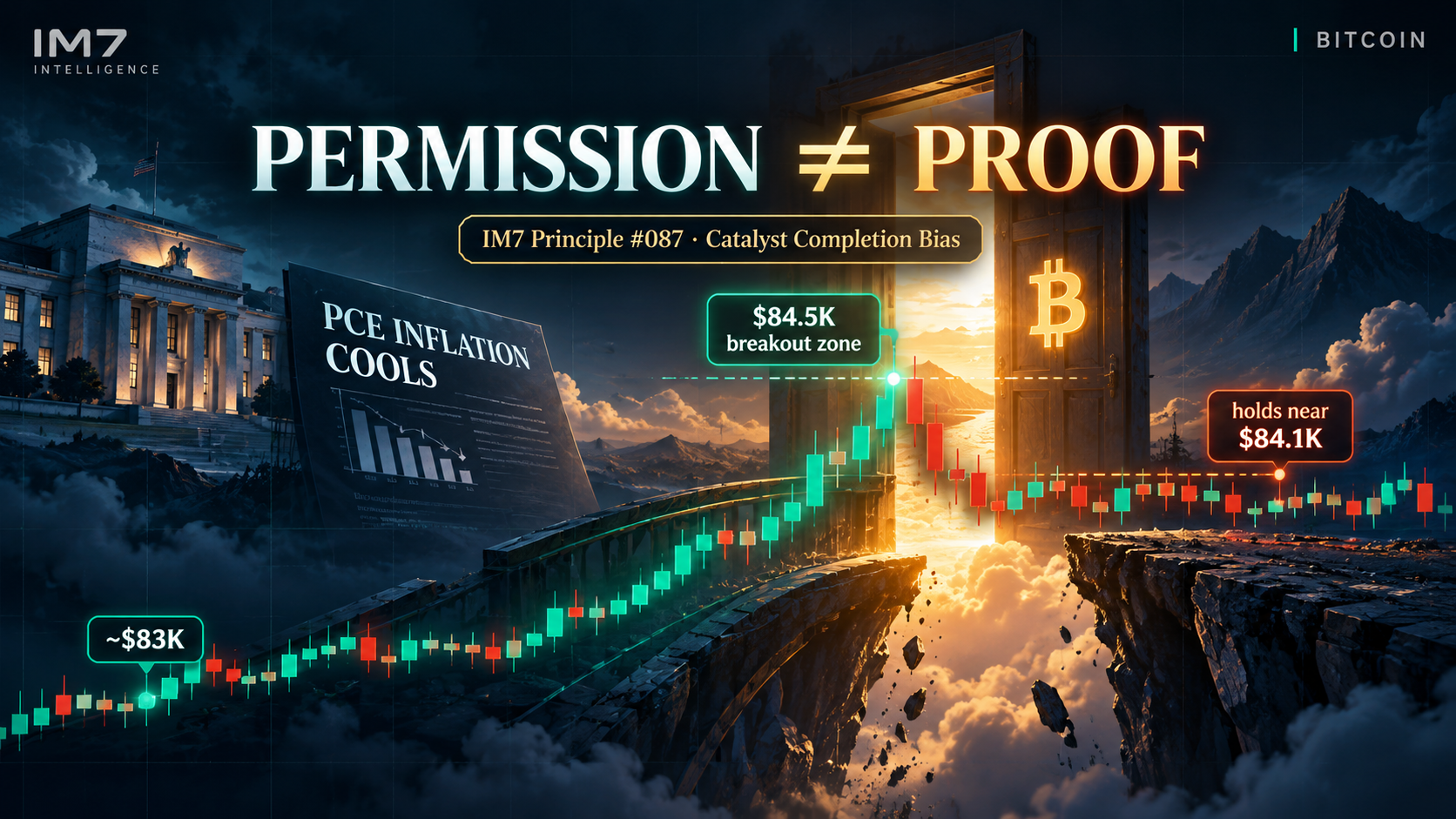
Bitcoin broke higher after cooler PCE data, then quickly gave back a large part of the move. The behavioral mistake was treating one resolved uncertainty as full confirmation. Good news can justify a breakout without proving the market will accept higher prices.
Executive Summary
Bitcoin got the macro catalyst traders had been waiting for: August PCE inflation came in cooler than expected, reducing immediate pressure for another Federal Reserve rate increase. Bitcoin responded by driving through the $84K area and briefly above $84.5K, but the next 2-hour candle surrendered a large portion of the move. The behavioral mistake was treating one resolved uncertainty — inflation — as though every remaining uncertainty had also disappeared. For the next decision, separate the quality of the catalyst from the quality of the market's response to it.
IM7 Principle
IM7 Principle #087 — Catalyst Completion Bias.
A favorable catalyst can resolve one source of uncertainty without resolving the entire market structure. Traders often mentally compress “one important question was answered” into “the thesis is now confirmed.”
Market Context
The September 30 Personal Income and Outlays report showed August headline PCE inflation at 3.4% year over year, below the 3.7% economists had expected. Core PCE was 3.0%, also below expectations, and markets reduced expectations for an October Federal Reserve rate increase after the release. :chatgpt-content-reference{index="0"}
That mattered because inflation and the expected path of interest rates had been a major source of uncertainty across risk assets.
Bitcoin responded immediately.
At the time of the 2-hour chart snapshot, price had accelerated from roughly the mid-$83K area, pushed through $84K, and printed a large green candle extending above $84.5K.
That was the catalyst reaction.
But the next candle changed the behavioral question.
Instead of cleanly holding the breakout area, Bitcoin immediately gave back a substantial portion of the advance and rotated toward approximately $84.1K.
The macro information improved.
The market's acceptance of higher prices was still being tested.
Those are two different observations.
What The Market Wanted You To Believe
"The good news confirmed the breakout."
The tape made that belief easy to adopt.
Inflation came in softer than expected.
Rate concerns eased.
Bitcoin accelerated through resistance.
Everything appeared to align at once.
When catalyst, direction, and emotion all agree, traders naturally stop separating them.
“The report was favorable” becomes:
“Bitcoin should rally.”
Which quickly becomes:
“The breakout is confirmed.”
But only the first statement was established by the data.
The second was an interpretation.
The third still required market evidence.
That distinction became visible immediately when the next 2-hour candle retraced a significant portion of the breakout.
The good news did not disappear.
What disappeared was the assumption that good news automatically guaranteed acceptance at higher prices.
Behavioral Observation
Watch what happens immediately after a highly anticipated catalyst resolves in the trader's favor.
Questions disappear rapidly.
Before the event, traders may ask:
- What will inflation show?
- How will rates react?
- Can Bitcoin clear resistance?
- Will buyers remain after the initial move?
After a favorable headline and one large green candle, those separate questions often collapse into one emotional conclusion:
“We got the answer.”
That is where Catalyst Completion Bias begins.
On the chart, look for the sequence:
- A known uncertainty dominates attention.
- The catalyst resolves favorably.
- Price accelerates immediately.
- Traders upgrade conviction before the first meaningful retest.
- The market then reveals whether the breakout was merely triggered or actually accepted.
The red candle after the breakout is therefore more informative than it initially appears.
It does not prove the bullish interpretation wrong.
It proves the catalyst did not answer every remaining question.
Cognitive Bias Breakdown
Human beings prefer coherent stories.
When several pieces of information line up at the same time, the mind tends to combine them into one simplified explanation.
Good inflation report.
Lower rate pressure.
Bitcoin breakout.
Therefore:
“Everything is bullish now.”
But markets contain multiple unresolved variables simultaneously.
The inflation report can improve the macro backdrop without eliminating technical resistance, positioning risk, profit-taking, liquidity constraints, or sellers already waiting above price.
This resembles the judgment shortcuts described by Tversky and Kahneman: under uncertainty, people frequently substitute a simpler question for a more difficult one Tversky & Kahneman, 1974.
The difficult question was:
“Has the new information created durable acceptance above this level?”
The easier question was:
“Was the news good?”
The answer to the second question may have been yes.
That did not automatically answer the first.
The Professional Read
A disciplined professional separates three stages:
Catalyst → Reaction → Acceptance
The catalyst tells you what new information entered the market.
The reaction tells you how aggressively participants responded.
Acceptance tells you whether the market can maintain the repricing after the initial emotional response fades.
Those stages should never be treated as interchangeable.
Cooler PCE was new information.
The large green Bitcoin candle was the reaction.
Whether higher prices could hold after the first pullback remained a separate question.
The professional therefore does not need to dismiss the breakout simply because a red candle appeared.
But they also do not promote the breakout to confirmation simply because the catalyst was favorable.
They wait for the market to distinguish temporary enthusiasm from durable agreement.
Decision Framework
After any major catalyst, separate the event into three questions:
1. What uncertainty was actually resolved?
- Inflation?
- Rates?
- Earnings?
- Regulation?
- Liquidity?
2. What did price do immediately?
- Break resistance?
- Reject?
- Accelerate?
- Fail to respond?
3. What happened after the reaction?
- Did the new level hold?
- Did buyers defend the first pullback?
- Did sellers immediately reclaim the level?
- Did volatility produce movement without acceptance?
Then ask:
- Am I trading the information or the market's response to the information?
- What uncertainty still remains?
- Would I still call this confirmed if the catalyst headline were removed from the chart?
- Has conviction increased because evidence improved, or because uncertainty felt uncomfortable before the report?
Risk Management Lesson
Catalysts create a specific risk-management problem: certainty expands faster than the evidence window.
A trader waiting all week for one economic report may feel enormous relief when the result supports their thesis.
That relief can produce:
- larger position sizing,
- chasing the breakout candle,
- reduced patience,
- weaker invalidation discipline,
- and the assumption that pullbacks are automatically buying opportunities.
But the market does not care how important the catalyst felt beforehand.
Position size should reflect what the market has actually demonstrated after the event.
The more emotionally satisfying the catalyst, the more valuable it becomes to separate the headline from the subsequent price behavior.
IM7 Quote
"Good news can open the door. The market still has to stay through it."
IM7 Observation
The most important information from this move was not simply that cooler PCE helped Bitcoin rally.
That relationship was understandable.
The more valuable observation came immediately afterward.
Bitcoin received favorable macro information, broke through a level traders had been watching, and then quickly surrendered a meaningful portion of the advance.
That exposed the difference between catalyst permission and market acceptance.
The data reduced one reason for hesitation.
It did not automatically remove every seller, erase every resistance level, or guarantee that traders would continue paying higher prices.
The professional question therefore shifts after the news.
Before the catalyst:
What will the data say?
After the catalyst:
What will the market do with what it now knows?
That second question is where the behavioral edge begins.
IM7 Decision Rule
After a favorable catalyst, do not treat the first reaction as confirmation.
Separate the news from the hold and require subsequent price behavior to prove that the market accepted the new information.
How did this land?
What emotion or bias did this article help you recognize?
References
- [1]Tversky, A. & Kahneman, D. (1974). Judgment under Uncertainty: Heuristics and Biases. Science. American Association for the Advancement of Science. https://www.science.org/doi/10.1126/science.185.4157.1124
- [2]Reuters (2026). US inflation rises below expectations in August; consumer spending robust. Reuters. Reuters. https://www.reuters.com/markets/us/us-inflation-rises-less-than-expected-august-consumer-spending-surges-2026-09-30/
Pass the signal forward.
IM7 Intelligence studies financial markets through the lens of psychology rather than prediction. Our research focuses on behavioral finance, crowd psychology, sentiment, and decision-making to help readers understand why markets move—not just where they move.
IM7 Intelligence publishes educational research on market psychology, behavioral finance, and investor behavior. Nothing published by IM7 Intelligence constitutes financial, investment, tax, or legal advice. Always conduct your own research before making financial decisions.
Read the market's emotion before it acts.
Where this article sits in the map.
- Confirmation BiasYou are here
- Behavioral Finance
- Risk Management
- Fear
Curated paths, not random articles.
Behavior read in real time.

Ismael Mercius
Ismael Mercius is the founder of IM7 Intelligence, where he writes about crypto market psychology, behavioral finance, and the sentiment cycles that drive digital asset prices. His work focuses on how traders actually make decisions — and the recurring errors that show up in their P&L.
- Crypto market psychology
- Behavioral finance
- Market sentiment analysis
- Trader behavior & decision-making