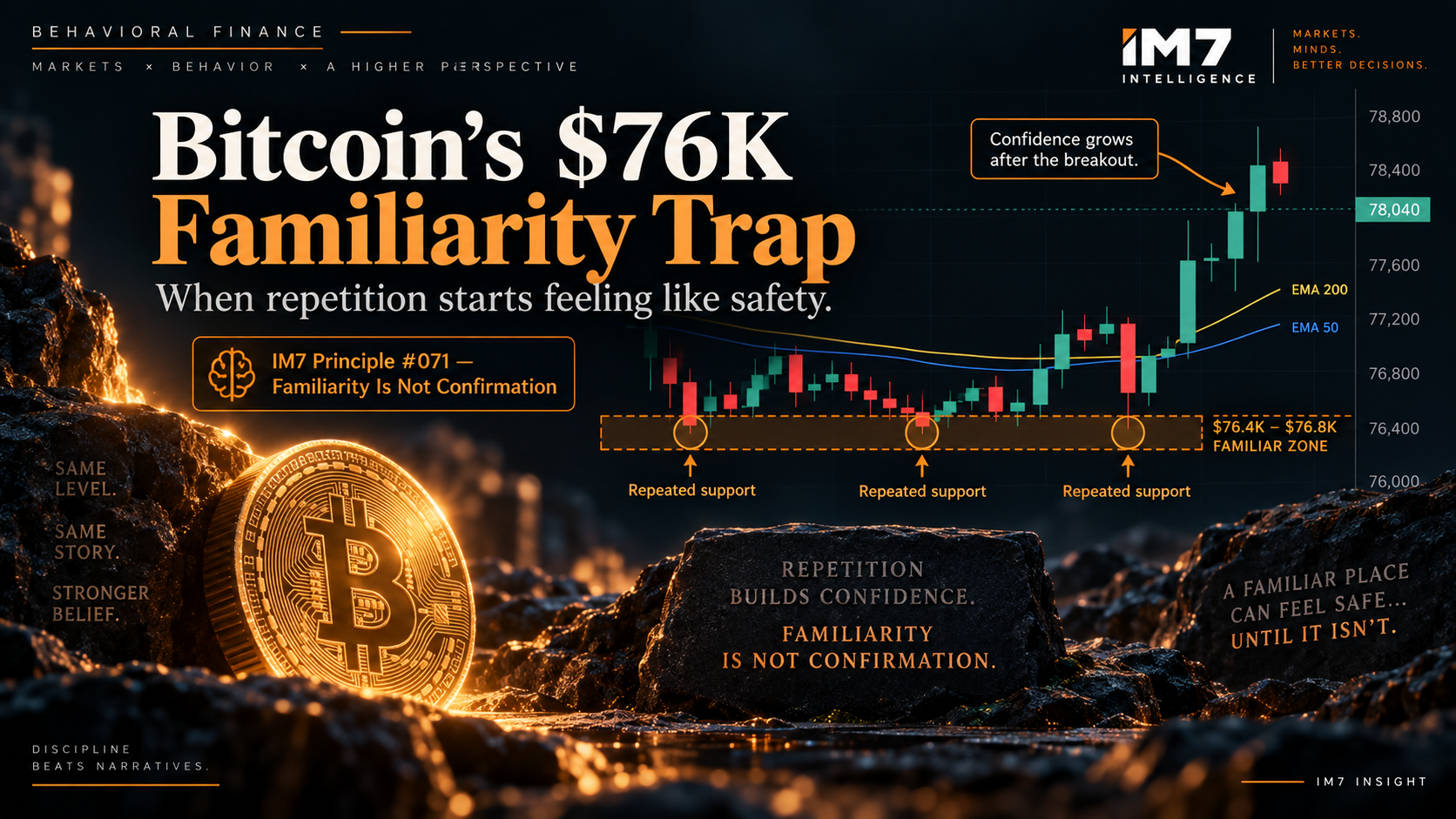
Bitcoin’s $76K Familiarity Trap: When Repetition Starts Feeling Like Safety
AI Generated • IM7 Intelligence
- Reading time
- 4 min read
- Word count
- 866 words
- Published
Bitcoin has defended the $76K area repeatedly, and each successful bounce makes traders more confident that the level is “safe.” But repetition can create false certainty. This article breaks down the familiarity trap behind repeated support tests and why a streak should never be mistaken for a rule.
Executive Summary
Bitcoin repeatedly defended the $76K area before pushing back above $78K, reinforcing the belief that the level is becoming reliable support. The behavioral risk is that repeated success can turn observation into certainty: traders stop asking why the level held and start assuming it will hold again. That shift matters because confidence built from repetition can survive even when the surrounding market environment changes. The lesson is not that $76K will fail — it is that repeated defense should never be treated as a guarantee.
IM7 Principle
IM7 Principle #14 — Familiarity Is Not Confirmation.
The more often a market behavior repeats, the more natural it feels to expect it again. Familiarity reduces uncertainty emotionally before the evidence has actually reduced it structurally.
Market Context
Bitcoin defended the $76K–$77K area multiple times before recovering back above $78K. Each successful defense strengthened the visual importance of the zone and rewarded traders who treated previous bounces as evidence of continued support.
At the same time, the broader environment remained uncertain. The important observation is not whether the level is bullish or bearish, but that traders now have several recent examples reinforcing the same expectation.
Repeated defense has therefore become part of the market's memory.
That memory can influence positioning just as strongly as the current candle.
What The Market Wanted You To Believe
"This level always holds."
Every successful bounce made that belief easier to accept.
The first defense looked like evidence.
The second created recognition.
The third started creating expectation.
Once a level becomes familiar, traders often stop evaluating each new test independently. Instead, they begin carrying the outcome of previous tests into the next decision.
The market rewarded that behavior again when Bitcoin recovered toward and above $78K.
That reward is exactly what makes the belief more dangerous.
Behavioral Observation
The crowd is not simply watching support.
It is learning to trust it.
Watch what happens after a level survives several tests. Traders become quicker to buy the next approach, more willing to increase size, and less interested in questioning whether the conditions around the level have changed.
Confidence rises because the pattern feels familiar.
That is the signal to watch.
Not the bounce itself.
The behavioral warning appears when traders begin saying:
"It held last time."
"It always bounces here."
"This level is strong."
Those statements may sound analytical, but they often reveal that memory has started replacing fresh evaluation.
Cognitive Bias Breakdown
This is a combination of familiarity bias and recency bias.
Familiarity bias describes the tendency to feel more comfortable with something simply because it has become recognizable.
Recency bias causes recent outcomes to receive more weight than they deserve.
Together, they create a powerful trading error:
A level holds several times, so traders begin treating the repeated outcome as evidence that the same result is increasingly likely.
But repetition does not remove uncertainty.
It only makes uncertainty feel smaller.
Each test still occurs under a new combination of liquidity, positioning, momentum, macro conditions, and trader expectations.
A familiar chart can therefore produce unfamiliar outcomes.
The Professional Read
A disciplined trader separates what happened from what must happen next.
The professional observation is simple:
Bitcoin defended the area several times.
That is evidence.
"Therefore it will hold again" is not evidence.
It is an inference.
Professionals continue evaluating participation, rejection, acceptance, momentum, liquidity, and the behavior around the level rather than assuming previous outcomes will repeat.
The goal is not to distrust support.
The goal is to avoid upgrading support into certainty.
Decision Framework
Before trusting a repeatedly defended level, ask:
- How many times has the level been tested?
- Is each bounce becoming stronger or weaker?
- Is participation increasing or fading?
- Has the broader market environment changed?
- Is price accepting above the level or merely reacting from it?
- Am I evaluating the current test, or remembering the previous one?
- Would I still trust this level if it had not worked three times already?
- Has repetition changed my position size or confidence more than the evidence justifies?
Risk Management Lesson
Repeated success can quietly increase risk-taking.
A trader who saw one successful defense may remain cautious.
A trader who saw three may size larger because the level feels proven.
That is where familiarity becomes dangerous.
Position size should reflect uncertainty, not emotional comfort.
A level becoming familiar is not a reason to reduce risk controls.
It may be a reason to examine them more carefully.
IM7 Quote
"Repetition is not a rule. It is a streak that has not broken yet."
IM7 Observation
Bitcoin's recovery above $78K does not invalidate the familiarity trap.
It strengthens it.
Every successful defense rewards traders who trusted the level, making the behavior more likely to repeat the next time price returns.
The market is therefore doing more than defending support.
It is training participants to expect support.
That expectation becomes important because the more confident traders become in a repeated outcome, the less prepared they may be for a different one.
IM7 Decision Rule
Never increase confidence solely because a level has worked repeatedly.
Treat every new test as a new decision and require current evidence before upgrading a familiar pattern into confirmation.
How did this land?
What emotion or bias did this article help you recognize?
References
- [1]Huberman, G. (2001). Familiarity Breeds Investment. The Review of Financial Studies. Oxford University Press. DOI: 10.1093/rfs/14.3.659. https://doi.org/10.1093/rfs/14.3.659
- [2]Tversky, A. & Kahneman, D. (1974). Judgment under Uncertainty: Heuristics and Biases. Science. American Association for the Advancement of Science. DOI: 10.1126/science.185.4157.1124. https://doi.org/10.1126/science.185.4157.1124
Pass the signal forward.
IM7 Intelligence studies financial markets through the lens of psychology rather than prediction. Our research focuses on behavioral finance, crowd psychology, sentiment, and decision-making to help readers understand why markets move—not just where they move.
IM7 Intelligence publishes educational research on market psychology, behavioral finance, and investor behavior. Nothing published by IM7 Intelligence constitutes financial, investment, tax, or legal advice. Always conduct your own research before making financial decisions.
Read the market's emotion before it acts.
Where this article sits in the map.
- Confirmation BiasYou are here
- Behavioral Finance
- Risk Management
- Fear
Curated paths, not random articles.
Behavior read in real time.

Ismael Mercius
Ismael Mercius is the founder of IM7 Intelligence, where he writes about crypto market psychology, behavioral finance, and the sentiment cycles that drive digital asset prices. His work focuses on how traders actually make decisions — and the recurring errors that show up in their P&L.
- Crypto market psychology
- Behavioral finance
- Market sentiment analysis
- Trader behavior & decision-making