Bitcoin Below $77K: When Weekend Silence Looked Like Safety
AI Generated • IM7 Intelligence
- Reading time
- 5 min read
- Word count
- 977 words
- Published
Bitcoin’s quiet weekend encouraged traders to believe the escalating oil and shipping risks had already been absorbed. But with major traditional markets closed, the silence reflected incomplete participation—not confirmed resilience.
Executive Summary
Bitcoin remained relatively quiet while geopolitical risk intensified around Saudi oil infrastructure and the Strait of Hormuz. That calm encouraged traders to believe the news had already been absorbed, even though U.S. equities, Treasuries, and ETF desks were closed. As Sunday trading progressed, BTC moved below $77,000 before attempting to reclaim it, exposing the danger of treating incomplete participation as a completed market verdict. The lesson is not that silence guarantees a delayed decline—it is that silence cannot confirm resilience until the relevant markets have had a genuine opportunity to respond.
IM7 Principle
IM7 Principle #070 — Silence Requires Participation.
A muted reaction is meaningful only when the participants capable of transmitting the catalyst have had a real opportunity to act. When major markets are closed, calm price action represents incomplete evidence—not confirmation that the risk has disappeared.
Market Context
Saudi Arabia temporarily shut its critical East–West oil pipeline following drone attacks, while another vessel was struck near the Strait of Hormuz ¹². These developments increased uncertainty around energy supply, inflation, yields, and global risk appetite.
Bitcoin continued trading through the weekend, but several markets that transmit macroeconomic risk did not. U.S. equities and Treasuries were closed, ETF creation and redemption activity was absent, and institutional participation was reduced.
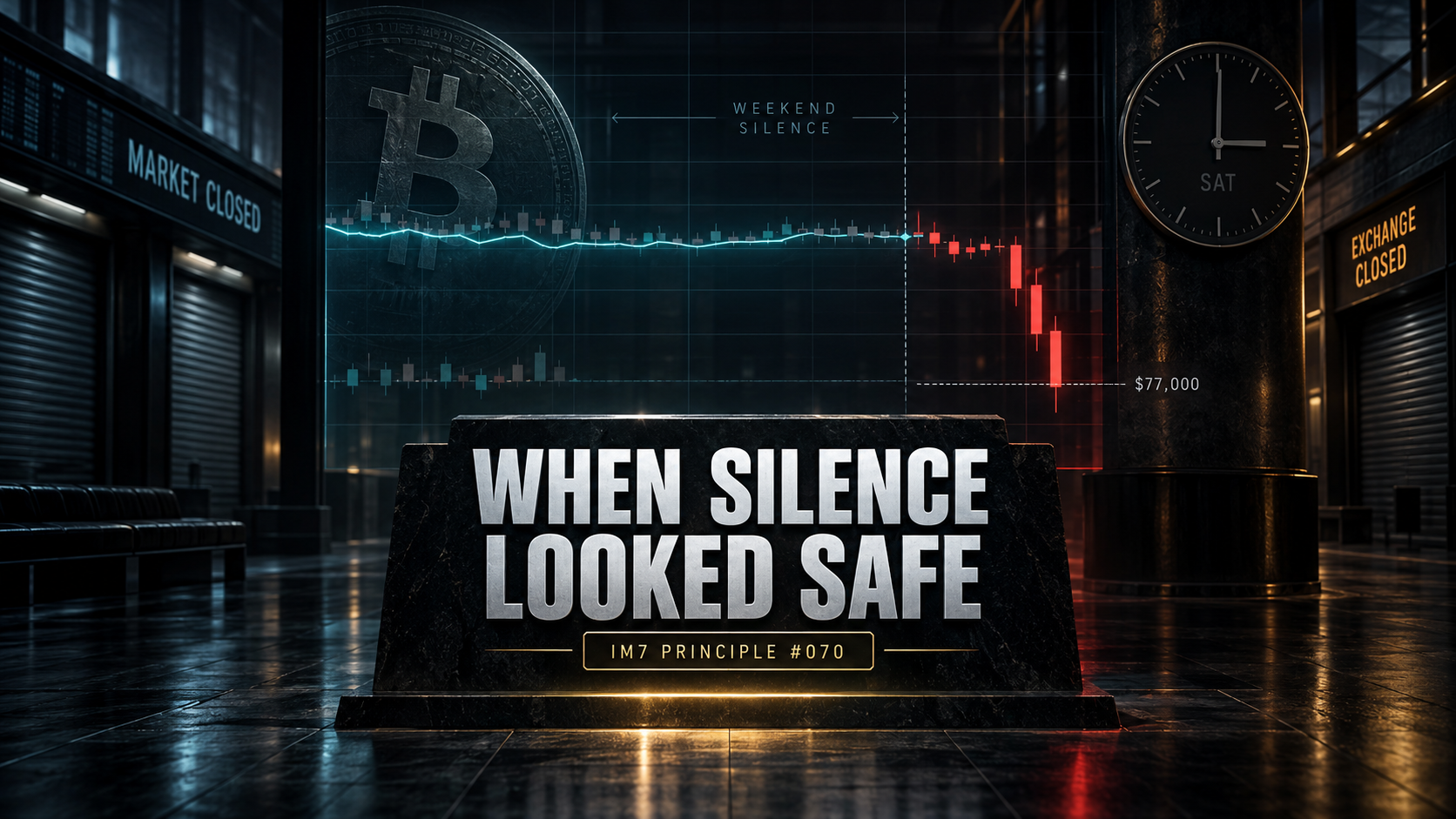
On the two-hour chart, BTC moved from a quiet consolidation near $77,200–$77,300 into two forceful red candles. Price tested below $77,000, traded beneath the 9 EMA, and remained below the 200 EMA near $77,500. Lower wicks around $76,500 showed responsive buying, but the developing rebound had not yet established sustained acceptance back above the broken area.
What The Market Wanted You To Believe
“Bitcoin absorbed the shock.”
The weekend tape invited traders to interpret stability as strength. Serious geopolitical developments appeared, yet Bitcoin did not immediately collapse, making the “resilient Bitcoin” explanation emotionally attractive.
That belief offered relief because it converted uncertainty into a conclusion. But the market had not completed the test. Bitcoin was open; much of the institutional machinery responsible for pricing inflation, yields, energy risk, and ETF demand was not.
The quiet period therefore could not prove that the catalyst was irrelevant. It only proved that Bitcoin had remained stable under limited weekend participation.
Behavioral Observation
The crowd is converting absence of reaction into evidence of safety.
This usually begins with quiet candles following a threatening headline. As time passes without an immediate decline, anxiety fades and confidence rises. Traders stop asking whether the market has fully processed the information and begin saying that the news “doesn’t matter.”
On the chart, watch for a compressed weekend range, repeated tests of the same support, price slipping beneath the short-term average, and then a sudden expansion candle as liquidity conditions change. The expansion does not automatically confirm a new trend. It reveals that the earlier calm was not sufficient evidence to settle the question.
Cognitive Bias Breakdown
This is a form of availability-driven closure: the mind makes a decision using the information currently visible and neglects what is missing. A quiet Bitcoin chart is visible. Closed Treasury markets, absent ETF flows, and reduced institutional participation are less visible.
Kahneman described this tendency as relying on the information immediately available while constructing a coherent explanation around it Kahneman, 2011. In this case, the visible chart produced the story: “Bitcoin is absorbing the news.”
But coherence is not completeness. The chart showed Bitcoin’s weekend response; it did not show the full cross-market response. Traders confused the evidence they had with all the evidence that mattered.
The Professional Read
A disciplined professional separates the event into three stages:
- Catalyst arrival: What happened, and which markets should transmit its effects?
- Opportunity to respond: Were those markets open, liquid, and sufficiently active?
- Observed response: Did price accept, reject, or remain unresolved after participation returned?
Under this framework, the weekend calm was neither bullish confirmation nor bearish invalidation. It was an incomplete test.
The move below $77,000 added information, but it still did not settle the issue by itself. The professional read focuses on whether price sustains trade below the level, reclaims it, or continues rotating around it after broader participation returns.
Decision Framework
Before interpreting a quiet reaction, ask:
- Which markets normally transmit this catalyst?
- Were those markets open when the news arrived?
- Was liquidity representative or unusually thin?
- Did price merely touch the level, or sustain trade beyond it?
- Did volume and range expand when participation returned?
- Is the conclusion based on an observed response or emotional relief?
If any major part of the transmission system was unavailable, classify the evidence as incomplete.
Risk Management Lesson
Incomplete evidence should produce smaller confidence, not larger exposure.
A quiet weekend can tempt traders to increase position size because uncertainty appears to have passed. But the uncertainty has not necessarily disappeared—it may simply be waiting for deeper liquidity. Position sizing should reflect what the market has actually confirmed, not how comfortable the absence of movement feels.
Patience means waiting for participation and price behavior to align. It does not mean predicting the direction of the eventual response.
IM7 Quote
“Silence becomes evidence only after the market had a chance to speak.”
IM7 Observation
Bitcoin’s move below $77,000 did not prove that the geopolitical catalyst caused the decline, and the developing rebound did not prove that the risk had been absorbed. The important observation is that weekend stability failed to provide the certainty traders assigned to it.
The operator does not trade the silence or dramatize the first response. The operator waits to see what price sustains once the relevant participants return.
IM7 Decision Rule
Never treat silence as confirmation until the markets capable of transmitting the catalyst have reopened and price has shown sustained behavior.
A quiet period may be informative, but only after participation, liquidity, and follow-through are considered.
How did this land?
What emotion or bias did this article help you recognize?
References
- [1]Reuters (2026). Saudi Pipeline Outage Threatens Loss of 4% of Global Oil Supply. Reuters. Thomson Reuters. https://www.reuters.com/business/energy/saudi-pipeline-outage-threatens-loss-4-global-oil-supply-2026-09-13/ (accessed 2026-09-13)
- [2]Associated Press (2026). Strike on Iranian Cargo Ship in the Strait of Hormuz Kills 1, Iranian Media Say. AP News. The Associated Press. https://apnews.com/article/aa034da0d8226f5a3b4794b10afb8b3b
- [3]Kahneman, Daniel (2011). Thinking, Fast and Slow. Book. Farrar, Straus and Giroux. https://us.macmillan.com/books/9780374533557/thinkingfastandslow/
Pass the signal forward.
IM7 Intelligence studies financial markets through the lens of psychology rather than prediction. Our research focuses on behavioral finance, crowd psychology, sentiment, and decision-making to help readers understand why markets move—not just where they move.
IM7 Intelligence publishes educational research on market psychology, behavioral finance, and investor behavior. Nothing published by IM7 Intelligence constitutes financial, investment, tax, or legal advice. Always conduct your own research before making financial decisions.
Read the market's emotion before it acts.
Where this article sits in the map.
- Confirmation BiasYou are here
- Behavioral Finance
- Risk Management
- Fear
Curated paths, not random articles.
Behavior read in real time.

Ismael Mercius
Ismael Mercius is the founder of IM7 Intelligence, where he writes about crypto market psychology, behavioral finance, and the sentiment cycles that drive digital asset prices. His work focuses on how traders actually make decisions — and the recurring errors that show up in their P&L.
- Crypto market psychology
- Behavioral finance
- Market sentiment analysis
- Trader behavior & decision-making