Psychology
Human psychology applied to markets, decisions and behavior.
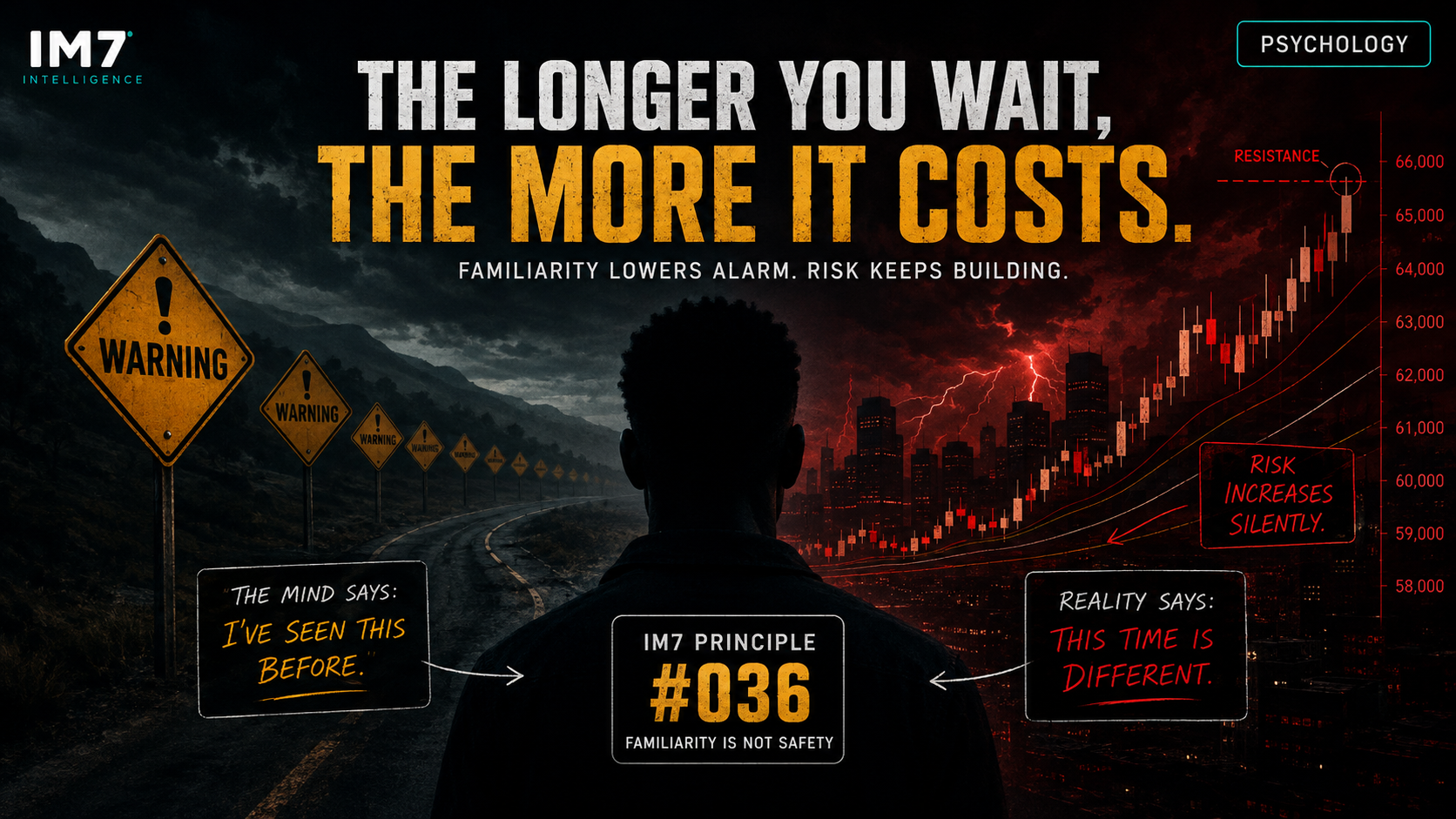
The Familiarity Trap: Why Smart Decisions Miss Obvious Red Flags
Repeated exposure doesn't make danger disappear—it makes it feel normal. The Familiarity Trap explains why intelligent people overlook obvious warning signs, not because they're incapable of seeing them, but because familiarity quietly replaces caution.
 Psychology
Outcome Bias: Why Good Outcomes Can Reward Bad Decisions
A profitable trade does not always reflect a sound decision. Outcome Bias causes traders to judge the quality of their process by the result instead of the evidence that supported it. When fortunate outcomes reinforce flawed decision-making, the next mistake often becomes larger, more confident, and more expensive.
Jul 29, 202610 min read Psychology
The Overconfidence Delusion: Why Intelligence Doesn't Protect You from Bad Decisions
Intelligence doesn't eliminate cognitive bias—it often disguises it. Overconfidence can lead even experienced investors, entrepreneurs, and professionals to underestimate risk, overestimate their knowledge, and mistake confidence for competence. Understanding this psychological trap is essential for better decisions in markets and beyond.
Jul 16, 202611 min read Psychology
The Allure of the Oracle: Why We Over-rely on Technical Indicators
Despite frequent evidence of their fallibility, market participants often exhibit profound trust in technical indicators. This persistent belief in predictive patterns, even when statistically tenuous, reveals deep-seated cognitive biases. Understanding the subconscious mechanisms driving this over-reliance is crucial for disciplined decision-making.
Jul 15, 20265 min read Psychology
Why Sideways Markets Feel Harder Than Crashes: The Psychology of Waiting and Expectation Bias
Sideways markets can often feel more emotionally taxing than sharp crashes, despite the absence of dramatic losses. This article explores the psychological underpinnings of why periods of consolidation, exemplified by Bitcoin's recent price action, challenge traders' emotional resilience more than volatile downturns. We delve into expectation bias, impatience, and the urge to overtrade when the market goes quiet.
Jul 4, 20263 min read Psychology
The Silent Killer of Trading Accounts: Why Sideways Markets Are More Dangerous Than Crashes
While dramatic market crashes often grab headlines, it's the prolonged, range-bound sideways markets that silently decimate more trading accounts. This article explores the psychological pitfalls that make low-volatility periods uniquely challenging for traders, using a recent Bitcoin 2-hour chart as a case study to illustrate these behavioral traps.
Jun 28, 20263 min read Psychology
The Premium for Certainty: Why Waiting for Confirmation Costs Investors Dearly
In the volatile world of markets, from Bitcoin to established equities, a common behavioral trap ensnares countless participants: the quest for certainty. Many believe that by waiting for confirmation, they are reducing risk, when in fact, they are often paying a steep premium for reassurance. This psychological dynamic, rooted in our innate aversion to uncertainty, reveals a fundamental truth about human decision-making and market behavior.
Jun 23, 20263 min read Psychology
Why the Biggest Bitcoin Moves Often Begin During Boring Markets: A Behavioral Finance Perspective
Investors often anticipate major market shifts to be heralded by dramatic price action. However, a deeper look into market psychology reveals that some of the most significant moves in assets like Bitcoin frequently germinate during periods of apparent calm and widespread disengagement. This phenomenon stems from a confluence of behavioral biases and subtle shifts in market dynamics.
Jun 17, 20263 min read Psychology
Emotional Compression: The Quiet Phase Before Breakouts
Major crypto moves rarely start with noise. They start with silence. We unpack the behavioral signature of emotional compression.
Jun 14, 20263 min read Psychology
Why Fear Creates Better Opportunities Than Euphoria in Bitcoin: A Behavioral Finance Perspective
In the volatile world of Bitcoin, emotions often drive market movements. This article deconstructs how fear, rather than euphoria, can present more compelling opportunities for savvy investors, drawing insights from behavioral finance and crowd psychology.
Jun 5, 20264 min read Psychology
The Psychology of Panic Selling in Crypto Markets
Panic selling is not a price event — it is a collapse in conviction. We break down the behavioral structure that turns drawdowns into capitulation.
Apr 12, 20264 min read