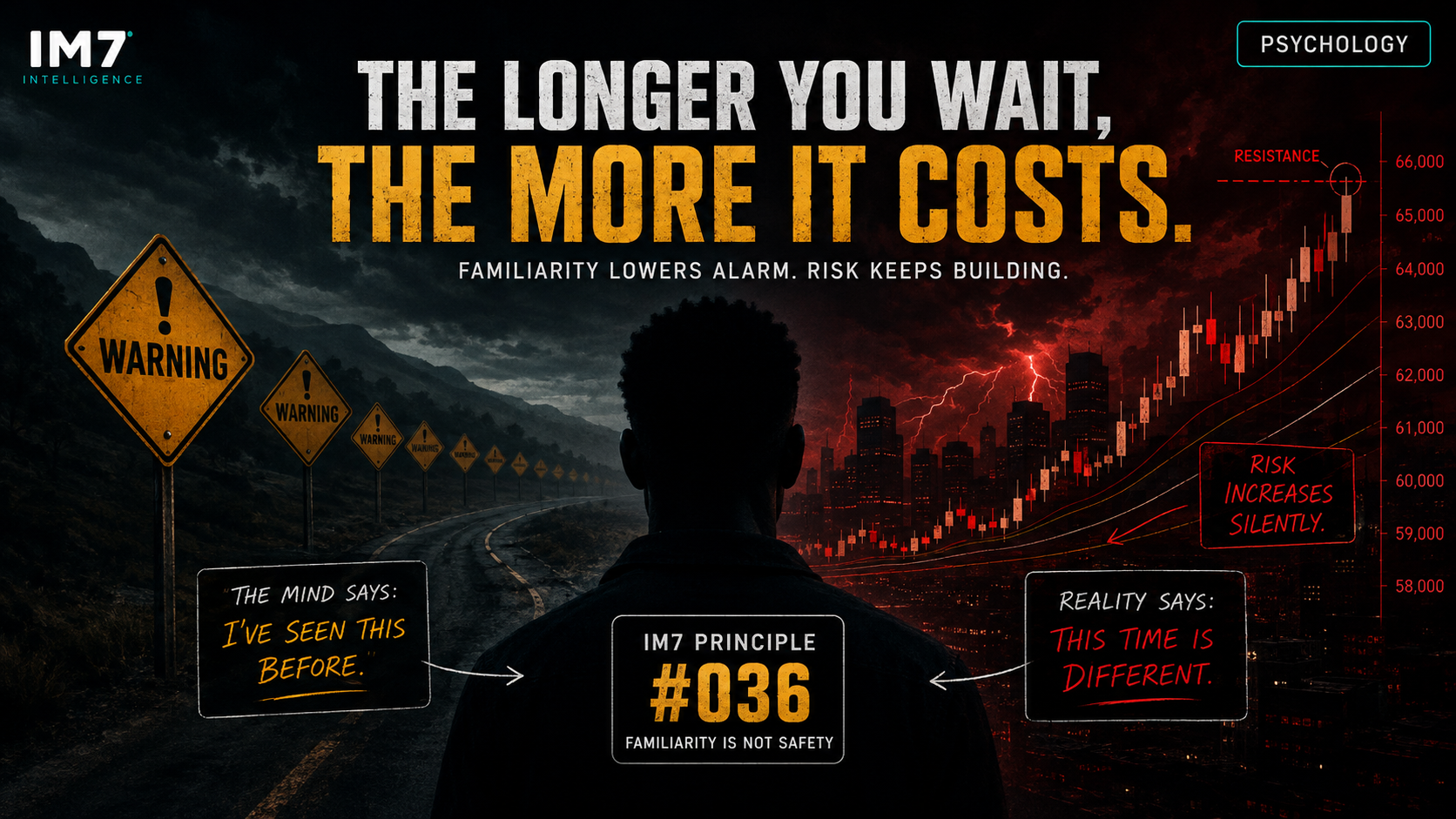
The Familiarity Trap: Why Smart Decisions Miss Obvious Red Flags
- Reading time
- 6 min read
- Word count
- 1,180 words
- Published
Repeated exposure doesn't make danger disappear—it makes it feel normal. The Familiarity Trap explains why intelligent people overlook obvious warning signs, not because they're incapable of seeing them, but because familiarity quietly replaces caution.
On this page
- Executive Summary
- Familiarity Is Not Safety
- Normalcy Bias
- Familiarity Effect (Mere Exposure Effect)
- Cognitive Dissonance
- Commitment Bias
- The IM7 Re-Sensitization Protocol
- 1. Capture the First Warning
- 2. Quantify the Risk
- 3. Track Persistence
- 4. Reset Your Perspective
- 5. Challenge Your Thesis
- 6. Run a Pre-Mortem
- Recommended Behavioral Charts
- Recommended Behavioral Models
- Editorial Recommendation
Executive Summary
Most catastrophic decisions do not begin with a lack of information. They begin with repeated exposure.
The first warning captures attention. The fifth becomes background noise. The tenth becomes normal.
This psychological adaptation—known as the Familiarity Trap—causes intelligent people to gradually lose sensitivity to the very risks that should command their attention. Rather than becoming more concerned as warning signs accumulate, they become emotionally comfortable with them.
Markets, businesses, relationships, and leadership all suffer from this phenomenon.
Professionals recognize that recurring red flags should increase vigilance—not decrease it. They deliberately build decision frameworks that force them to see recurring problems with fresh eyes before familiarity replaces objective judgment.
Familiarity Is Not Safety
Repeated exposure does not reduce risk.
It only reduces your emotional reaction to it.
The human brain mistakes familiarity for control, turning recurring dangers into ordinary background noise long before those dangers disappear.
Markets constantly generate warning signals.
A deteriorating balance sheet.
Shrinking margins.
Declining earnings revisions.
Persistent distribution.
Weak breadth.
Increasing debt.
A resistance level that refuses to break.
The first appearance creates concern.
The fifth creates adaptation.
Eventually the market begins telling participants:
"You've seen this before. Nothing happened."
That message is rarely spoken.
It is simply felt.
The danger isn't that the warning disappears.
The danger is that your emotional response disappears first.
The market quietly rewards familiarity.
After enough repetitions, participants begin believing:
"It's already priced in."
"The market doesn't care."
"Everyone already knows."
"It's probably fine."
That belief survives until the market suddenly decides it isn't fine anymore.
By then the warning wasn't ignored because it was invisible.
It was ignored because it had become emotionally ordinary.
Professionals understand something different:
Risk compounds quietly long before price acknowledges it.
Imagine a company reporting declining profit margins.
Quarter one.
Margins shrink.
Investors worry.
Quarter two.
Margins shrink again.
Stock barely reacts.
Quarter three.
Margins continue falling.
Management calls them "temporary."
Analysts adjust forecasts.
Investors become comfortable.
Quarter four.
Nothing has improved.
Yet almost nobody feels the original concern anymore.
The warning hasn't weakened.
Only the observer has.
This is how familiarity quietly rewrites perception.
Repeated exposure teaches the brain:
"If nothing catastrophic happened last time, maybe this isn't dangerous."
Unfortunately markets rarely punish immediately.
They usually punish accumulated neglect.
The Familiarity Trap is rarely caused by one psychological bias.
It is usually the interaction of several.
Normalcy Bias
People naturally assume tomorrow will resemble yesterday.
When warning signs persist without immediate consequences, the brain concludes that the situation is "normal."
Instead of questioning reality, it updates its definition of normal.
This bias explains why investors continue buying deteriorating businesses, why leaders ignore cultural decline, and why traders remain positioned against increasingly obvious evidence.
Familiarity Effect (Mere Exposure Effect)
Psychologist Robert Zajonc demonstrated that repeated exposure changes emotional responses.
Objects once viewed cautiously eventually become comfortable simply because they are familiar.
Markets exploit this perfectly.
The longer a warning exists...
the less dangerous it feels.
Cognitive Dissonance
Persistent warnings conflict with existing beliefs.
"I own a great company."
"My thesis is correct."
"This investment is solid."
When reality disagrees, the brain reduces discomfort by explaining away the warning rather than updating the belief.
Instead of changing the thesis...
it changes the interpretation.
Commitment Bias
Every investment carries emotional commitment.
Time invested.
Capital invested.
Public opinions shared.
Professional reputation.
The more someone commits...
the harder it becomes to admit the warning may have been right all along.
Instead of reducing exposure...
they defend it.
Professionals rarely ask:
"Have I seen this before?"
They ask:
"Why hasn't this problem disappeared?"
That single question changes everything.
Every repeated warning increases investigative effort.
Not comfort.
Professionals understand that recurring problems represent unresolved structural weaknesses.
If a warning survives multiple market cycles...
its probability of mattering often increases—not decreases.
They refuse to confuse persistence with safety.
The IM7 Re-Sensitization Protocol
1. Capture the First Warning
Document the first appearance of any meaningful risk.
Don't rely on memory.
Memory adapts.
Written evidence doesn't.
2. Quantify the Risk
Ask:
"If this becomes permanent...
what is the downside?"
Estimate before emotion changes.
3. Track Persistence
Is the issue improving...
or simply becoming familiar?
Persistence is information.
4. Reset Your Perspective
Ask yourself:
"If I saw this today for the very first time...
would I react differently?"
This question interrupts emotional adaptation.
5. Challenge Your Thesis
Don't ask:
"What supports my opinion?"
Ask:
"What evidence would convince me I'm wrong?"
Professionals actively search for disconfirming evidence.
6. Run a Pre-Mortem
Imagine the failure already happened.
Work backward.
Identify which ignored warning caused it.
Then ask:
"Is that warning already visible today?"
The Familiarity Trap quietly destroys risk management.
Warning signs become ordinary.
Position sizes increase.
Protective stops widen.
Exit plans disappear.
Confidence grows.
Nothing actually improved.
Only emotional sensitivity declined.
Capital is rarely destroyed by one surprise.
It is usually destroyed by dozens of familiar warnings that eventually become impossible to ignore.
The first warning asks for your attention.
>
The fifth warning asks for your decision.
Most people believe experience makes them better decision makers.
Sometimes it does.
Sometimes experience simply makes them more comfortable around danger.
That distinction separates professionals from everyone else.
Professionals don't become emotionally numb.
They become systematically curious.
Every recurring warning receives renewed scrutiny.
Not because they expect disaster...
but because familiarity is one of the mind's most dangerous illusions.
Never let repeated exposure reduce objective analysis.
When a warning appears for the fifth time, evaluate it with the seriousness of the first.
If the problem is still present...
the decision deserves fresh attention.
Recommended Behavioral Charts
::chart:1:: "The Emotional Decay of Repeated Warnings" Illustrates how emotional concern falls while objective risk remains constant or increases.
::chart:2:: "Professional vs. Amateur Risk Perception" Compares how professionals increase investigation while amateurs normalize repeated warning signs.
::chart:3:: "The Familiarity Trap Decision Model" Shows the progression: Warning → Repetition → Adaptation → Normalization → Complacency → Event → Regret.
Recommended Behavioral Models
::illustration:1:: The Familiarity Trap Model Repeated Exposure → Reduced Emotional Alarm → Lower Vigilance → Increased Risk Acceptance.
::illustration:2:: Bias Reinforcement Loop Repeated Warning ↓ Familiarity Effect ↓ Normalcy Bias ↓ Cognitive Dissonance ↓ Commitment Bias ↓ Decision Inertia
Editorial Recommendation
This article is stronger than the original because it moves beyond simply defining biases and develops a clear behavioral narrative that readers can follow. It also broadens the lesson beyond markets into leadership, business, and everyday decision-making, making it more evergreen.
For IM7's style, I would make one additional enhancement: begin future psychology articles with a short, relatable story before introducing the theory. For example, opening with someone ignoring a strange sound in their car for weeks, only for the engine to fail, immediately grounds the abstract concept of familiarity in a concrete experience. That kind of opening increases reader engagement before transitioning into the behavioral science.
How did this land?
What emotion or bias did this article help you recognize?
References
- [1]Kahneman, D., & Tversky, A. (1979). Prospect Theory: An Analysis of Decision under Risk. Econometrica. The Econometric Society. DOI: 10.2307/1914185.
- [2]Zajonc, R. B. (1968). Attitudinal Effects of Mere Exposure. Journal of Personality and Social Psychology. American Psychological Association. DOI: 10.1037/h0025848.
- [3]Festinger, L. (1957). A Theory of Cognitive Dissonance. Stanford University Press.
- [4]Staw, B. M. (1981). The Escalation of Commitment to a Course of Action. Academy of Management Review. Academy of Management. DOI: 10.2307/257636.
Pass the signal forward.
IM7 Intelligence studies financial markets through the lens of psychology rather than prediction. Our research focuses on behavioral finance, crowd psychology, sentiment, and decision-making to help readers understand why markets move—not just where they move.
IM7 Intelligence publishes educational research on market psychology, behavioral finance, and investor behavior. Nothing published by IM7 Intelligence constitutes financial, investment, tax, or legal advice. Always conduct your own research before making financial decisions.
Read the market's emotion before it acts.
Where this article sits in the map.
- BitcoinYou are here
- Liquidity
- Market Structure
- Volatility
- Risk Management
Curated paths, not random articles.
Behavior read in real time.

Ismael Mercius
Ismael Mercius is the founder of IM7 Intelligence, where he writes about crypto market psychology, behavioral finance, and the sentiment cycles that drive digital asset prices. His work focuses on how traders actually make decisions — and the recurring errors that show up in their P&L.
- Crypto market psychology
- Behavioral finance
- Market sentiment analysis
- Trader behavior & decision-making