The Rally Is Real. That Doesn’t Make Your $86K Entry Safe.
AI Generated • IM7 Intelligence
- Reading time
- 4 min read
- Word count
- 894 words
- Published
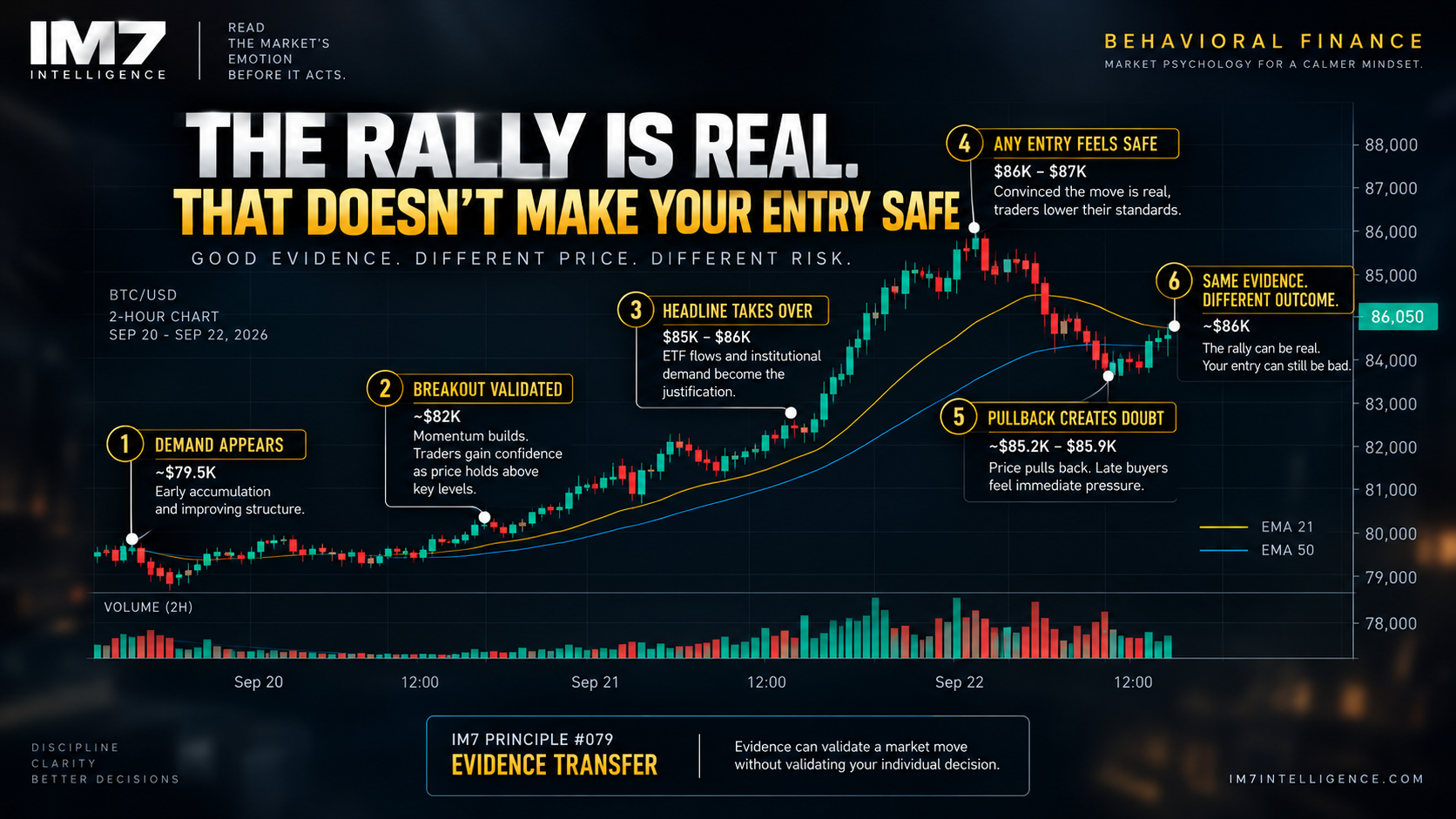
Bitcoin’s rally has real evidence behind it, including strong ETF demand. But evidence that validates the move does not automatically validate a late entry. Traders get into trouble when they transfer confidence in the market to confidence in the price they are paying.
Executive Summary
Bitcoin's rally toward $86K came with legitimate evidence behind it. U.S. spot Bitcoin ETFs recorded roughly $999 million in net inflows on September 21, while corporate Bitcoin accumulation continued. :contentReference[oaicite:0]{index=0}
But legitimate evidence creates its own behavioral trap.
When traders see strong demand validating a rally, they can begin treating that same evidence as validation of whatever price they are personally considering paying. Those are two different questions: Is the move real? and Is my decision at this price disciplined?
Confusing them is Evidence Transfer.
IM7 Principle
IM7 Principle #079 — Evidence Transfer
Evidence that strengthens a market thesis does not automatically strengthen every decision made because of that thesis.
The mistake begins when confidence in the move gets transferred directly into confidence in your entry.
Market Context
Bitcoin pushed above $86K after a sharp advance, while U.S. spot Bitcoin ETFs recorded approximately $999 million in net inflows on September 21. BlackRock's IBIT, ARK/21Shares' ARKB and Fidelity's FBTC accounted for most of those flows. :contentReference[oaicite:1]{index=1}
Corporate accumulation provided another visible source of confidence. Strive disclosed purchasing 1,355 BTC between September 14 and September 18 at an average price of approximately $79,475. :contentReference[oaicite:2]{index=2}
These are legitimate pieces of market evidence.
The behavioral problem begins with what traders conclude from them.
What The Market Wanted You To Believe
"If the demand is real, buying now must be safe."
The first half can be supported while the second remains unproven.
Strong ETF inflows can provide evidence of demand.
Corporate accumulation can provide evidence that large buyers were willing to deploy capital.
Neither fact automatically tells an individual trader that the price, timing, position size or risk-reward of a later decision is appropriate.
The market can validate the rally without validating your trade.
Behavioral Observation
Watch for the moment the trader stops discussing price and starts discussing only who is buying.
"BlackRock's ETF is getting inflows."
"Institutions are buying."
"Companies are accumulating."
Those statements can contain useful information.
But when they become the entire justification for acting, something has changed.
The trader is no longer asking:
"What does this evidence tell me about the market?"
They're asking:
"How can I use this evidence to justify what I already want to do?"
Cognitive Bias Breakdown
Evidence Transfer can draw on [confirmation bias](/library/confirmation-bias).
Once a trader wants participation, information supporting the broader bullish thesis becomes especially attractive. Evidence that the rally has genuine demand underneath it can then be mentally converted into evidence that participating immediately is the correct decision.
But those conclusions operate at different levels.
Market evidence: demand exists.
Decision evidence: this specific action, at this specific price, under these specific conditions, fits the trader's process.
Strong evidence for the first does not automatically establish the second.
The Professional Read
A disciplined operator does not dismiss strong evidence.
They classify it correctly.
ETF inflows belong in the assessment of demand.
Corporate purchases belong in the assessment of positioning and participation.
Price structure belongs in the assessment of what the market is currently accepting.
Risk, timing and position size belong to the individual decision.
Keeping those categories separate prevents good information from becoming bad justification.
The professional question is not:
"Is the rally legitimate?"
It is:
"What exactly does this evidence prove — and what does it not prove?"
Decision Framework
Before using bullish evidence to justify a decision, ask:
- What exactly does this evidence confirm?
- Does it validate the market thesis or my specific decision?
- At what price and under what conditions did the evidence occur?
- Has price materially changed since then?
- Would I still make this decision without the headline attached to it?
- What evidence would tell me my interpretation is wrong?
If those questions produce different answers, keep them separate.
Risk Management Lesson
Good evidence should improve analysis.
It should not automatically increase risk.
A trader can correctly identify institutional demand and still make a poorly structured decision.
That is why position sizing, patience and confirmation standards should remain tied to the conditions of the trade — not the prestige of the names supporting the broader thesis.
IM7 Quote
"The rally being real doesn't mean your entry is."
IM7 Observation
The most dangerous evidence is not always false evidence.
Sometimes it is true evidence used for the wrong decision.
Bitcoin can have genuine demand.
ETF flows can be strong.
Corporate accumulation can be real.
And a trader can still arrive late, abandon patience, oversize or accept conditions they would have rejected before seeing the headline.
The facts did not become wrong.
Their application did.
IM7 Decision Rule
Never use evidence for the move as automatic evidence for your entry.
Before acting, state separately what validates the market thesis and what validates your individual decision.
Confirmation bias describes the tendency to seek or interpret evidence in ways that favor an existing belief or hypothesis Nickerson, 1998.
In this setup, the problem is not that the evidence is false. The ETF inflows and institutional demand can be real. The behavioral error occurs when a trader who already wants to participate interprets evidence supporting the broader rally as evidence supporting their specific entry.
Market evidence: demand exists.
Decision evidence: this specific action, at this specific price, under these specific conditions, fits the trader's process.
Strong evidence for the first does not automatically establish the second.
How did this land?
What emotion or bias did this article help you recognize?
References
- [1]Nickerson, R. S. (1998). Confirmation Bias: A Ubiquitous Phenomenon in Many Guises. Review of General Psychology. Educational Publishing Foundation. DOI: 10.1037/1089-2680.2.2.175. https://doi.org/10.1037/1089-2680.2.2.175 (accessed 2026-09-22)
Pass the signal forward.
IM7 Intelligence studies financial markets through the lens of psychology rather than prediction. Our research focuses on behavioral finance, crowd psychology, sentiment, and decision-making to help readers understand why markets move—not just where they move.
IM7 Intelligence publishes educational research on market psychology, behavioral finance, and investor behavior. Nothing published by IM7 Intelligence constitutes financial, investment, tax, or legal advice. Always conduct your own research before making financial decisions.
Read the market's emotion before it acts.
Where this article sits in the map.
- Confirmation BiasYou are here
- Behavioral Finance
- Risk Management
- Fear
Curated paths, not random articles.
Behavior read in real time.

Ismael Mercius
Ismael Mercius is the founder of IM7 Intelligence, where he writes about crypto market psychology, behavioral finance, and the sentiment cycles that drive digital asset prices. His work focuses on how traders actually make decisions — and the recurring errors that show up in their P&L.
- Crypto market psychology
- Behavioral finance
- Market sentiment analysis
- Trader behavior & decision-making