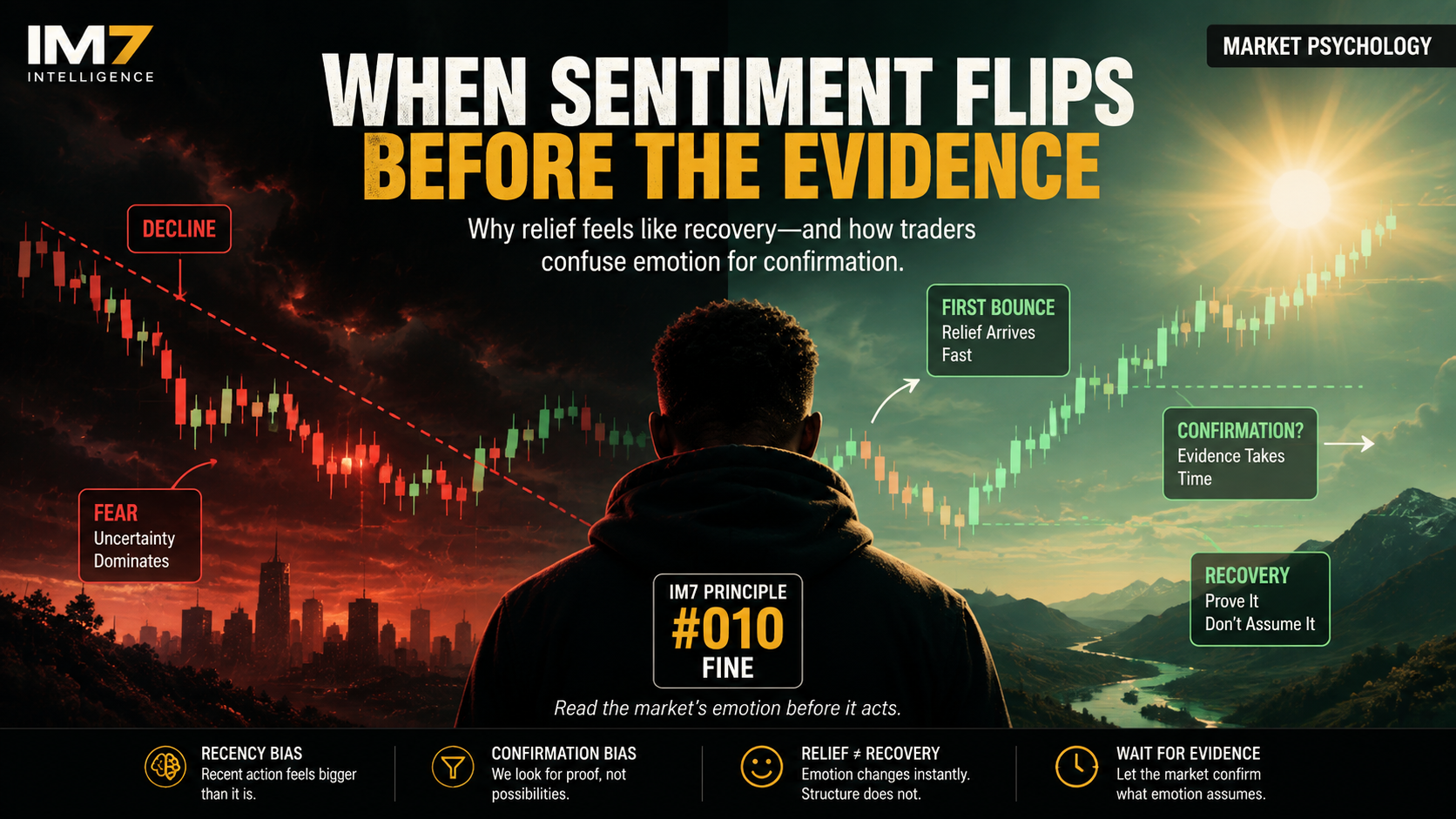
The First Bounce Fallacy: Why Bitcoin Traders Confuse Relief with Recovery
- Reading time
- 11 min read
- Word count
- 2,341 words
- Published
Bitcoin’s first bounce can feel like confirmation before the market has confirmed anything. Relief becomes conviction, and a temporary rebound becomes a recovery narrative. The danger isn’t the bounce—it’s how quickly traders decide what it means.
On this page
- Executive Summary
- IM7 Principle
- IM7 Principle — The Recovery Narrative Bias
- Market Context
- What The Market Wanted You To Believe
- Behavioral Observation
- Behavioral Chart 01 — The First Bounce Conviction Gap
- Cognitive Bias Breakdown
- 1. Recency Bias
- 2. Confirmation Bias
- 3. Relief
- 4. Fear of Missing Out
- Behavioral Model 01 — The Relief-to-Conviction Loop
- The Evidence Gap
- Behavioral Chart 02 — Relief Rally vs. Confirmed Recovery
- The Professional Read
- Stage 1 — Reaction
- Stage 2 — Follow-Through
- Stage 3 — Pullback
- Stage 4 — Reclaim
- Stage 5 — Retest
- Behavioral Model 02 — The Confirmation Ladder
- The Most Dangerous Sentence: "I'll Miss It"
- Decision Framework
- 1. What Actually Changed?
- 2. What Has Not Been Proven?
- 3. What Would Strengthen the Thesis?
- 4. What Would Weaken the Thesis?
- 5. Am I Responding to Structure or Urgency?
- 6. How Much Conviction Has the Evidence Earned?
- Risk Management Lesson
- Behavioral Chart 03 — Conviction vs. Evidence
- IM7 Quote
- IM7 Observation
- Behavioral Model 03 — Observation → Hypothesis → Confirmation
- IF EVIDENCE STRENGTHENS
- IF EVIDENCE WEAKENS
- IM7 Decision Rule
Executive Summary
Bitcoin does not need to confirm a recovery for traders to feel as though one has begun.
After a sustained decline, the first meaningful bounce can create a disproportionate psychological response. Red candles disappear. Price accelerates upward. Recent losses begin shrinking. Traders who stayed defensive start worrying that they waited too long. Traders already positioned long feel validated.
Nothing about those reactions proves that market structure has changed.
That distinction is the foundation of what IM7 calls the First Bounce Fallacy: the tendency to convert the first meaningful relief move after a decline into evidence of a durable recovery before sufficient structural confirmation exists.
The mistake is not recognizing the bounce.
The mistake is deciding too quickly what the bounce means.
A professional does not need to ignore the first move. The professional separates observation from interpretation. Price can rebound before resistance is reclaimed, before higher lows are established, before follow-through appears, and before the market demonstrates that buyers can defend newly recovered levels.
Relief is an event.
Recovery is a process.
Confusing the two is where premature conviction begins.
IM7 Principle
IM7 Principle — The Recovery Narrative Bias
After sustained downside pressure, the first meaningful positive move can produce emotional relief faster than the market can produce structural evidence of recovery.
The longer traders have endured uncertainty, losses, or defensive positioning, the more psychologically powerful the first strong bounce can become.
This creates an important asymmetry:
[Sentiment](/library/sentiment) can reverse in one candle. Structure usually cannot.
The professional response is not automatic skepticism toward every bounce. It is conditional conviction.
A bounce earns attention.
Follow-through earns evidence.
Structure earns conviction.
Market Context
Bitcoin's volatility makes the distinction between relief and recovery especially important.
Following sustained selling, price does not need a complete change in underlying conditions to produce a sharp rebound. A move can emerge from several mechanisms: reduced selling pressure, short covering, tactical buying, mean reversion, renewed speculative demand, or some combination of them.
The chart alone does not immediately tell the trader which mechanism will prove durable.
That uncertainty creates the behavioral trap.
During the decline, traders become conditioned to expect more weakness. When price suddenly moves in the opposite direction, the psychological contrast can be more powerful than the structural evidence.
The bounce feels important partly because the preceding decline felt painful.
That emotional contrast can compress the trader's decision process:
Decline → Bounce → Relief → Interpretation → Conviction
But the market has only completed the first two steps.
The remaining three happen inside the trader.
That is where the First Bounce Fallacy begins.
What The Market Wanted You To Believe
"The bottom is in. If you wait for confirmation, you'll miss the recovery."
This narrative is persuasive because the first bounce can immediately reward aggressive participation.
Someone who buys early sees green.
Someone who waits sees price moving without them.
The emotional comparison creates urgency.
The trader is no longer evaluating only whether the market has confirmed a reversal. They are also evaluating the psychological cost of being left behind.
That changes the question from:
"Has the market actually changed?"
to:
"What if this is my last chance to get in?"
Those are not equivalent questions.
One evaluates evidence.
The other evaluates regret.
And regret is capable of producing conviction long before structure does.
Behavioral Observation
The important information is not simply that Bitcoin bounced.
The important information is what happens after the bounce.
A strong first move can attract attention and change sentiment quickly. But the professional read begins when the initial emotional impulse ends.
Does price continue establishing higher lows?
Can reclaimed resistance hold as support?
Does the next rally extend the structure, or merely revisit the first bounce high?
Does price maintain progress after the urgency surrounding the original move disappears?
These questions separate the magnitude of the first move from the quality of the subsequent structure.
A dramatic candle can demonstrate demand at one moment.
It cannot, by itself, demonstrate durable demand across time.
Behavioral Chart 01 — The First Bounce Conviction Gap
Purpose: Compare the speed of price relief with the slower accumulation of structural confirmation.
The chart should show a decline followed by a sharp initial rebound. Overlay two conceptual measures:
- Emotional conviction rising sharply during the first bounce
- Structural confirmation rising more slowly as higher lows, resistance reclamation, and successful retests accumulate
Highlight the gap between the two.
Behavioral lesson: Conviction often reaches a high level before the evidence supporting it does.
Cognitive Bias Breakdown
The First Bounce Fallacy is rarely driven by one bias alone.
It is usually a behavioral stack.
1. Recency Bias
The newest information receives disproportionate weight.
After several sessions of weakness, one forceful positive move becomes psychologically dominant because it is immediate, visible, and emotionally relieving.
The trader begins weighting the latest candle more heavily than the structure that preceded it.
The question quietly changes from:
"What has the market been doing?"
to:
"Did you see what Bitcoin just did?"
That change in framing matters.
2. Confirmation Bias
Once the trader begins believing that the bottom is in, subsequent information is no longer processed neutrally.
Small green candles become confirmation.
Bullish headlines become confirmation.
A minor resistance break becomes confirmation.
Meanwhile, failed follow-through, weak retests, or unresolved resistance can be downgraded as temporary noise.
The trader stops testing the thesis and begins protecting it.
3. Relief
Relief is not merely an emotion following the trade.
It can influence the interpretation of the trade.
After sustained downside pressure, traders want the uncertainty to end. A bounce offers a psychologically attractive answer:
"That was the bottom."
The narrative removes ambiguity.
Markets rarely become structurally safe simply because participants are tired of uncertainty.
4. Fear of Missing Out
Once price begins moving without the trader, patience develops an immediate emotional cost.
Waiting for confirmation may be strategically rational while simultaneously feeling psychologically expensive.
That conflict is precisely why confirmation discipline is difficult.
Behavioral Model 01 — The Relief-to-Conviction Loop
Decline ↓ Emotional Pressure ↓ First Strong Bounce ↓ Relief ↓ Recovery Narrative ↓ Selective Confirmation ↓ Increased Conviction ↓ Greater Exposure / Reduced Skepticism
Add a feedback arrow from Increased Conviction back to Selective Confirmation.
Behavioral lesson: Once relief becomes a narrative, the trader can begin filtering new evidence through the position already taken.
The Evidence Gap
The central problem is not bullishness.
It is evidence compression.
The trader observes one piece of information — a strong rebound — and allows it to answer several different questions:
- Has selling pressure weakened?
- Has the trend reversed?
- Has resistance been reclaimed?
- Will buyers defend the next pullback?
- Has a durable higher low formed?
- Is the broader market regime changing?
One candle cannot reliably answer all of them.
Yet emotionally, it can feel as though it has.
That is the evidence gap:
The distance between what price has actually demonstrated and what the trader has already concluded.
Behavioral Chart 02 — Relief Rally vs. Confirmed Recovery
Create a side-by-side comparison.
Path A — Relief Rally Decline → Sharp Bounce → Failed Follow-Through → Resistance Holds → Lower Retest
Path B — Developing Recovery Decline → Bounce → Controlled Pullback → Higher Low → Resistance Reclaim → Successful Retest → Continuation
Do not imply that Path B guarantees future appreciation.
Behavioral lesson: The first bounce can look similar in both paths. The distinction emerges through what happens afterward.
The Professional Read
A disciplined professional does not need to predict whether the first bounce will fail.
That is the wrong standard.
The objective is to determine what has been proven and what remains unresolved.
The professional separates the market into stages.
Stage 1 — Reaction
Price bounces.
This establishes one fact:
Buyers were willing to transact more aggressively at that moment.
It does not establish a new trend.
Stage 2 — Follow-Through
The market attempts to extend the move.
Now the professional observes whether demand persists after the original impulse.
Stage 3 — Pullback
This is often more informative than the original bounce.
Can price retain meaningful portions of the recovery?
Does the market establish a higher low?
Do buyers defend previously reclaimed territory?
Stage 4 — Reclaim
Former resistance is challenged or recovered.
The professional asks whether the level is merely crossed or actually accepted.
Stage 5 — Retest
The market is given an opportunity to invalidate the bullish interpretation.
If reclaimed structure survives the test, the recovery thesis gains evidence.
Notice what changed:
The professional did not attempt to eliminate uncertainty.
The professional forced conviction to earn its way upward as evidence accumulated.
Behavioral Model 02 — The Confirmation Ladder
Level 1 — Bounce Observation only
↓
Level 2 — Follow-Through Initial evidence
↓
Level 3 — Higher Low Structural improvement
↓
Level 4 — Resistance Reclaim Additional confirmation
↓
Level 5 — Successful Retest Stronger structural evidence
↓
Level 6 — Sustained Continuation Recovery thesis gains credibility
Place a vertical label beside the ladder:
Conviction should rise with evidence — not jump ahead of it.
The Most Dangerous Sentence: "I'll Miss It"
The First Bounce Fallacy becomes particularly powerful when the trader believes confirmation itself is expensive.
This produces a false binary:
Buy immediately or miss the entire move.
But markets are not obligated to offer only one decision point.
A developing trend can create multiple opportunities for evaluation: pullbacks, retests, consolidations, breakouts, and changes in structure.
Waiting has a cost.
So does being wrong early.
The relevant question is not whether waiting might produce a worse entry.
It is:
What am I receiving in exchange for accepting a potentially worse entry?
The answer should be information.
A trader who enters later may sacrifice some price advantage while gaining additional evidence.
That is an information trade-off.
Professionals understand that the cheapest price and the highest-quality information rarely arrive simultaneously.
Decision Framework
Before converting Bitcoin's first meaningful bounce into a recovery thesis, separate the decision into six questions.
1. What Actually Changed?
Describe the observable event without interpretation.
Example:
Price rebounded sharply from a recent low.
Not:
Bitcoin has reversed.
Language discipline prevents interpretation from disguising itself as evidence.
2. What Has Not Been Proven?
Explicitly identify unresolved questions.
Has a higher low formed?
Has resistance been reclaimed?
Has the reclaim survived a retest?
Has follow-through persisted?
3. What Would Strengthen the Thesis?
Define evidence before emotion demands it.
This could include:
- sustained higher lows,
- successful resistance reclamation,
- constructive retests,
- broader participation,
- persistent demand across subsequent sessions.
4. What Would Weaken the Thesis?
A thesis without invalidation criteria can become a belief.
Define what would force reassessment.
5. Am I Responding to Structure or Urgency?
Ask:
Would I make the same decision if the bounce had happened more slowly?
If the answer changes dramatically, speed may be influencing judgment.
6. How Much Conviction Has the Evidence Earned?
Conviction does not need to be binary.
It can increase incrementally.
The professional does not need to choose between:
"The recovery is confirmed."
and:
"The bounce means nothing."
There is a third position:
"The evidence improved, but confirmation remains incomplete."
That is often the most intellectually honest position available.
Risk Management Lesson
The greatest risk in the First Bounce Fallacy is not simply entering early.
It is allowing position size to reflect emotional certainty rather than evidentiary certainty.
A trader may rationally participate in an early-stage reversal attempt while acknowledging that confirmation is incomplete.
The behavioral failure occurs when:
limited evidence + strong relief = oversized conviction
That combination can produce excessive leverage, poor invalidation discipline, and resistance to contradictory information.
Risk should reflect what the market has demonstrated — not how strongly the trader wants the decline to be finished.
Behavioral Chart 03 — Conviction vs. Evidence
Create a conceptual timeline beginning at the market low.
Plot:
Emotional Conviction
- jumps rapidly during the first bounce
- remains elevated as the recovery narrative forms
Structural Evidence
- begins low
- rises incrementally only if follow-through, higher lows, resistance reclamation, and successful retests occur
Mark the region where emotional conviction exceeds structural evidence:
Premature Conviction Zone
Behavioral lesson: Risk becomes dangerous when exposure follows the conviction curve instead of the evidence curve.
IM7 Quote
"The first bounce offers relief, not proof. Conviction has to survive the retest."
IM7 Observation
The first bounce is psychologically powerful because it solves two problems simultaneously.
It improves price.
And it reduces uncertainty.
The second benefit may be more dangerous than the first.
Humans naturally prefer coherent explanations to unresolved ambiguity. After a difficult decline, "the recovery has started" is a cleaner story than "conditions may be improving, but the evidence remains incomplete."
Markets do not reward narratives for being emotionally satisfying.
They test them.
The first bounce therefore should not be treated as meaningless. It should be treated as the beginning of an investigation.
What follows determines what the bounce eventually becomes.
A failed rally.
A range.
A temporary squeeze.
An early recovery.
Or something the trader did not anticipate.
The professional advantage comes from delaying the label long enough for the market to provide additional evidence.
Behavioral Model 03 — Observation → Hypothesis → Confirmation
OBSERVATION "Bitcoin bounced."
↓
HYPOTHESIS "A recovery may be developing."
↓
TEST Follow-through? Higher low? Resistance reclaim? Successful retest?
↓
IF EVIDENCE STRENGTHENS
Increase confidence incrementally.
IF EVIDENCE WEAKENS
Reduce or reject the hypothesis.
↓
UPDATED DECISION
Place a warning beside the model:
Behavioral Error:
Observation ↓ Conclusion
"Bitcoin bounced → the bottom is in."
The professional inserts hypothesis testing between observation and conviction.
IM7 Decision Rule
Never promote a bounce directly into a recovery thesis.
Treat the first move as an observation.
Form a hypothesis.
Define what would confirm it.
Define what would invalidate it.
Then allow conviction to rise only as the market supplies additional evidence.
Relief can happen in one candle. Recovery has to prove itself across structure.
How did this land?
What emotion or bias did this article help you recognize?
References
- [1]Tversky, A., & Kahneman, D. (1974). Judgment under Uncertainty: Heuristics and Biases. Science.
- [2]Nickerson, R. S. (1988). Confirmation Bias: A Ubiquitous Phenomenon in Many Guises..
- [3]Nickerson (1998).
Pass the signal forward.
IM7 Intelligence studies financial markets through the lens of psychology rather than prediction. Our research focuses on behavioral finance, crowd psychology, sentiment, and decision-making to help readers understand why markets move—not just where they move.
IM7 Intelligence publishes educational research on market psychology, behavioral finance, and investor behavior. Nothing published by IM7 Intelligence constitutes financial, investment, tax, or legal advice. Always conduct your own research before making financial decisions.
Read the market's emotion before it acts.
Where this article sits in the map.
- Confirmation BiasYou are here
- Behavioral Finance
- Risk Management
- Fear
Curated paths, not random articles.
Behavior read in real time.

Ismael Mercius
Ismael Mercius is the founder of IM7 Intelligence, where he writes about crypto market psychology, behavioral finance, and the sentiment cycles that drive digital asset prices. His work focuses on how traders actually make decisions — and the recurring errors that show up in their P&L.
- Crypto market psychology
- Behavioral finance
- Market sentiment analysis
- Trader behavior & decision-making