When Sentiment Flips Before Evidence: The Gap Between Feeling and Fact
- Reading time
- 12 min read
- Word count
- 2,479 words
- Published
A sharp market rally can flip sentiment faster than the underlying evidence changes. Traders may begin positioning for continuation while broader structural confirmation remains incomplete. That gap between feeling and fact reveals a core behavioral risk: sentiment can turn long before the evidence justifies conviction.
On this page
- Executive Summary
- IM7 Principle
- IM7 Principle — Sentiment Can Turn Before Structure Does
- Market Context
- What The Market Wanted You To Believe
- Behavioral Observation
- Behavioral Chart 01 — The Sentiment–Structure Gap
- Cognitive Bias Breakdown
- Recency Bias
- Confirmation Bias
- FOMO
- Herd Behavior
- Commitment Bias
- Behavioral Model 01 — The Conviction Acceleration Loop
- The Professional Read
- 1. Has sentiment changed?
- 2. Has price responded?
- 3. Has structure confirmed?
- Behavioral Chart 02 — Sentiment vs. Confirmation
- Behavioral Model 02 — The Three-Stage Confirmation Ladder
- Stage 1 — Sentiment Improvement
- Stage 2 — Price Reaction
- Stage 3 — Structural Confirmation
- Decision Framework
- The Sentiment–Structure Test
- Behavioral Chart 03 — Confidence Should Lag Evidence
- Behavioral Model 03 — The Evidence–Conviction Matrix
- Low Evidence / Low Conviction
- Low Evidence / High Conviction
- High Evidence / Low Conviction
- High Evidence / High Conviction
- Risk Management Lesson
- IM7 Quote
- IM7 Observation
- IM7 Decision Rule
Executive Summary
Markets do not need complete evidence to change mood.
A strong candle, an encouraging headline, an unexpected data release, or a sudden reversal can transform fear into optimism within minutes. Price responds. Narratives change. Traders who were cautious begin worrying that they are late.
But an emotional shift and a structural shift are not the same event.
Sentiment can improve before liquidity improves. Price can rally before participation broadens. Traders can become confident before the evidence supporting that confidence becomes durable.
That creates one of the most important gaps in behavioral decision-making: the distance between feeling that conditions have changed and having sufficient evidence that they have changed.
The danger is not optimism itself. The danger is allowing the speed of an emotional change to determine the strength of a conclusion.
A disciplined participant therefore separates three stages:
- Sentiment improvement — how participants feel changes.
- Price reaction — markets begin expressing that change.
- Structural confirmation — broader evidence demonstrates that the change is becoming durable.
Those stages can occur together.
They do not have to.
That distinction is where patience becomes an analytical advantage.
IM7 Principle
IM7 Principle — Sentiment Can Turn Before Structure Does
Collective emotion can change faster than the conditions supporting it.
Markets can move from fear to optimism after a single catalyst because humans rapidly update expectations when new information is emotionally salient. Structural conditions usually require more evidence: sustained participation, broader confirmation, continued capital commitment, and persistence through subsequent tests.
A change in sentiment deserves attention.
It does not automatically deserve conviction.
The central question is:
What changed first — the evidence, or the way traders felt about the evidence?
Market Context
Consider a market that has experienced sustained selling pressure or prolonged uncertainty.
Participants become defensive. Expectations fall. Traders reduce exposure, hesitate to enter new positions, or begin treating weakness as the dominant regime.
Then something changes.
A positive headline appears.
An economic release exceeds expectations.
Price breaks sharply higher.
A previously weak asset suddenly produces a large bullish candle.
None of these events is meaningless. New information can legitimately alter probabilities.
The behavioral problem begins when participants compress the entire analytical process into one conclusion:
Price moved, therefore the larger condition has changed.
That conclusion may eventually prove correct.
But at the moment it is formed, the evidence may still be incomplete.
A price reaction tells us that participants responded to information. Structural confirmation requires something more: evidence that the new behavior can persist beyond the initial emotional response.
That difference matters because sentiment is capable of repricing expectations much faster than underlying conditions can be verified.
What The Market Wanted You To Believe
“The uncertainty is over. The recovery has begun.”
This narrative becomes especially powerful after prolonged fear or hesitation.
Why?
Because the rally does more than change price.
It removes discomfort.
The trader who spent days or weeks uncertain suddenly receives what feels like an answer. The participant who remained defensive begins experiencing a different pain: the fear of being left behind.
That emotional transition can happen extremely quickly:
uncertainty → relief → optimism → urgency → conviction
The dangerous step is the final one.
A trader may begin with legitimate evidence that sentiment is improving and end with a much stronger belief that a durable recovery has already been confirmed.
The market did not necessarily provide that conclusion.
The trader's emotional system completed it.
Behavioral Observation
The critical behavioral signal is not simply that price rises.
It is the speed at which interpretation changes relative to the amount of new evidence available.
Imagine a market that has spent several sessions producing weak or indecisive price action. Participants are cautious and positioning reflects uncertainty.
Then a strong bullish catalyst arrives.
Price accelerates.
Commentary becomes more optimistic.
Traders who previously demanded confirmation begin lowering their threshold for participation.
The same uncertainty they tolerated before the rally suddenly becomes intolerable once prices begin moving without them.
That is an important behavioral inversion.
Before the rally:
“I need more evidence before I buy.”
After the rally:
“If I wait for more evidence, I'll miss it.”
The underlying need for evidence did not necessarily change.
The emotional cost of waiting did.
That is how sentiment can alter the decision threshold before structure alters the investment thesis.
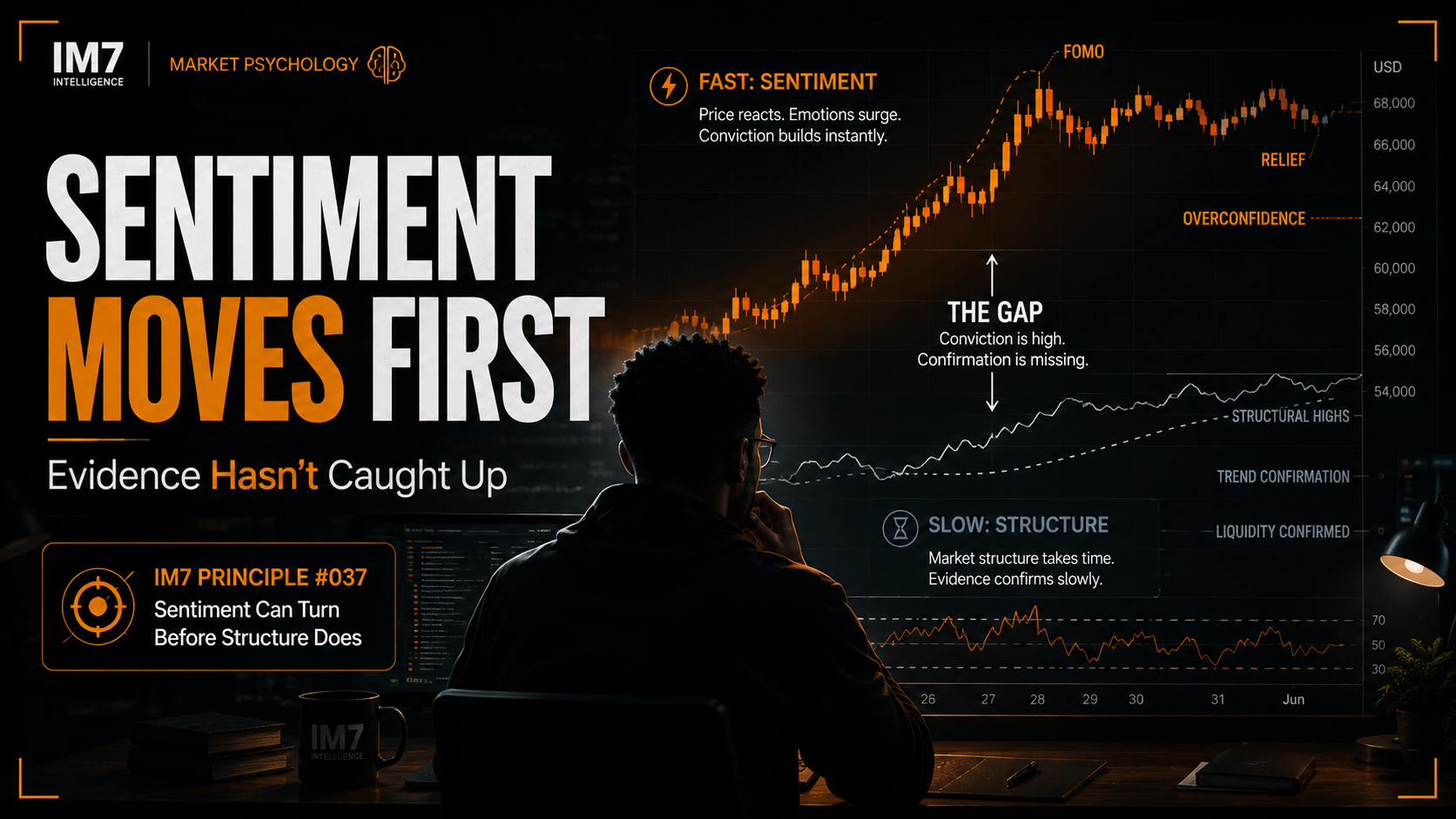
Behavioral Chart 01 — The Sentiment–Structure Gap
Purpose: Show how rapidly sentiment can move relative to structural confirmation.
Behavioral sequence:
Fear / uncertainty ↓ Positive catalyst ↓ Sharp price reaction ↓ Sentiment accelerates ↓ FOMO increases ↓ Conviction rises ↓ Structural evidence remains incomplete
Key question:
Did confirmation increase as quickly as confidence did?
Cognitive Bias Breakdown
Recency Bias
Recency bias causes recent information to receive disproportionate weight in judgment.
A strong rally immediately following weakness can therefore feel more informative than the preceding sequence of evidence.
The trader does not simply observe:
“Conditions improved today.”
The mind is tempted to extrapolate:
“Conditions have changed.”
Those are fundamentally different claims.
Recent price action can contain valuable information, but its emotional vividness can cause traders to assign it more explanatory power than the broader evidence supports.
Confirmation Bias
Once a trader begins believing that a recovery is underway, subsequent information can be filtered through that conclusion.
Bullish evidence receives greater attention.
Contradictory evidence becomes temporary noise.
A failed breakout becomes “healthy consolidation.”
Weak participation becomes “the market climbing a wall of worry.”
Unresolved risks become “already priced in.”
The problem is not that any individual explanation must be wrong.
The problem is that the position can begin controlling the interpretation.
At that point, the trader is no longer asking:
“What does the evidence say?”
The question quietly becomes:
“How can I make the evidence fit what I already believe?”
FOMO
Fear of missing out changes the cost structure of waiting.
Before the move, patience feels prudent.
After the move begins, patience feels expensive.
Every additional green candle appears to increase the cost of hesitation.
This creates an important behavioral distortion:
The less attractive the entry becomes, the more psychologically urgent the trade can feel.
Price appreciation can therefore increase emotional demand for certainty precisely when disciplined analysis should become more demanding.
Herd Behavior
When many participants begin responding to the same catalyst, social confirmation strengthens the narrative.
Price is rising.
Commentary is bullish.
Other traders are participating.
The story appears increasingly validated.
But agreement among participants is not independent evidence when those participants are reacting to the same underlying stimulus.
Ten people responding to one catalyst do not necessarily provide ten separate confirmations.
Sometimes they represent one piece of information amplified through ten emotional responses.
Commitment Bias
Once capital has been committed, the analytical problem changes.
The trader is no longer evaluating the market from a neutral position.
Now there is something to defend.
A position.
An entry.
A prediction.
A public opinion.
A missed opportunity finally acted upon.
This makes structural confirmation even more important after entry, because the psychological incentive to reinterpret contradictory evidence has increased.
Behavioral Model 01 — The Conviction Acceleration Loop
Catalyst → Price reaction → Emotional relief → Narrative formation → Social reinforcement → FOMO → Increased participation → Stronger price reaction → Increased conviction
The loop can become self-reinforcing.
That does not mean the move is false.
It means price strength alone cannot tell you how much of the move represents durable structural improvement versus participants responding to one another.
The professional question is not:
“Is everyone bullish now?”
It is:
“What independent evidence is appearing alongside the bullishness?”
The Professional Read
A disciplined participant does not dismiss a sentiment reversal.
That would simply replace one bias with another.
Instead, sentiment is treated as information whose significance must be tested.
The professional separates three questions.
1. Has sentiment changed?
Look for observable changes in risk appetite, narrative tone, positioning behavior, volatility expectations, and price response.
2. Has price responded?
Determine whether the market is actually repricing or whether enthusiasm exists primarily in commentary and expectations.
3. Has structure confirmed?
Now raise the evidentiary standard.
Depending on the market and thesis being evaluated, confirmation may include:
- broader participation,
- sustained volume,
- persistence above important structural levels,
- improving market breadth,
- follow-through across multiple sessions,
- confirmation from related markets,
- improving liquidity conditions,
- fundamental revisions,
- stronger earnings expectations,
- or repeated successful tests of newly established support.
Not every market requires every signal.
The purpose is not to create an impossible checklist.
The purpose is to prevent one emotionally powerful event from becoming the entire thesis.
A professional can acknowledge:
“Sentiment has improved.”
without prematurely concluding:
“The regime has changed.”
That distinction protects analytical flexibility.
Behavioral Chart 02 — Sentiment vs. Confirmation
Sentiment Curve: Fast-moving and emotionally responsive.
Structural Confirmation Curve: Slower-moving and evidence-dependent.
Immediately after a catalyst, the distance between those curves can expand rapidly.
That distance is the Sentiment–Structure Gap.
The wider the gap becomes, the more important it is to distinguish participation from conviction.
A trader may choose to participate before full confirmation.
But the position size, risk tolerance, and confidence level should reflect the fact that confirmation remains incomplete.
Behavioral Model 02 — The Three-Stage Confirmation Ladder
Stage 1 — Sentiment Improvement
Question: Are participants changing how they feel?
Evidence may include:
- narrative improvement,
- reduced fear,
- increased risk appetite,
- stronger reactions to positive information.
Interpretation: Attention warranted.
Not confirmation.
Stage 2 — Price Reaction
Question: Is the market expressing the sentiment shift through price?
Evidence may include:
- breakout attempts,
- stronger momentum,
- recovery of important levels,
- increased participation.
Interpretation: Probabilities may be changing.
Still not necessarily structural confirmation.
Stage 3 — Structural Confirmation
Question: Is the new behavior persisting and broadening?
Evidence may include:
- sustained follow-through,
- broader participation,
- successful retests,
- supportive cross-market behavior,
- improving fundamentals or liquidity,
- persistence beyond the original catalyst.
Interpretation: Greater conviction may now be justified.
The framework prevents an emotional shortcut:
Stage 1 → Stage 3
without requiring the market to prove Stage 2 and Stage 3 independently.
Decision Framework
The Sentiment–Structure Test
Before increasing conviction after a sudden sentiment reversal, ask:
1. What exactly changed?
Identify the catalyst.
Was it price?
News?
Economic data?
Positioning?
Liquidity?
A narrative shift?
Do not allow “the market feels different” to substitute for identifying the actual variable.
2. What changed because of the catalyst?
Separate reaction from interpretation.
What did price actually do?
What did participation do?
What did volatility do?
What did related markets do?
Document observable changes before explaining them.
3. What has NOT changed?
This is one of the most important questions.
Which risks remain unresolved?
Which structural levels remain unconfirmed?
Which fundamental conditions remain unchanged?
Which parts of the original bearish or cautious thesis are still intact?
A strong decision process records contradictory evidence rather than hiding it.
4. What evidence would confirm the new thesis?
Define confirmation before emotion changes the standard.
Examples might include:
- sustained trading above a key level,
- successful retest,
- broader participation,
- multiple periods of follow-through,
- improving liquidity,
- supportive fundamental revisions.
The exact criteria should depend on the thesis being tested.
5. What evidence would invalidate it?
A thesis without invalidation criteria can become a narrative.
Determine what would demonstrate that the sentiment reversal failed to become structural.
6. Match conviction to evidence.
This is the central risk rule.
If sentiment has changed but structure has not confirmed, conviction should not behave as though confirmation already exists.
You can update probabilities without pretending uncertainty disappeared.
Behavioral Chart 03 — Confidence Should Lag Evidence
A common emotional sequence looks like this:
Evidence: 30% → 40% → 45% Confidence: 30% → 65% → 85%
One emotionally powerful catalyst produces a much larger change in confidence than in available evidence.
A disciplined process attempts to keep the two more closely aligned:
Evidence strengthens → confidence increases proportionally.
The goal is not emotional neutrality.
The goal is preventing conviction from outrunning its evidentiary foundation.
Behavioral Model 03 — The Evidence–Conviction Matrix
Low Evidence / Low Conviction
State: Uncertainty
Appropriate response: observe, research, define triggers.
Low Evidence / High Conviction
State: Behavioral danger
Possible drivers:
- FOMO,
- recency bias,
- narrative attachment,
- herd behavior,
- relief.
Appropriate response: reduce certainty and demand independent confirmation.
High Evidence / Low Conviction
State: Hesitation
Possible drivers:
- anchoring to the previous regime,
- fear from recent losses,
- excessive skepticism.
Appropriate response: reassess whether old beliefs are preventing adaptation.
High Evidence / High Conviction
State: Evidence-supported thesis
Appropriate response: execute according to predetermined risk parameters while continuing to monitor invalidation conditions.
The objective is not maximum conviction.
It is calibrated conviction.
Risk Management Lesson
The solution is not to wait until uncertainty disappears.
Markets rarely provide that luxury.
The solution is to make exposure reflect the quality of confirmation available.
When sentiment improves but structure remains incomplete, a trader might choose smaller exposure, tighter thesis monitoring, staged entries, predefined invalidation, or no position at all.
The appropriate response depends on the strategy.
What should not happen is allowing emotional certainty to silently increase risk.
A trader can be directionally correct and still make a poor decision if the position was too large for the amount of evidence available.
Likewise, waiting for additional confirmation may sacrifice some upside.
That is not automatically a mistake.
The price of confirmation is often entering later.
The benefit is reducing the probability that temporary sentiment is mistaken for durable change.
Risk management therefore asks a different question from prediction:
How much uncertainty am I being compensated to accept?
IM7 Quote
“Your feelings can reprice the market faster than the evidence can justify them.”
IM7 Observation
Sentiment and structure operate on different clocks.
Sentiment is reflexive.
Humans can change expectations almost instantly after a surprising event. Price can accelerate that process because rising prices create their own psychological evidence: people become more optimistic partly because they observe other people becoming more optimistic.
Structure is slower.
Durable changes generally require persistence, participation, capital commitment, and evidence capable of surviving subsequent tests.
That creates a recurring behavioral asymmetry:
emotion updates quickly; evidence accumulates gradually.
This does not make early sentiment shifts useless.
In fact, sentiment can sometimes identify a changing environment before slower indicators recognize it.
The mistake is not noticing the early change.
The mistake is assigning Stage 3 conviction to Stage 1 evidence.
Market intelligence requires enough flexibility to recognize change early and enough discipline to avoid declaring that change complete before the evidence earns the conclusion.
IM7 Decision Rule
Never allow conviction to move faster than the evidence supporting it.
When sentiment changes rapidly, identify what actually changed, separate price reaction from structural confirmation, define the evidence required for the new thesis, and scale conviction only as independent confirmation accumulates.
A market can change before every indicator confirms it.
Your job is not to wait for certainty.
Your job is to know exactly how much evidence your conviction has earned.
How did this land?
What emotion or bias did this article help you recognize?
References
- [1]Tversky, A., & Kahneman, D. (1974). Judgment under Uncertainty: Heuristics and Biases. Science. American Association for the Advancement of Science. DOI: 10.1126/science.185.4157.1124.
- [2]Nickerson, R. S. (1998). Confirmation Bias: A Ubiquitous Phenomenon in Many Guises. Review of General Psychology. American Psychological Association. DOI: 10.1037/1089-2680.2.2.175.
Pass the signal forward.
IM7 Intelligence studies financial markets through the lens of psychology rather than prediction. Our research focuses on behavioral finance, crowd psychology, sentiment, and decision-making to help readers understand why markets move—not just where they move.
IM7 Intelligence publishes educational research on market psychology, behavioral finance, and investor behavior. Nothing published by IM7 Intelligence constitutes financial, investment, tax, or legal advice. Always conduct your own research before making financial decisions.
Read the market's emotion before it acts.
Where this article sits in the map.
- Confirmation BiasYou are here
- Behavioral Finance
- Risk Management
- Fear
Curated paths, not random articles.
Behavior read in real time.

Ismael Mercius
Ismael Mercius is the founder of IM7 Intelligence, where he writes about crypto market psychology, behavioral finance, and the sentiment cycles that drive digital asset prices. His work focuses on how traders actually make decisions — and the recurring errors that show up in their P&L.
- Crypto market psychology
- Behavioral finance
- Market sentiment analysis
- Trader behavior & decision-making