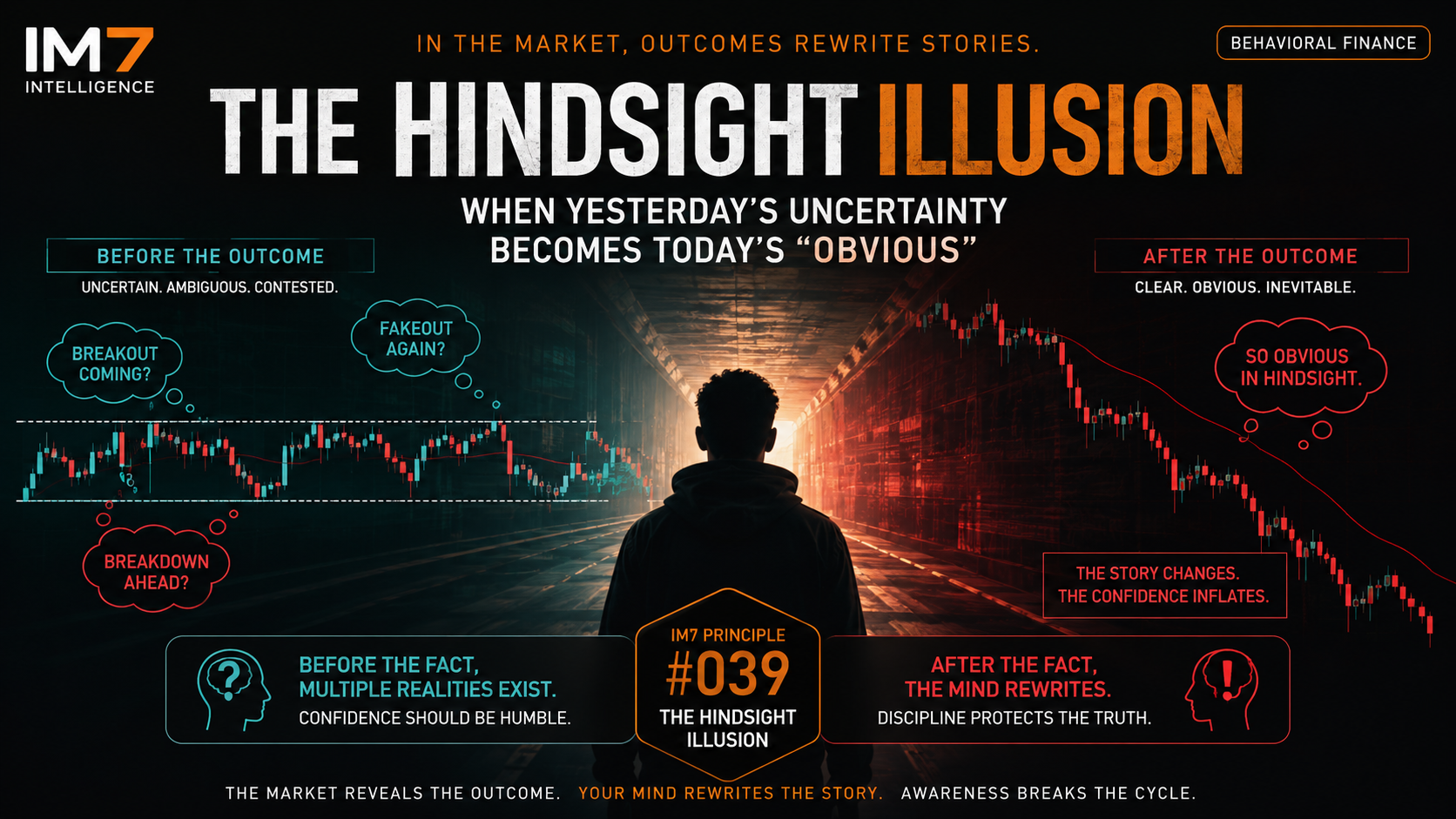
When the Range Breaks: Why Bitcoin Suddenly Looks Obvious
- Reading time
- 10 min read
- Word count
- 2,204 words
- Published
Bitcoin’s range looked ambiguous—until it broke. Then the warning signs suddenly seemed obvious. That shift is hindsight bias: once the outcome is known, traders rewrite uncertainty as predictability and mistake being right about the result for having had better evidence.
On this page
- Executive Summary
- IM7 Principle
- IM7 Principle — The Hindsight Illusion
- Market Context
- What The Market Wanted You To Believe
- Behavioral Observation
- Behavioral Chart 01 — Uncertainty Before, Certainty After
- Cognitive Bias Breakdown
- Hindsight Bias
- Outcome Bias
- Confirmation Bias
- Behavioral Model 01 — The Hindsight Reconstruction Loop
- The Information-Time Problem
- Behavioral Chart 02 — Evidence Available Before vs. After Resolution
- The Professional Read
- Decision Quality vs. Outcome Quality
- Good Decision + Good Outcome
- Good Decision + Bad Outcome
- Bad Decision + Good Outcome
- Bad Decision + Bad Outcome
- Behavioral Model 02 — Decision Quality vs. Outcome Quality Matrix
- Why "I Should Have Known" Is Dangerous
- Decision Framework
- 1. Freeze the Evidence
- 2. Record Competing Evidence
- 3. Define Resolution Conditions
- 4. Assign Confidence Before the Outcome
- 5. Review Using Only Pre-Decision Information
- 6. Update Without Rewriting
- Risk Management Lesson
- Behavioral Chart 03 — Confidence Reconstruction After the Outcome
- HINDSIGHT DISTORTION
- IM7 Quote
- IM7 Observation
- Behavioral Model 03 — Uncertainty → Resolution → Narrative Rewrite
- IM7 Decision Rule
Executive Summary
Bitcoin's recent range breakdown creates a useful behavioral case study.
Before the move, the same price structure supported competing interpretations. Some traders emphasized failed highs. Others emphasized support, higher lows, or the possibility of another recovery attempt. The evidence did not force one universally obvious conclusion.
Then the range broke.
Once the outcome became known, the ambiguity that existed beforehand became much harder to remember.
Signals that once looked mixed suddenly appeared directional. Rejections became warnings. Weak candles became clues. Failed attempts to advance became evidence that the breakdown had supposedly been visible all along.
The chart did not become clearer retroactively.
The outcome became known.
This is the foundation of hindsight bias: once we know what happened, our memory of what was knowable beforehand can change with it.
The danger is not merely misremembering the past.
It is allowing retrospective certainty to inflate confidence in the next uncertain decision.
IM7 Principle
IM7 Principle — The Hindsight Illusion
Once an outcome is known, traders systematically underestimate how uncertain the situation was before it occurred.
The mind reconstructs the evidence around the result.
Signals that supported the eventual outcome become more memorable.
Signals that contradicted it become easier to dismiss.
Ambiguity becomes a coherent story.
The result is an illusion:
"I should have known."
Sometimes the correct lesson is not that you failed to see the answer.
Sometimes there was not enough evidence to justify certainty yet.
Professional decision-making requires preserving that distinction.
Market Context
Bitcoin had been trading within a relatively contained price range in which neither side had produced a durable resolution.
Inside that structure, the same candles allowed multiple interpretations.
A rejection near the upper portion of the range could be read as bearish.
A defense of the lower portion could be read as bullish.
A higher low could suggest improving structure.
Failure to extend upward could suggest weakening demand.
None of those observations needed to be false.
The problem begins when an observation is promoted into certainty before the market has resolved the structure.
Then Bitcoin broke lower.
The important behavioral event was not simply the decline.
It was what happened to perception after the decline.
What had previously been interpreted as uncertain suddenly began to look obvious.
What The Market Wanted You To Believe
"The breakdown was obvious. The warning signs were there the whole time."
That statement becomes persuasive only after the outcome is visible.
Before resolution, traders must evaluate incomplete information.
After resolution, they evaluate that same information while already knowing the answer.
Those are fundamentally different cognitive environments.
Once the breakdown occurred, every bearish clue gained psychological weight.
A failed rally looked more important.
A rejection looked more predictive.
A weak candle looked more meaningful.
The human mind naturally begins organizing those observations into a coherent sequence that appears to explain the result.
But coherence after the fact is not the same thing as predictability before the fact.
That distinction protects traders from confusing a known outcome with a previously knowable outcome.
Behavioral Observation
Before the range resolved, traders faced uncertainty.
After the range resolved, they faced a known result.
That single change dramatically alters how prior information is interpreted.
Imagine looking at the chart while the final range candle is still forming.
You do not know the next candle.
You do not know whether support will hold.
You do not know whether price will reclaim the range.
You do not know whether the eventual resolution will be immediate or delayed.
Now look at the exact same sequence after a large breakdown candle has printed.
The previous candles suddenly appear to "point" toward the outcome.
Nothing about those historical candles changed.
Your informational position changed.
That is the behavioral event worth studying.
Behavioral Chart 01 — Uncertainty Before, Certainty After
Purpose: Show the same Bitcoin range twice.
Left panel — Before Resolution
- Final outcome hidden
- Mixed candles inside the range
- Labels: "Rejection?", "Support?", "Higher Low?", "Failed Rally?"
- Perceived certainty: LOW
Right panel — After Resolution
- Breakdown visible
- Same earlier candles highlighted as "warnings"
- Perceived certainty: HIGH
Behavioral lesson: The evidence did not change. Knowledge of the outcome changed how the evidence felt.
Cognitive Bias Breakdown
Hindsight Bias
Hindsight bias is the tendency to perceive an event as having been more predictable after learning its outcome than it appeared beforehand Fischhoff, 1975.
Its most recognizable form is:
"I knew it all along."
The trader may genuinely remember being more certain than they actually were.
That is what makes the bias dangerous.
It does not necessarily feel like dishonesty.
It feels like memory.
Outcome Bias
Outcome bias adds a second distortion.
A good outcome can make a poor decision process appear intelligent.
A bad outcome can make a disciplined decision appear foolish.
Suppose two traders take different actions inside the range.
One makes an aggressive bearish bet with weak justification and happens to be correct.
Another waits because the structure has not yet confirmed.
After the breakdown, the first trader may appear superior simply because the result favored them.
But outcome alone does not reveal the quality of the reasoning that produced the decision.
Confirmation Bias
Once the outcome is known, confirmation bias can assist hindsight bias by helping the trader reconstruct the past.
Bearish evidence becomes easier to remember.
Bullish evidence becomes easier to dismiss.
The historical chart becomes psychologically cleaner than the live chart ever was.
Behavioral Model 01 — The Hindsight Reconstruction Loop
Uncertain Setup ↓ Outcome Occurs ↓ Winning Evidence Becomes Salient ↓ Contradictory Evidence Fades ↓ Past Feels More Predictable ↓ Confidence Increases ↓ Next Uncertain Setup ↓ Greater Risk of Overconfidence
Add a feedback arrow from Confidence Increases into the next uncertain setup.
Core insight: Hindsight does not only rewrite yesterday.
It changes how aggressively you approach tomorrow.
The Information-Time Problem
Every market decision exists at a specific point in time.
At that moment, the trader has access only to information that has already occurred.
This sounds obvious.
Behaviorally, it is one of the easiest rules to violate during review.
Once the future becomes the past, the trader unconsciously allows later information to contaminate the evaluation of the earlier decision.
That creates an unfair test.
The correct question is not:
"Was my prediction right?"
It is:
"Given the information available at that moment, was my process reasonable?"
That question produces very different lessons.
Behavioral Chart 02 — Evidence Available Before vs. After Resolution
Create a horizontal timeline.
T0 — Range Active Available:
- range boundaries
- recent candles
- current momentum
- unresolved structure
Unavailable:
- direction of breakout
- size of breakout
- whether breakout will hold
T1 — Breakdown New information:
- support failure
- directional expansion
- changed structure
T2 — Review Danger:
- using T1 information to judge what should have been known at T0
Highlight:
INFORMATION LEAK
T1 knowledge → contaminates evaluation of T0 decision.
Behavioral lesson: Evaluate decisions using only the information that existed when the decision was made.
The Professional Read
A disciplined professional does not need to pretend the range was perfectly balanced.
Some evidence may have favored one direction.
Some traders may have built legitimate asymmetric theses.
The professional distinction is more precise:
Evidence strength and certainty are not the same thing.
You can believe one outcome is more plausible without treating it as inevitable.
Before resolution, the professional asks:
- What evidence currently supports the bearish case?
- What evidence currently supports the bullish case?
- What remains unresolved?
- What event would materially change the probability?
- What would invalidate my current interpretation?
- How much risk does the current evidence justify?
Then the market moves.
Afterward, the professional does not ask:
"Why didn't I know?"
They ask:
"Did the market reveal information that was unavailable when I made the decision?"
If yes, the correct response may simply be to update.
That is not analytical failure.
That is how evidence-based decision-making works.
Decision Quality vs. Outcome Quality
This distinction deserves explicit separation.
A trader can make:
Good Decision + Good Outcome
The process was sound and the result cooperated.
Good Decision + Bad Outcome
The process was sound, but uncertainty resolved against the position.
Bad Decision + Good Outcome
The process was weak, but the trader was rewarded anyway.
This is one of the most dangerous combinations because success reinforces poor reasoning.
Bad Decision + Bad Outcome
The process was weak and the result exposed it.
Behavioral Model 02 — Decision Quality vs. Outcome Quality Matrix
Create a 2×2 matrix.
| | GOOD OUTCOME | BAD OUTCOME | |---|---|---| | GOOD PROCESS | Earned Win | Acceptable Loss | | BAD PROCESS | Dangerous Win | Corrective Loss |
Add the behavioral warnings:
Earned Win Do not become overconfident.
Acceptable Loss Do not abandon a good process because variance hurt.
Dangerous Win Highest learning risk. Poor reasoning receives positive reinforcement.
Corrective Loss Painful but diagnostically useful.
Core lesson: Judge the process separately from the outcome.
Why "I Should Have Known" Is Dangerous
The phrase sounds disciplined.
Sometimes it is.
There are legitimate cases where a trader ignored clear evidence, violated a rule, or acted against their own framework.
But "I should have known" can also become a form of hindsight punishment.
The trader looks at information that became meaningful only after the outcome and treats it as though its meaning had always been obvious.
That produces two problems.
First, the trader learns the wrong lesson from the previous trade.
Second, they enter the next setup believing they have improved their predictive ability more than they actually have.
Hindsight can therefore turn one known outcome into future overconfidence.
Decision Framework
1. Freeze the Evidence
Before entering or rejecting a trade, record what you currently believe and why.
Do not rely on memory later.
2. Record Competing Evidence
Write down evidence that supports your thesis and evidence that weakens it.
This preserves the ambiguity that hindsight tends to erase.
3. Define Resolution Conditions
State what market behavior would materially strengthen or invalidate your thesis.
4. Assign Confidence Before the Outcome
Use a confidence range rather than binary certainty.
Example:
Bearish thesis: moderate confidence, structure unresolved.
That record becomes valuable after the market moves.
5. Review Using Only Pre-Decision Information
When evaluating the decision, temporarily hide subsequent candles if possible.
Ask:
Would I still judge this decision the same way if I did not know what happened next?
6. Update Without Rewriting
New evidence should update the model.
It should not rewrite what the old evidence actually justified.
Risk Management Lesson
Hindsight bias becomes financially dangerous when retrospective certainty changes future position sizing.
A trader correctly anticipates one breakdown.
Afterward, the setup appears obvious.
Confidence increases.
The next range appears.
The trader assumes they now recognize the pattern.
Position size increases.
Tolerance for contradictory evidence decreases.
But the second range is not obligated to resolve like the first.
The dangerous sequence is:
Correct Outcome → Reconstructed Certainty → Inflated Skill Perception → Greater Exposure → Higher Consequence if Wrong
Risk management should prevent one successful outcome from dramatically changing exposure unless the trader can demonstrate that the process, not merely the prediction, produced repeatable value.
Behavioral Chart 03 — Confidence Reconstruction After the Outcome
Plot three conceptual lines across time:
Actual Pre-Outcome Confidence Moderate and unstable during the range.
Remembered Confidence Rises sharply after the breakdown.
Outcome Certainty 100% only after the move occurs.
Highlight the gap between:
What I actually knew then
and
What I remember knowing now
Label the gap:
HINDSIGHT DISTORTION
Behavioral lesson: Memory of conviction often becomes stronger after the outcome than conviction actually was before it.
IM7 Quote
"The chart didn't become obvious. The outcome became known."
IM7 Observation
Markets repeatedly create a strange transformation.
Before an event, intelligent people disagree.
After the event, everyone begins explaining why the answer was obvious.
This is not unique to Bitcoin.
It appears in markets, business, politics, sports, careers, and everyday decisions.
Uncertainty is uncomfortable.
Known outcomes are coherent.
The mind prefers coherence.
That preference makes hindsight bias particularly difficult to detect because the reconstructed story often feels rational.
The professional advantage is not eliminating hindsight bias completely.
It is building systems that preserve what uncertainty actually looked like before the result arrived.
Screenshots.
Decision journals.
Probability estimates.
Invalidation criteria.
Written competing evidence.
Those records protect the trader from their own reconstructed memory.
Behavioral Model 03 — Uncertainty → Resolution → Narrative Rewrite
1. UNCERTAINTY Multiple outcomes remain possible.
↓
2. NARRATIVE FORMATION Trader develops a preferred interpretation.
↓
3. RESOLUTION Market produces an outcome.
↓
4. MEMORY FILTERING Supporting evidence becomes more salient.
↓
5. NARRATIVE REWRITE Outcome begins to feel inevitable.
↓
6. CONFIDENCE TRANSFER Retrospective certainty carries into the next decision.
Add a corrective path:
Decision Journal + Pre-Outcome Confidence Record + Disconfirming Evidence ↓ Preserved Uncertainty ↓ Better Learning
IM7 Decision Rule
Never grade yesterday's decision using information that only became available today.
Freeze the evidence.
Record your confidence.
Define what would change your view.
Then review the process using only what was knowable at the moment of decision.
The outcome can teach you something new.
It should not rewrite what you actually knew before it happened.
How did this land?
What emotion or bias did this article help you recognize?
References
- [1]Fischhoff, B. (1975). Hindsight ≠ foresight: The effect of outcome knowledge on judgment under uncertainty.. Journal of Experimental Psychology: Human Perception and Performance. American Psychological Association. DOI: 10.1037/0096-1523.1.3.288.
- [2]Kahneman, D., & Tversky, A. (1979). Prospect Theory: An Analysis of Decision under Risk.. Econometrica. The Econometric Society. DOI: 10.2307/1914185.
- [3]Tversky, A., & Kahneman, D. (1974). Judgment under Uncertainty: Heuristics and Biases.. Science. American Association for the Advancement of Science. DOI: 10.1126/science.185.4157.1124.
- [4]Baron, J., & Hershey, J. C. (1988). Outcome bias in decision evaluation.. DOI: 10.1037/0022-3514.54.4.569.
- [5]Roese, N. J., & Vohs, K. D. (2012). Hindsight bias. Perspectives on Psychological Science, . DOI: 10.1177/1745691612454303.
Pass the signal forward.
IM7 Intelligence studies financial markets through the lens of psychology rather than prediction. Our research focuses on behavioral finance, crowd psychology, sentiment, and decision-making to help readers understand why markets move—not just where they move.
IM7 Intelligence publishes educational research on market psychology, behavioral finance, and investor behavior. Nothing published by IM7 Intelligence constitutes financial, investment, tax, or legal advice. Always conduct your own research before making financial decisions.
Read the market's emotion before it acts.
Where this article sits in the map.
- Confirmation BiasYou are here
- Behavioral Finance
- Risk Management
- Fear
Curated paths, not random articles.
Behavior read in real time.

Ismael Mercius
Ismael Mercius is the founder of IM7 Intelligence, where he writes about crypto market psychology, behavioral finance, and the sentiment cycles that drive digital asset prices. His work focuses on how traders actually make decisions — and the recurring errors that show up in their P&L.
- Crypto market psychology
- Behavioral finance
- Market sentiment analysis
- Trader behavior & decision-making