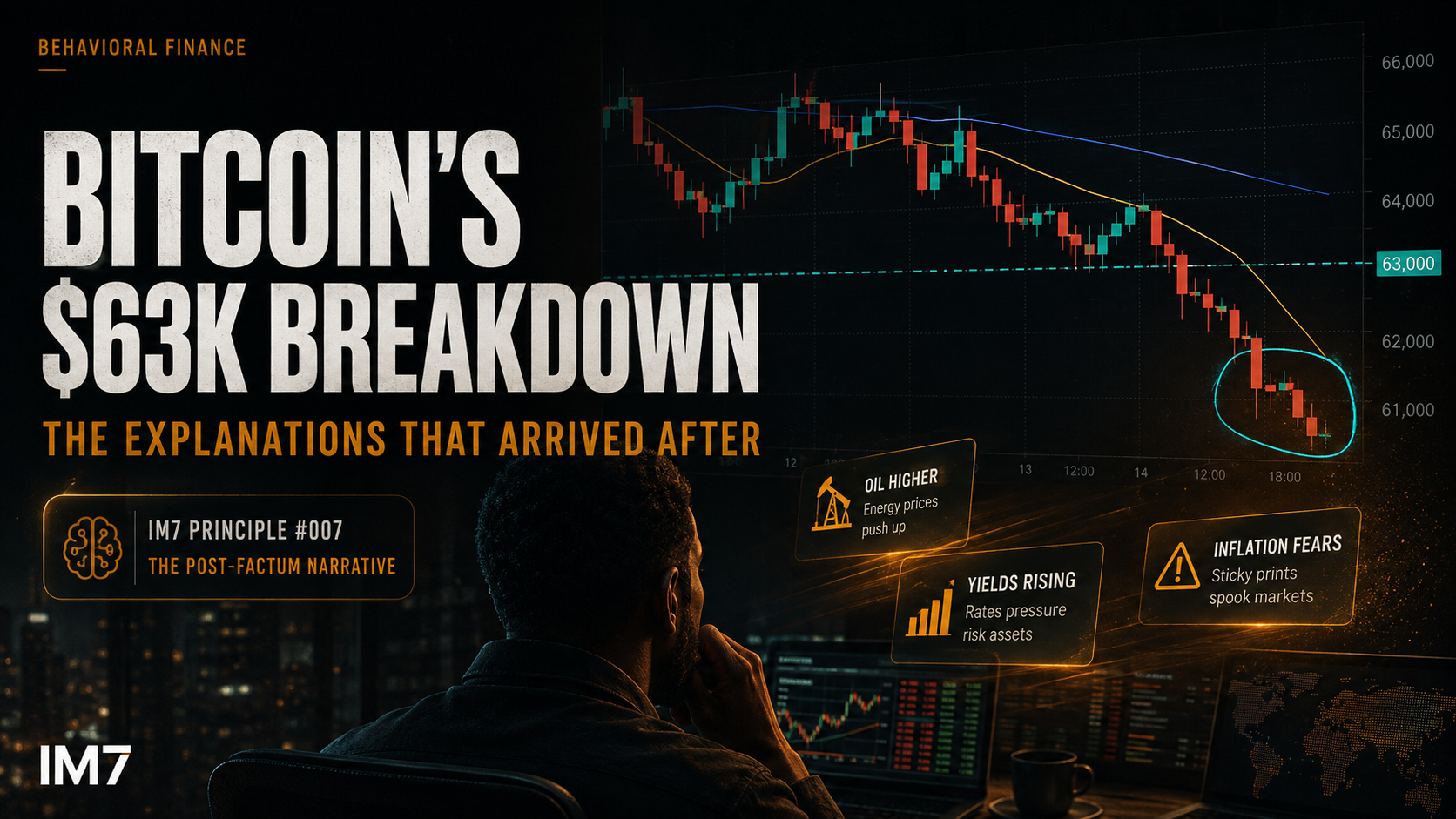
Bitcoin’s $63K Breakdown: Why the Explanations Came After
- Reading time
- 10 min read
- Word count
- 2,050 words
- Published
Bitcoin’s move below $63,000 triggered an immediate wave of explanations — macro pressure, yields, oil, market structure. The behavioral risk is that once the outcome is known, those explanations can feel more obvious and predictive than they actually were beforehand. The real test is separating post-move understanding from genuine pre-move edge.
On this page
- Executive Summary
- IM7 Principle #007 — The Post-Factum Narrative
- A coherent explanation after the event does not prove the event was predictable beforehand.
- Market Context
- What the Market Let Traders Believe
- Behavioral Observation
- Before the move
- After the move
- Behavioral Chart 01 — Before the Move vs. After the Move
- BEFORE OUTCOME
- AFTER OUTCOME
- Cognitive Bias Breakdown
- 1. Hindsight Bias
- 2. Narrative Construction
- 3. Confirmation Bias
- Behavioral Model 01 — The Hindsight Compression Model
- The Professional Read
- Observable fact
- Interpretation
- Thesis
- Prediction
- Behavioral Chart 02 — Clarity Before vs. After the Outcome
- Objective information available
- Subjective perceived clarity
- Decision Framework
- 1. Freeze the Information Set
- 2. Separate Fact From Story
- 3. Run the Opposite-Outcome Test
- 4. Evaluate Actionability
- 5. Grade the Process, Not the Outcome
- Behavioral Model 02 — The Freeze-Frame Audit
- Risk Management Lesson
- Behavioral Chart 03 — Narrative Confidence vs. Predictive Evidence
- Predictive evidence available before move
- Narrative confidence after move
- IM7 Quote
- IM7 Observation
- Behavioral Model 03 — The Post-Factum Narrative Loop
- Practical Decision Audit
- IM7 Decision Rule
- Behavioral Principle
- Hindsight Bias
- Final IM7 Principle
- The Post-Factum Narrative
Executive Summary
Bitcoin’s move below $63,000 produced something markets generate almost as reliably as volatility:
an explanation.
Oil.
Bond yields.
Inflation pressure.
Macro uncertainty.
Within hours of the move, multiple narratives could be assembled to explain why Bitcoin declined.
Some of those factors may be relevant.
But relevance is not the same as proven causality, and explaining an outcome after it occurs is not the same as possessing an actionable edge before it occurs.
That distinction is the behavioral story.
Once the outcome becomes known, the uncertainty that existed beforehand becomes psychologically compressed. Events begin to look more connected. Warning signs appear more obvious. Alternative scenarios disappear from memory.
The result is hindsight bias reinforced by narrative construction.
Traders can walk away believing:
“The move was obvious.”
when the more accurate statement may be:
“The explanation became obvious after the move.”
The professional advantage is not refusing to analyze what happened.
It is refusing to confuse post-move understanding with pre-move foresight.
IM7 Principle #007 — The Post-Factum Narrative
A coherent explanation after the event does not prove the event was predictable beforehand.
Markets are complex systems.
Multiple variables can move simultaneously:
- price,
- rates,
- commodities,
- positioning,
- sentiment,
- liquidity,
- expectations,
- and news.
Once an outcome occurs, the mind naturally searches backward for the variables that best fit what happened.
That process can produce a convincing story.
The danger begins when the story is mistaken for evidence that the outcome should have been obvious in advance.
IM7 Principle #007 separates two different skills:
Explaining what happened
and
having had enough evidence beforehand to act intelligently.
They are not interchangeable.
Market Context
Bitcoin traded below the $63,000 level following recent weakness.
At the same time, market commentary pointed toward several macro variables, including oil prices, bond yields, inflation expectations, and broader risk sentiment.
Those observations provide context.
They do not, by themselves, establish a single definitive cause for Bitcoin’s decline.
That matters because markets rarely offer clean experimental conditions.
Multiple forces can operate simultaneously, and different participants can react to the same information in different ways.
The evidence-first approach therefore begins with what can actually be observed:
- Bitcoin moved below $63,000.
- Several macro narratives were subsequently used to explain the move.
- The outcome was clearer after price moved than it was beforehand.
Everything beyond that requires interpretation.
What the Market Let Traders Believe
“Now that Bitcoin fell, the reason is obvious.”
This is where hindsight becomes dangerous.
After a decline, traders can connect existing information into a clean sequence:
Higher oil.
Higher yields.
Inflation concern.
Risk assets weaken.
Bitcoin falls.
The sequence sounds logical.
But logical does not automatically mean predictive.
Before the outcome, other scenarios may also have been plausible.
Bitcoin could have absorbed the macro pressure.
Another market variable could have dominated.
The information could already have been reflected in price.
The reaction could have been delayed, muted, or reversed.
Once Bitcoin declined, those alternative paths became much easier to forget.
The realized path began to look inevitable.
That is not the market becoming clearer.
That is memory reorganizing uncertainty around the known outcome.
Behavioral Observation
The most important shift occurs in how the same information feels before and after the move.
Before the move
Oil prices may look relevant.
Bond yields may look relevant.
Inflation concerns may look relevant.
But their precise impact on Bitcoin remains uncertain.
After the move
Bitcoin falls.
Now those same variables suddenly appear interconnected.
The trader says:
“Of course Bitcoin dropped.”
Nothing necessarily changed about the historical information.
What changed was knowledge of the result.
That knowledge makes the path backward easier to construct.
Behavioral Chart 01 — Before the Move vs. After the Move
Visual concept:
Split the chart into two sides.
BEFORE OUTCOME
Show multiple plausible paths:
- Bitcoin falls
- Bitcoin ranges
- Bitcoin rebounds
Alongside several possible influences:
- oil
- yields
- inflation
- sentiment
- market structure
Label:
“Multiple explanations. Multiple possible outcomes.”
AFTER OUTCOME
Show the realized Bitcoin decline with one clean narrative connecting the selected variables.
Label:
“One outcome. One story suddenly feels obvious.”
Behavioral takeaway:
The outcome removes possibilities from memory faster than it removes uncertainty from history.
Cognitive Bias Breakdown
1. Hindsight Bias
Hindsight bias describes the tendency to view an event as more predictable after learning its outcome.
Fischhoff’s early research demonstrated that knowledge of an outcome changes how people evaluate what could have been known beforehand Fischhoff, 1975.
In markets, this appears constantly.
Before the move:
“Bitcoin could go either way.”
After the move:
“The warning signs were everywhere.”
The past did not become more predictable.
The observer gained information that was unavailable at the decision point:
the result.
2. Narrative Construction
Humans prefer coherent causal stories.
Complexity is uncomfortable.
A story such as:
oil ↑ → yields ↑ → inflation concern ↑ → Bitcoin ↓
is cognitively satisfying because it converts a messy system into a sequence.
The problem is not that the sequence is necessarily wrong.
The problem is overestimating how much predictive power the sequence had before the result was known.
A narrative can explain.
That does not mean it could reliably forecast.
3. Confirmation Bias
Once a trader has a prior directional belief, post-move narratives can reinforce it.
A bearish trader may interpret the decline as proof that their macro thesis was correct.
A bullish trader may explain the same decline as temporary macro pressure inside a larger bullish structure.
Both sides can selectively choose the explanation that best preserves their prior worldview.
The move happened once.
The narratives multiply afterward.
::model:1::
Behavioral Model 01 — The Hindsight Compression Model
Pre-move uncertainty ↓ Multiple possible outcomes ↓ Market outcome becomes known ↓ Alternative scenarios fade from attention ↓ Supporting evidence becomes more salient ↓ Past uncertainty feels smaller ↓ Outcome appears increasingly predictable
IM7 correction:
Knowing what happened changes how obvious the past feels.
The Professional Read
A disciplined professional asks a different question.
Not:
“Can I explain why Bitcoin fell?”
But:
“Could this information have justified the decision before Bitcoin fell?”
That distinction is critical.
Oil, yields, and inflation may have been legitimate risk inputs.
But the professional evaluates their usefulness according to what was knowable at the time.
The proper test is counterfactual:
If Bitcoin had rallied instead, would this same evidence still have looked like an obvious bearish signal?
If the answer is no, then the explanation may be partly dependent on knowing the outcome.
Professionals therefore separate:
Observable fact
Bitcoin moved below $63,000.
Interpretation
Macro pressure may have contributed.
Thesis
These conditions may remain relevant to future Bitcoin behavior.
Prediction
Bitcoin will continue lower because of them.
Those statements are not equivalent.
The further down that ladder a trader moves, the greater the evidentiary burden becomes.
Behavioral Chart 02 — Clarity Before vs. After the Outcome
Visual concept:
Plot two conceptual lines:
Objective information available
Changes only modestly around the event.
Subjective perceived clarity
Rises sharply after the outcome becomes known.
Mark the gap between the two:
Hindsight Gap
Label the chart clearly as conceptual rather than measured.
Behavioral takeaway:
Outcomes can increase perceived certainty faster than they increase actual information.
Decision Framework
1. Freeze the Information Set
Before analyzing the outcome, reconstruct what was actually known beforehand.
Ask:
- What data existed?
- What was uncertain?
- What competing scenarios were plausible?
- What information arrived only afterward?
2. Separate Fact From Story
Write the factual sequence without interpretation.
Example:
Bitcoin traded below $63,000.
Then list possible explanations separately.
Do not merge the two.
3. Run the Opposite-Outcome Test
Ask:
“If Bitcoin had rallied instead, could I have constructed an equally convincing explanation?”
If yes, the original explanation may have weak predictive specificity.
4. Evaluate Actionability
Ask whether the pre-move evidence offered:
- a defined entry,
- a defined invalidation,
- an acceptable risk/reward structure,
- and sufficient confidence to justify exposure.
An explanation without those components may be intellectually useful but operationally useless.
5. Grade the Process, Not the Outcome
A correct trade can come from a poor process.
A losing trade can come from a sound process.
The goal is not to reward yourself merely because price ultimately moved in the direction you expected.
Grade what you knew and what you did with it.
::model:2::
Behavioral Model 02 — The Freeze-Frame Audit
Step 1: Pause at the moment before the move.
Step 2: List only information available at that time.
Step 3: List all plausible outcomes.
Step 4: Record the decision that evidence justified.
Step 5: Reveal the actual outcome.
Step 6: Compare process quality with outcome.
Purpose:
Prevent information discovered after the event from contaminating evaluation of the original decision.
Risk Management Lesson
Hindsight bias becomes financially dangerous when retrospective clarity increases future position size.
The sequence can look like this:
“I understood why Bitcoin fell.”
becomes:
“I saw the move correctly.”
which becomes:
“I understand this relationship.”
which becomes:
“Next time I should size larger.”
That progression can manufacture overconfidence from a single explanatory success.
But explanatory accuracy is not the same as predictive calibration.
If the original evidence did not provide a reliable pre-move edge, increasing exposure because the narrative later made sense is dangerous.
Risk should therefore scale with:
- evidence quality,
- repeatability,
- defined invalidation,
- historical reliability,
- and uncertainty.
Not with how convincing the explanation sounds afterward.
Behavioral Chart 03 — Narrative Confidence vs. Predictive Evidence
Visual concept:
Show two conceptual bars or lines.
Predictive evidence available before move
Moderate / uncertain.
Narrative confidence after move
High.
Then illustrate the behavioral mistake:
High narrative confidence → inflated future conviction
Add a correction arrow:
Return to original evidence set.
Behavioral takeaway:
Retrospective confidence should not automatically become prospective risk.
IM7 Quote
“A good explanation after the move isn’t the same as a good decision before it.”
IM7 Observation
Markets produce stories almost immediately after they produce outcomes.
That is not inherently bad.
Post-event analysis is useful.
Understanding relationships matters.
Studying macro conditions matters.
Reviewing what moved and why matters.
The behavioral error begins when the explanation changes our memory of what was knowable beforehand.
The move looks obvious.
The warning signs look obvious.
The correct action looks obvious.
But that clarity often belongs to the present, not the past.
A trader who does not distinguish those two perspectives can become increasingly confident while learning very little about actual predictive skill.
The better question is:
“What could I have reasonably concluded before I knew the answer?”
That is the question that improves decision-making.
::model:3::
Behavioral Model 03 — The Post-Factum Narrative Loop
Outcome occurs ↓ Trader searches for causes ↓ Relevant facts are selected ↓ Facts are organized into a coherent story ↓ Story makes outcome feel inevitable ↓ Trader overestimates prior predictability ↓ Confidence in future forecasts increases
Loop risk:
The trader learns certainty instead of learning uncertainty.
Professional interruption:
Return to the pre-move information set and grade the original process.
Practical Decision Audit
Before accepting a post-move explanation, ask:
- Was this factor observable before the move?
- Did I identify it before the outcome?
- Did it provide a clear directional implication at the time?
- What alternative outcomes were still plausible?
- Would I tell the same story if price had moved the opposite direction?
- Could this evidence have produced an executable trade with defined risk?
- Am I evaluating my process or merely admiring the outcome?
If the explanation only became compelling after price confirmed it, treat it as:
context, not proof of foresight.
IM7 Decision Rule
Judge the decision from the evidence available before the outcome — not from the clarity that arrived afterward.
When reviewing a market move:
Freeze the timeline. Reconstruct the evidence. Restore the alternative outcomes. Separate fact from explanation. Grade the process. Then study the result.
Do not let the outcome rewrite what you actually knew.
Behavioral Principle
Hindsight Bias
Once an outcome becomes known, people tend to perceive the event as having been more predictable than it appeared beforehand.
In markets, this can cause traders to confuse retrospective explanation with genuine predictive skill.
Canonical source: Fischhoff (1975).
Final IM7 Principle
The Post-Factum Narrative
The market moves first.
The explanation often comes second.
The danger begins when the explanation convinces you that you knew the answer before the market gave it to you.
How did this land?
What emotion or bias did this article help you recognize?
References
- [1]Fischhoff, B. (1975). Hindsight ≠ foresight: The effect of outcome knowledge on judgment under uncertainty. Journal of Experimental Psychology: Human Perception and Performance. American Psychological Association. DOI: 10.1037/0096-1523.1.3.288.
- [2]Taleb, N. N. (2007). The Black Swan: The Impact of the Highly Improbable..
Pass the signal forward.
IM7 Intelligence studies financial markets through the lens of psychology rather than prediction. Our research focuses on behavioral finance, crowd psychology, sentiment, and decision-making to help readers understand why markets move—not just where they move.
IM7 Intelligence publishes educational research on market psychology, behavioral finance, and investor behavior. Nothing published by IM7 Intelligence constitutes financial, investment, tax, or legal advice. Always conduct your own research before making financial decisions.
Read the market's emotion before it acts.
Where this article sits in the map.
- Confirmation BiasYou are here
- Behavioral Finance
- Risk Management
- Fear
Curated paths, not random articles.
Behavior read in real time.

Ismael Mercius
Ismael Mercius is the founder of IM7 Intelligence, where he writes about crypto market psychology, behavioral finance, and the sentiment cycles that drive digital asset prices. His work focuses on how traders actually make decisions — and the recurring errors that show up in their P&L.
- Crypto market psychology
- Behavioral finance
- Market sentiment analysis
- Trader behavior & decision-making