Why Bitcoin Feels Safer at $81K Than It Did at $76K
AI Generated • IM7 Intelligence
- Reading time
- 3 min read
- Word count
- 403 words
- Published
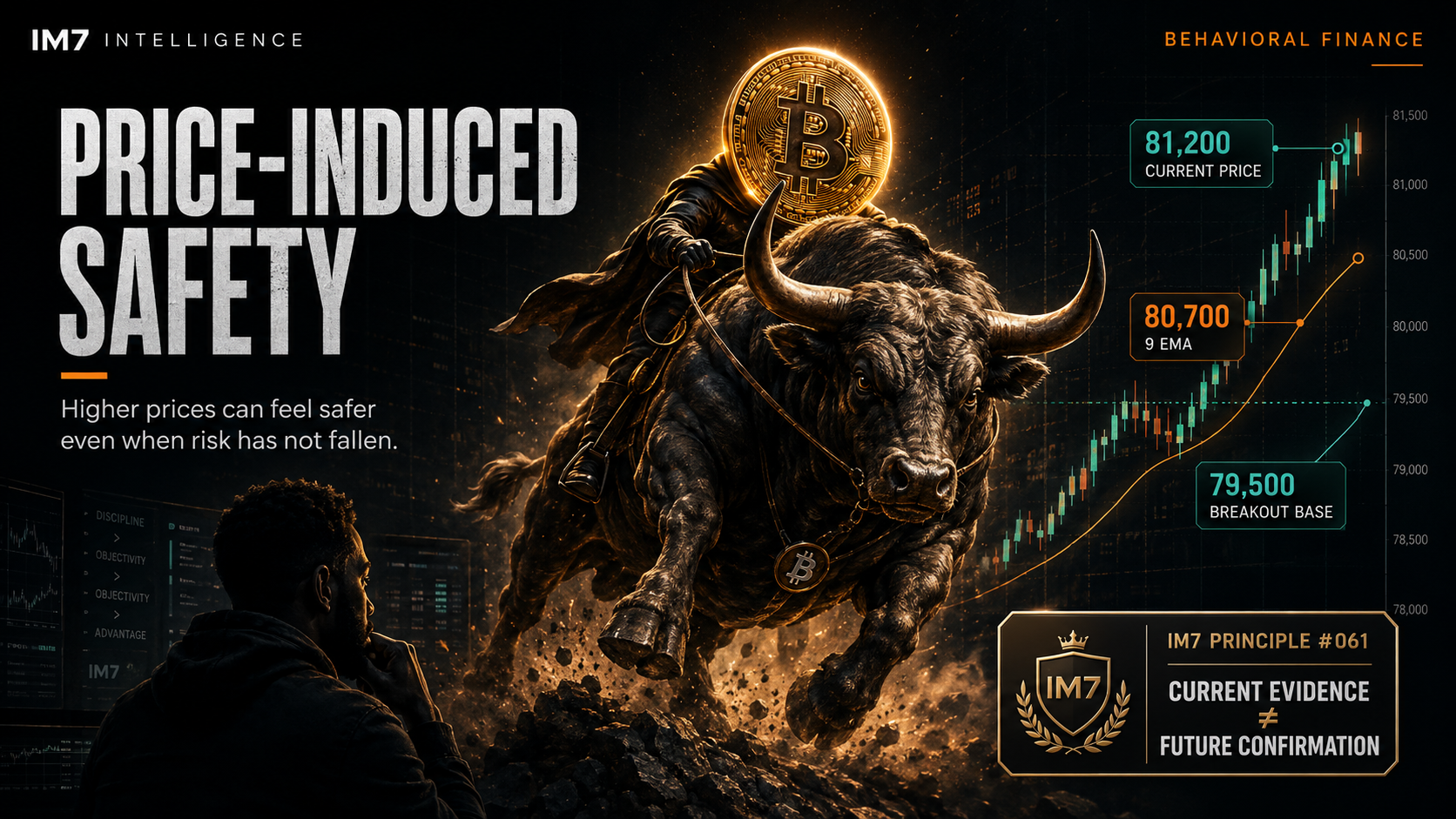
Bitcoin surged from the upper-$79K area toward $81.9K, and traders who felt uneasy near $76K now feel increasingly comfortable buying higher. The behavioral trap is Price-Induced Safety: rising price can reduce perceived risk even when actual market risk has not fallen.
Three days ago, Bitcoin near $76,000 felt dangerous.
Today, above $81,000, the same asset feels like an opportunity.
That reversal is the story.
Bitcoin surged from the upper-$79K area toward roughly $81.9K as softer rate expectations, falling yields, a weaker dollar, heavy short liquidations, and strong ETF inflows pushed price back above $80K.
But the bigger shift may be psychological.
At $76K, traders were cautious.
At $81K, many of those same traders feel more comfortable buying.
The asset became more expensive.
Perceived risk went down.
That is the trap.
Price-Induced Safety
Rising prices can create a sense of safety.
As price moves higher, traders see green candles, stronger headlines, inflows, breakouts, and short squeezes. Those signals reduce fear and increase willingness to participate.
The paradox is simple:
The more expensive the asset becomes, the safer it can feel.
That does not mean actual risk has fallen.
It means confidence has risen.
Why the Move Matters
Bitcoin’s move toward $81.9K created a strong emotional reset.
Bears were squeezed.
Bulls were validated.
Sidelined traders were given a reason to feel late.
That combination increases decision pressure.
This is also where traders can confuse a powerful move with guaranteed continuation.
A vertical candle confirms demand existed.
It does not confirm that every higher price will be accepted.
The Recency Loop
The newest candle often gets too much authority.
After a sharp bullish move, traders naturally begin projecting that strength forward. Recent returns change expectations. Expectations change perceived risk. Perceived risk changes positioning.
That is the Recency Loop.
Yesterday’s candle becomes tomorrow’s thesis.
The danger begins when traders stop observing strength and start assuming continuation.
The Other Side of the Move
As price rises, more holders move into profit.
That can increase the number of psychologically available sellers.
In other words, the same rally that attracts new buyers can also create stronger incentives for existing holders to distribute.
This is why rising confidence does not automatically mean falling risk.
Buyers may feel safer at the exact moment sellers become more willing to act.
Better Decision Framework
Instead of asking:
“Does Bitcoin look bullish?”
Ask:
“What has actually been confirmed?”
A breakout is evidence.
Holding above a reclaimed level is stronger evidence.
Sustained acceptance is stronger still.
Conviction should build progressively.
It should not arrive all at once because one candle was large.
How did this land?
What emotion or bias did this article help you recognize?
References
- [1]Michael Weber, Bernardo Candia, Olivier Coibion, Yuriy Gorodnichenko (2026). Do You Even Crypto, Bro? Cryptocurrencies in Household Finance. Federal Reserve Bank of Cleveland Working Paper No. 26-16. DOI: 10.26509/frbc-wp-202616. https://www.clevelandfed.org/publications/working-paper/2026/wp-2616-cryptocurrencies-in-household-finance
- [2]Frederik Theissen (2026). Doubt at the Boundaries. Glassnode — The Week On-chain. https://research.glassnode.com/the-week-onchain-week-35-2026/
- [3]Danny Park (2026). US Bitcoin ETFs Report the Largest Inflow Day Since January, Worth $731 Million. The Block. https://www.theblock.co/news/markets/2026-09-04-us-bitcoin-etfs-largest-inflow-day-since-january-413515
- [4]Fed Rate Comments Spark Powerful Bitcoin, Crypto Rally. Bitcoin ETFs Near Entries. (2026). Investor's Business Daily. https://www.investors.com/news/bitcoin-price-fed-waller-rate-signal-crypto-stocks-short-squeeze-liquidations/
Pass the signal forward.
IM7 Intelligence studies financial markets through the lens of psychology rather than prediction. Our research focuses on behavioral finance, crowd psychology, sentiment, and decision-making to help readers understand why markets move—not just where they move.
IM7 Intelligence publishes educational research on market psychology, behavioral finance, and investor behavior. Nothing published by IM7 Intelligence constitutes financial, investment, tax, or legal advice. Always conduct your own research before making financial decisions.
Read the market's emotion before it acts.
Where this article sits in the map.
- Confirmation BiasYou are here
- Behavioral Finance
- Risk Management
- Fear
Curated paths, not random articles.
Behavior read in real time.

Ismael Mercius
Ismael Mercius is the founder of IM7 Intelligence, where he writes about crypto market psychology, behavioral finance, and the sentiment cycles that drive digital asset prices. His work focuses on how traders actually make decisions — and the recurring errors that show up in their P&L.
- Crypto market psychology
- Behavioral finance
- Market sentiment analysis
- Trader behavior & decision-making