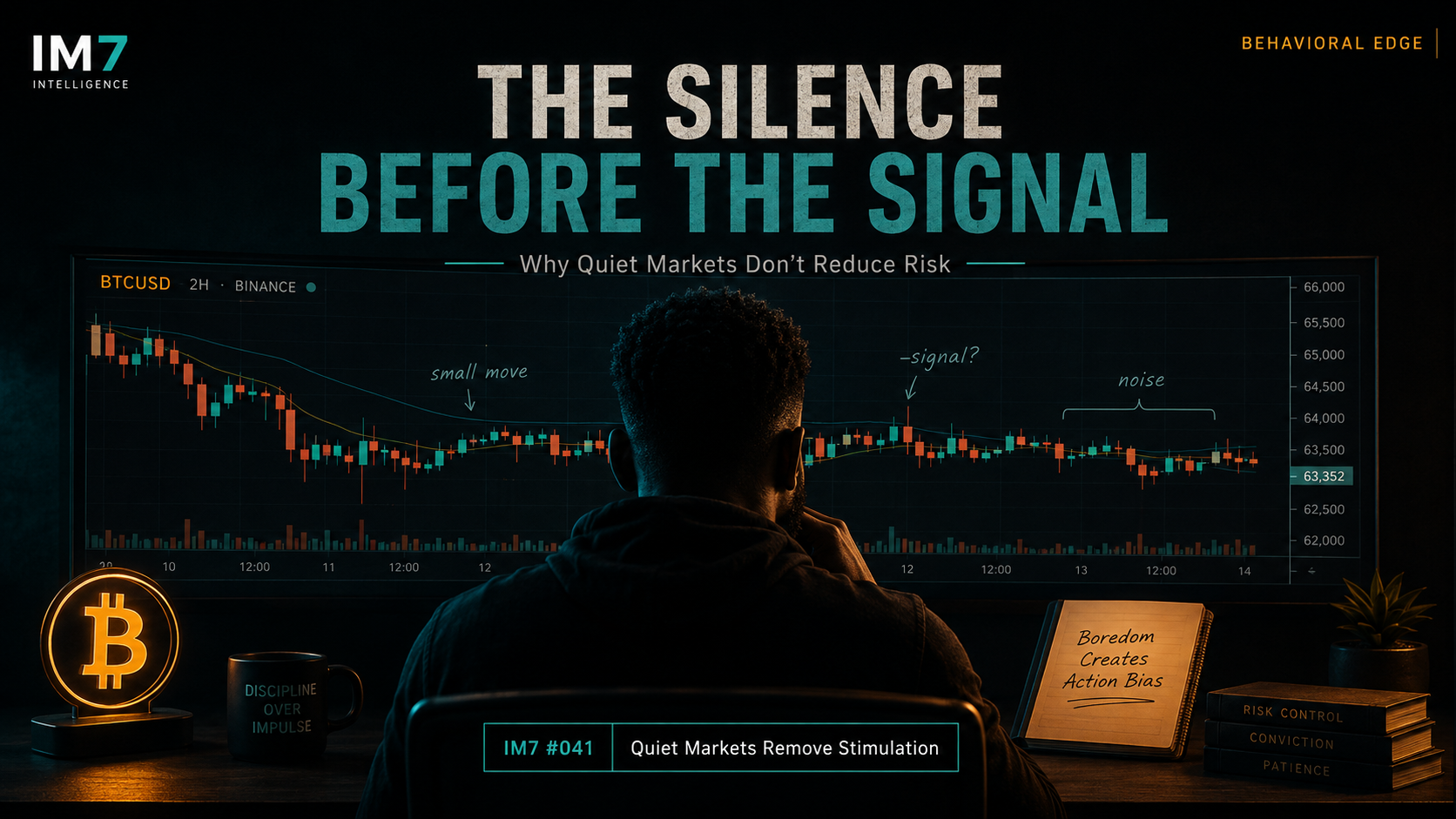
The Silence Before the Signal: Why Quiet Markets Don't Reduce Risk
- Reading time
- 9 min read
- Word count
- 1,975 words
- Published
Bitcoin perpetual trading activity recently fell to multi-year lows, creating an environment that can feel deceptively safe. But low stimulation changes trader behavior. Boredom, impatience, and action bias can lower setup standards and turn ordinary market noise into perceived opportunity. The professional challenge is not predicting what happens next, but recognizing when the urge to act is stronger than the evidence.
On this page
- Executive Summary
- IM7 Principle
- Quiet Markets Don’t Remove Risk. They Remove Stimulation.
- Market Context
- What the Market Let Traders Believe
- Behavioral Observation
- Behavioral Chart 01 — Market Activity vs. Perceived Signal Importance
- Cognitive Bias Breakdown
- 1. Action Bias
- 2. Recency Weighting
- 3. Signal Inflation
- Behavioral Model 01 — The Quiet-Market Action Loop
- The Professional Read
- Decision Framework
- 1. Define the Evidence Threshold Before Boredom Appears
- 2. Separate Signal From Stimulation
- 3. Audit Your Search Behavior
- 4. Challenge the Urge to Participate
- 5. Require Follow-Through
- 6. Preserve Optionality
- Behavioral Chart 02 — Evidence Threshold Compression
- Disciplined state
- Bored state
- Behavioral Model 02 — Signal Inflation
- Stage 1 — Quiet
- Stage 2 — Search
- Stage 3 — Magnification
- Stage 4 — Narrative
- Stage 5 — Conviction
- Stage 6 — Action
- Risk Management Lesson
- Behavioral Chart 03 — Opportunity Scarcity vs. Trading Frequency
- Behavioral Model 03 — The Discipline Gap
- Market provides:
- Trader emotionally wants:
- Behavioral gap:
- IM7 Observation
- IM7 Quote
- IM7 Decision Rule
- Practical Trader Checklist
- Reference
Executive Summary
Bitcoin perpetual trading activity has recently fallen to multi-year lows, creating an unusually quiet environment for short-term participants.
At first glance, less activity can feel reassuring.
Fewer dramatic moves can create the impression that risk has declined, the market has become easier to read, or there is simply less to worry about.
But quiet markets introduce a different problem.
They remove stimulation.
When meaningful opportunities become scarce, traders do not automatically become more patient. Some become more sensitive to small price movements, increasingly willing to interpret ordinary fluctuations as meaningful signals.
A minor candle becomes “the breakout.”
A routine bounce becomes “confirmation.”
A brief deviation becomes “something is starting.”
The underlying market evidence may not have materially improved.
What changed was the trader’s threshold for what counts as evidence.
This report examines how boredom, action bias, and signal inflation can transform a quiet market into a behavioral risk-management problem.
The professional advantage is not predicting when Bitcoin will become active again.
It is maintaining the same evidence standard when the market gives you less to work with.
IM7 Principle
Quiet Markets Don’t Remove Risk. They Remove Stimulation.
When market activity declines, traders may assume the environment has become safer.
That conclusion confuses two different kinds of risk.
There is market risk: what price can do.
And there is decision risk: what the trader may do because the market is not giving them enough stimulation.
In active markets, the behavioral danger can be panic, FOMO, or chasing.
In quiet markets, the danger can become boredom.
Boredom does not announce itself like fear.
It simply lowers standards.
The trader who normally demands several pieces of evidence may suddenly act on one.
The setup did not improve.
The threshold deteriorated.
Market Context
Recent reporting based on K33 Research notes that Bitcoin perpetual trading activity across major derivatives venues such as Binance and Bybit has fallen to its lowest levels since 2023 following an extended period of subdued, range-oriented price action.
That establishes an observable condition:
less speculative trading activity is occurring than during more active periods.
It does not establish what Bitcoin must do next.
Low activity is not automatically bullish.
It is not automatically bearish.
And it does not guarantee that a major breakout is imminent.
The more useful IM7 question is behavioral:
What happens to the trader when the market provides fewer obvious opportunities?
For an active participant accustomed to frequent stimulation, the absence of strong movement can itself create pressure.
Nothing happening begins to feel like a problem that needs solving.
What the Market Let Traders Believe
“Nothing is happening, so I need to look harder.”
This is where quiet conditions become psychologically interesting.
When large movements are absent, small movements occupy more attention.
A candle that might look ordinary during an active session suddenly becomes the most interesting event on the screen.
A local high becomes resistance.
A small breach becomes a breakout.
A minor recovery becomes evidence that buyers have returned.
The trader may not realize that their analytical standard has changed.
They believe they are discovering more information.
In reality, they may simply be assigning more meaning to less information.
That is the quiet-market trap.
Behavioral Observation
Consider a trader watching Bitcoin for several hours without a high-conviction setup.
At first, waiting feels disciplined.
Later, it begins to feel unproductive.
The trader zooms in.
Then changes timeframes.
Then adds another indicator.
Then notices a small candle pushing outside a recent micro-range.
That candle now feels important.
Not necessarily because its evidentiary quality is high.
Because it finally provides something to react to.
This is how boredom can produce signal inflation.
The perceived significance of an event rises simply because there are fewer competing events demanding attention.
Behavioral Chart 01 — Market Activity vs. Perceived Signal Importance
Visual concept: Show market activity declining across a quiet period while the perceived significance assigned to small price movements rises.
Label several ordinary intrarange candles:
- routine fluctuation,
- minor deviation,
- local range test.
Then show how the bored trader increasingly labels them:
- “setup forming,”
- “confirmation,”
- “breakout.”
Behavioral takeaway:
When stimulation falls, ordinary information can begin to feel extraordinary.
Cognitive Bias Breakdown
1. Action Bias
Action bias describes the tendency to prefer doing something over doing nothing, particularly when inactivity feels uncomfortable or irresponsible.
In trading, action bias can create the belief that participation itself is productive.
A trader may feel that:
- watching without trading is wasting time,
- missing a small move is unacceptable,
- being flat means being unprepared,
- or taking a marginal setup is better than taking no setup.
That logic reverses professional decision-making.
The correct question is not:
“Can I find a trade?”
It is:
“Has the market earned my risk?”
Behavioral research on action bias shows that people can favor intervention even when inaction may be preferable [Patt & Zeckhauser, 2000].
2. Recency Weighting
A prolonged quiet period can also distort expectations.
The longer subdued conditions persist, the easier it becomes to treat recent behavior as normal.
Traders may unconsciously assume:
“This market keeps doing the same thing.”
That can reduce sensitivity to regime change.
Or it can create the opposite error:
“It has been quiet for so long that something huge must happen now.”
Both interpretations manufacture certainty from elapsed time.
Neither is guaranteed by the evidence.
3. Signal Inflation
Signal inflation is the IM7 term for what happens when the trader lowers the threshold separating noise from actionable evidence.
What normally requires several confirmations begins to require one.
What normally looks incomplete begins to look sufficient.
The market has not necessarily become clearer.
The trader has become easier to convince.
::model:1::
Behavioral Model 01 — The Quiet-Market Action Loop
Low market activity ↓ Reduced stimulation ↓ Boredom / impatience increases ↓ Trader searches harder for opportunity ↓ Evidence threshold falls ↓ Small moves receive greater significance ↓ Marginal setup becomes actionable ↓ Trading activity temporarily relieves boredom
The key insight:
The trade can reward the need for stimulation even before it rewards the trading thesis.
The Professional Read
A disciplined professional does not assume quiet means safe.
They also do not assume quiet means danger is imminent.
They separate market condition from behavioral response.
If evidence quality is weak, the professional does not improve the evidence by staring harder.
They maintain the standard.
A setup that required three independent conditions yesterday should not require one condition today merely because nothing interesting has happened for six hours.
The professional may respond to a quiet environment by:
- reducing trade frequency,
- reducing exposure,
- requiring cleaner invalidation,
- widening the opportunity set across time rather than forcing frequency,
- stepping away from the screen,
- or doing nothing.
Inaction is not automatically the correct decision.
But it must remain an available decision.
That distinction matters.
Decision Framework
1. Define the Evidence Threshold Before Boredom Appears
Specify what qualifies as a valid setup before spending hours watching the market.
Do not rewrite the standard after becoming impatient.
2. Separate Signal From Stimulation
Ask:
“Would this candle look important in a more active market?”
If not, determine why it suddenly feels important now.
3. Audit Your Search Behavior
Repeatedly changing timeframes, indicators, or setups can indicate that you are searching for permission rather than evidence.
4. Challenge the Urge to Participate
Ask:
“If I had already taken three excellent trades this week, would I still feel compelled to take this one?”
If the answer changes, opportunity may not be the real driver.
5. Require Follow-Through
Do not automatically promote the first small deviation into a complete directional thesis.
Allow additional market behavior to increase or decrease confidence.
6. Preserve Optionality
Remaining flat preserves capital and decision flexibility.
That has value.
Behavioral Chart 02 — Evidence Threshold Compression
Visual concept: Show two horizontal thresholds.
Disciplined state
High evidence threshold:
- structure,
- context,
- trigger,
- invalidation,
- follow-through.
Bored state
Compressed threshold:
- one candle,
- one indicator,
- one feeling,
- “good enough.”
Show the evidence required to trigger action shrinking as boredom rises.
Behavioral takeaway:
Boredom rarely announces that standards are falling. It simply makes weaker evidence feel sufficient.
Behavioral Model 02 — Signal Inflation
Stage 1 — Quiet
Few obvious opportunities.
Stage 2 — Search
Attention intensifies.
Stage 3 — Magnification
Minor fluctuations receive disproportionate focus.
Stage 4 — Narrative
The trader explains why the movement matters.
Stage 5 — Conviction
The explanation begins to feel like evidence.
Stage 6 — Action
Risk is committed to a setup that may not have qualified under normal standards.
IM7 correction:
The scarcity of signals does not increase the quality of the signals available.
::model:2::
Risk Management Lesson
Quiet environments can damage capital differently from dramatic markets.
The danger may not be one catastrophic decision.
It may be decision leakage.
One unnecessary trade.
Then another.
Then another.
Small commissions, spreads, slippage, poor entries, and marginal losses accumulate.
More importantly, repeated low-quality decisions can weaken behavioral discipline.
The trader becomes conditioned to act without sufficient evidence.
That habit can become far more expensive when volatility eventually changes.
Risk management therefore includes protecting the quality of the decision process.
A trader should not ask only:
“How much can I lose on this trade?”
They should also ask:
“What behavior am I training by taking it?”
A profitable boredom trade can still reinforce a bad process.
Behavioral Chart 03 — Opportunity Scarcity vs. Trading Frequency
Visual concept: Show actual high-quality opportunity frequency decreasing while the impatient trader's desired trading frequency remains constant.
The gap between the two becomes:
Forced Trades
Illustrate how that gap grows as genuine opportunity becomes scarce.
Behavioral takeaway:
When opportunity falls but your required activity stays constant, standards must fall to fill the gap.
Behavioral Model 03 — The Discipline Gap
Market provides:
2 high-quality opportunities.
Trader emotionally wants:
6 trades.
Behavioral gap:
4 decisions must either become:
- patience,
- observation,
- research,
- or forced trades.
The professional converts the gap into patience.
The undisciplined trader converts it into lower standards.
::model:3::
IM7 Observation
The hardest market is not always the one moving fastest.
Sometimes it is the one doing almost nothing.
Fast markets test emotional control through fear and urgency.
Quiet markets test emotional control through boredom and impatience.
The trader begins searching for stimulation while believing they are searching for opportunity.
That distinction can be difficult to detect because the behavior still looks analytical.
Charts are open.
Indicators are being reviewed.
Levels are being drawn.
The trader appears productive.
But the underlying question has changed from:
“Is there sufficient evidence?”
to:
“Can I find something worth trading?”
Once that happens, analysis can become a justification engine.
IM7 Quote
“Quiet markets don’t remove risk. They remove stimulation.”
IM7 Decision Rule
Do not lower your evidence threshold because the market lowered your stimulation.
When activity is scarce:
Keep the standard. Separate boredom from opportunity. Require evidence. Allow uncertainty to remain unresolved. Preserve capital when the setup does not qualify.
The market does not owe the trader a trade.
And the trader does not need to create one.
Practical Trader Checklist
Before taking a trade in a quiet market, ask:
- Would this setup qualify under normal market conditions?
- Has the evidence improved, or has my patience deteriorated?
- Am I changing timeframes or indicators because I am searching for confirmation?
- What specific evidence separates this move from ordinary noise?
- Would I still take this trade if I had already met my weekly performance target?
- Am I accepting weaker evidence simply because I want something to happen?
- What do I lose by remaining flat?
If the strongest reason for acting is:
“I’ve been waiting long enough.”
the market has not given you a signal.
Boredom has.
Reference
¹ Patt, A., & Zeckhauser, R. (2000). Action Bias and Environmental Decisions. Journal of Risk and Uncertainty, 21, 45–72.
How did this land?
What emotion or bias did this article help you recognize?
References
- [1]Baron, Jonathan; Ritov, Ilana (2004). Action bias in decision making. Journal of Behavioral Decision Making. DOI: 10.1002/bdm.443.
- [2]Patt & Zeckhauser (2004).
Pass the signal forward.
IM7 Intelligence studies financial markets through the lens of psychology rather than prediction. Our research focuses on behavioral finance, crowd psychology, sentiment, and decision-making to help readers understand why markets move—not just where they move.
IM7 Intelligence publishes educational research on market psychology, behavioral finance, and investor behavior. Nothing published by IM7 Intelligence constitutes financial, investment, tax, or legal advice. Always conduct your own research before making financial decisions.
Read the market's emotion before it acts.
Where this article sits in the map.
- Confirmation BiasYou are here
- Behavioral Finance
- Risk Management
- Fear
Curated paths, not random articles.
Behavior read in real time.

Ismael Mercius
Ismael Mercius is the founder of IM7 Intelligence, where he writes about crypto market psychology, behavioral finance, and the sentiment cycles that drive digital asset prices. His work focuses on how traders actually make decisions — and the recurring errors that show up in their P&L.
- Crypto market psychology
- Behavioral finance
- Market sentiment analysis
- Trader behavior & decision-making