Bitcoin Got More Proof — And a Worse Entry
AI Generated • IM7 Intelligence
- Reading time
- 4 min read
- Word count
- 879 words
- Published
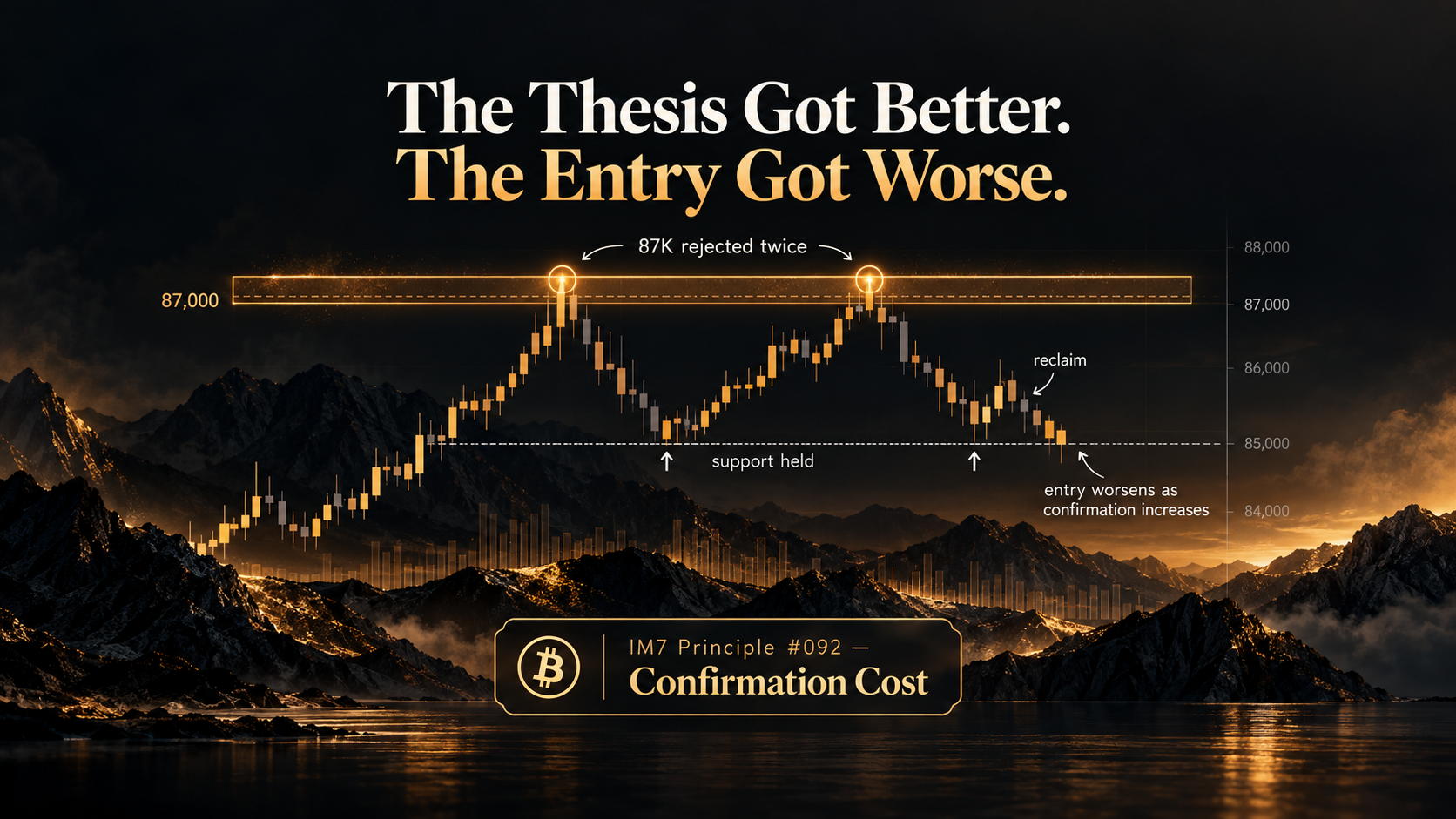
Bitcoin’s evidence improved as price climbed back toward the $87K area, but the trade location deteriorated at the same time. The behavioral trap is Confirmation Cost: waiting for more certainty can improve conviction while shrinking the margin for error. Better evidence does not automatically mean a better entry.
Executive Summary
Bitcoin’s evidence improved as price recovered from the mid-$84Ks, reclaimed $85K, and pushed back into the upper-$86K area. At the same time, the price required to participate became progressively worse, while the distance to the prior rejection zone shrank. That creates Confirmation Cost: traders become more comfortable exactly as their margin for error deteriorates. The next decision should separate confidence in the thesis from quality of the entry.
IM7 Principle
IM7 Principle #092 — Confirmation Cost.
As uncertainty decreases, traders often become willing to pay increasingly unfavorable prices for the same thesis. Better evidence can improve conviction while simultaneously reducing the margin for error.
Market Context
Bitcoin spent the week repairing damage from the prior flush.
The sequence was constructive:
- the lower-$84K area held,
- $85K was reclaimed,
- price returned to the $86Ks,
- momentum improved,
- and the prior rejection zone came back into view.
Each step improved the bullish case.
But each step also moved price farther away from the earlier recovery zone and closer to the level where sellers had already rejected the market before.
That matters because evidence quality and entry quality are not the same variable.
The market can become easier to believe while becoming less attractive to chase.
What The Market Wanted You To Believe
"The recovery is confirmed."
The tape rewarded patience with more evidence.
First, the low held.
Then $85K came back.
Then the $86Ks returned.
Then price approached the same area that had rejected the previous breakout.
The emotional effect is predictable.
Uncertainty falls.
Confidence rises.
Urgency rises with it.
That is where the trap forms.
The trader sees more proof and assumes the decision has become safer.
But the price paid for that certainty has also changed.
A stronger thesis does not automatically create a better location.
Behavioral Observation
Watch for the moment when confidence and price move in the same direction.
Early in a recovery, the evidence is incomplete and the trade feels uncomfortable.
Later, more conditions improve.
The thesis becomes easier to defend.
But by then:
- price may be farther from support,
- resistance may be closer,
- the reward-to-risk profile may be less forgiving,
- and the market may already reflect much of the improved information.
The behavioral error is treating reduced uncertainty as if it improves every part of the decision.
It does not.
Confirmation can improve belief while degrading location.
Cognitive Bias Breakdown
This setup combines two common tendencies.
The first is uncertainty aversion.
People prefer decisions that feel more resolved and more understandable.
The second is the tendency to use stronger evidence as justification for stronger action.
That sounds reasonable, but the market adds a complication:
the evidence and the price often change together.
By the time the thesis feels obvious, the market may have already repriced around that information.
The trader therefore pays an emotional premium for certainty.
Kahneman and Tversky’s work on decision-making under uncertainty helps explain why reduced ambiguity changes perceived attractiveness even when the underlying payoff structure has also changed Kahneman & Tversky, 1979.
In practical terms:
certainty can become expensive.
The Professional Read
A disciplined professional separates two questions:
1. Is the thesis getting stronger?
and
2. Is the location getting better?
Those questions can produce opposite answers.
For example:
- support holding can improve the thesis,
- reclaiming a level can improve the thesis,
- momentum improving can improve the thesis,
- approaching prior resistance can worsen location.
The professional does not reject confirmation.
The professional refuses to confuse confirmation with favorable asymmetry.
Better evidence can justify more confidence.
It does not automatically justify more urgency.
Decision Framework
Before acting on stronger confirmation, ask:
- What new evidence improved?
- How much did price move while that evidence accumulated?
- What level now invalidates the thesis?
- How far away is that invalidation point?
- How close is the nearest unresolved resistance?
- Did confidence improve faster than the trade’s asymmetry?
Then separate the outputs:
Thesis quality: improving, unchanged, or weakening.
Entry quality: improving, unchanged, or deteriorating.
Do not merge them.
Risk Management Lesson
The danger appears when traders increase size simply because conviction increased.
If price has already moved substantially, the same thesis can carry worse downside asymmetry even though the evidence is better.
That creates a common sequence:
- uncertainty falls,
- confidence rises,
- size increases,
- location worsens,
- and the trader becomes most aggressive near the least forgiving part of the move.
Risk should be tied to structure, distance to invalidation, and available margin for error.
Not simply to how emotionally convincing the setup feels.
IM7 Quote
"Certainty has a price."
IM7 Observation
The market did not make the thesis worse.
It made belief easier.
That distinction matters.
Every reclaim and every stronger candle gave traders more reason to trust the recovery.
But the same process also moved price closer to the zone that had already rejected the market.
The trader who waited for maximum comfort received more confirmation.
The trader also paid more for it.
That is Confirmation Cost.
The lesson is not to avoid evidence.
The lesson is to understand what that evidence cost by the time it arrived.
IM7 Decision Rule
When confirmation improves, reassess location before increasing urgency.
A stronger thesis can justify more confidence while still requiring less aggressive action.
How did this land?
What emotion or bias did this article help you recognize?
References
- [1]Kahneman, D. & Tversky, A. (1979). Prospect Theory: An Analysis of Decision under Risk. Econometrica. The Econometric Society. DOI: 10.2307/1914185. https://www.jstor.org/stable/1914185
Pass the signal forward.
IM7 Intelligence studies financial markets through the lens of psychology rather than prediction. Our research focuses on behavioral finance, crowd psychology, sentiment, and decision-making to help readers understand why markets move—not just where they move.
IM7 Intelligence publishes educational research on market psychology, behavioral finance, and investor behavior. Nothing published by IM7 Intelligence constitutes financial, investment, tax, or legal advice. Always conduct your own research before making financial decisions.
Read the market's emotion before it acts.
Where this article sits in the map.
- Confirmation BiasYou are here
- Behavioral Finance
- Risk Management
- Fear
Curated paths, not random articles.
Behavior read in real time.

Ismael Mercius
Ismael Mercius is the founder of IM7 Intelligence, where he writes about crypto market psychology, behavioral finance, and the sentiment cycles that drive digital asset prices. His work focuses on how traders actually make decisions — and the recurring errors that show up in their P&L.
- Crypto market psychology
- Behavioral finance
- Market sentiment analysis
- Trader behavior & decision-making