Bitcoin Flushed $1 Billion in Leverage: Why a Bounce Doesn't Confirm Recovery
AI Generated • IM7 Intelligence
- Reading time
- 6 min read
- Word count
- 1,335 words
- Published
Bitcoin bounced after over $1 billion in reported liquidations. But forced selling ending doesn't necessarily mean buyers have returned. Here's how the expectation trap shapes trader behavior during market recoveries.
Executive Summary
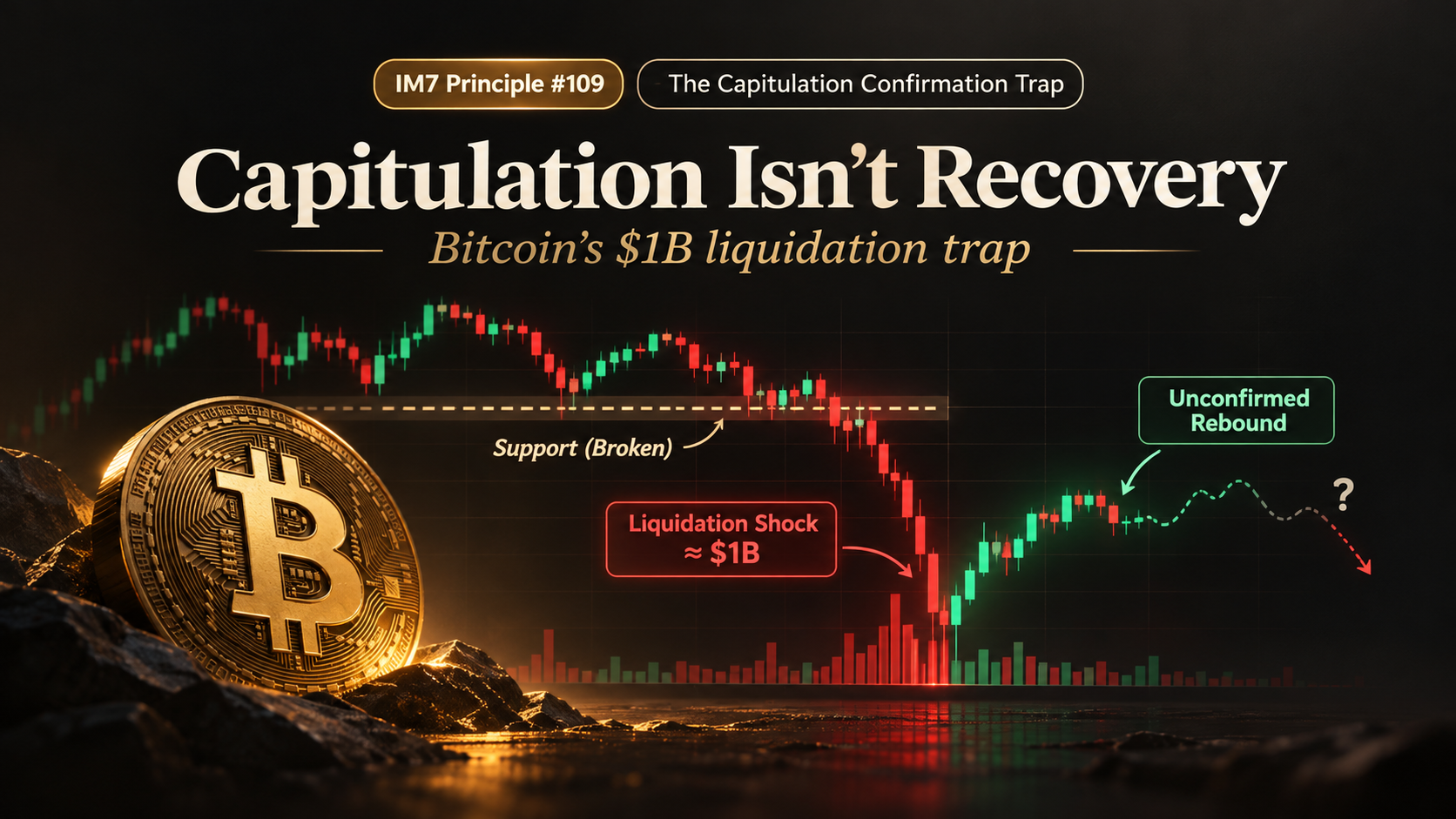
Bitcoin's November selloff triggered more than $1 billion in reported derivatives liquidations as leveraged positions were forcibly closed and price fell toward $55,000 before rebounding. The recovery attempt created a familiar psychological temptation: interpreting the exhaustion of forced sellers as proof that buyers had returned. Yet declining selling pressure and increasing buying conviction are fundamentally different developments. Understanding that distinction helps traders avoid confusing a temporary rebound with a confirmed change in market structure.
IM7 Principle
IM7 Principle — The Capitulation Confirmation Trap
The exhaustion of forced selling can create the appearance of recovery before sustainable buying demand has been established.
A market's ability to stop falling is not the same as its ability to sustain a rally.
Market Context
Bitcoin entered November 20 under substantial selling pressure as weakness spread across cryptocurrency and other risk assets.
During the selloff, Bitcoin broke below $60,000, extended its decline toward $55,000, and subsequently rebounded.
Reports published around November 20–21 described more than $1 billion in Bitcoin futures liquidations within a rolling 24-hour period, with leveraged long positions accounting for much of the forced unwinding.
These liquidation figures depend on the provider and observation window; they should not be interpreted as a single fixed daily total.
Three observable conditions shaped the environment:
- Market structure: Bitcoin had lost multiple previously defended price levels.
- Positioning: Forced liquidations reduced leveraged exposure and amplified downside volatility.
- Sentiment: Sharp losses encouraged fear, defensive positioning, and attempts to identify a market bottom.
The immediate rebound demonstrated that price could recover from the liquidation-driven decline.
It did not independently demonstrate sustained buyer control.
What The Market Wanted You To Believe
"The forced sellers are gone. The recovery is confirmed."
After a liquidation event, a rebound can feel especially convincing.
The market has already experienced a sharp decline. Leveraged traders have been forced out. Price begins recovering.
For an observer searching for the bottom, these developments can appear to complete the bearish story.
But that interpretation skips an important question:
Who is actually buying after the forced selling stops?
A rebound can occur because selling pressure temporarily weakens, short positions are covered, or opportunistic buyers respond to lower prices.
Those forces may contribute to a lasting recovery, but their immediate presence does not establish one.
The market can reward early confidence with a short-lived bounce before challenging the underlying thesis.
Behavioral Observation
Before the breakdown, traders repeatedly watched familiar support areas.
Each successful reaction encouraged the belief that buyers would continue defending those prices.
Once those levels failed, attention shifted toward a different source of reassurance: capitulation.
The psychological mechanism remained surprisingly similar.
Before the decline, familiarity with support created confidence.
After the decline, familiarity with liquidation-driven rebounds created hope.
The pattern changed, but the desire for confirmation did not.
On the chart, watch the sequence:
- A sharp decline through previously defended support.
- An acceleration in selling as leveraged positions are liquidated.
- A strong rebound from the resulting low.
- A recovery attempt toward falling short-term moving averages or former support.
- The subsequent reaction that reveals whether buyers can sustain higher prices.
The fifth observation matters because the initial rebound alone cannot settle the recovery thesis.
Cognitive Bias Breakdown
The central bias is [confirmation bias](/library/confirmation-bias): the tendency to favor information that supports an existing belief while giving less weight to contradictory evidence.
A trader expecting a bottom may interpret a strong green candle as decisive evidence that the market has recovered.
The same trader may discount unresolved bearish structure, weak buying participation, or resistance above price.
This tendency is closely related to the confirmation-bias framework described by Nickerson (1998).
There is also a familiarity component.
Before the decline, repeated support reactions made a price level feel increasingly dependable.
After the decline, recognizable signs of capitulation made the recovery narrative feel increasingly plausible.
In both cases, the trader risks replacing a complete evidence assessment with a familiar pattern.
Recognition creates an expectation. It does not validate the expectation.
The practical danger is not recognizing a pattern.
The danger is treating recognition as proof.
The Professional Read
A disciplined market participant separates observations from interpretations.
Observation: Bitcoin experienced a significant liquidation-driven decline.
Observation: Price subsequently rebounded.
Interpretation: Forced selling may have weakened, and some buyers may be responding.
Unresolved question: Has demand strengthened enough to sustain a change in market structure?
These statements should not be collapsed into one conclusion.
The professional does not need to deny the rebound or predict another decline.
Instead, the professional evaluates the quality of the recovery.
That includes examining whether price can reclaim important levels, maintain them through subsequent trading periods, and demonstrate meaningful buyer participation.
A temporary move above a level is not sustained acceptance.
A strong candle is not an entire recovery structure.
A decline in liquidations is not necessarily evidence of renewed spot demand.
The objective is to determine what the market has demonstrated rather than what the trader wants the market to demonstrate.
Decision Framework
The IM7 Recovery Confirmation Checklist
Before interpreting a liquidation-driven bounce as a recovery:
- [ ] Separate selling exhaustion from buying demand. Has selling merely slowed, or is new buying participation evident?
- [ ] Examine market structure. Has price recovered important breakdown levels?
- [ ] Check follow-through. Are subsequent candles sustaining the move?
- [ ] Evaluate volume and participation. Is the rebound supported by meaningful activity?
- [ ] Observe retests. Can former resistance become support?
- [ ] Identify conflicting evidence. What observable developments would challenge the recovery thesis?
- [ ] Respect uncertainty. Is the conclusion supported by repeated evidence rather than one dramatic candle?
The purpose of this checklist is not to predict the next move.
It is to prevent a single emotionally compelling observation from becoming an unsupported conclusion.
Risk Management Lesson
Liquidation-driven markets can produce unusually sharp moves in both directions.
A powerful rebound may encourage traders to increase exposure precisely when volatility and uncertainty remain elevated.
That creates a dangerous mismatch between conviction and evidence.
Risk management should reflect the uncertainty of the environment.
Position size should remain consistent with a predefined risk budget. Invalidation conditions should be identified before exposure is taken. Leverage should not be increased simply because a rebound appears dramatic.
Waiting for additional confirmation can also have a cost: a market may move before the evidence becomes clearer.
But the objective of disciplined decision-making is not to capture every possible move.
It is to avoid allowing emotional certainty to determine risk.
A larger candle does not justify a larger risk budget.
IM7 Quote
"Capitulation can remove the sellers. Only demand can confirm the recovery."
IM7 Observation
Bitcoin's latest selloff illustrates how quickly the market can exchange one reassuring narrative for another.
First, traders become comfortable with familiar support levels.
Then those levels break.
After the liquidation-driven decline, attention shifts toward the idea that the worst must be over.
The same psychological vulnerability survives both environments.
Traders are not necessarily misreading the initial reaction.
They are assuming that the reaction determines what happens next.
The real distinction is between identifying where the market responded and establishing whether that response has durable support.
For IM7 Intelligence, the defining question is not whether Bitcoin bounced.
It is whether the evidence supporting recovery has improved enough to justify changing the thesis.
IM7 Decision Rule
Never promote a liquidation-driven bounce into a recovery thesis without evidence of sustained buyer participation and improving market structure.
Treat the first reaction as information. Require follow-through before treating it as confirmation.
IM7 Intelligence — [Market Psychology](/library/behavioral-finance). Human Behavior. Better Decisions.
Educational market commentary. Not financial advice.
Research References
- CoinDesk, November 20–21, 2026 — Reporting on Bitcoin's decline below $57,000 and more than $1 billion in Bitcoin futures liquidations.
- Reuters, November 20–21, 2026 — Reporting on Bitcoin's decline below $60,000 and the broader risk-asset selloff.
- Nickerson, R. S. (1998). Confirmation Bias: A Ubiquitous Phenomenon in Many Guises. Review of General Psychology, 2(2), 175–220.
How did this land?
What emotion or bias did this article help you recognize?
References
- [1]Nickerson, R. S. (1998). Confirmation Bias: A Ubiquitous Phenomenon in Many Guises. Review of General Psychology, 2(2), 175–220. Educational Publishing Foundation. DOI: 10.1037/1089-2680.2.2.175. https://doi.org/10.1037/1089-2680.2.2.175
- [2]
- [3]Liqwall (2026). Crypto Liquidations on November 20, 2026: $1.25B. Reuters. Reuters. https://liqwall.com/liquidations/2026-11-20
Pass the signal forward.
IM7 Intelligence studies financial markets through the lens of psychology rather than prediction. Our research focuses on behavioral finance, crowd psychology, sentiment, and decision-making to help readers understand why markets move—not just where they move.
IM7 Intelligence publishes educational research on market psychology, behavioral finance, and investor behavior. Nothing published by IM7 Intelligence constitutes financial, investment, tax, or legal advice. Always conduct your own research before making financial decisions.
Read the market's emotion before it acts.
Where this article sits in the map.
- Confirmation BiasYou are here
- Behavioral Finance
- Risk Management
- Fear
Curated paths, not random articles.
Behavior read in real time.

Ismael Mercius
Ismael Mercius is the founder of IM7 Intelligence, where he writes about crypto market psychology, behavioral finance, and the sentiment cycles that drive digital asset prices. His work focuses on how traders actually make decisions — and the recurring errors that show up in their P&L.
- Crypto market psychology
- Behavioral finance
- Market sentiment analysis
- Trader behavior & decision-making