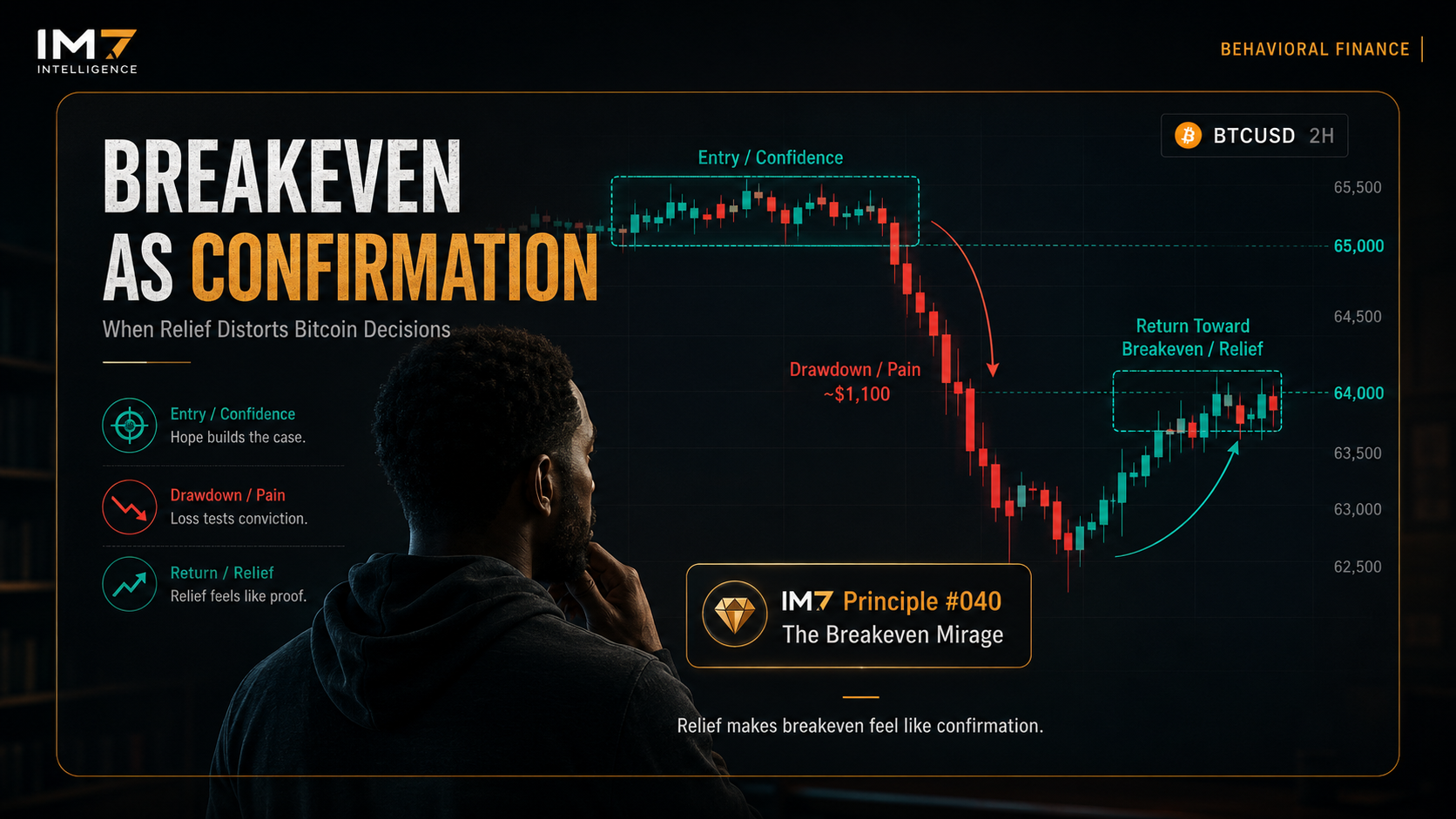
Breakeven as Confirmation: When Relief Distorts Bitcoin Decisions
- Reading time
- 10 min read
- Word count
- 2,014 words
- Published
Bitcoin's recent price action presented a classic behavioral dilemma: after a significant drop, price returned near prior consolidation levels. This return often generates 'relief,' yet traders frequently misinterpret this emotional state as validation of their initial market view.
On this page
- Executive Summary
- IM7 Principle #008 — The Breakeven Mirage
- Relief can make a return to entry feel like validation.
- Market Context
- What the Market Let Traders Believe
- Behavioral Observation
- Behavioral Chart 01 — Price Recovery vs. Emotional Recovery
- Cognitive Bias Breakdown
- 1. Anchoring
- 2. Relief
- 3. Confirmation Bias
- Behavioral Model 01 — The Breakeven Relief Loop
- The Professional Read
- Question 1 — Where did I enter?
- Question 2 — What is price doing now?
- Question 3 — Is the current evidence strong enough to justify holding, exiting, adding, or doing nothing?
- Decision Framework
- 1. Separate cost basis from market evidence
- 2. Identify what has materially changed
- 3. Rebuild the thesis from zero
- 4. Define invalidation using current conditions
- 5. Decide as though you were flat
- Behavioral Model 02 — Entry Price vs. Evidence
- Personal Reference Point
- Emotional Interpretation
- Behavioral Distortion
- Evidence-First Correction
- Risk Management Lesson
- Behavioral Chart 02 — Distance From Entry vs. Emotional Pressure
- Why Breakeven Feels So Powerful
- Behavioral Model 03 — The P&L Interpretation Trap
- IM7 Observation
- IM7 Quote
- Behavioral Principle
- Anchoring + Confirmation Bias
- IM7 Decision Rule
- Practical Trader Checklist
Executive Summary
Bitcoin’s recent 2-hour price action created a clean behavioral test.
After trading near the $64,000 area, BTCUSD declined approximately $1,100 before recovering toward the same region. For a trader who entered near the earlier consolidation zone and held through the decline, that return can feel profoundly different from an ordinary rally.
The position that produced fear is suddenly close to breakeven.
The emotional pressure decreases.
And that relief can easily be mistaken for new market information.
This is where anchoring becomes dangerous. Instead of evaluating the current setup independently, traders begin measuring the market relative to one highly personal reference point: their entry price.
A return to that price can therefore feel like proof:
“I was right to hold.”
But breakeven establishes only one fact:
Price returned near where the trader entered.
It does not establish that the original thesis was correct, that the current structure has improved, or that the next move will continue in the trader’s preferred direction.
The professional advantage is learning to separate emotional recovery from evidentiary improvement.
IM7 Principle #008 — The Breakeven Mirage
Relief can make a return to entry feel like validation.
A trader's entry price is personally important.
The market does not share that attachment.
Once a position moves significantly against the trader, the original entry can become a psychological anchor. Every subsequent candle is unconsciously measured against the possibility of getting back there.
This creates a dangerous substitution:
Instead of asking:
“Is this still a good trade based on what the market is showing now?”
the trader begins asking:
“Can I just get back to where I started?”
When price finally approaches that level, relief can feel like confirmation.
That is the breakeven mirage.
Market Context
BTCUSD recently declined approximately $1,100 from the earlier consolidation area visible on the 2-hour chart before beginning a recovery.
Price subsequently climbed back toward the region around $64,000, placing it near the zone from which the earlier decline accelerated.
The important evidence visible on the chart is straightforward:
- price experienced a substantial decline,
- a lower area was reached,
- several candles formed beneath the earlier zone,
- and price later recovered toward that previous region.
What the chart does not tell us by itself is whether this recovery must continue or fail.
That uncertainty is precisely what makes the behavioral response important.
A trader who endured the entire decline does not experience the return to $64,000 as neutral information.
They experience it through the memory of the drawdown.
What the Market Let Traders Believe
“We came all the way back. Holding was the right decision.”
Imagine two traders looking at the same recovery.
The first has no position.
They see price returning toward a previous area and ask:
- What has changed?
- What evidence supports continuation?
- What would invalidate this recovery?
- What does the current structure justify?
The second trader bought near the earlier level and held through the decline.
They may see something entirely different:
“I survived it.”
“I knew it would come back.”
“Selling would have been the mistake.”
“Now it can finally continue.”
Same recovery.
Different psychological experience.
The market provided the price movement.
The entry price provided the story.
Behavioral Observation
The strongest feature of this setup is not simply the green recovery candle.
It is the relationship between the recovery and the trader's personal reference point.
A trader who watched an open position move approximately $1,100 against them may experience the return toward entry as a removal of pain.
That removal can produce relief.
Relief can then change interpretation.
Information that would have looked uncertain to an uncommitted observer can suddenly appear encouraging to the trader who desperately wanted the position to recover.
That does not mean the trader's bullish interpretation is necessarily wrong.
It means their confidence may now be contaminated by emotional relief.
Behavioral Chart 01 — Price Recovery vs. Emotional Recovery
Visual concept: Plot the visible BTCUSD decline and recovery, highlighting the earlier entry/consolidation zone and subsequent return toward it.
Overlay the trader's emotional sequence:
Confidence → Fear → Drawdown Stress → Hope → Relief Near Entry
Behavioral takeaway:
Price can return to your entry before the evidence returns to your thesis.
Cognitive Bias Breakdown
Three mechanisms interact here.
1. Anchoring
Anchoring describes the tendency to rely excessively on an initial reference point when making subsequent judgments.
For a trader, the entry price can become one of the strongest anchors available.
After entering at $64,000, that number is no longer merely a market price.
It becomes:
- the point where the decision began,
- the line separating profit from loss,
- the level associated with being “right” or “wrong,”
- and eventually the price the trader wants the market to recover.
The problem is that none of those meanings belong to the market itself.
They belong to the trader.
2. Relief
Relief is not a cognitive bias by itself, but it can change decision quality.
As a loss shrinks, psychological pressure falls.
That emotional improvement can be mistaken for improvement in the trade.
The trader feels better.
Therefore the setup appears better.
That inference is dangerous.
3. Confirmation Bias
Once relief restores confidence, confirmation bias can take over.
The trader begins noticing evidence supporting the original decision while minimizing information that might challenge it.
A recovery candle becomes:
“Proof buyers are back.”
A pause becomes:
“Healthy consolidation.”
Contradictory evidence receives less weight because the desired conclusion has already become emotionally valuable.
::model:1::
Behavioral Model 01 — The Breakeven Relief Loop
Entry price established ↓ Price moves against the position ↓ Entry becomes psychological anchor ↓ Trader focuses on getting back to breakeven ↓ Price recovers toward entry ↓ Emotional pain decreases ↓ Relief is interpreted as validation ↓ Original thesis receives renewed confidence
The market may have supplied only a recovery.
The mind can turn that recovery into a verdict.
The Professional Read
A disciplined professional separates three questions that emotionally involved traders often combine.
Question 1 — Where did I enter?
This matters for accounting, position management, and realized or unrealized P&L.
Question 2 — What is price doing now?
This is a market observation.
Question 3 — Is the current evidence strong enough to justify holding, exiting, adding, or doing nothing?
This is the decision.
The mistake is allowing Question 1 to answer Question 3.
A professional therefore attempts to evaluate the current chart as though the original entry price belonged to someone else.
One useful test is:
“If I had no position right now, would I initiate this exact trade here based on the evidence currently available?”
If the answer is no, then returning to breakeven should not automatically increase conviction.
That does not mean the correct action is necessarily to exit.
It means the decision should be made from current evidence, not emotional history.
Decision Framework
1. Separate cost basis from market evidence
Write down your entry price, then mentally remove it from the analysis.
Ask what the chart would mean if you had never entered.
2. Identify what has materially changed
Do not accept “price came back” as sufficient.
Ask:
- Has structure improved?
- Has the sequence of price action changed?
- Has the original invalidation condition changed?
- Has new evidence emerged?
3. Rebuild the thesis from zero
State the current bullish case.
Then state the current bearish case.
Do not reuse the original thesis automatically.
4. Define invalidation using current conditions
Your risk level should not exist merely because it allows you to avoid realizing a loss.
Define what evidence would make the current thesis weaker.
5. Decide as though you were flat
Ask:
“If I had cash instead of this position, would I choose this exposure right now?”
That question often exposes anchoring immediately.
Behavioral Model 02 — Entry Price vs. Evidence
Personal Reference Point
“My entry is near $64,000.”
Emotional Interpretation
“Getting back there means the trade recovered.”
Behavioral Distortion
“Therefore my original decision must have been correct.”
Evidence-First Correction
“Returning to my entry tells me where price is. It does not tell me whether my thesis is valid.”
This distinction is small linguistically.
Financially, it can be enormous.
Risk Management Lesson
Breakeven becomes dangerous when it changes risk behavior.
A trader desperate to get back to entry may:
- hold beyond the original invalidation,
- widen a stop,
- refuse to reduce exposure,
- add to a losing position,
- ignore contradictory evidence,
- or decline a reasonable exit because they now expect vindication.
This transforms an emotional preference into a capital-allocation decision.
Loss aversion strengthens the effect.
Realizing a loss feels final.
Holding preserves the possibility that the market will reverse and erase the psychological discomfort.
But the market is not obligated to return to anyone's cost basis.
Risk management therefore needs to remain independent of the desire to be made whole.
A better rule is:
Position risk follows current evidence and predefined limits — not distance from breakeven.
Behavioral Chart 02 — Distance From Entry vs. Emotional Pressure
Visual concept: Show conceptual emotional pressure increasing as price moves farther below entry, then rapidly declining as price approaches breakeven.
Alongside it, show that market evidence does not necessarily improve at the same rate.
Behavioral takeaway:
Emotional pain can disappear faster than uncertainty.
Why Breakeven Feels So Powerful
Breakeven carries symbolic meaning.
At a loss, the trader feels wrong.
At entry, the trader feels restored.
Above entry, the trader feels vindicated.
But those psychological categories do not necessarily correspond to changes in market quality.
This creates a hidden danger:
P&L becomes a substitute for analysis.
If price is below entry, the setup feels bad.
If price returns to entry, it feels repaired.
If price rises above entry, the original thesis suddenly feels brilliant.
The trader is no longer asking whether their analysis is improving.
They are asking whether their account balance is relieving emotional discomfort.
::model:2::
Behavioral Model 03 — The P&L Interpretation Trap
Negative P&L → “Something is wrong.”
Approaching breakeven → “Maybe I was right.”
Breakeven → “The trade recovered.”
Small profit → “My thesis was correct.”
But P&L describes the outcome relative to entry.
It does not independently measure analytical quality.
A poor decision can become profitable.
A sound decision can lose.
The two concepts must remain separate.
IM7 Observation
The most dangerous moment in a losing trade may not be maximum fear.
It may be maximum relief.
Fear can make risk obvious.
Relief can make risk disappear psychologically before it disappears structurally.
That is why returning toward breakeven deserves deliberate reassessment.
Not celebration.
Not revenge.
Not immediate recommitment.
Reassessment.
The trader should ask:
“What has actually improved besides my P&L?”
If the answer is unclear, the emotional improvement may be greater than the evidentiary improvement.
That difference matters.
IM7 Quote
“Relief makes breakeven feel like confirmation. But emotional recovery is not market validation.”
Behavioral Principle
Anchoring + Confirmation Bias
Traders can become anchored to their entry price and evaluate subsequent market action relative to that personal reference point. When price returns toward breakeven, relief can strengthen confirmation bias, causing the trader to interpret the recovery as proof of the original thesis even when the underlying evidence remains uncertain.
Canonical references: Tversky & Kahneman (1974); Nickerson (1998).
IM7 Decision Rule
Never confuse emotional recovery with evidentiary improvement.
When price returns toward your entry:
Detach from the cost basis. Reassess the market from zero. Identify what has actually changed. Challenge the original thesis. Reconfirm invalidation. Then decide.
Your entry price matters to your account.
It does not matter to Bitcoin.
Practical Trader Checklist
Before treating a return to breakeven as confirmation, ask:
- What evidence has improved since my original entry?
- Would I take this trade right now if I were completely flat?
- Am I interpreting this move differently because my unrealized loss disappeared?
- What evidence would make me abandon the thesis today?
- Is my position size appropriate for the uncertainty that still exists?
- Am I protecting capital — or protecting my need to have been right?
If the strongest argument for staying in the trade is:
“I finally got back to even.”
that is not a market thesis.
That is relief talking.
How did this land?
What emotion or bias did this article help you recognize?
References
- [1]Tversky, A., & Kahneman, D. (1974). Judgment under Uncertainty: Heuristics and Biases. Science. American Association for the Advancement of Science. DOI: 10.1126/science.185.4157.1124.
- [2]Nickerson, R. S. (1988). Confirmation Bias: A Ubiquitous Phenomenon in Many Guises..
Pass the signal forward.
IM7 Intelligence studies financial markets through the lens of psychology rather than prediction. Our research focuses on behavioral finance, crowd psychology, sentiment, and decision-making to help readers understand why markets move—not just where they move.
IM7 Intelligence publishes educational research on market psychology, behavioral finance, and investor behavior. Nothing published by IM7 Intelligence constitutes financial, investment, tax, or legal advice. Always conduct your own research before making financial decisions.
Read the market's emotion before it acts.
Where this article sits in the map.
- BitcoinYou are here
- Liquidity
- Market Structure
- Volatility
- Risk Management
Curated paths, not random articles.
Behavior read in real time.

Ismael Mercius
Ismael Mercius is the founder of IM7 Intelligence, where he writes about crypto market psychology, behavioral finance, and the sentiment cycles that drive digital asset prices. His work focuses on how traders actually make decisions — and the recurring errors that show up in their P&L.
- Crypto market psychology
- Behavioral finance
- Market sentiment analysis
- Trader behavior & decision-making