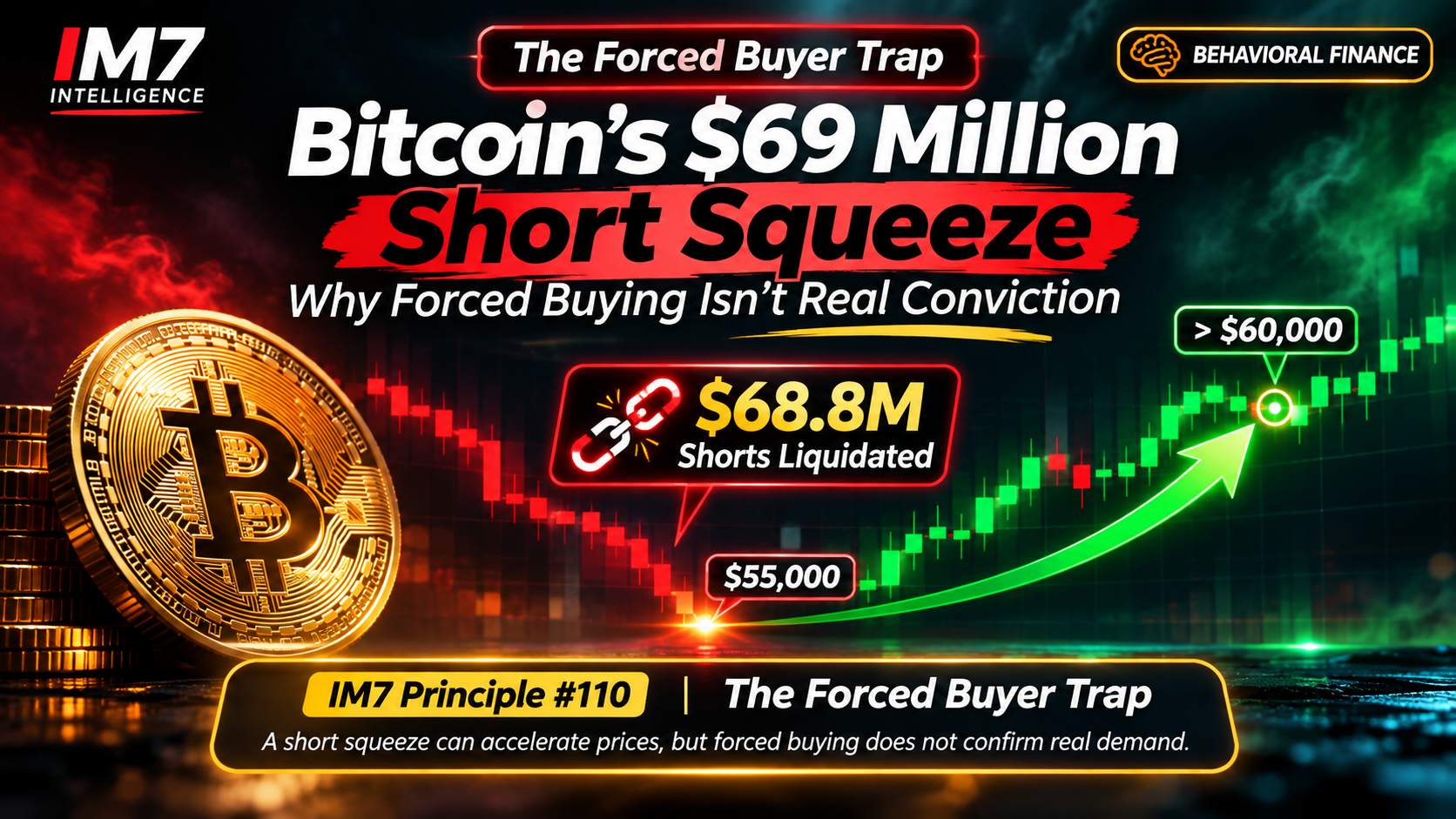
Bitcoin's $69 Million Short Squeeze: Why Forced Buying Isn't Real Conviction
AI Generated • IM7 Intelligence
- Reading time
- 3 min read
- Word count
- 715 words
- Published
Bitcoin rebounded above $60,000 as nearly $69 million in short positions were reportedly liquidated during one hour. But forced buying isn't proof of sustained demand. Discover the psychology behind short squeezes and why traders mistake price momentum for investor conviction.
Executive Summary
Bitcoin rebounded from approximately $55,000 to above $60,000 after a sharp selloff. During one reported hour, approximately $68.8 million in short positions were liquidated. The rebound exposed a behavioral trap: interpreting forced buying as evidence of renewed investor conviction. Understanding who is buying—and why—can help traders distinguish price momentum from sustainable demand.
IM7 Principle
The Forced Buyer Trap
A short squeeze can accelerate prices without establishing genuine investor conviction. Forced buying explains part of a market reaction; sustained acceptance provides stronger evidence of demand.
Market Context
Bitcoin's rebound followed an aggressive decline that disrupted leveraged positions.
On the November 22 two-hour chart, BTC traded near $60,766, above its rising 9 EMA near $59,908.
A reported one-hour liquidation window showed:
- Short liquidations: approximately $68.8 million.
- Long liquidations: approximately $1.6 million.
- Price: above $60,000, following a rebound from the $55,000 area.
The figures describe one reported interval, not the entire rebound.
Price had recovered, but sustained acceptance above nearby resistance remained unconfirmed.
What The Market Wanted You To Believe
"Bitcoin is rising. Buyers must be back."
A powerful green candle can create the impression that investor confidence has returned.
But short sellers facing liquidation may be forced to close positions, generating buy orders regardless of whether they believe Bitcoin will continue rising.
The market can move higher before voluntary demand has been established.
Price movement reveals what happened. It does not automatically reveal why.
Behavioral Observation
After a sharp rebound, traders may shift from fear to optimism.
The emotional sequence is familiar: relief becomes excitement, and excitement becomes conviction.
On the chart, watch for a rapid green candle, acceleration through nearby levels, and the subsequent reaction when forced buying subsides.
The critical observation is whether price maintains those gains once the initial squeeze loses momentum.
Cognitive Bias Breakdown
Outcome bias occurs when people judge a decision or process by its visible result rather than the information and mechanisms behind it.
A trader sees Bitcoin rising and concludes that buyers have regained control.
Yet the same price movement can result partly from liquidations, short covering, and voluntary purchases.
Baron and Hershey (1988) documented how outcomes influence judgments of decision quality.
The behavioral mistake is treating a positive outcome as proof of the underlying explanation.
The Professional Read
A disciplined trader separates three questions:
- What happened? Bitcoin rebounded sharply.
- What contributed? Reported short liquidations indicate forced buying occurred.
- What remains unconfirmed? Whether independent buyers can sustain higher prices.
A squeeze and a genuine recovery can coexist.
The professional doesn't assume either outcome. The professional watches for follow-through.
Decision Framework
Before interpreting a short squeeze as recovery:
- [ ] Identify whether liquidations contributed to the move.
- [ ] Examine spot buying participation.
- [ ] Check whether important levels are reclaimed.
- [ ] Wait for completed candles and follow-through.
- [ ] Evaluate whether higher prices are sustained.
- [ ] Identify evidence that would contradict the thesis.
Risk Management Lesson
A sharp rebound can encourage oversized positions and emotional decision-making.
But volatility increases uncertainty even when price moves favorably.
Keep position size within a predefined risk budget, establish invalidation conditions, and avoid increasing leverage simply because a candle appears convincing.
Strong momentum does not eliminate risk.
IM7 Quote
"A forced buyer can move the market without believing in the move."
IM7 Observation
Bitcoin's rebound illustrates how easily traders confuse the source of buying with its apparent strength.
Yesterday's concern was whether forced selling had ended.
Today's concern is whether forced buying represents genuine demand.
Both expose the same vulnerability: assigning certainty to a price reaction before understanding its underlying mechanism.
The question isn't simply how far Bitcoin bounced.
It's who bought, why they bought, and whether demand persists.
IM7 Decision Rule
Never treat a short squeeze alone as confirmation of recovery.
Separate forced buying from voluntary demand, then evaluate sustained acceptance and market structure before revising the thesis.
IM7 Intelligence — [Market Psychology](/library/behavioral-finance). Human Behavior. Better Decisions.
Educational analysis only. Not financial advice.
Research note: The liquidation amounts are reported figures from the November 21–22 research brief and require a linked, timestamped primary data source before publication. Behavioral reference: Baron, J., & Hershey, J. C. (1988), Outcome Bias in Decision Evaluation, Journal of Personality and Social Psychology, 54(4), 569–579.
How did this land?
What emotion or bias did this article help you recognize?
References
- [1]Baron, J., & Hershey, J. C. (1988). Outcome Bias in Decision Evaluation. Journal of Personality and Social Psychology, 54(4), 569–579. American Psychological Association. DOI: 10.1037/0022-3514.54.4.569. https://doi.org/10.1037/0022-3514.54.4.569?utm_source=chatgpt.com (accessed 2026-11-22)
- [2]crypto.news (2026). Bitcoin price above $60,000 after crash. What would make the recovery last?. crypto.news. crypto.news. https://crypto.news/bitcoin-price-above-60000-after-crash-what-would-make-the-recovery-last/?utm_source=chatgpt.com
- [3]Liqwall (2026). Bitcoin (BTC) Liquidations on November 21, 2026. Liqwall. Liqwall. https://liqwall.com/liquidations/btc/2026-11-21?utm_source=chatgpt.com
Pass the signal forward.
IM7 Intelligence studies financial markets through the lens of psychology rather than prediction. Our research focuses on behavioral finance, crowd psychology, sentiment, and decision-making to help readers understand why markets move—not just where they move.
IM7 Intelligence publishes educational research on market psychology, behavioral finance, and investor behavior. Nothing published by IM7 Intelligence constitutes financial, investment, tax, or legal advice. Always conduct your own research before making financial decisions.
Read the market's emotion before it acts.
Where this article sits in the map.
- Confirmation BiasYou are here
- Behavioral Finance
- Risk Management
- Fear
Curated paths, not random articles.
Behavior read in real time.

Ismael Mercius
Ismael Mercius is the founder of IM7 Intelligence, where he writes about crypto market psychology, behavioral finance, and the sentiment cycles that drive digital asset prices. His work focuses on how traders actually make decisions — and the recurring errors that show up in their P&L.
- Crypto market psychology
- Behavioral finance
- Market sentiment analysis
- Trader behavior & decision-making